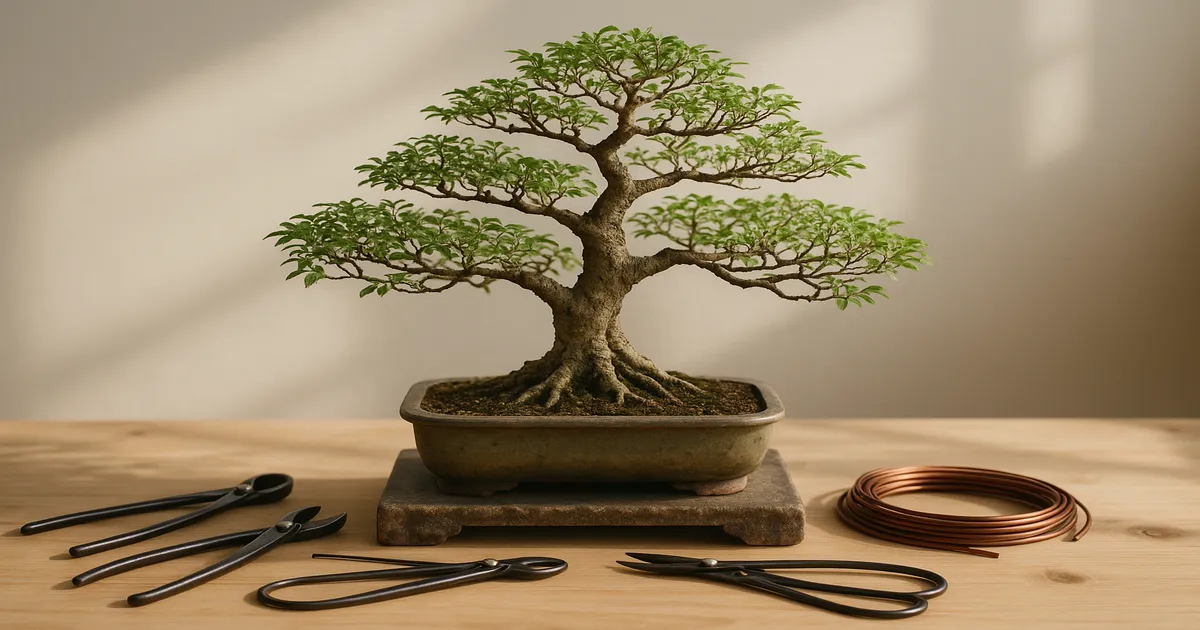
Quick Answer: Chinese elm (Ulmus parvifolia) thrives outdoors in full sun to partial shade, needs watering when the top half-inch of soil begins to dry, and benefits from active pruning throughout the growing season. Repot every 1–2 years in early spring using a fast-draining inorganic mix. It’s widely considered the best beginner bonsai species — forgiving, vigorous, and beautiful year-round.
Chinese Elm Bonsai Care: What You Need to Know
Key Care Requirements at a Glance
| Factor | Requirement |
|---|---|
| Light | 4–6 hours direct sun daily; south- or east-facing |
| Water | When top 0.5–1 inch of soil begins to dry |
| Soil | 40–50% akadama, 25–30% pumice, 20–30% lava rock |
| Growing Temp | 65–95°F (18–35°C) |
| Hardiness Zones | USDA Zones 5–10 |
| Repotting | Every 1–2 years (young trees); every 2–3 years (mature) |
| Pruning | Maintenance throughout growing season; structural in late winter |
Is Chinese Elm a Good Bonsai for Beginners?
Absolutely — and it’s not even close. Ulmus parvifolia back-buds reliably after pruning, tolerates the occasional missed watering, and develops fine ramification faster than most other species. It’s widely available at nurseries and bonsai shops, often at accessible price points, and it responds well to virtually every classical bonsai style.
The forgiving nature of Chinese elm bonsai care means beginners can learn fundamental techniques — pruning, wiring, repotting — without the anxiety of working on a finicky or rare specimen.
Understanding the Chinese Elm
Ulmus parvifolia vs. Ulmus pumila: Avoid This Common Mislabeling
Walk into many garden centers and you’ll find trees labeled “Chinese elm” that are actually Ulmus pumila — the Siberian elm. This is one of the most persistent mislabeling problems in the nursery trade, and it matters because the two species differ significantly in quality and bonsai suitability.
U. parvifolia (true Chinese elm) has small, glossy leaves with a distinctly asymmetrical base — one side clearly extends further down the petiole than the other. Its mature bark develops the beautiful mottled “lacebark” pattern of gray, orange, brown, and cream. U. pumila has rougher, more uniform bark, coarser growth, and a more symmetrical leaf base. Always verify the species before purchasing.
Growth Habit and Lacebark Appeal
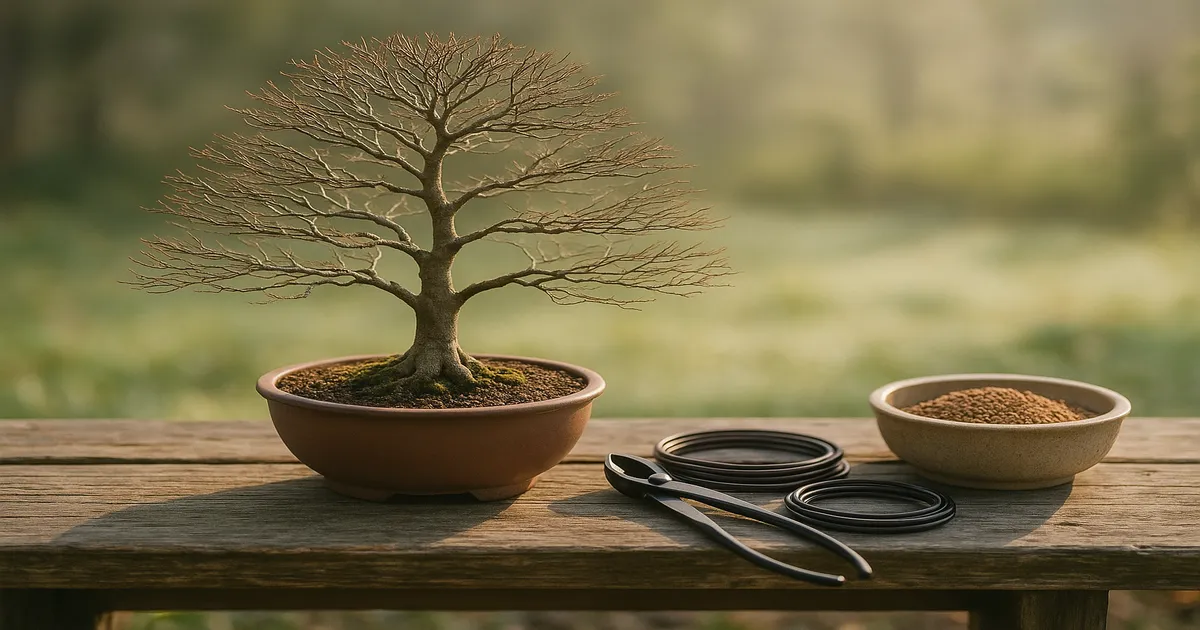
Native to China, Japan, Korea, and parts of Southeast Asia, Chinese elm is semi-evergreen to deciduous depending on your climate. In mild winters above roughly 25°F (-4°C), it holds most of its foliage. In colder zones it drops fully — and that’s when the lacebark really shines, displaying exfoliating patches of gray, orange, brown, and cream that make the tree visually compelling even when bare.
Leaves are small (0.5–2.5 inches / 1.3–6.4 cm), ovate, and serrated — naturally suited to bonsai scale. Growth is vigorous, with 12–24 inches (30–60 cm) of new shoots possible in a single season, which means plenty of material to work with throughout the year.
Popular Cultivars for Bonsai
| Cultivar | Key Traits |
|---|---|
| Seiju | Dwarf, corky bark, very small leaves, slow growth — highly prized |
| Hokkaido | Leaves under 0.5 in (1.3 cm), compact internodes, cork-like texture |
| Catlin | Dense fine foliage, slight weeping habit, popular in the US |
| True Green | Semi-evergreen, holds foliage in mild winters, vigorous grower |
| Frosty | White-margined variegated leaves — ornamental, less common in traditional bonsai |
For most beginners, standard U. parvifolia from a reputable bonsai nursery is the ideal starting point. Named cultivars offer specific aesthetic advantages but are often harder to source and more expensive.
Light and Temperature for Chinese Elm Bonsai Care
Outdoor vs. Indoor Placement
Chinese elm is fundamentally an outdoor species. It can be kept indoors, but only with significant supplemental lighting — a south-facing window alone rarely provides enough intensity for long-term health. Without adequate light, internodes stretch, leaves enlarge, and the tree becomes vulnerable to pests.
The most practical approach: outdoors from spring through fall, brought inside only during hard freezes. If you do grow indoors year-round, full-spectrum LED or T5 fluorescent lighting delivering 2,000–5,000 lux for 12–16 hours per day is the minimum requirement. A quality grow light makes a real difference here.
Sunlight and Seasonal Positioning
Aim for at least 4–6 hours of direct sun daily. A south- or east-facing position works best in the Northern Hemisphere. Higher light intensity directly correlates with smaller, more compact leaves — a genuine advantage for bonsai aesthetics. Move the tree to a slightly shadier spot during extreme heat above 100°F (38°C) to prevent leaf scorch.
Cold Hardiness, Dormancy, and Winter Protection
Chinese elm benefits from a 6–10 week cool dormancy at 25–45°F (-4–7°C). This rest period promotes vigor and long-term health. Skipping it by keeping the tree in a heated room all winter gradually weakens the tree over several seasons.
Zone-specific strategies:
- Zones 7–10: A sheltered outdoor spot, unheated garage, or cold greenhouse is usually sufficient.
- Zones 5–6: Move to an unheated garage or cold frame when nighttime temperatures consistently drop below 25°F (-4°C). Provide some light on warmer days.
- All zones: Never bring a dormant tree into a warm, heated indoor environment. The goal is cold but not frozen roots — aim for 28–45°F (-2–7°C) storage temperatures.
Soil, Watering, and Humidity
Best Soil Mix for Chinese Elm Bonsai
The standard mix is roughly 40–50% akadama, 25–30% pumice, and 20–30% lava rock. Adjust by climate: in humid regions or if you tend to water heavily, drop akadama to 30% and increase pumice to 40% for faster drainage. In dry climates or for indoor trees, increase akadama to 60% and reduce lava rock to 15% for better moisture retention. Use 3–6 mm particle size for standard bonsai pots; 1–3 mm for shohin trees.
A budget alternative — 50% coarse horticultural grit mixed with 50% quality cactus potting mix — is functional but less ideal. Avoid standard potting soil entirely. It compacts, retains too much moisture, and suffocates roots.
How Often to Water a Chinese Elm Bonsai
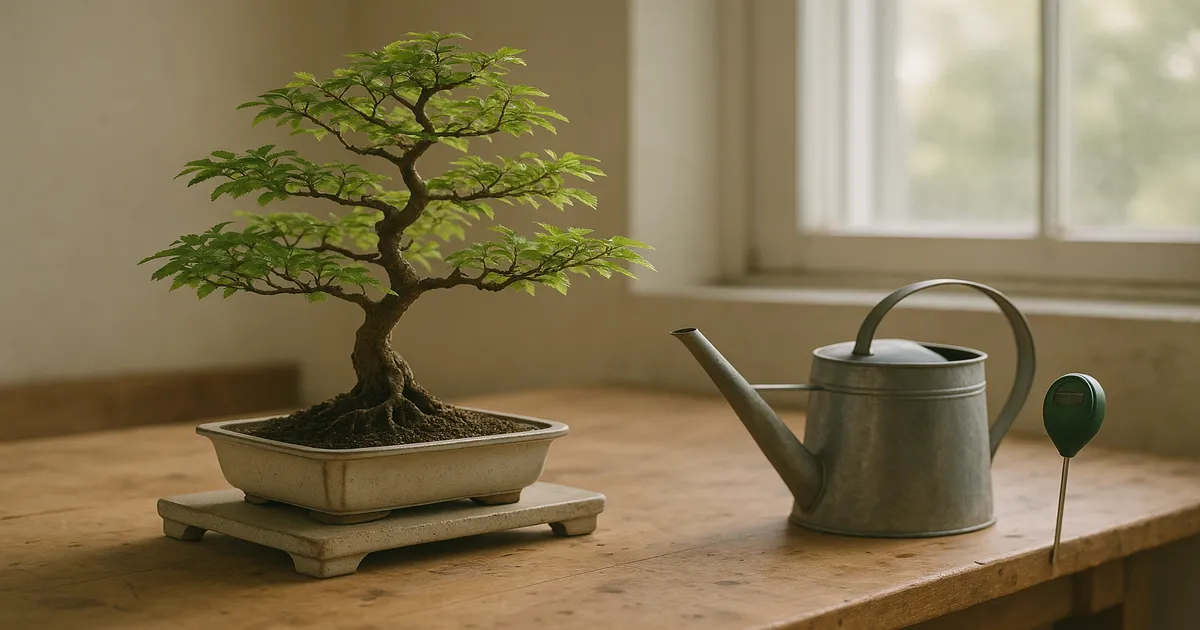
Forget fixed schedules. Water when the top 0.5–1 inch (1.3–2.5 cm) of soil begins to dry — this might mean once a day in hot summer conditions or every two to three days in cooler, humid weather. During winter dormancy, scale back to roughly once every 7–14 days, just enough to prevent the root ball from drying out completely.
Always water thoroughly, pouring until water flows freely from the drainage holes. This ensures the entire root mass gets moistened and flushes accumulated mineral salts. Rainwater or filtered water is ideal; hard tap water can gradually raise soil pH and should be periodically flushed with rainwater if it’s your only option.
Humidity and Indoor Growing
Central heating can drop relative humidity to 20–30%, which stresses Chinese elm considerably. A pebble-filled humidity tray beneath the pot, a small room humidifier, or grouping plants together all help maintain adequate moisture in the air.
Signs of Overwatering and Underwatering
| Overwatering | Underwatering |
|---|---|
| Yellow leaves dropping without browning | Leaf edges browning and crisping |
| Soft, dark-colored roots (root rot) | Leaves curling inward |
| Soil stays wet for 3–4+ days | Soil pulling away from pot edges |
| Wilting despite wet soil | Pot feels very lightweight |
| Persistent algae or moss on soil surface | Leaves dropping green or browning rapidly |
Pruning Your Chinese Elm Bonsai
Maintenance Pruning: Building Fine Ramification
This is the bread-and-butter work of Chinese elm bonsai care. Throughout the growing season, prune new shoots back to 1–2 leaves once they’ve extended to 4–6 leaves. Repeat this consistently and you’ll develop increasingly fine branch division — the hallmark of a refined bonsai. Use sharp, clean scissors for small shoots, cutting just above a leaf node at a slight angle to minimize dieback.
Structural Pruning: Timing and Technique
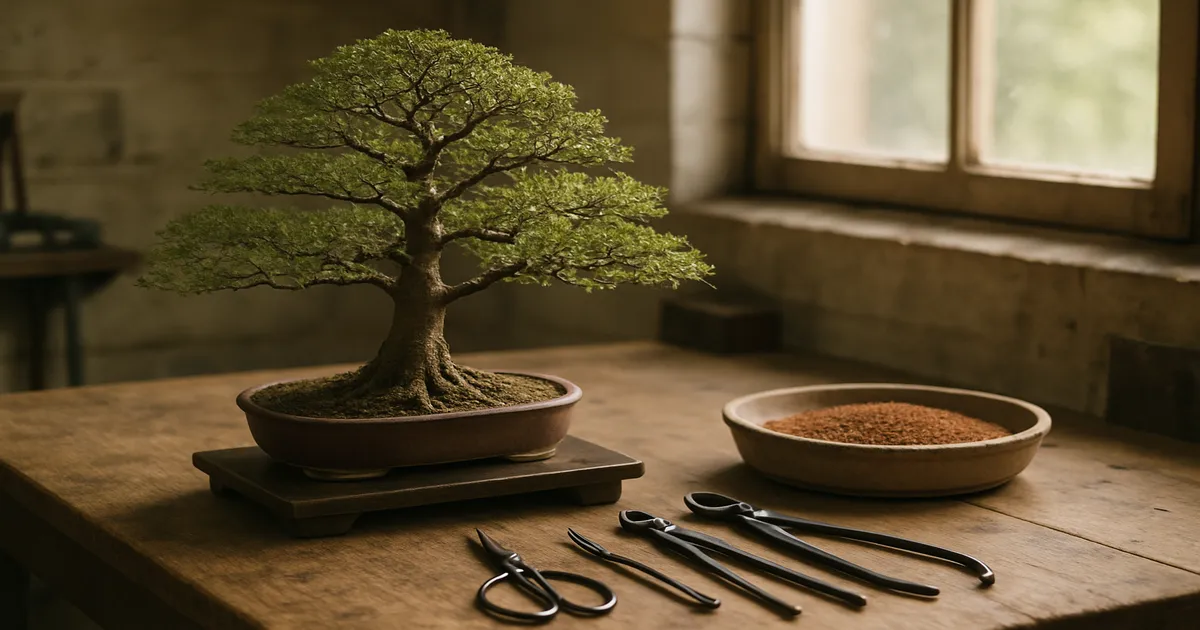
Major branch work belongs in late winter, just before bud break. The tree’s energy reserves are high, and wound healing kicks off almost immediately once growth begins. Use concave cutters on any branch over 0.25 inch (6 mm) in diameter — the concave wound heals flush with the trunk rather than leaving a knob. Always remove branches cleanly at the collar with no stubs, and avoid bar branches (two branches at the same height on opposite sides) and wheel branches (multiple branches from one node).
Defoliation and Wound Care
Partial or full defoliation in early summer can reduce leaf size and improve light penetration to inner branches. Only do this on healthy, vigorous trees — never on a recently repotted or stressed specimen. Remove leaves with scissors, leaving the petiole attached; it will drop on its own within a week or two.
For wound care, cuts under 0.5 inch (12 mm) generally heal faster without sealant. For larger cuts, apply a wound paste — products containing trichoderma fungi offer added protection against fungal pathogens. Larger wounds may take 2–5 years to fully callus over, so structural pruning decisions deserve careful thought.
Wiring Chinese Elm Bonsai Branches
Wire Type and Gauge Selection
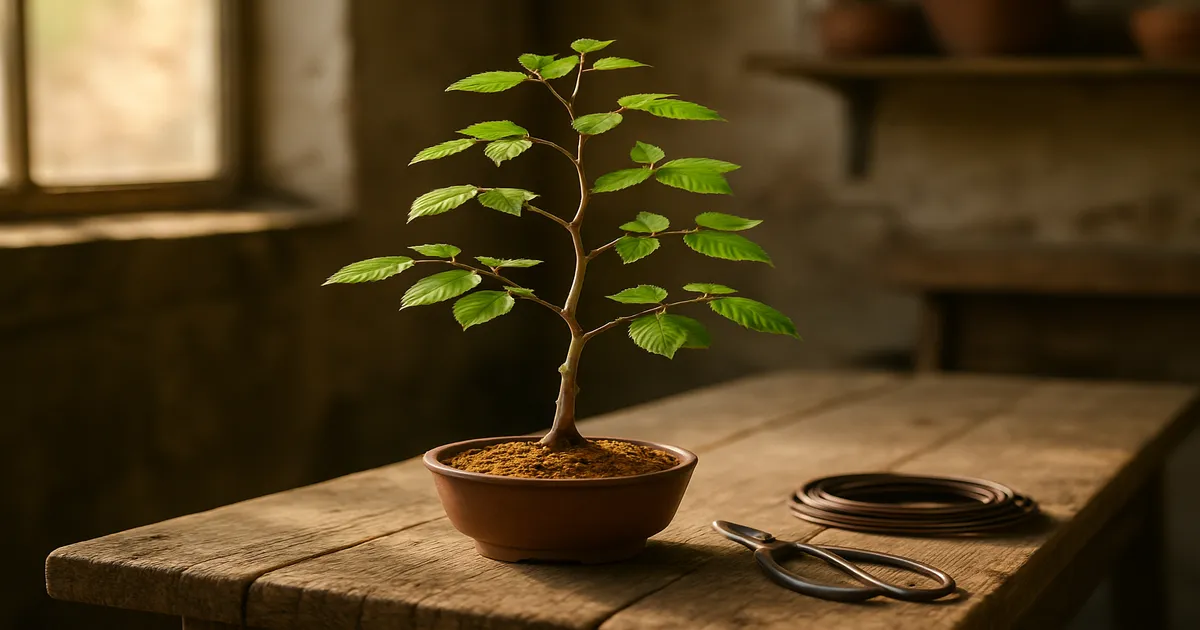
Anodized aluminum wire is the right choice for most growers. It’s softer on bark, easier to bend, and forgiving of technique errors. Copper wire holds more strongly and suits thick, stubborn branches, but it’s less forgiving on bark if left too long.
Wire diameter should be approximately one-third the diameter of the branch:
| Branch Diameter | Wire Gauge |
|---|---|
| Under 3 mm | 1.0–1.5 mm |
| 3–6 mm | 2.0–2.5 mm |
| 6–12 mm | 3.0–4.0 mm |
Wind at a 45-degree angle, anchoring the wire at the trunk or a larger branch first. The wire should be snug but not biting in — you should be able to slide a fingernail underneath it.
Timing and Removal
The best time to wire is late winter before bud break, when branches are bare and clearly visible. During the growing season, check wired branches every 2–4 weeks — Chinese elm can bite wire in within weeks during a strong spring flush. Chinese elm typically sets its new position within 3–6 months.
Always cut wire off rather than unwinding it. Cut at every second or third coil and remove in small segments. Unwinding risks snapping the branch or tearing bark. Minor wire marks heal within a season; deep scars can be permanent.
Repotting Chinese Elm Bonsai
How Often and When to Repot
Young, developing trees need repotting every 1–2 years. Mature specimens can go 2–3 years between repots. Signs it’s time regardless of schedule: roots circling the pot interior, roots emerging from drainage holes, water running off the surface instead of soaking in, or a noticeable drop in vigor despite consistent care.
Early spring is ideal — just as buds begin to swell but before leaves open. In mild climates (Zones 7–10), autumn after leaf drop is also acceptable. Avoid midsummer repotting; heat stress compounds transplant shock.
Step-by-Step Repotting Process
- Remove the tree from its pot and gently tease the root ball apart with a root hook or chopstick.
- Comb out the roots, working from the edges inward.
- Prune up to one-third of the total root mass — remove long, circling roots and prioritize keeping fine feeder roots.
- Clean the pot (or prepare a new one) and add a drainage layer of coarse lava rock.
- Place the tree, fill in with fresh soil mix, and work it into the root spaces with a chopstick to eliminate air pockets.
- Water thoroughly and move to a shaded, sheltered spot for 2–4 weeks.
- Hold off on fertilizing for 4–6 weeks to let the root system recover.
Root Pruning and Pot Selection
Remove long, thick roots in favor of shorter, finer ones — this encourages the dense, fibrous root system that supports fine ramification above. For pot selection, pot length should be roughly two-thirds the height of the tree (or two-thirds the width of the canopy for wider designs). Oval and rectangular pots suit most formal styles; round pots work well for literati and informal designs.
Styling Chinese Elm Bonsai
Best Bonsai Styles for Chinese Elm
Chinese elm’s flexible branches, vigorous back-budding, and naturally graceful form make it well-suited to several classical styles:
- Informal upright (moyogi): The most natural fit — gentle trunk movement with a tapering apex.
- Slanting (shakan): The trunk lean adds drama while fine foliage balances the composition.
- Forest (yose-ue): Multiple trees in one pot create a woodland scene; Chinese elm’s fine leaves and varied bark are ideal.
- Literati (bunjin): A sparse, elongated style that showcases the lacebark trunk and minimalist branch structure.
Developing Nebari and Trunk Character
Surface root spread (nebari) develops through strategic repotting and surface root training. At each repotting, gently spread the radial roots outward and remove any that cross or grow downward. Over several cycles, this creates the broad, anchored base that characterizes mature bonsai.
Trunk character — taper, movement, and bark texture — develops most rapidly in the ground or in large training containers. If you’re working with young material, consider a year or two in a large nursery pot or grow bed before committing to a bonsai container.
Troubleshooting Common Chinese Elm Bonsai Problems
Leaf Drop: Normal Dormancy or a Problem?
Autumn and winter leaf drop is completely normal — Chinese elm is a semi-deciduous species. Gradual leaf drop as temperatures cool is healthy dormancy behavior.
Stress-related leaf drop looks different: sudden mass leaf drop in summer, leaves dropping while still green after a move indoors, or leaves browning rapidly before dropping. These signal a care issue — usually a dramatic light change, underwatering, or root damage.
Common Pests: Spider Mites, Scale, and Aphids
- Spider mites: Most common indoors in low humidity. Look for fine webbing and stippled, dull leaves. Treat with insecticidal soap or neem oil, and increase humidity.
- Scale insects: Brown or white bumps on branches and stems. Scrub off with a soft brush dipped in diluted neem oil; repeat weekly for 3–4 weeks.
- Aphids: Clusters of soft-bodied insects on new growth. A strong jet of water dislodges most colonies; follow up with neem oil if they persist.
Common Diseases
Chinese elm is generally disease-resistant, but two issues appear occasionally:
- Powdery mildew: A white, powdery coating on leaves, usually in humid, low-airflow conditions. Improve air circulation and apply a diluted neem oil spray.
- Root rot: Caused by consistently waterlogged soil. If caught early, remove the tree from its pot, trim affected roots back to healthy tissue, dust with sulfur powder, and repot into fresh, fast-draining mix.
Frequently Asked Questions About Chinese Elm Bonsai Care
Can Chinese elm bonsai be kept indoors permanently? It can survive indoors, but it won’t thrive without supplemental grow lighting. A south-facing window alone is rarely sufficient. If you must keep it inside year-round, use a full-spectrum LED or T5 grow light at 2,000–5,000 lux for 12–16 hours daily, and keep it away from heating vents.
Why is my Chinese elm dropping leaves in summer? Summer leaf drop is almost always a stress response — most commonly sudden light reduction (such as moving the tree indoors), underwatering, or root damage from overwatering. Check soil moisture, review recent changes in placement, and inspect the roots if the problem persists.
How do I make my Chinese elm’s leaves smaller? Consistent maintenance pruning, high light levels, and controlled fertilizing all reduce leaf size over time. Defoliation in early summer on a healthy, vigorous tree can also trigger a flush of smaller replacement leaves. Avoid over-fertilizing with nitrogen, which encourages large, lush growth.
When should I repot my Chinese elm bonsai? Early spring, just as the buds begin to swell, is the ideal window. This gives the tree the entire growing season to recover and establish new roots. Avoid repotting in midsummer or when the tree is showing signs of stress.
How fast does Chinese elm bonsai grow? Quite fast compared to most bonsai species. In active growth conditions with adequate light, water, and fertilizer, a Chinese elm can push 12–24 inches (30–60 cm) of new shoot growth per season. This vigorous growth is one of the reasons it’s so well-suited to bonsai development — there’s always material to work with.