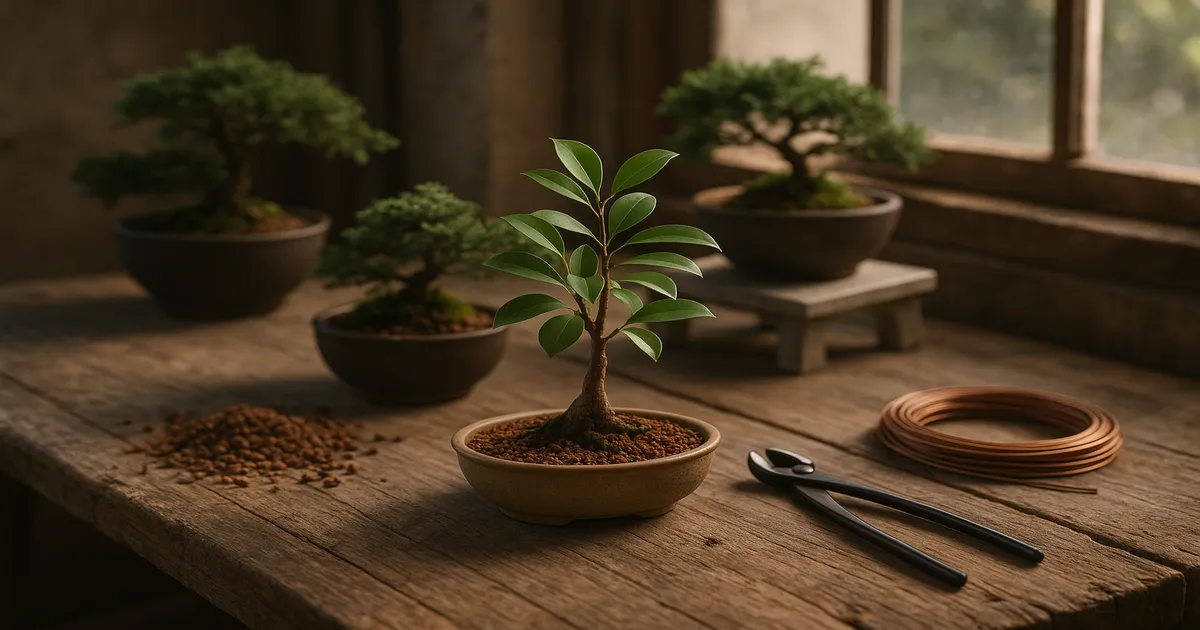
Quick Answer: Bonsai is a living art form — not a species of tree — that uses pruning, wiring, and careful cultivation to grow miniature trees in containers. This beginner’s guide covers everything you need to get started: choosing the right species, soil, watering, pruning, and troubleshooting. Download the free PDF checklist at the end to keep the essentials at your fingertips.
If you’ve been searching for a bonsai a beginners guide PDF to save and reference offline, you’re in the right place. This guide covers every foundational skill in one place, and there’s a downloadable checklist at the bottom so you can take the key points with you.
Bonsai for Beginners: What You Actually Need to Know
What Is Bonsai? (And What It Is Not)
The word bonsai (盆栽) literally means “planted in a container” — bon (tray or pot) + sai (planting). The art originated in China as penjing more than 1,300 years ago before being refined in Japan during the Heian period (794–1185 CE).
Bonsai is not a species. It’s a horticultural practice applied to any woody plant that tolerates root restriction and has proportionally small leaves. A juniper, a maple, a fig — all can become bonsai.
The Five Best Species for Beginners
| Species | Scientific Name | Indoor / Outdoor |
|---|---|---|
| Japanese Maple | Acer palmatum | Outdoor only |
| Juniper | Juniperus spp. | Outdoor only |
| Ficus | Ficus retusa / F. microcarpa | Indoor preferred |
| Chinese Elm | Ulmus parvifolia | Both |
| Fukien Tea | Carmona retusa | Indoor preferred |
How to Use This Guide (and Download the Free PDF)
This guide follows a natural learning sequence: pick a species, set up the right environment, master watering and soil, then move into pruning and wiring. Work through it in order if you’re brand new, or jump to the section you need.
Download the Free Beginner’s Bonsai Checklist PDF → (species selection, daily care reminders, and a seasonal task calendar)
Choosing Your First Bonsai: Species Profiles
Japanese Maple (Acer palmatum): Best for Outdoor Growers
Japanese Maples are deciduous trees prized for spectacular autumn color — reds, oranges, and gold — and naturally fine, layered branching. They develop ramification (dense twig structure) quickly and respond beautifully to pruning. Popular cultivars include ‘Deshojo’ (brilliant red spring foliage), ‘Kiyohime’ (dwarf and compact), and ‘Arakawa’ (cork-like bark even on young trees). Hardy in USDA Zones 5–8.
Key beginner consideration: Japanese Maples must live outdoors year-round. They require winter dormancy to survive long-term. A heated house will eventually kill one.
Juniper (Juniperus spp.): The Classic Beginner Conifer
Junipers are the most iconic bonsai in the Western world — rugged, evergreen, and extraordinarily tolerant of pruning and wiring. Their natural silhouette on rocky mountainsides translates perfectly to bonsai aesthetics, including deadwood features like jin and shari. The most beginner-friendly options are J. procumbens ‘Nana’ (widely available) and J. chinensis ‘Shimpaku’ (the most revered in Japanese bonsai). Hardy in USDA Zones 4–9 depending on species.
Key beginner consideration: Junipers are strictly outdoor trees. Kept inside permanently, they decline and die within months. No exceptions.
Ficus (Ficus retusa / F. microcarpa): The Best Indoor Bonsai
If you want a bonsai on your desk or windowsill, Ficus is your answer. It tolerates the low light and dry air of heated homes better than almost any other species. In humid conditions it develops impressive aerial roots and a buttressed trunk that looks ancient even on young trees. Good varieties include F. retusa (Chinese Banyan) and F. microcarpa ‘Green Island’ (rounder, thicker leaves). Hardy outdoors only in USDA Zones 10–12.
Key beginner consideration: Ficus is the most forgiving indoor species and the right choice if you can’t guarantee outdoor space or cold winter storage.
Chinese Elm (Ulmus parvifolia): The Most Forgiving First Tree
Chinese Elm is arguably the single best first bonsai. It’s fast-growing, develops beautiful flaking bark with age, produces naturally fine twiggy branching, and tolerates beginner mistakes in watering and light better than most species. Popular cultivars include ‘Seiju’ (dwarf with corky bark) and ‘Catlin’ (very small leaves). Hardy in USDA Zones 5–9.
Key beginner consideration: Its semi-evergreen nature means it may drop leaves in winter — this is normal, not a crisis.
Fukien Tea (Carmona retusa): Flowers and Fruit Indoors
Fukien Tea is a tropical shrub with small, glossy dark-green leaves dotted with tiny white spots. It produces delicate white flowers and red or black berries, giving it year-round visual interest that few other indoor bonsai can match. Hardy outdoors only in USDA Zones 10–11.
Key beginner consideration: Fukien Tea is less forgiving than Ficus or Chinese Elm. It’s sensitive to cold drafts and temperature swings. Keep it stable and bright.
Light, Temperature, and Environment
Indoor vs. Outdoor Placement
The indoor/outdoor distinction is the single most important environmental decision you’ll make. Get it wrong and the tree declines slowly — which makes the cause hard to diagnose.
Outdoor species — Juniper and Japanese Maple — need a minimum of six hours of direct sunlight daily during the growing season. Junipers prefer full sun (six to eight-plus hours); more sun means tighter, more compact foliage. Maples appreciate morning sun with afternoon shade where summer temperatures regularly exceed 90°F (32°C).
Indoor species need the brightest spot you can provide. Place Ficus and Fukien Tea within 12–24 inches of a south- or east-facing window. Ficus tolerates as little as 800–1,000 foot-candles but thrives at 2,000–3,000 fc. Fukien Tea wants a minimum of 3,000–4,000 fc — it needs more light than most people give it.
When natural light falls short, supplement with full-spectrum LED grow lights rated 5,000–6,500K, positioned 6–12 inches above the canopy and running 12–14 hours per day. This works well for Ficus, Fukien Tea, and Chinese Elm kept indoors through winter.
Temperature Ranges
| Species | Ideal Growing Temp | Winter Minimum |
|---|---|---|
| Japanese Maple | 60–80°F (16–27°C) | 20–25°F (-7 to -4°C) |
| Juniper | 65–85°F (18–29°C) | 10–15°F (-12 to -9°C) |
| Ficus | 65–85°F (18–29°C) | 55°F (13°C) |
| Chinese Elm | 60–80°F (16–27°C) | 20°F (-7°C) |
| Fukien Tea | 65–80°F (18–27°C) | 60°F (16°C) |
Winter Protection for Outdoor Bonsai
Temperate bonsai need cold dormancy, but the pot — not the tree — is the real vulnerability. Container roots freeze faster than in-ground roots, so protect the pot while letting the tree experience natural cold.
- USDA Zones 6 and warmer: an unheated garage or cold frame is usually sufficient
- Zones 4–5: wrap the pot in burlap, foam, or mulch; aim for storage temperatures of 28–40°F (-2 to 4°C)
- Never bring a juniper or maple indoors for winter. Warm temperatures break dormancy prematurely, exhaust the tree’s energy reserves, and weaken it over successive years.
Bonsai Soil and Watering
Why Bonsai Soil Is Nothing Like Potting Mix
Standard potting mix is designed to retain moisture — exactly the wrong property for a shallow bonsai pot. A dense, peat-heavy mix stays wet too long, suffocates roots, and invites rot. Bonsai soil needs to drain freely within one to two seconds of watering while still holding just enough moisture for root uptake. Garden soil is even worse; it compacts into a brick in a small container and blocks gas exchange entirely.
The Standard Beginner Soil Mix
| Component | Proportion | Function |
|---|---|---|
| Akadama (fired Japanese clay) | 50% | Water retention, cation exchange, root support |
| Pumice (volcanic) | 25% | Drainage, aeration, root anchoring |
| Lava rock (crushed) | 25% | Long-term drainage structure |
Pre-blended akadama-based mixes are available if you’d rather not source components separately.
Species-specific adjustments:
- Juniper: Drier conditions preferred — 40% akadama / 33% pumice / 27% lava rock
- Ficus and Fukien Tea: Slightly more moisture retention — 60% akadama / 20% pumice / 20% lava rock
- Japanese Maple: Standard mix; some growers add 10% fine horticultural grit
Particle size matters too. For trees under 8 inches tall, use 1/8–3/16 inch (3–5mm) particles. Medium trees (8–18 inches) do well with 3/16–1/4 inch (5–6mm) particles.
Budget alternatives: If akadama isn’t available locally, use Turface MVP (calcined clay) as a 1:1 substitute, coarse perlite in place of pumice, and decomposed granite instead of lava rock.
Watering: When and How
There’s no universal schedule. Frequency depends on species, pot size, season, temperature, and humidity. In summer, an outdoor bonsai in a small pot may need water twice a day. In winter dormancy, the same tree might go one to two weeks between waterings.
The finger test: Push your finger 1/2 to 1 inch (1.3–2.5 cm) into the soil. Moist — wait. Barely damp — water now. Dry — water immediately; you may already be behind.
The two-pass method: Water the entire soil surface with a fine-rose watering can until water runs freely from all drainage holes. Wait 5–10 minutes, then water again. The second pass reaches deep roots that the first pass only begins to saturate.
| Symptom | Overwatering | Underwatering |
|---|---|---|
| Leaves | Yellow, soft, drop easily | Crispy brown edges, curling |
| Roots | Mushy, dark, foul smell | Dry, brittle, pulling away from pot |
| Soil | Never fully dries; algae on surface | Pulls away from pot edges; pot feels very light |
| Other | Fungus gnats present | Premature leaf drop in deciduous species |
Tropical species (Ficus, Fukien Tea) also benefit from a humidity tray — a shallow tray filled with gravel and water, with the pot sitting above the waterline. This raises local humidity around the foliage without wetting the roots.
Pruning Your Bonsai
Maintenance vs. Structural Pruning
Maintenance pruning keeps the existing shape intact and builds ramification — the fine, dense twig structure that gives mature bonsai their refined appearance. You do it throughout the growing season, clipping back new shoots as they extend beyond the tree’s silhouette.
Structural pruning is a bigger intervention: removing entire branches or significantly altering the primary structure. It requires more recovery time and should be timed carefully.
How to Prune Each Species
- Japanese Maple: Cut new shoots back to 1–2 leaves throughout spring and summer using sharp scissors.
- Juniper: Never cut juniper foliage with scissors — cut ends brown and die. Pinch new growth with your fingers instead, pulling gently in the direction of growth.
- Ficus / Chinese Elm: Cut extending shoots back to 2–3 nodes. Both species respond vigorously and can be pruned frequently.
- Fukien Tea: Light pinching throughout the year; avoid heavy pruning during cooler months.
Timing by species:
- Deciduous (Maple, Elm): Major structural cuts in late winter, just before bud break.
- Conifers (Juniper): Late summer to early autumn (August–September in the Northern Hemisphere), allowing wound callusing before winter.
- Tropicals (Ficus, Fukien Tea): Any time of year; spring and early summer are ideal for larger cuts.
Essential Pruning Tools
A minimal starter kit covers most situations:
- Concave branch cutters — the curved blade creates a slightly hollow wound that heals flush rather than leaving a raised scar
- Bonsai scissors — for maintenance pruning and leaf work
- Cut paste (wound sealant) — apply to any cut larger than 1/4 inch (6mm) in diameter
- Jin pliers — if you work with junipers and want to create deadwood features
Wiring Bonsai: Shaping Branches
Copper vs. Aluminum Wire
Wiring repositions branches to achieve the angles and movement that define a tree’s character — something pruning alone can’t accomplish. Aluminum wire is softer and more forgiving, making it the right choice for beginners and for tropical species like Ficus. Copper wire is stronger and holds its position better, which is why experienced practitioners prefer it for conifers, but it’s less forgiving on thin branches. Start with aluminum.
How to Apply Wire Correctly
- Wrap at a 45-degree angle — steeper provides less holding power; shallower angles can damage bark
- Select a gauge that is one-third the diameter of the branch
- Wire two branches with one piece where possible — more efficient and more secure
- Never cross two wires on the same branch — the crossing point concentrates pressure and bites into bark faster
How Long to Leave Wire On
Check wired branches every two to four weeks during the growing season. Wire can bite into bark surprisingly fast on vigorous trees. Remove wire by cutting it in segments with wire cutters — never unwind it from a set branch, as this risks snapping the branch or tearing bark.
Repotting Bonsai: Roots, Timing, and Pots
Repotting refreshes exhausted soil, prevents root-bound stress, and allows root pruning — which is what keeps the tree small and the root system healthy. Fast-growing species like Chinese Elm need repotting every one to two years; slower species like Juniper and Japanese Maple every three to five years. The right time is late winter or early spring, just as buds begin to swell but before leaves open. Repotting during active growth or in summer stresses the tree unnecessarily.
When you repot, remove roughly one-third of the root mass, cutting cleanly with sharp scissors or root cutters. Comb out the roots gently before trimming — never tear them. Repot into fresh bonsai soil and water thoroughly. Keep the tree out of direct sun for two to three weeks while it recovers.
Bonsai Beginners Guide PDF: Frequently Asked Questions
How long does it take to grow a bonsai from scratch? A bonsai grown from seed can take 5–10 years to reach a presentable size. Starting with nursery stock or a pre-bonsai cuts that timeline to 2–4 years. Most beginners get the best results buying a young, partially trained tree and developing it further.
Can I keep any bonsai indoors? Only tropical and subtropical species — Ficus, Fukien Tea, and some Chinese Elms — tolerate indoor conditions long-term. Junipers and Japanese Maples are outdoor trees and will decline if kept inside permanently. The most common beginner mistake is treating all bonsai as houseplants.
How do I know if my bonsai is dying? Check the roots first. Healthy roots are white or light tan and firm. Dark, mushy roots indicate overwatering and rot. Dry, brittle roots indicate underwatering or severe root-bound stress. Leaf symptoms — yellowing, browning, sudden drop — are usually a consequence of root problems, not the cause.
Do bonsai need fertiliser? Yes. Because bonsai grow in small volumes of fast-draining soil, nutrients wash out quickly. Use a balanced fertiliser (NPK around 6-6-6 or 10-10-10) every two weeks during the growing season. Switch to a low-nitrogen, high-phosphorus formula (such as 0-10-10) in late summer to harden growth before winter.
What is the easiest bonsai for a complete beginner? Chinese Elm (Ulmus parvifolia) is the most consistently recommended first tree. It’s fast-growing, tolerates beginner mistakes, develops attractive bark quickly, and adapts to both indoor and outdoor conditions. Ficus is the best choice if you have no outdoor space at all.
Download the Free Beginner’s Bonsai Checklist PDF → (species selection, daily care reminders, and a seasonal task calendar — everything from this bonsai beginners guide in one printable sheet)