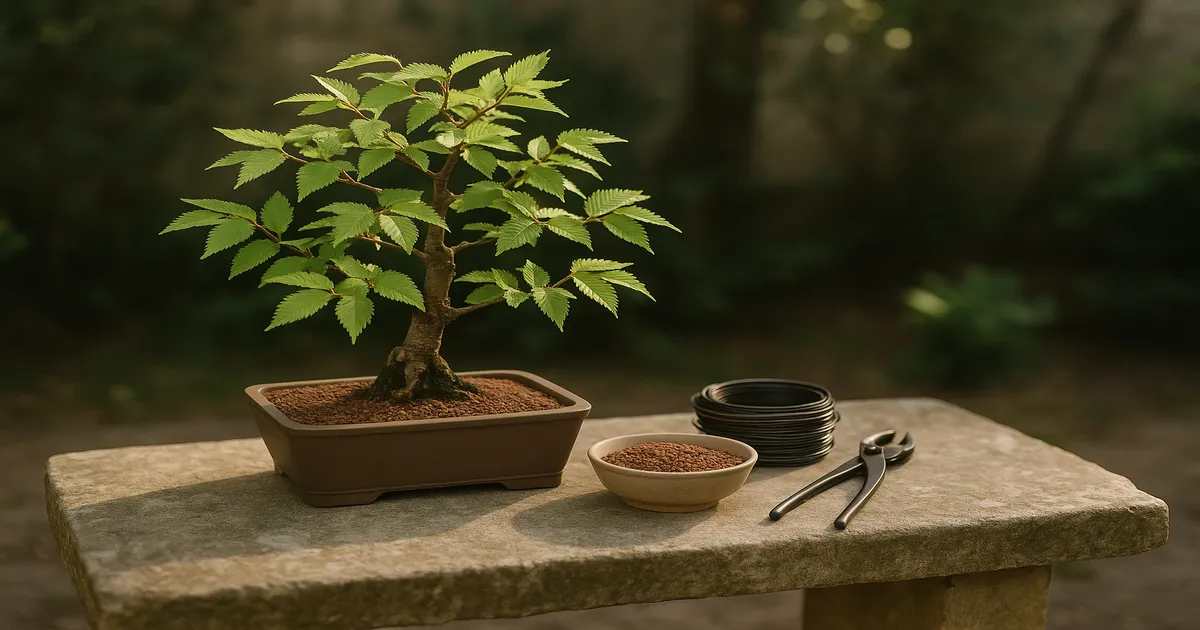
Quick Answer: Hornbeam (Carpinus spp.) is a strictly outdoor bonsai that needs at least 6 hours of direct sun daily, a well-draining akadama-based soil mix, consistent maintenance pruning to build fine ramification, and a mandatory 8–12 week winter dormancy. Get those fundamentals right and you’ll be rewarded with one of the most muscular, elegant deciduous bonsai in the hobby.
Knowing how to care for a hornbeam tree starts with accepting that this species has a few non-negotiable requirements — but once you meet them, hornbeam practically trains itself. Its vigorous back-budding, naturally small leaves, and unmistakable fluted gray bark make it one of the most satisfying deciduous bonsai you can grow, whether you’re in your first year or your thirtieth.
Hornbeam Tree Care at a Glance
| Factor | Requirement |
|---|---|
| Placement | Outdoors only — no permanent indoor keeping |
| Sunlight | 6+ hours direct sun daily |
| Soil | 50% akadama / 30% pumice / 20% lava rock |
| Watering | When top ½ inch dries; daily in summer |
| Pruning | Shoots back to 1–2 leaves throughout growing season |
| Winter dormancy | 8–12 weeks at 25–45°F (−4–7°C) |
| Repotting | Every 2–3 years (young); 3–5 years (mature) |
Is Hornbeam a Good Bonsai for Beginners?
Yes — with one caveat. Hornbeam forgives pruning mistakes better than most species because it back-buds vigorously even on old wood. The caveat is that it will not tolerate being kept indoors or skipping winter dormancy. Respect those two rules and hornbeam is genuinely one of the most beginner-friendly deciduous bonsai available.
Hornbeam Species Overview: Choosing the Right Carpinus
Hornbeam belongs to the genus Carpinus in the Betulaceae (birch) family — around 30–40 deciduous species native to temperate forests across Europe, East Asia, and eastern North America. The name is descriptive: “horn” refers to the wood’s exceptional toughness, and “beam” is Old English for tree.
In the wild, hornbeams grow as understory trees on well-drained slopes and forest margins. They develop a slow, sinuous growth habit that translates beautifully to bonsai. The hallmarks are deeply fluted, muscular gray bark, doubly-serrated leaves with prominent parallel veins, and ornamental clusters of nutlets on three-lobed bracts that hang like lanterns in late summer.
Best Hornbeam Species for Bonsai
| Species | Common Name | Native Range | Bonsai Suitability |
|---|---|---|---|
| C. betulus | European Hornbeam | Europe, SW Asia | Most widely available in the West; superb ramification |
| C. japonica | Japanese Hornbeam | Japan, Korea | Larger, more textured leaves; higher humidity needs |
| C. laxiflora | Loose-flowered Hornbeam | Japan, Korea, China | Elegant fine branching; popular for shohin |
| C. turczaninowii | Korean Hornbeam | Korea, N China, Japan | Gold standard for mame/shohin; naturally tiny leaves |
| C. caroliniana | American Hornbeam / Musclewood | Eastern North America | Outstanding collected material; extremely hardy |
| C. tschonoskii | Yeddo Hornbeam | Japan | Fine twigs; excellent autumn color |
If you’re in North America and want to collect native material, C. caroliniana (Musclewood) is an exceptional choice — hardy to Zone 3, with bark that rivals any species in the genus for visual drama. For refined shohin and mame work, C. turczaninowii is hard to beat; leaves reduce to as small as half an inch with good ramification and selective defoliation. C. betulus is the safest all-around pick for beginners in Zones 4–8 due to its wide availability and robust constitution.
How to Care for a Hornbeam Tree: Light and Temperature
Why Hornbeam Must Live Outdoors
Hornbeam is a temperate deciduous tree that requires genuine seasonal change to stay healthy. Keeping one indoors long-term disrupts its dormancy cycle, weakens its immune response, and typically leads to decline within one to three years. Short display stints of a week or two in a cool, bright room are fine during the growing season — permanent indoor placement is not.
Sunlight Requirements
Aim for a minimum of 6 hours of direct sunlight daily throughout the growing season. In Zones 4–6, full sun all day is ideal and encourages compact internodal growth. In Zones 7–9, where summer temperatures regularly exceed 90°F (32°C), a morning-sun/afternoon-shade position prevents leaf scorch while still delivering sufficient light.
Insufficient light has compounding consequences: internodes stretch, leaves grow large and soft, branching weakens, and fungal disease becomes more likely. If your tree is producing long, floppy new shoots, more sun is almost always the answer.
Temperature Ranges and Hardiness Zones
Hornbeam grows best between 65–80°F (18–27°C) during the active season. Once temperatures climb above 95°F (35°C) for extended periods, move the tree to partial shade and increase watering frequency.
- C. betulus: Zones 4–8
- C. japonica: Zones 4–7
- C. turczaninowii: Zones 5–8
- C. caroliniana: Zones 3–9
Container bonsai lose approximately one to two zones of cold hardiness compared to in-ground trees, because roots are exposed to ambient air temperature on all sides. Factor this into your winter planning.
Winter Dormancy
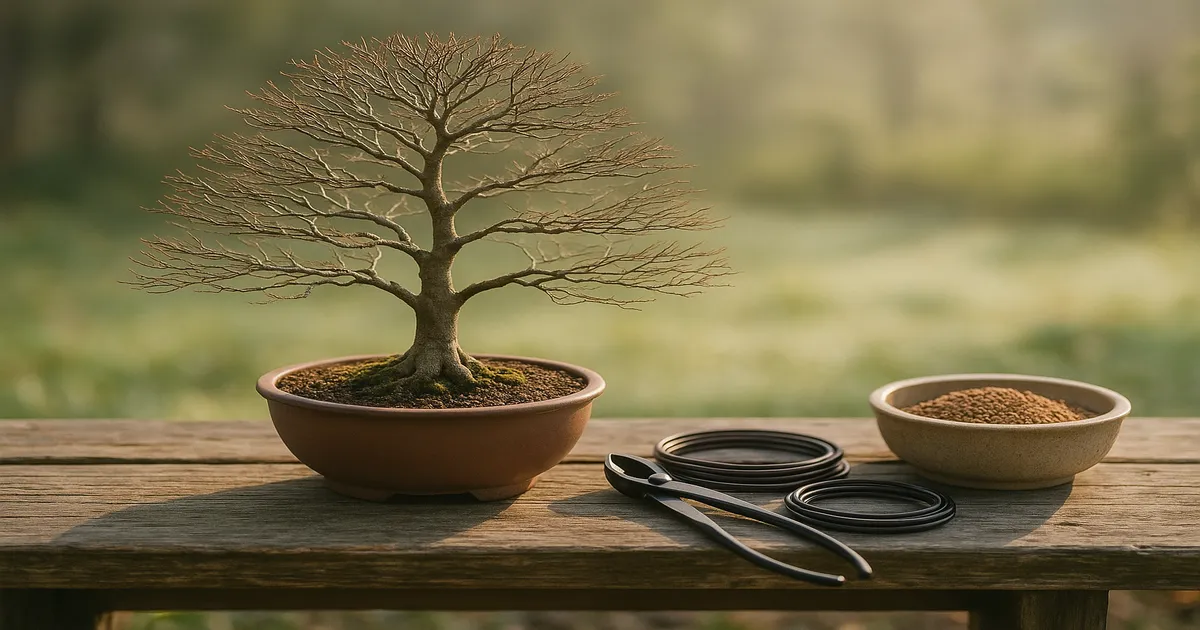
Hornbeam needs 8–12 weeks of cold dormancy at 25–45°F (−4–7°C) to complete its annual cycle. Dormancy is triggered by a combination of shortening days and temperatures consistently below 50°F (10°C). Skipping or shortening this period exhausts the tree’s energy reserves and leads to progressive decline.
When nighttime temperatures drop consistently below 15°F (−9°C), move your tree into an unheated garage, cold frame, or unheated greenhouse. Target a storage temperature of 28–40°F (−2–4°C) — cold enough to hold dormancy, warm enough to prevent the root ball from freezing solid. Avoid any space that stays above 50°F (10°C); premature dormancy break in a heated room is one of the most common ways growers inadvertently damage their trees. Water every two to three weeks during storage and protect from desiccating winds, which can cause branch dieback even at manageable temperatures.
Soil, Repotting, and Roots
The Ideal Hornbeam Bonsai Soil Mix
The standard mix is 50% akadama / 30% pumice / 20% lava rock. (Bonsai Jack Inorganic Bonsai Soil Mix)
Each component does a specific job. Akadama provides moisture retention and cation exchange capacity, supporting the fine feeder roots hornbeam develops with good ramification. Pumice improves aeration and prevents compaction. Lava rock adds long-lasting structural drainage and mineral content. Target a soil pH of 6.0–6.8.
Never use standard potting compost, garden soil, or peat-based mixes. They retain too much moisture, compact quickly, and smother fine roots. Standard horticultural sand is equally problematic — the particles are too fine and fill air pockets rather than creating them.
Climate adjustments:
- Hot/dry climates (Zones 7–9): Shift to 60% akadama / 25% pumice / 15% lava rock to improve moisture retention.
- High-humidity or wet climates: Use 40% akadama / 35% pumice / 25% lava rock to prevent waterlogging.
Particle size by pot size:
- Shohin/mame (under 8 inches): 3–5 mm
- Medium bonsai (8–18 inches): 5–6 mm
- Large bonsai (over 18 inches): 8–10 mm
When and How to Repot
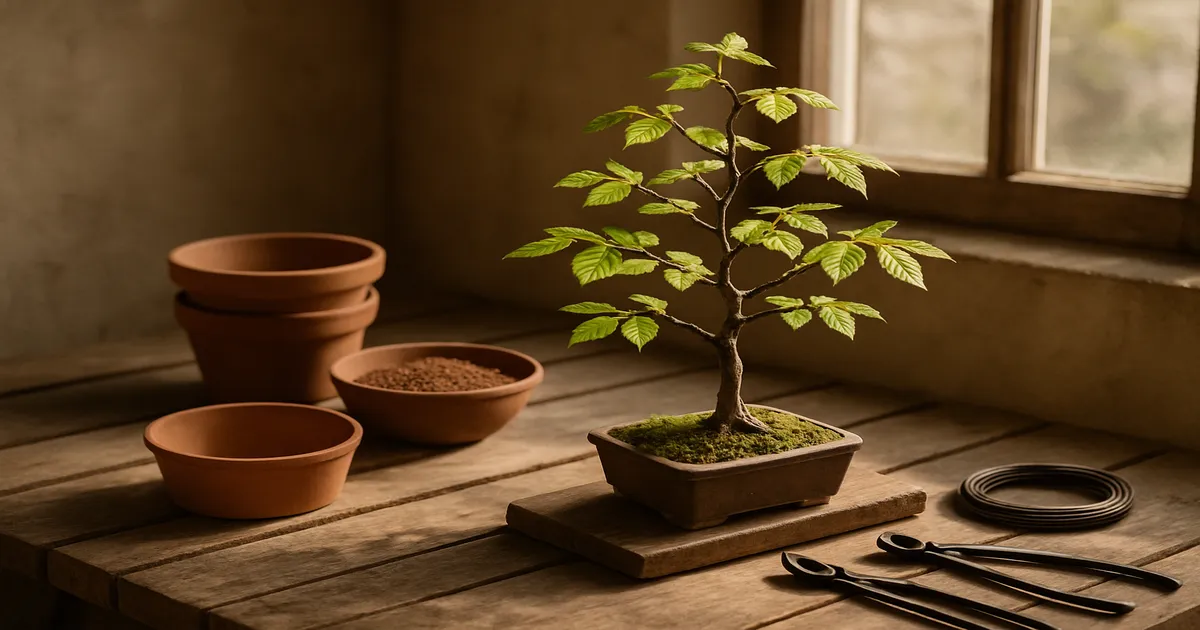
Repot in early spring just before bud break — this is when the tree’s energy is surging upward and roots recover fastest. Young trees need repotting every two to three years; mature specimens every three to five years. Don’t wait for the tree to show stress. Akadama breaks down into dense, poorly-draining sludge over two to three years and needs replacement on schedule regardless of how the tree looks.
Comb out the root mass gently and remove up to one-third of the root volume, cutting cleanly with sharp scissors. Prioritize removing thick, circling roots and retaining the fine white feeder roots — those are what feed the tree. After repotting, keep the tree in a sheltered, semi-shaded spot for two to three weeks while roots re-establish.
Watering Hornbeam Bonsai
How Often to Water
Water when the top half-inch (1.2 cm) of substrate begins to dry out. In warm weather this typically means once daily; during summer heat above 85°F (29°C), check twice daily. The chopstick test is reliable: push a wooden chopstick 1–2 inches into the soil — if it comes out damp, wait; if dry, water now.
Technique
Water thoroughly until water flows freely from every drainage hole, then stop. This ensures complete saturation and flushes accumulated mineral salts. Partial watering leaves the lower root zone dry and encourages shallow rooting. Avoid watering over the foliage during peak afternoon heat, which increases leaf scorch risk.
Rainwater is ideal. If you’re using tap water with a pH above 7.5 or high chlorine content, let it stand for 24 hours before use. Never leave water pooled in drip trays for more than 30 minutes.
Seasonal Schedule
- Spring: Increase gradually as temperatures rise and buds break.
- Summer: Peak demand — monitor daily or twice daily in heat.
- Autumn: Reduce gradually as leaves color and temperatures drop.
- Winter dormancy: Water every 2–3 weeks; check the root ball directly rather than relying on surface assessment.
Overwatering vs. Underwatering
Overwatering signs: yellowing leaves starting in the lower or inner canopy; wilting despite wet soil; soft or mushy roots at repotting; soil that never fully dries between waterings.
Underwatering signs: leaf margins browning and crisping from the tips inward; soil pulling away from pot edges; leaves feeling papery or brittle; rapid wilting on warm days with slow recovery after watering.
Hornbeam performs best at 50–70% relative humidity. In dry climates, a humidity tray — a shallow tray of gravel and water with the pot elevated above the waterline — raises local humidity meaningfully. Morning misting is beneficial; evening misting is not, as wet foliage overnight encourages fungal disease. Note that C. japonica is noticeably more sensitive to low humidity than C. betulus and benefits from a humidity tray year-round in dry climates.
Pruning Hornbeam Bonsai for Ramification and Structure
Maintenance Pruning
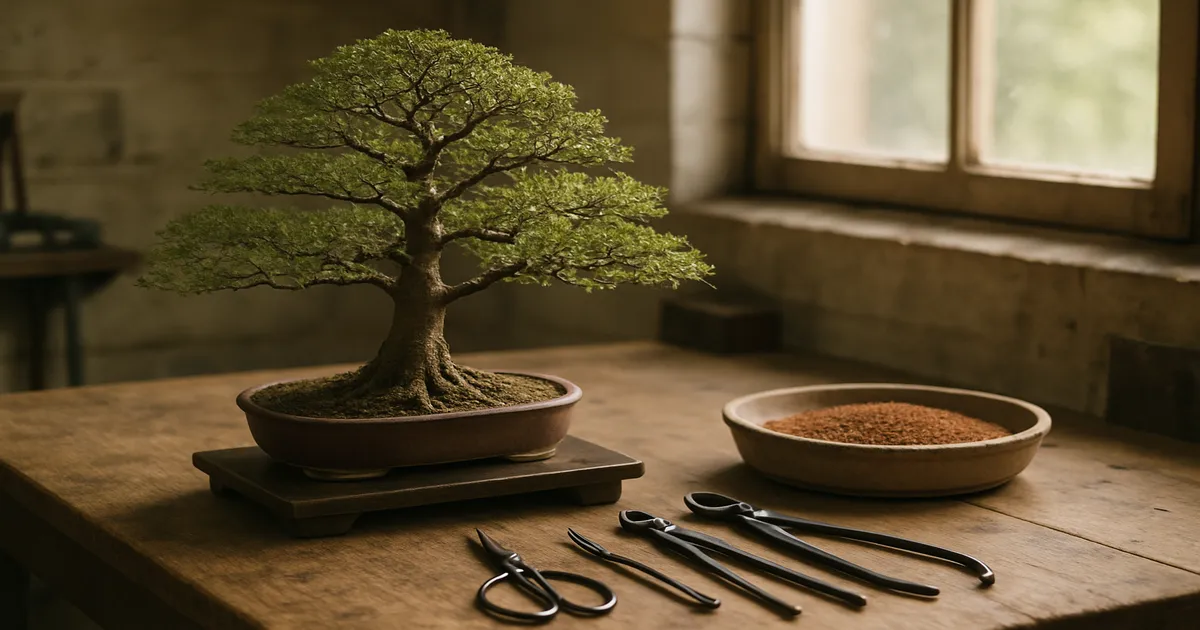
Hornbeam is exceptional at producing fine, twiggy branching — but only if you prune consistently. Once new shoots reach 4–6 leaves, cut them back to 1–2 leaves. Repeat every three to six weeks throughout the growing season. This constant interruption forces the tree to push multiple buds at each cut point, gradually building the dense ramification that gives a hornbeam its aged appearance.
After leaf drop in autumn (October–November), spend time on detailed refinement. Bare branches reveal the structure clearly, and crossing, redundant, or inward-pointing twigs are easy to spot and remove. Avoid heavy pruning in late August through September — new growth stimulated that late may not harden before the first frost.
Structural Pruning
Do major structural work in late winter just before bud swell (late February to mid-March in most temperate zones), or immediately after leaf hardening in late spring. The tree heals fastest when growth energy is high.
When selecting branches, keep these principles in mind:
- Taper: Each branch should be thickest at the trunk and narrow progressively toward the tip.
- Alternation: Branches should alternate left, right, and back in a spiral up the trunk.
- Angle: Aim for 45–60° from the trunk — avoid branches pointing straight up or straight down.
- Remove: Crossing branches, parallel “bar branches” at the same height, front-facing branches, and anything that disrupts the overall silhouette.
Apply cut paste immediately to any wound larger than ¼ inch (6 mm) in diameter to prevent desiccation and block disease entry. Always use concave branch cutters — the slightly hollow wound they create heals flush with the trunk surface rather than leaving a raised knob. Hornbeam heals more slowly than species like Zelkova, so protecting cuts matters more than it might with faster-healing trees.
Defoliation
Full defoliation in early to mid-June on a vigorous, healthy specimen can reduce leaf size by 30–50% and significantly increases back-budding. Only defoliate trees that are well-established, fully healthy, and have not been repotted the same year — it’s a significant stress. Partial defoliation (removing only the largest leaves) is a gentler alternative for less vigorous trees and still delivers meaningful improvement.
Sacrifice Branches
If you need to thicken the trunk or a specific section, allow one or two branches to grow freely for a full season or two without pruning. These sacrifice branches channel enormous energy into the trunk below them. Once you’ve achieved the desired girth, remove them cleanly. It’s one of the fastest ways to add convincing taper to a young hornbeam.
Wiring Hornbeam Bonsai
Wire Type and Gauge
Anodized aluminum wire is the right choice for most hornbeam work. It’s gentler on the bark, easier to handle, and provides sufficient holding power for the species’ moderate branch flexibility. Reserve copper wire for thick, stubborn branches where aluminum can’t hold the position — hornbeam bark marks easily and copper requires more care in application.
Follow the one-third rule: wire diameter should be approximately one-third the diameter of the branch.
- Trunk / heavy primaries: 3.5–4.0 mm aluminum
- Primary to secondary branches: 2.0–3.0 mm aluminum
- Fine secondary/tertiary branches: 1.0–1.5 mm aluminum
- Fine twigs: 0.8–1.0 mm aluminum
Timing and Technique
The best wiring window is late winter before bud break — branches are bare, flexible, and the tree will grow rapidly into its new position. The second window is after leaf hardening in late spring (May–June). Avoid wiring during active bud break, during summer heat stress, or immediately after repotting.
Always double-wire — anchor one wire to two branches of similar diameter, running it at a consistent 45° spiral angle. Never wrap so tightly that the wire bites into the bark from day one. Wrap raffia or rubber tape around the bark before wiring any branch you’re concerned about.
Hornbeam thickens quickly during the growing season — wire can bite into bark within 4–8 weeks in active growth. Check wired branches every two to three weeks from spring onward. When the bark begins to bulge around the wire, remove it immediately. Always cut wire off in segments with wire cutters rather than unwinding it; unwinding risks snapping branches and tearing bark.
Troubleshooting Common Hornbeam Problems
Leaf Scorch
Brown, papery patches appearing in the middle of leaves (not just the margins) in summer are classic leaf scorch, caused by intense afternoon sun, underwatering, or desiccating wind. Move the tree to a morning-sun/afternoon-shade position, add a humidity tray, and ensure watering is adequate. Scorched leaves won’t recover, but the tree will push healthy foliage the following season.
Powdery Mildew and Leaf Spot
Powdery mildew appears as a white powdery coating, usually in late summer when nights cool and humidity rises. It’s rarely fatal but weakens the tree over time. Improve air circulation, avoid evening misting, and treat with a dilute neem oil or potassium bicarbonate spray. Leaf spot (small brown or black lesions with yellow halos) is caused by fungal pathogens and responds to the same treatment. Remove and dispose of affected leaves — do not compost them.
Aphids and Scale
Aphids cluster on new growth in spring and are easily dislodged with a strong water jet or treated with insecticidal soap. Scale insects appear as small brown bumps on branches and are best removed manually with a soft brush and rubbing alcohol, followed by a neem oil application. Check the undersides of leaves and branch crotches regularly.
Failure to Leaf Out in Spring
If a hornbeam fails to push buds in spring, the most common causes are: dormancy broken too early in a warm space, root rot from overwatering during winter storage, or a root ball that froze solid. Check the roots — healthy roots are white or tan and firm; rotted roots are dark, soft, and smell unpleasant. If rot is present, repot immediately into fresh soil, remove all affected roots, and keep the tree in a sheltered spot with minimal watering until new growth appears.
Frequently Asked Questions
Can I keep a hornbeam bonsai indoors? No — not permanently. Hornbeam is a temperate deciduous tree that requires outdoor conditions and a genuine winter dormancy. Brief indoor display periods of one to two weeks are fine, but the tree must return outdoors. Permanent indoor keeping leads to decline within one to three years.
How do I know when to repot my hornbeam? Repot young trees every two to three years and mature trees every three to five years, always in early spring just before bud break. Don’t wait for the tree to show stress — akadama degrades on a predictable schedule and needs replacing regardless of how the tree looks on the surface.
Why are my hornbeam’s leaves turning yellow in summer? Summer yellowing that starts in the lower or inner canopy usually indicates overwatering or poor soil drainage. If the soil stays wet for more than two days between waterings, consider repotting into a coarser mix. Yellowing across the whole canopy can also signal nutrient deficiency — apply a balanced fertilizer (e.g., a slow-release pellet such as Biogold Original Bonsai Fertilizer) during the growing season.
When is the best time to wire a hornbeam? Late winter before bud break is ideal — branches are bare, flexible, and easy to position. You can also wire after leaves harden in late spring. Check wired branches every two to three weeks during the growing season, as hornbeam can develop wire marks within four to eight weeks.
How do I reduce leaf size on a hornbeam bonsai? Consistent maintenance pruning — cutting new shoots back to one to two leaves every three to six weeks — naturally reduces leaf size over several seasons. Full defoliation in early to mid-June on a healthy, established tree can achieve a 30–50% reduction in a single season. Increased light and good ramification also contribute to smaller leaves over time.