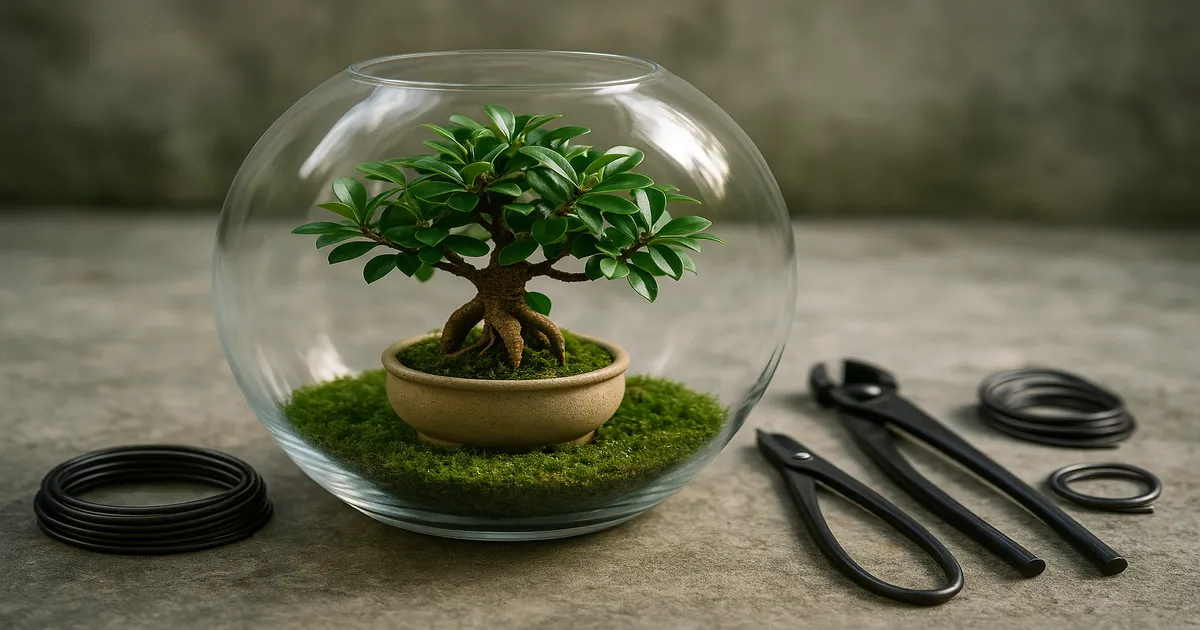
Quick Answer: For a closed terrarium, Ficus microcarpa (Ginseng Ficus) is the best all-around choice — it tolerates high humidity, low light, and reduced airflow better than any other species. Carmona retusa (Fukien Tea) is the runner-up if you want year-round flowers and berries in a sealed environment.
Choosing the best bonsai for a closed terrarium is harder than it looks. Most bonsai species are outdoor trees that need full sun, cold dormancy, and strong airflow — the exact opposite of what a sealed glass enclosure provides. The good news is that a handful of tropical and subtropical species don’t just survive in a closed terrarium; they genuinely thrive. This guide compares six of the best candidates side by side so you can pick the right tree for your setup, your skill level, and the look you’re after.
What Makes a Good Closed Terrarium Bonsai?
Not every compact tree belongs in a sealed glass box. These five criteria separate the species that flourish from the ones that slowly decline.
Humidity Tolerance (70–95% RH)
A fully sealed terrarium routinely hits 70–95% relative humidity. That’s comfortable for tropical rainforest natives and fatal for most temperate species. If a plant originates from a dry or seasonally arid climate, cross it off your list.
Low-Light Adaptability
Glass filters UV light and reduces PAR (Photosynthetically Active Radiation) by 25–50% compared to open air. A species that demands full sun will slowly starve inside glass, no matter how bright the room. Look for plants rated for 1,000–5,000 lux in indoor conditions.
Compact Growth and Small Leaves
Inside a terrarium, scale is everything. Species with naturally small leaves — or leaves that reduce readily under training — look proportionate and need less corrective pruning to maintain the illusion of a full-sized tree.
Resilience to Reduced Airflow
Stagnant air encourages fungal disease and root rot. Species adapted to dense forest understories handle low-airflow conditions far better than open-habitat plants. This single factor eliminates junipers, pines, and most temperate species entirely.
Frost Sensitivity and Temperature Range
Every viable candidate must be a frost-tender tropical or subtropical. Temperate bonsai need cold dormancy to survive long-term — something a sealed indoor terrarium simply cannot provide. All six species reviewed here are USDA Zone 10–12 plants.
Closed Terrarium Bonsai: At-a-Glance Comparison
| Species | Humidity Tolerance | Light Requirement | Optimal Temp | Difficulty | Flowers/Fruit | Best Style | Lid Type |
|---|---|---|---|---|---|---|---|
| Ficus microcarpa | 70–95% | 1,000–3,000 lux | 65–85°F | Beginner | No | Informal upright, root-over-rock | Fully sealed |
| Carmona retusa | 60–80%+ | 3,000–8,000 lux | 65–85°F | Intermediate | Yes (both) | Informal upright, literati | Fully sealed |
| Serissa foetida | 70–90% | 3,000–8,000 lux | 60–75°F | Intermediate+ | Yes (flowers) | Broom, informal upright | Fully sealed |
| Schefflera arboricola | 70–95% | 1,000–3,000 lux | 65–85°F | Beginner+ | No | Root-over-rock, aerial root | Fully sealed |
| Ficus benjamina ‘Natasja’ | 70–90% | 2,000–5,000 lux | 65–80°F | Intermediate | No | Weeping, informal upright | Fully sealed |
| Podocarpus macrophyllus | 60–80% | 3,000–6,000 lux | 60–80°F | Intermediate | No | Formal upright, literati | Semi-open only |
The 6 Best Bonsai Species for a Closed Terrarium
1. Ficus microcarpa (Ginseng Ficus / Chinese Banyan)
Ficus microcarpa is the gold standard for closed terrarium bonsai, and it earns that title honestly. In a sealed, humid environment it naturally develops the dramatic aerial roots and thickened nebari that growers spend years coaxing out of trees in open air. The ‘Ginseng’ cultivar arrives with a ready-made bulbous root base; ‘Moclame’ offers a more compact leaf and cleaner branching structure. Both work beautifully inside glass.
Key specs:
- Humidity: 70–95%
- Light: 1,000–3,000 lux
- Temperature: 65–85°F (18–29°C), minimum 55°F (13°C)
- Lid type: Fully sealed compatible
Pros
- Tolerates lower light than almost any other bonsai species
- Develops aerial roots naturally in sealed, humid conditions
- Back-buds readily from old wood after pruning
- Widely available as pre-trained starter bonsai
Cons
- Milky sap irritates skin and eyes — wear gloves when pruning
- Vigorous growth means pruning every 4–6 weeks in warm conditions
- Abrupt temperature changes or being moved can trigger leaf drop
Best for: Beginners and experienced growers who want a reliable, dramatic-looking terrarium bonsai with minimal fuss.
2. Carmona retusa (Fukien Tea)
Carmona retusa is the most ornamentally rewarding closed terrarium bonsai you can grow. It produces small white flowers and red-to-black berries almost year-round when conditions are stable. Here’s the irony: Carmona is notorious among indoor bonsai growers for sulking at the slightest cold draft or humidity swing. A sealed terrarium eliminates both problems at once, turning one of the trickiest indoor bonsai into a surprisingly manageable specimen.
Key specs:
- Humidity: 60–80%+
- Light: 3,000–8,000 lux
- Temperature: 65–85°F (18–29°C), minimum 60°F (16°C)
- Lid type: Fully sealed compatible
Pros
- Produces flowers and berries simultaneously — exceptional visual interest year-round
- Attractive dark-green foliage with distinctive white lenticels on the bark
- Thrives in the stable warmth and humidity a sealed terrarium naturally provides
Cons
- Most cold-sensitive species in this comparison — a brief chill can cause rapid defoliation
- Needs significantly more light than Ficus; grow lights are essentially mandatory
- Less forgiving of beginner mistakes than Ficus microcarpa
Best for: Hobbyists who want year-round visual interest beyond foliage and can provide adequate supplemental lighting.
3. Serissa foetida (Tree of a Thousand Stars / Snow Rose)
Serissa has a reputation for being difficult — and in open-air indoor conditions, that reputation is mostly deserved. But the stable humidity and temperature of a closed terrarium address its two biggest weaknesses: fluctuating moisture and inconsistent warmth. Inside a sealed enclosure, Serissa rewards patience with dense twiggy ramification, prolific tiny white flowers, and some of the most refined branch structure of any species on this list.
Key specs:
- Humidity: 70–90%
- Light: 3,000–8,000 lux
- Temperature: 60–75°F (16–24°C)
- Lid type: Fully sealed compatible
Pros
- Exceptionally prolific flowering for a bonsai species
- Develops outstanding fine-branch ramification over time
- Multiple cultivars available: ‘Variegata’ (white-edged leaves), ‘Pink Mystic’, ‘Snow Rose’ (double flowers)
- Stable terrarium conditions prevent the notorious environmental sulking
Cons
- Emits an unpleasant odor when pruned — open the terrarium and ventilate the room briefly after each session
- Sensitive to heavy pruning; prune lightly and frequently rather than aggressively
- Prefers slightly cooler nights (60–65°F / 16–18°C), which can conflict with warm indoor environments
Best for: Experienced hobbyists who want a flowering specimen with exceptional branch structure and are comfortable with careful, frequent maintenance.
4. Schefflera arboricola (Dwarf Umbrella)
If dramatic root and trunk development is your goal, Schefflera arboricola belongs near the top of your list. In a high-humidity sealed terrarium, it produces curtains of aerial roots that drape down the trunk and fuse over time — a visual effect that normally takes outdoor growers years to achieve in tropical climates. It also handles aggressive pruning without complaint, making it one of the most forgiving species to train.
Key specs:
- Humidity: 70–95%
- Light: 1,000–3,000 lux
- Temperature: 65–85°F (18–29°C), minimum 50°F (10°C)
- Lid type: Fully sealed compatible
Pros
- Develops spectacular aerial roots faster in sealed humid conditions than almost any other species
- Most cold-tolerant of all six candidates — survives brief dips to 50°F (10°C)
- Tolerates aggressive pruning; pushes new growth from bare wood reliably
- Excellent for root-over-rock and banyan-style compositions
Cons
- Palmate compound leaves are less traditionally “bonsai-like” — a matter of taste, but worth noting
- Variegated cultivars (‘Gold Capella’) are noticeably less vigorous than the standard green form
- Can outgrow a small terrarium surprisingly quickly; plan for regular pruning
Best for: Hobbyists who prioritize dramatic root and trunk development over traditional bonsai leaf aesthetics.
5. Ficus benjamina ‘Natasja’ (Weeping Fig)
The standard Ficus benjamina with its large, glossy leaves is not a terrarium candidate. The ‘Natasja’ cultivar is a different story. It grows with a naturally compact, arching habit, and its already-small leaves reduce further with defoliation training. The weeping branch structure gives it a graceful, almost willow-like silhouette that stands apart from the more upright Ficus microcarpa.
Key specs:
- Humidity: 70–90%
- Light: 2,000–5,000 lux
- Temperature: 65–80°F (18–27°C), minimum 55°F (13°C)
- Lid type: Fully sealed compatible
Pros
- Elegant weeping branch structure — a distinctive aesthetic among terrarium bonsai
- Leaves reduce further with defoliation, achieving excellent miniature scale
- Responds well to wiring for precise branch placement
- Good ramification potential with patient training
Cons
- More sensitive to environmental changes than F. microcarpa — expect leaf drop when first sealed into a new terrarium
- Only the ‘Natasja’ cultivar is suitable; standard large-leaved Ficus benjamina forms are completely unsuitable
- Defoliation for leaf reduction requires experience to execute safely
Best for: Hobbyists who want a graceful, weeping aesthetic and are comfortable with defoliation techniques.
6. Podocarpus macrophyllus (Buddhist Pine) — Semi-Open Terrariums Only
Podocarpus is the only species on this list that cannot go into a fully sealed terrarium. Its subtropical origins make it genuinely humidity-tolerant, and its needle-like foliage scratches the itch for a conifer aesthetic that junipers and pines simply cannot satisfy in an enclosed environment. But it needs airflow. A partially vented or semi-open lid is non-negotiable — stagnant air will cause fungal problems within weeks.
Key specs:
- Humidity: 60–80%
- Light: 3,000–6,000 lux
- Temperature: 60–80°F (16–27°C)
- Lid type: Semi-open / partially vented only
Pros
- Conifer-like needle foliage — the only viable option for this aesthetic in a terrarium context
- Elegant formal upright and literati forms develop naturally
- Responds well to pruning and develops good taper over time
Cons
- Cannot be used in a fully sealed terrarium — stagnant air causes fungal problems and eventual decline
- Slowest-growing species in this comparison; patience is required
- Less widely available as pre-trained bonsai stock compared to Ficus species
Best for: Hobbyists who want a conifer aesthetic and are building a semi-open terrarium with a vented or partially open lid.
Our Verdict: Which Closed Terrarium Bonsai Is Right for You?
Best Overall: Ficus microcarpa. No other species combines low-light tolerance, humidity adaptability, forgiving growth habits, and wide availability the way Ginseng Ficus does. If you’re building your first closed terrarium bonsai, start here.
Best for Ornamental Interest: Carmona retusa. Simultaneous flowers and berries on a miniature tree inside a glass enclosure is genuinely spectacular. Carmona delivers that — provided you invest in adequate grow lighting and keep temperatures above 60°F (16°C).
Best for Dramatic Structure: Schefflera arboricola. For aerial roots, banyan-style trunks, and bold structural development, Schefflera outperforms every other species on this list. The non-traditional leaf shape is the only real trade-off.
Best for Experienced Growers: Serissa foetida. The stable terrarium environment unlocks Serissa’s best qualities while neutralizing its worst tendencies. Growers who commit to light, frequent pruning will be rewarded with exceptional flowering and branch refinement.
Best Weeping Form: Ficus benjamina ‘Natasja’. The graceful arching silhouette is unlike anything else here. It requires extra care during the transition into a sealed environment, but the aesthetic payoff is worth it for patient growers.
Best for Semi-Open Terrariums: Podocarpus macrophyllus. If your build includes a vented lid and you want a conifer look, Podocarpus is your only practical option. Accept the slower pace and enjoy the elegant result.
Species to Avoid in Closed Terrariums
- Junipers (Juniperus spp.) — need full sun, strong airflow, and cold dormancy; will decline within months in a sealed system
- Japanese Maple (Acer palmatum) — requires seasonal cold dormancy and outdoor conditions to survive long-term
- Pines (Pinus spp.) — demand excellent drainage, airflow, and cold winters; incompatible with sealed humid environments
- Chinese Elm (Ulmus parvifolia) — can adapt to indoor conditions in open air, but stagnant air in a fully sealed terrarium leads to fungal problems and gradual decline
Frequently Asked Questions
Can any bonsai species grow in a closed terrarium?
No — only tropical and subtropical species tolerant of high humidity, low light, and minimal airflow are suitable. Temperate species like junipers, maples, and pines require cold dormancy, full sun, and strong air circulation. They will decline rapidly in a sealed environment regardless of how well you care for them.
How often do you water a closed terrarium bonsai?
Typically every 2–6 weeks, depending on how tightly the terrarium is sealed, the size of the tree, and ambient room temperature. The most reliable method is to watch the condensation: a light morning mist on the upper glass that clears by afternoon is ideal. Heavy, persistent condensation means the system is too wet; no condensation for several days is your signal to add water.
What soil mix works best for a closed terrarium bonsai?
Avoid standard potting soil — it stays too wet and compacts over time in a sealed environment. For moisture-tolerant species like Ficus and Schefflera, a mix of 40% akadama, 30% pumice, 20% lava rock, and 10% horticultural charcoal works well. Serissa and Carmona prefer slightly sharper drainage: 30% akadama, 40% pumice, 20% lava rock, and 10% charcoal. Always include a 1–2 inch drainage layer of coarse lava rock or LECA at the bottom of the enclosure, separated from the soil by fine mesh.
Do closed terrarium bonsai need grow lights?
Strongly recommended, yes. Standard glass filters 25–50% of UV and PAR, which leaves most window placements inadequate for sustained healthy growth. Use a full-spectrum LED grow light at 5,000–6,500K color temperature, targeting 50–150 µmol/m²/s of PAR at the canopy level, run for 12–14 hours per day on a timer. Keep the light 6–12 inches above the terrarium to prevent heat buildup inside the enclosure.
How do you prune and wire a bonsai inside a closed terrarium?
The most practical approach is to temporarily remove the tree from the terrarium for pruning and wiring sessions. Use sharp, clean concave cutters and apply cut paste to any wound larger than 3mm. Remove all cut debris before resealing — organic matter in a humid sealed environment invites mold fast. For wiring, aluminum wire is preferred over copper because it’s gentler on bark. Check wire every 3–4 weeks; tropical species in warm, humid conditions grow quickly and wire can bite into bark surprisingly fast.