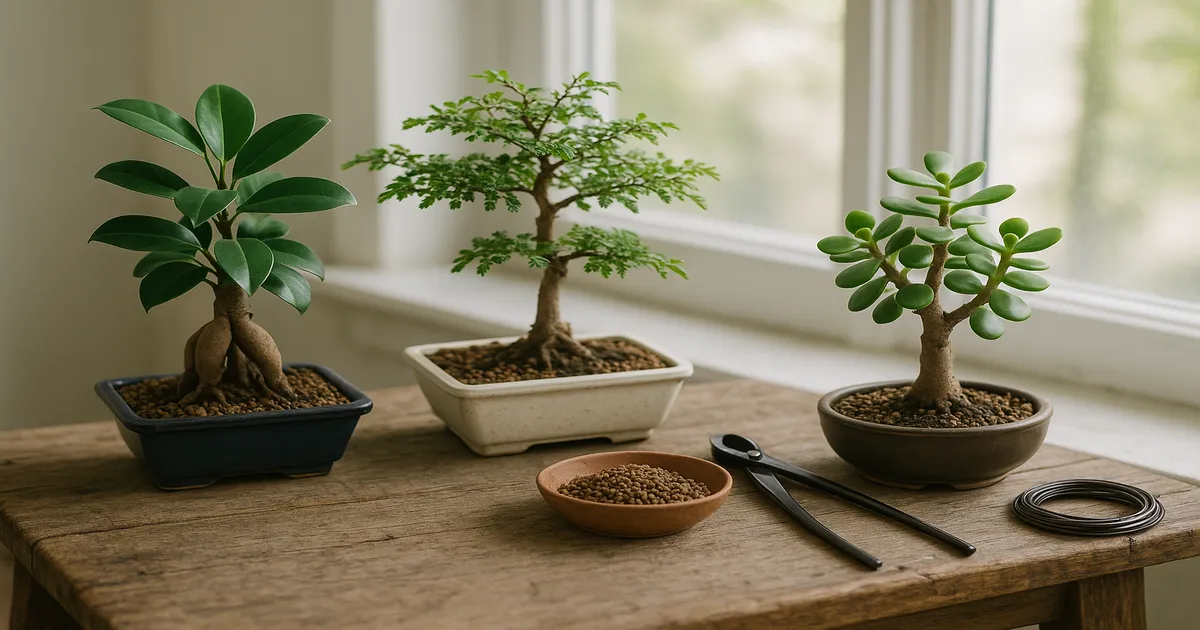
Quick Answer: The best bonsai for beginners indoors is the Ficus retusa — it tolerates low light, forgives watering mistakes, and bounces back from hard pruning like almost nothing else. If you want faster visible progress and dramatic aerial roots, the Schefflera arboricola is a close runner-up that costs almost nothing to buy and develops quickly. Avoid Serissa as your first tree; it’s widely sold to beginners but earns its nickname “tree of a thousand headaches.”
Choosing the best bonsai for beginners indoors is harder than it looks. Walk into any garden centre and you’ll find a shelf of pre-styled trees with zero guidance on which ones will actually survive your apartment. Some species are genuinely forgiving; others are marketed as beginner-friendly while quietly punishing every mistake. This guide cuts through the noise with honest reviews of the six most widely available indoor species, so you can buy with confidence.
What Makes a Good Beginner Indoor Bonsai?
Light Tolerance
Light kills more indoor bonsai than overwatering does. Most indoor spaces measure only 200–800 lux away from windows — far below what any bonsai needs to thrive. Before you buy, spend $15–25 on a clip-on lux meter and measure the actual light at the spot where you plan to keep the tree. (Dr.Meter LX1330B)
Ficus retusa and Schefflera arboricola can survive at 1,000–2,000 lux, making them the only species on this list that are genuinely apartment-friendly without supplemental lighting. Every other species needs at least 3,000 lux — and ideally a south-facing window or a dedicated grow light.
Watering Forgiveness
The range here is wide. Jade plant can go 21–30 days without water in winter and shrug it off. Serissa, at the other extreme, struggles with both overwatering and underwatering and will drop leaves to protest either. For most beginners, a drought-tolerant species is the safer bet — missed waterings are far more common than overwatering when life gets busy.
Growth Rate
Fast growers like Schefflera and Chinese Elm give you more opportunities to practise pruning and see results quickly. That feedback loop is genuinely valuable when you’re learning. Jade grows slowly, which means fewer mistakes but also years before you see meaningful development.
Styling Potential
Think about what you find beautiful. Chinese Elm has spectacular flaking, mottled bark in orange, grey, and green. Schefflera and Ficus produce dramatic aerial roots in humidity. Carmona flowers and fruits year-round. The tree you find most beautiful is the one you’ll pay closest attention to.
Best Bonsai for Beginners Indoors: At-a-Glance Comparison
| Species | Min. Light (lux) | Watering Frequency | Difficulty | Best For | Price |
|---|---|---|---|---|---|
| Ficus retusa | 1,000–2,000 | Every 3–7 days | Beginner | Overall best pick | $$ |
| Schefflera arboricola | 1,000–2,000 | Every 3–6 days | Beginner | Fast development | $ |
| Ulmus parvifolia | 2,000–3,000 | Every 2–5 days | Beginner | Learning pruning | $$ |
| Carmona retusa | 2,000–3,000 | Every 2–4 days | Beginner–Intermediate | Flowering indoors | $$ |
| Crassula ovata | 2,000–3,000 | Every 7–30 days | Beginner | Forgetful waterers | $ |
| Serissa foetida | 3,000–5,000 | Every 2–4 days | Intermediate | Experienced beginners | $$ |
Ficus and Schefflera stand apart with the lowest light requirements and the widest tolerance for beginner mistakes. Jade is uniquely forgiving for irregular waterers but needs more light than most apartments provide naturally. Serissa demands the most from its environment and offers the least margin for error.
Ficus retusa (Ginseng Ficus / Tiger Bark Ficus)
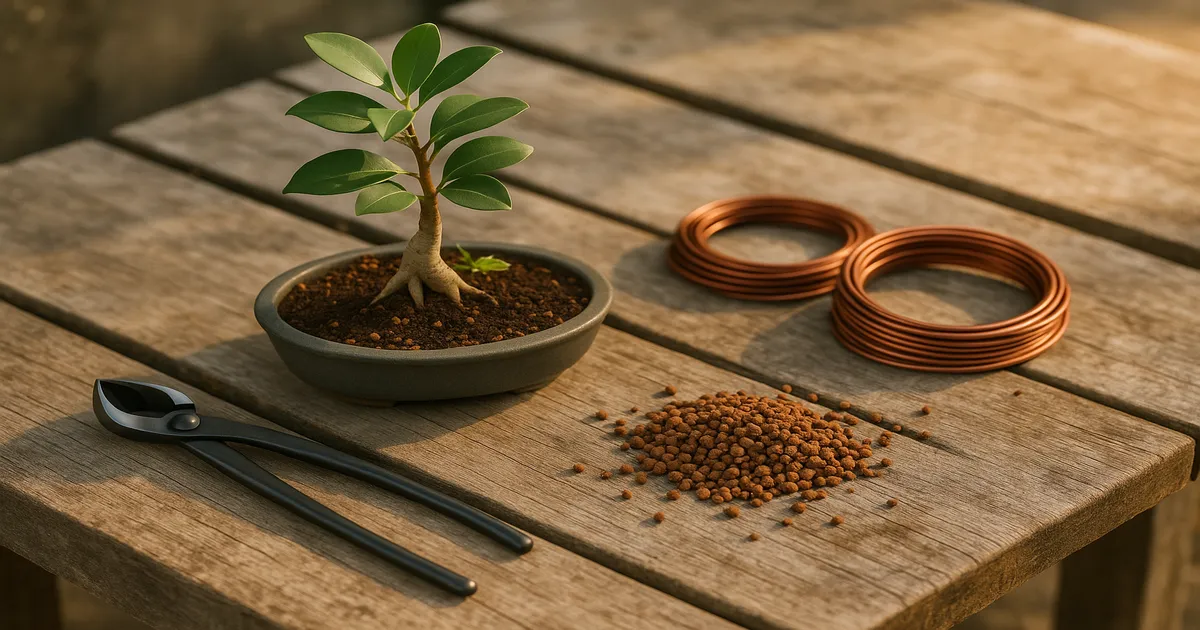
Ficus retusa is the gold standard for indoor bonsai beginners, and it’s earned that reputation honestly. It tolerates 1,000–2,000 lux — the kind of light you get near an east-facing window — and recovers from both overwatering and underwatering with minimal drama. Prune it hard and it responds with vigorous back-budding. Neglect it for a week and it won’t punish you.
A quick note on varieties: the “Ginseng” form sold at big-box stores has swollen, tuberous exposed roots grafted onto pre-grown rootstock. It’s dramatic-looking and perfectly fine to grow, but it isn’t a traditional bonsai form. The “Tiger Bark” form (F. retusa proper) has smooth grey bark and a more conventional silhouette. Both are equally beginner-friendly. Avoid F. benjamina — it drops leaves aggressively when moved and is genuinely harder to manage.
Care snapshot:
- Light: 3,000–5,000 lux ideal; survives at 1,000–2,000 lux
- Temperature: 65–85°F (18–29°C); never below 55°F (13°C)
- Watering: Every 3–7 days; check the top 0.5–1 inch of soil before watering
- Soil: 60% pumice / 20% akadama / 20% lava rock (Bonsai Jack Gritty Mix 111)
- Humidity: Moderate; aerial roots develop above 60% RH
Pros
- Lowest light requirement of any woody bonsai on this list
- Heals from pruning cuts faster than any other species here
- Widely available at garden centres, IKEA, and big-box stores
- Develops dramatic aerial roots when humidity is consistently high
Cons
- Milky latex sap irritates skin and eyes — wear gloves when pruning
- F. benjamina is often mislabelled as F. retusa; confirm your variety before buying
- May shed leaves after being relocated, even when healthy — this is normal and temporary
Best for: Virtually any beginner in any indoor environment. If you’re unsure which species to choose, this is the answer.
Schefflera arboricola (Dwarf Umbrella Tree)
Schefflera is the fastest-developing indoor bonsai on this list, and at nursery prices it’s often the cheapest way to get started. In the right conditions — humidity above 60% and decent light — it can produce visible aerial roots within months, creating the kind of dramatic banyan-style nebari that usually takes years on other species. The clip-and-grow technique works beautifully here: cut back hard, wait for new shoots, repeat.
The compound palmate leaves (seven to nine leaflets per leaf) look less “traditional” than the single leaves of Ficus or Elm, and that’s the main aesthetic objection some people raise. Fair enough — it’s a matter of taste. But for sheer speed of development and ease of care, Schefflera is genuinely hard to beat.
Care snapshot:
- Light: 3,000–6,000 lux ideal; tolerates 1,000–2,000 lux
- Temperature: 65–80°F (18–27°C); cold-sensitive below 55°F (13°C)
- Watering: Every 3–6 days; allow the top inch to dry slightly between waterings
- Soil: 50% pumice / 30% lava rock / 20% akadama
- Humidity: 60%+ for best aerial root development
Pros
- Fastest growth rate of the group — visible progress within weeks
- Aerial roots develop quickly at moderate humidity
- Tolerates low light nearly as well as Ficus
- Often available as cheap nursery stock under $15
Cons
- Compound leaves look less traditional than single-leaf species
- Variegated form grows noticeably slower and is less suitable for beginners
- Needs consistent humidity above 60% to develop the aerial roots it’s famous for
Best for: Beginners who want rapid visible progress and the dramatic look of aerial roots without waiting years.
Ulmus parvifolia (Chinese Elm)
Chinese Elm is the best species on this list for learning how bonsai actually works. It back-buds prolifically after pruning, giving you constant opportunities to practise branch selection and develop fine ramification. The bark is genuinely beautiful — it flakes in patches of orange, grey, and green, giving even young trees a convincingly aged appearance.
Indoors, Chinese Elm behaves as semi-evergreen, holding most of its leaves year-round. It does benefit from a cool dormancy period (45–55°F / 7–13°C for six to eight weeks in winter) if you can manage it — a cool garage or unheated room works well. Without that rest period it may partially defoliate in late winter, which looks alarming but is usually fine. Of all the species here, it’s the most cold-tolerant and the most forgiving of temperature fluctuations.
Care snapshot:
- Light: 5,000–8,000 lux ideal; needs more light than Ficus or Schefflera
- Temperature: 40–90°F (4–32°C); benefits from cool winter dormancy at 45–55°F (7–13°C)
- Watering: Every 2–5 days; don’t allow to dry out completely
- Soil: 50% akadama / 30% pumice / 20% lava rock
- Humidity: Moderate
Pros
- Stunning flaking, mottled bark — among the most beautiful of any bonsai species
- Excellent back-budding makes it ideal for learning structural pruning
- Most cold-tolerant species on this list
- Fine ramification develops faster than most species
Cons
- Needs more light than Ficus or Schefflera — a south-facing window or grow light is important
- Benefits significantly from outdoor summers; purely indoor specimens grow slower
- May partially defoliate in winter without a cool dormancy period
Best for: Beginners focused on learning branch structure, ramification, and traditional bonsai aesthetics.
Carmona retusa (Fukien Tea)
Fukien Tea does something none of the other species here can match: it flowers and fruits indoors, year-round, without any special treatment. Tiny white flowers appear regularly among the small, dark-green glossy leaves — which have distinctive white hydathode dots — followed by red berries that slowly ripen to black. For a bonsai that looks genuinely alive and dynamic on a windowsill, Carmona is hard to beat aesthetically.
The trade-off is that it’s less forgiving than Ficus. It needs more light — ideally 5,000–8,000 lux, which means a strong south-facing window or a grow light in most apartments. It also doesn’t tolerate drying out completely, so you need to stay on top of watering more than you would with Ficus or Jade. Place it well and keep it consistently moist, and it’s a rewarding, low-drama tree. Put it in a dim corner and forget to water it, and it will struggle.
Care snapshot:
- Light: 5,000–8,000 lux ideal; needs a bright window or grow light
- Temperature: 65–80°F (18–27°C); cold-sensitive below 55°F (13°C)
- Watering: Every 2–4 days; do not allow to dry out completely
- Soil: 50% akadama / 30% pumice / 20% lava rock
- Humidity: High; 50–70% RH preferred
Pros
- Flowers and fruits indoors without special treatment — unique on this list
- Naturally compact growth and short internodes
- Pre-styled specimens widely available with good initial structure
- Glossy, attractive foliage year-round
Cons
- Higher light requirement than Ficus or Schefflera — placement is critical
- Does not tolerate drying out; unforgiving of missed waterings
- Cold-sensitive; struggles below 55°F (13°C) — keep away from draughty windows in winter
Best for: Beginners who prioritise ornamental flowering and have a bright south-facing window or are willing to add a grow light.
Crassula ovata (Jade Plant Bonsai)
Jade is the bonsai for people who travel, forget, or simply have chaotic schedules. In winter it can go 21–30 days without water and emerge completely unscathed. It thrives in the dry indoor air that kills most tropical species. With age it develops beautiful cork-like bark and a genuinely tree-like silhouette — though you need patience, because this is the slowest-growing species on the list.
One useful note: Portulacaria afra (Elephant Bush) is often sold alongside Jade and used interchangeably in bonsai. It has smaller leaves, faster growth, and more flexible branches that are easier to wire — making it arguably the better choice for bonsai work specifically, even though it belongs to a different genus.
Care snapshot:
- Light: 5,000–10,000 lux ideal; needs high light or a grow light
- Temperature: 65–75°F (18–24°C); tolerates brief cold to 40°F (4°C) if kept dry; frost kills it
- Watering: Every 7–14 days in the growing season; every 21–30 days in winter
- Soil: 70% pumice / 20% lava rock / 10% akadama, or a commercial cactus mix cut 50/50 with pumice
- Humidity: Low — actually prefers dry indoor air
Pros
- Near-indestructible for forgetful or irregular waterers
- Thrives in dry indoor air — no humidity tray needed
- Very inexpensive; often propagated from cuttings for free
- Develops beautiful aged, cork-like bark over time
Cons
- Needs high light — a grow light is often necessary in apartments
- Slowest growth of the group; feedback from pruning comes slowly
- Roots rot rapidly if overwatered in dense soil — drainage is non-negotiable
- No meaningful cold tolerance; frost is fatal
Best for: Beginners who travel frequently, have irregular schedules, or simply tend to forget watering.
Serissa foetida (Snow Rose / Tree of a Thousand Stars)
Let’s be honest: Serissa is sold to beginners constantly, and it defeats beginners constantly. A temperature swing of 10°F (5.5°C), a missed watering, a draught from an open window — any of these can trigger a dramatic leaf drop that looks like the tree is dying. Sometimes it is.
When conditions are right, though, Serissa is genuinely beautiful. The tiny star-shaped flowers — available in single, double, and pink varieties — are unlike anything else in indoor bonsai, and fine twiggy ramification develops quickly. If you can provide stable warmth, high light, consistent moisture, and high humidity, it rewards you. That’s a lot of “ifs” for a first tree.
Care snapshot:
- Light: 6,000–10,000 lux ideal — the highest requirement on this list
- Temperature: 65–75°F (18–24°C); extremely sensitive to fluctuations over 10°F (5.5°C)
- Watering: Every 2–4 days; sensitive to both over- and underwatering
- Soil: 60% akadama / 20% pumice / 20% lava rock; prefers slightly acidic pH 5.5–6.5
- Humidity: High; 60–70% RH
Pros
- Stunning miniature flowers in single, double, or pink varieties
- Fine, twiggy ramification develops faster than most species
- Compact and elegant; suits small spaces beautifully
Cons
- Drops leaves with any temperature fluctuation over 10°F (5.5°C) — the most sensitive species here
- Needs the highest light of any species on this list
- Roots smell unpleasant when disturbed (hence foetida)
- Unforgiving of both overwatering and underwatering simultaneously
Best for: Beginners who can provide a consistently warm, bright, humid environment and are prepared for a steeper learning curve.
Our Verdict: Which Indoor Bonsai Should You Buy?
Best Overall for Beginners: Ficus retusa
Ficus retusa is the safest default choice for virtually any indoor environment. It tolerates the widest range of conditions, recovers from mistakes, and is available everywhere. If you’re choosing just one tree and you’re not sure what you’re doing yet — buy a Ficus.
Best for Fast Development: Schefflera arboricola
Schefflera gives you more visible progress per month than any other species here. Cheap to buy, fast to grow, and capable of producing dramatic aerial roots within months. The compound leaves aren’t for everyone, but the development speed is genuinely motivating for beginners.
Best for Learning Pruning: Chinese Elm
No species teaches bonsai fundamentals — branch selection, ramification, back-budding — better than Chinese Elm. The beautiful flaking bark is a bonus. Just make sure you have enough light, and consider moving it outdoors for summer if you can.
Best for Forgetful Waterers: Jade Plant
Jade is the only species here that actively prefers to be left alone. If your schedule is unpredictable or you travel regularly, it’s the obvious choice. Pair it with a grow light and a very fast-draining soil mix.
Best for Flowering Indoors: Fukien Tea
Carmona’s year-round flowers and berries make it uniquely rewarding as a living ornament. Give it a bright window or a grow light, stay on top of watering, and it will perform beautifully.
Best for Experienced Beginners: Serissa foetida
If you’ve successfully kept a Ficus or Schefflera alive for a year and want a challenge, Serissa is a worthy next step. Don’t buy it as your first tree.
A Few Things to Avoid
- Never use standard potting soil for any of these species. It retains too much water and is the single most common cause of bonsai death. Use a fast-draining mix of pumice, akadama, and lava rock.
- Don’t place your tree far from a window without supplemental light. If the spot measures under 2,000 lux, add a grow light.
- Don’t buy Serissa as your first tree, no matter how beautiful it looks on the shelf.
- Invest in proper bonsai tools early. A sharp concave cutter makes clean pruning cuts that heal faster and reduces the risk of die-back on all six species.
All six species are available pre-styled, which is a perfectly fine way to start. The right soil and the right light placement will do more for your tree’s long-term health than species choice alone. Get those two things right, and you’re most of the way there.
Frequently Asked Questions
What is the easiest indoor bonsai tree for beginners?
Ficus retusa is the easiest indoor bonsai for beginners by a meaningful margin. It tolerates low light, forgives both overwatering and underwatering, and responds well to pruning. Its wide availability at garden centres and big-box stores makes it easy to find a healthy specimen at a reasonable price.
Can bonsai trees survive in low-light apartments?
Ficus retusa and Schefflera arboricola are the only species on this list that can genuinely survive at 1,000–2,000 lux — the light level typical of an apartment away from windows. All other species will slowly decline without supplemental lighting. A lux meter is one of the best investments you can make before choosing a species; most people are surprised how dim their rooms actually are. A full-spectrum LED grow light resolves the problem for any species.
How often should you water an indoor bonsai?
Never water on a fixed schedule. Instead, check the soil daily and water when the top 0.5–1 inch (1–2.5 cm) feels dry. In practice, that means roughly every 3–7 days for Ficus, every 2–4 days for Carmona and Serissa, and every 7–30 days for Jade depending on the season. When you do water, water thoroughly until it drains from the holes at the bottom — then don’t water again until the soil starts to dry.
What soil should I use for a beginner indoor bonsai?
Standard potting soil is too dense and retains too much water — it’s the leading cause of bonsai death for beginners. Use a fast-draining mix of inorganic components: a 1:1:1 blend of akadama, pumice, and lava rock works well for most species. For Jade specifically, a commercial cactus mix cut 50/50 with pumice is an acceptable and inexpensive starting point. Pre-mixed bonsai soil is also available from specialist suppliers if you’d rather not blend your own.
Is Serissa a good bonsai for beginners?
No — not as a first tree. Serissa is widely sold to beginners but is genuinely an intermediate-level species. It drops leaves in response to temperature changes, draughts, inconsistent watering, and insufficient light, and it needs the highest light of any species on this list. The flowers are beautiful, but the learning curve is steep. Start with a Ficus retusa, keep it alive and healthy for a year, and then consider Serissa as a rewarding next challenge.