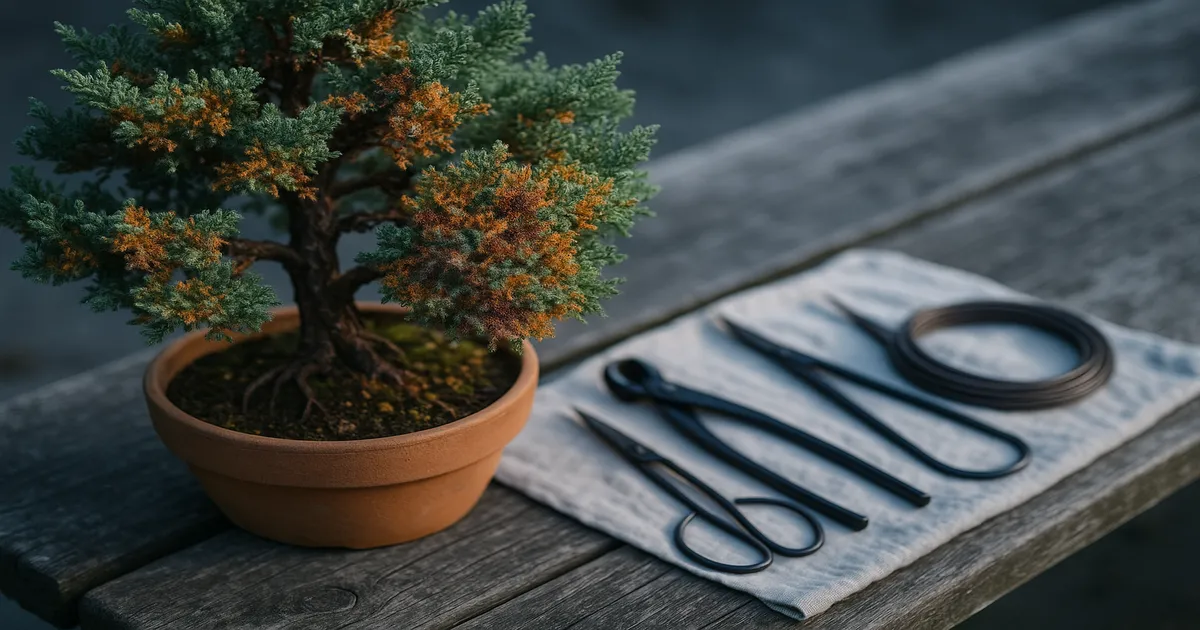
Quick Answer: The most common fungal problems on junipers are cedar-apple rust (bright orange jelly-like growths on branches), Phomopsis tip blight (brown dying shoot tips), and Phytophthora root rot (mushy roots, white mold on soil). Most are treatable if caught early — the key is matching your symptoms to the right disease and acting fast.
If you’re staring at your juniper right now asking “what is this fungus on my juniper?”, you’re in the right place. Junipers are tough, long-lived trees, but their dense foliage and outdoor lifestyle make them surprisingly vulnerable to a handful of fungal diseases. This guide walks you through identification, treatment, and how to stop it coming back.
What Is This Fungus? Identifying Common Juniper Diseases at a Glance
How to Use This Diagnostic Guide
Start with the symptom table below. Match what you’re seeing to the most likely disease, then jump to the detailed section for confirmation and treatment. If you’re seeing multiple symptoms at once, check for root rot first — it’s the most dangerous and the easiest to miss until it’s too late.
Visual Symptom Checklist
| What You See | Where on the Tree | Likely Disease |
|---|---|---|
| Orange, gelatinous, tentacle-like growths | Branches, woody galls | Cedar-Apple Rust |
| Brown, dying shoot tips; black dots on dead tissue | New growth tips | Phomopsis Tip Blight |
| Brown tip dieback, older wood affected | Base of shoots, older stems | Kabatina Tip Blight |
| Mushy roots, white mold on soil surface | Root zone, soil | Phytophthora Root Rot |
| Fuzzy grey coating on foliage | Foliage, stems | Botrytis (Grey Mould) |
| Black sooty coating on leaves | Foliage surface | Sooty Mould (pest-linked) |
Early identification is everything. Most of these diseases are manageable with the right response — but delay turns a pruning problem into a dead tree.
Species Background and Disease Susceptibility
Common Bonsai Varieties
Juniperus contains roughly 50–70 species in the family Cupressaceae. Foliage comes in two forms: awl-shaped (sharp, needle-like) in juvenile growth and scale-like in adult growth. Many bonsai specimens carry both simultaneously.
| Species | Common Name | Disease Notes |
|---|---|---|
| J. chinensis ‘Shimpaku’ | Shimpaku Juniper | Dense pads trap moisture; moderate rust risk |
| J. procumbens ‘Nana’ | Dwarf Japanese Garden Juniper | Prostrate habit; good airflow if positioned well |
| J. rigida | Needle Juniper | Open structure; lower mould risk |
| J. californica | California Juniper | Drought-adapted; vulnerable if overwatered |
| J. chinensis | Chinese Juniper | Most popular bonsai species; susceptible to Phomopsis |
| J. virginiana | Eastern Red Cedar | Primary cedar-apple rust host |
Why Junipers Are Prone to Fungal Problems
Dense foliage pads are beautiful, but they create a microclimate — humid, poorly ventilated air trapped close to the branches. Add evening watering or a shaded position, and you’ve created ideal conditions for fungal spores to germinate.
Junipers need 6–10 hours of direct sun daily. Moving one indoors — even temporarily — is one of the fastest ways to trigger fungal disease. Low light weakens the tree, slows transpiration, and keeps foliage damp far longer than it should be.
Fungus on Juniper: Detailed Identification and Treatment
Cedar-Apple Rust (Gymnosporangium spp.): Orange Jelly Growths
This one stops people in their tracks. In wet spring weather, round woody galls (1–2 inches across) on juniper branches erupt with bright orange, gelatinous tentacles — the telial horns that release spores. The galls themselves are brown and inconspicuous for most of the year; the orange display lasts only a few days to a few weeks but is unmistakable.
Cedar-apple rust requires two hosts to complete its life cycle: junipers and members of the Rosaceae family (apples, crabapples, hawthorns). It cannot spread from juniper to juniper directly. Juniperus virginiana is the primary bonsai host, though J. scopulorum is also affected. Heavy gall loads weaken branches and cause dieback over time.
Treatment: Apply myclobutanil (Spectracide Immunox Multi-Purpose Fungicide) or propiconazole preventively in spring, starting when temperatures are consistently above 50°F (10°C). Repeat every 7–14 days through the infection window. Remove galls before the orange horns appear — once spores are releasing, the damage is already happening. Cut back to healthy wood and bag all removed material.
Phomopsis Tip Blight (Phomopsis juniperovora): Brown, Dying Shoot Tips
Phomopsis is one of the most common juniper diseases in humid climates. New shoot tips turn light green, then yellow, then brown — the dieback progressing back down the shoot. Look closely at the dead tissue with a hand lens and you’ll see tiny black dots: the pycnidia (spore-producing bodies) that distinguish Phomopsis from simple drought stress.
It spreads most aggressively in cool, wet spring weather when new growth is most vulnerable. Juniperus chinensis varieties are frequently affected. The disease overwinters in infected tissue, so leaving dead shoots on the tree is essentially leaving an infection reservoir in place.
Treatment: Apply mancozeb at bud swell and repeat every 10–14 days through wet spring weather. Propiconazole is also effective for systemic protection. Remove all infected material with sterilised tools.
Kabatina Tip Blight: Similar Symptoms, Different Cause
Kabatina (Kabatina juniperi) produces almost identical browning at shoot tips, which causes a lot of confusion. The key difference: Kabatina infects through wounds and affects older growth at the base of the previous year’s shoots, whereas Phomopsis targets the current season’s new tips. Kabatina’s pycnidia appear earlier in the season — late winter to early spring. Treatment is similar for both, but timing matters.
Phytophthora Root Rot: When the Problem Starts Underground
Phytophthora is technically a water mould (oomycete) rather than a true fungus, but it behaves like one and is treated similarly. The first above-ground sign is often sudden, dramatic foliage browning — by which point root damage is already severe.
Dig down and check the roots. Healthy juniper roots are white to tan and firm. Phytophthora-infected roots are brown, black, and mushy, and may smell foul. You may also notice white mold on the soil surface. The cause is almost always poorly draining soil combined with overwatering. Once the majority of the root system is gone, recovery is very difficult.
Treatment: Phosphonate-based fungicides (fosetyl-aluminium) can protect remaining healthy roots but won’t reverse existing damage. Repot immediately into fresh, fast-draining bonsai mix — akadama 40%, pumice 30%, lava rock 30% . Drainage improvement is non-negotiable.
Botrytis (Grey Mould): Fuzzy Grey Coating on Foliage
Botrytis cinerea produces a fuzzy grey-brown spore mass on affected foliage and stems, usually during cool, damp, low-light conditions. It’s an opportunistic pathogen — it colonises stressed, wounded, or already-dying tissue. If you’re seeing grey fuzz on your juniper, it’s often a secondary infection following physical damage, frost, or prolonged shade.
Treatment: Improve airflow and light immediately. Remove and destroy affected material. Copper-based fungicides work well as a preventive and early treatment. Botrytis spores are airborne and spread quickly in a crowded collection, so act fast.
Sooty Mould: Black Coating Linked to Pest Activity
Sooty mould is a black, powdery or crusty coating that grows on honeydew secreted by sap-sucking insects — aphids, scale, and spider mites are the usual culprits. The mould itself doesn’t infect the plant, but it blocks light and signals an underlying pest problem. Treat the pest infestation first; the sooty mould will diminish once the honeydew source is gone. Neem oil applied in the evening is effective against both the pests and residual mould. Don’t apply above 90°F (32°C) or you risk leaf burn.
Prevention: Conditions That Resist Fungal Disease
Light, Watering, and Soil
Strong light is your best non-chemical tool. Six hours of direct sun is the minimum; 8–10 hours is ideal. It keeps foliage dry, strengthens the tree’s immune response, and drives vigorous growth that outpaces minor infections.
Never water on a fixed schedule. Use the chopstick test — push a chopstick 1–2 inches into the soil and water when it comes out barely damp to dry. Water thoroughly in the morning so foliage and soil surface dry out during the day. Never mist foliage in the evening — wet foliage overnight is a direct invitation to Botrytis and other moulds.
The standard juniper bonsai mix is akadama 40–50%, pumice 25–30%, lava rock 20–30%. In humid climates or if you tend to overwater, shift to akadama 30%, pumice 40%, lava rock 30% to increase drainage. Use 3–6mm particle size. Avoid standard potting compost entirely — it compacts, stays wet, and is the primary reason so many junipers die from root rot in their first year.
Air Circulation and Seasonal Hygiene
Position your juniper where air moves freely around it — not tucked against a wall or surrounded by pots on all sides. When you prune, open up dense foliage pads to let light and air penetrate. This single habit does more to prevent fungal disease than most sprays.
| Season | Action |
|---|---|
| Late winter | Inspect for rust galls; remove before orange horns appear |
| Early spring (bud swell) | Apply mancozeb or copper spray if tip blight has been a problem |
| Spring (wet weather) | Repeat fungicide every 10–14 days; avoid evening watering |
| Summer | Monitor for sooty mould and pests; neem oil if needed |
| Autumn | Remove dead foliage and debris from pot surface |
| Winter | Ensure good drainage; protect roots from freezing; no misting |
Repotting, Pruning, and Wiring Essentials
Repotting
Young trees need repotting every 1–2 years; mature trees every 3–5 years. Repot in early spring as buds begin to swell but before new growth pushes. Remove no more than one-third of the root mass. Cut roots cleanly — torn roots invite disease. After repotting, keep the tree in sheltered shade for 2–4 weeks and hold off fertilising for 4–6 weeks.
Pruning for Airflow
For scale-foliage varieties, pinch extending shoot tips back to 2–3 pairs of scales using your fingertips or sharp scissors. Never strip or pull foliage — it damages the branch and causes dieback. For needle-foliage varieties like J. rigida, cut extending shoots back while always leaving some foliage on each branch. Junipers will not bud back from bare wood.
Do major structural work in late winter to early spring, just before growth begins, or in late autumn after the season’s growth has hardened off. Never remove more than one-third of the foliage mass in a single session.
Wiring
Wire diameter should be approximately one-third the diameter of the branch. Aluminium wire is more forgiving for beginners; copper holds position with less wire mass and suits more advanced work. Apply wire at a 45-degree angle to the branch. Check every 2–3 weeks during the growing season — juniper branches thicken fast and wire bites in quickly. When removing wire, always cut it off in segments rather than unwinding; unwinding a set branch can snap it.
Frequently Asked Questions
Can I use household fungicide spray on my juniper bonsai? Most general-purpose household fungicides are not labelled for bonsai use and may contain concentrations that damage foliage. Use products specifically labelled for ornamental trees or junipers, and always follow the dilution rates on the label.
My juniper has orange growths — is it dying? Not necessarily. Cedar-apple rust galls are alarming but rarely fatal if caught early. Remove the galls before the orange horns appear, apply a labelled fungicide, and the tree can recover fully. A tree with only a few galls and healthy foliage elsewhere is not in immediate danger.
How do I tell the difference between fungal damage and drought stress? Drought stress causes uniform browning across the canopy, starting at the tips, and the soil will be bone dry. Fungal tip blight causes patchy browning on specific shoots, often with visible black dots (pycnidia) on the dead tissue. Root rot causes sudden, dramatic browning even when the soil is moist — that combination is a strong indicator.
Can I save a juniper with root rot? It depends on how much healthy root remains. If you find some firm white roots when you unpot the tree, there’s a chance. Repot immediately into fast-draining mix, remove all mushy roots cleanly, treat with a phosphonate fungicide, and place the tree in bright, sheltered conditions. If every root is black and mushy and the foliage is uniformly brown, recovery is extremely unlikely.
How often should I apply preventive fungicide? For tip blight prevention during wet spring weather, apply every 10–14 days from bud swell until conditions dry out. For rust prevention, apply every 7–14 days during the infection window (roughly when temperatures are consistently above 50°F / 10°C in spring). Outside of these windows, good cultural practice — full sun, morning watering, open foliage — is more valuable than routine spraying.