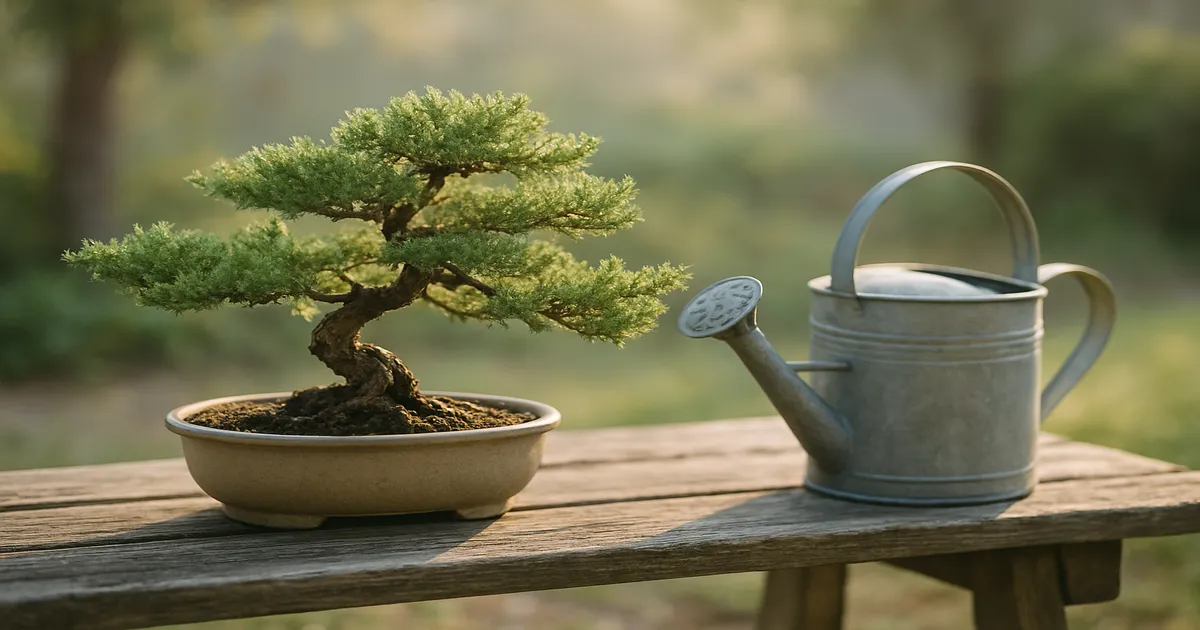
Quick Answer: Water your juniper bonsai thoroughly until water flows freely from every drainage hole, then wait until the soil is nearly — but not completely — dry before watering again. Junipers hate waterlogged roots; they need both moisture and oxygen at the root zone. In summer that may mean watering daily; in winter dormancy, once every 7–14 days is enough.
Getting the watering right is the single biggest factor in keeping a juniper bonsai alive. This juniper bonsai watering guide covers technique, seasonal frequency, soil choice, and how to diagnose overwatering versus underwatering — so you can stop guessing and start reading your tree.
Juniper Bonsai Watering: The Core Rule
Water thoroughly, then let the soil approach — but never reach — complete dryness before watering again. Every other piece of advice below supports that one principle.
Junipers evolved in rocky, well-drained soils with full sun and good airflow. Their roots need oxygen just as much as moisture, which means soggy soil is more dangerous than a brief dry spell. They are not houseplants. Keeping a juniper on a windowsill disrupts its transpiration cycle and almost always leads to decline. Short indoor display periods of two to three days are fine; permanent indoor placement is not.
No fixed schedule works for everyone. Season, pot size, soil mix, and local climate all override the calendar. The most reliable cue is pot weight: lift the pot right after watering, then lift it again when dry. That difference in weight becomes your best guide.
Seasonal Frequency at a Glance
| Season / Condition | Approximate Frequency |
|---|---|
| Summer, hot climate, small pot | 1–2 times daily |
| Summer, temperate climate, medium pot | Once daily or every other day |
| Spring / Autumn, moderate temperatures | Every 2–3 days |
| Overcast or cool periods | Reduce by 30–50% |
| Winter dormancy (cold storage) | Every 7–14 days |
Popular Juniper Varieties and Their Watering Needs
The genus Juniperus contains 50–70 species distributed across the Northern Hemisphere, from sea level to alpine elevations above 16,000 ft (4,877 m). For bonsai, a handful of varieties dominate:
| Variety | Notes |
|---|---|
| Shimpaku (J. chinensis ‘Shimpaku’) | Most prized in Japanese bonsai; fine scale foliage; slightly moisture-sensitive |
| Itoigawa (J. chinensis ‘Itoigawa’) | Ultra-fine foliage; slower growing; needs consistent moisture |
| Procumbens Nana (J. procumbens ‘Nana’) | Forgiving beginner variety; tolerates minor watering errors |
| Kishu (J. chinensis ‘Kishu’) | Very compact; fine foliage; increasingly popular in the West |
| Chinese Juniper (J. chinensis) | Vigorous and widely available; excellent for beginners |
Most varieties share the same fundamental watering approach. Itoigawa and Shimpaku are slightly more sensitive to drought stress during active growth, so they reward daily monitoring in summer.
How Native Habitat Shapes Watering Needs
In the wild, junipers grow in rocky, nutrient-poor soils that drain almost instantly after rain. Roots spread wide to capture surface moisture, then dry out quickly between rain events. Replicating that cycle — thorough saturation followed by a drying period — is exactly what we’re aiming for in a bonsai pot.
Soil Mix: The Foundation of Good Watering
You cannot water a juniper correctly if it’s sitting in the wrong soil. Standard potting compost retains too much moisture, creates anaerobic conditions, and makes root rot almost inevitable. The substrate you choose determines how fast the soil dries — and therefore how often you need to water.
Recommended Mixes
| Component | Beginner Mix | Intermediate/Advanced Mix | Purpose |
|---|---|---|---|
| Akadama | 50% | 33% | Water and nutrient retention; breaks down gradually |
| Pumice | 25% | 33% | Drainage, aeration, root anchoring |
| Lava Rock | 25% | 33% | Long-term structural drainage and aeration |
A quality akadama is worth sourcing properly — cheap substitutes often break down too quickly and compact into a water-retaining sludge. The beginner mix (2:1:1) holds a little more moisture, which is forgiving if you occasionally miss a watering. The equal-thirds mix drains faster, which means more frequent watering but significantly healthier roots long-term.
If your soil dries out too quickly — common in very hot, dry climates — adding 10–15% fine pine bark to either mix buffers moisture without sacrificing drainage.
- Particle size: 3–5 mm for standard bonsai; 2–3 mm for mame and shohin trees
- pH target: 5.5–6.5 (slightly acidic); outside this range, nutrient uptake suffers
- Avoid: Any soil that clumps, compacts, or stays wet for more than 2–3 days after watering
How to Water a Juniper Bonsai Correctly
Step-by-Step Technique
- Use a watering can with a fine rose head or a hose fitted with a gentle breaker nozzle. A hard jet disturbs soil and exposes roots.
- Water slowly and evenly across the entire soil surface — don’t just wet one spot.
- Continue until water flows freely from all drainage holes, not just one.
- Wait 30–60 seconds, then do a second pass. This ensures the full soil volume is saturated and flushes accumulated fertilizer salts.
That second pass matters more than most beginners realise. Light surface watering that never reaches the lower root zone is one of the most common — and most damaging — mistakes in bonsai care.
The Finger and Chopstick Moisture Test
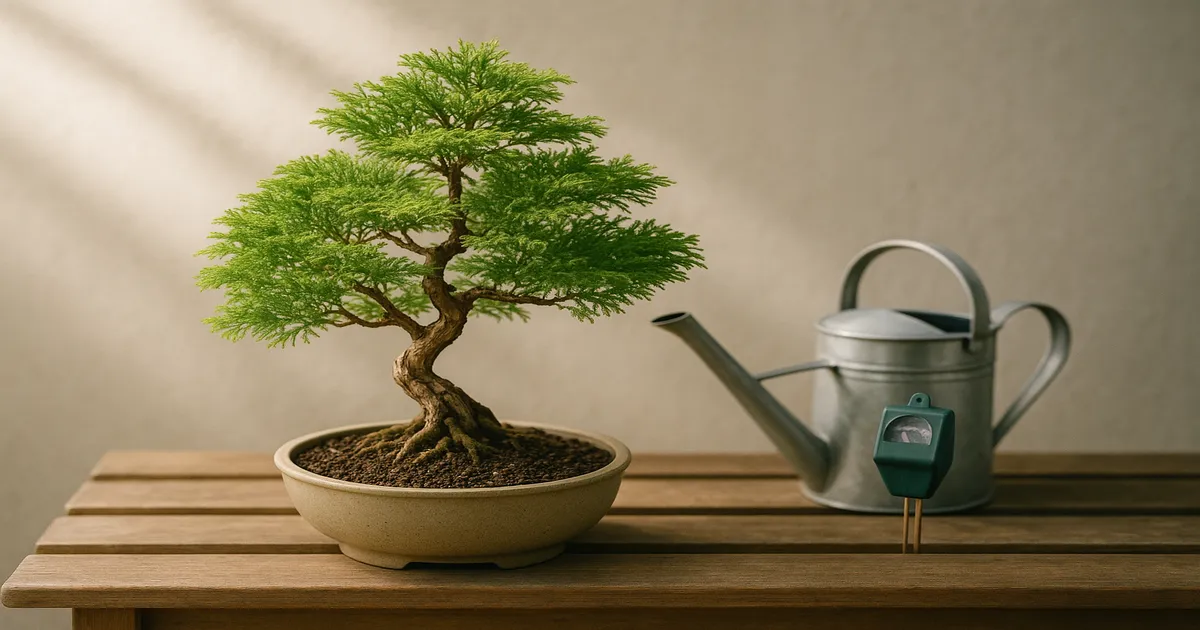
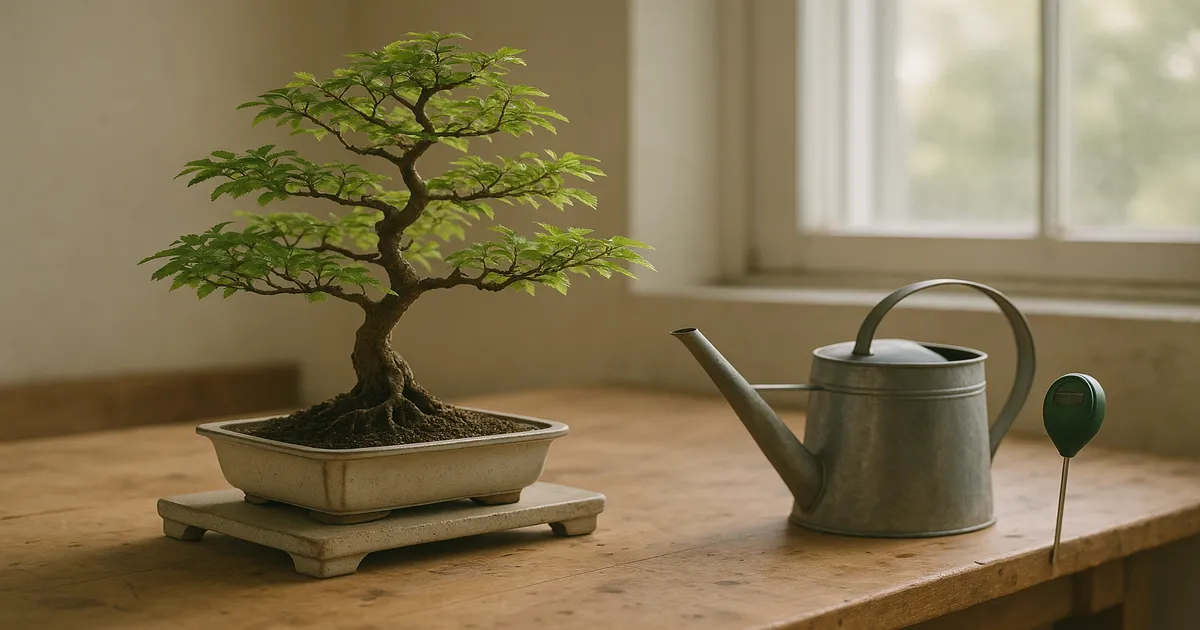
Push your finger or a wooden chopstick about 1 inch (2.5 cm) into the soil. If it comes out damp, wait. If it comes out dry or barely moist, water thoroughly. Moisture meters can be useful training aids, but they give misleading readings in coarse inorganic substrates — always cross-reference with a finger check.
Water Quality and pH
- Best: Collected rainwater — naturally slightly acidic (pH 6.0–6.5) and free of additives.
- Acceptable: Municipal tap water left to sit 24 hours to off-gas chlorine.
- Problematic: Alkaline water above pH 7.5 used consistently causes chlorosis and nutrient lockout. A small amount of white vinegar or citric acid brings the pH down.
Hard water leaves white mineral deposits on foliage and soil. Flushing periodically with rainwater prevents buildup.
Humidity Trays and Misting
A humidity tray — a shallow tray filled with water and pebbles, with the pot sitting above the waterline — raises local humidity and genuinely helps in dry climates. Just make sure the pot isn’t sitting in the water itself. Misting is supplemental, not a substitute for watering. If you mist, do it in the morning so foliage dries before evening; evening misting promotes fungal disease.
Juniper Bonsai Watering Guide by Season
Spring: Ramping Up as Growth Emerges
Water demand increases steadily as temperatures climb and buds begin to break. New growth is particularly vulnerable to drought stress — a dry spell during the first flush can set the tree back significantly. Start checking soil moisture daily as soon as you see buds swelling.
Summer: Peak Demand and Heat Management
Small pots in hot climates may need water twice a day. Check morning and evening when temperatures consistently exceed 95°F (35°C). If afternoon heat is extreme, moving the tree to a spot with morning sun and afternoon shade reduces transpiration demand without compromising overall light — but the tree still needs at least six hours of direct sun daily.
Autumn: Hardening Off Before Dormancy
As days shorten and temperatures drop, gradually reduce watering frequency. Letting the soil dry slightly more between waterings helps harden off new growth before winter — soft, lush growth going into a freeze is far more vulnerable to cold damage. Ease into it over four to six weeks rather than cutting back water abruptly.
Winter Dormancy: Minimal but Essential
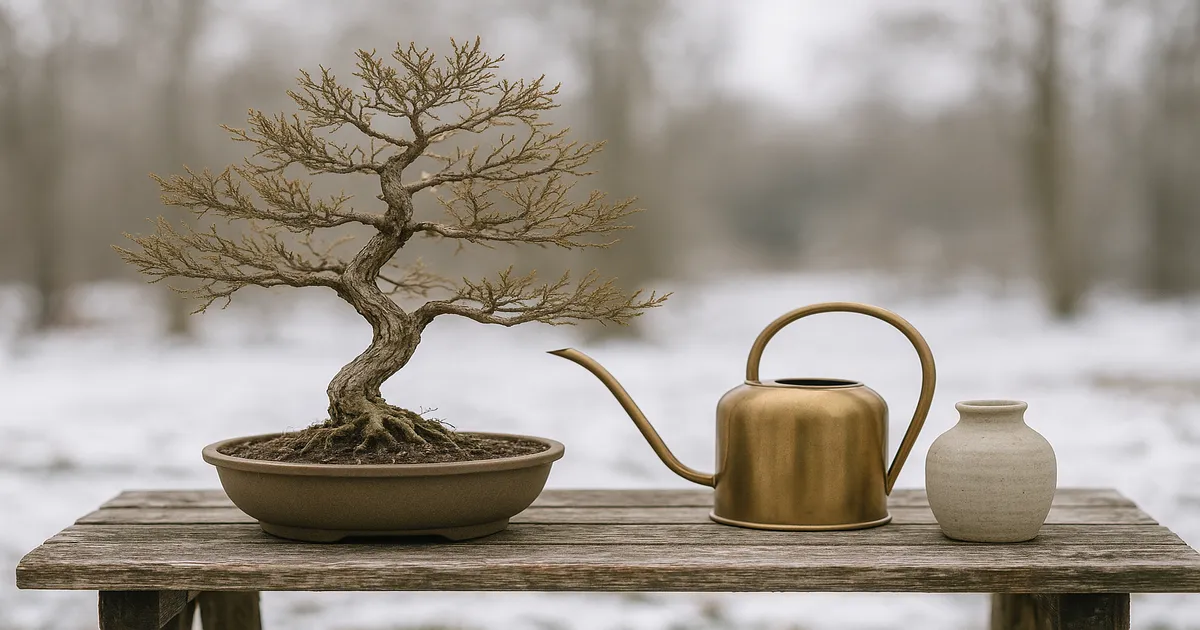
Dormant roots are largely inactive, but the tree still needs occasional moisture to prevent complete desiccation. Water every 7–14 days, choosing days when temperatures are above 40°F (4°C) so moisture can be absorbed before the soil freezes. A juniper that dries out completely during dormancy will not recover in spring.
Diagnosing Watering Problems
Overwatering vs. Underwatering: Symptom Comparison
| Symptom | Overwatering | Underwatering |
|---|---|---|
| Foliage color | Yellow-green to brown | Green to brown (rapid) |
| Foliage texture | Soft, slightly mushy | Dry, crispy, brittle |
| Browning pattern | Tips inward; patchy | Uniform across tree |
| Soil condition | Persistently wet | Bone dry, shrinking from edges |
| Root condition | Soft, dark, malodorous | Dry, brittle, light-colored |
| Recovery speed | Slow (weeks to months) | Faster if caught early |
How to Rescue an Overwatered or Underwatered Juniper
Underwatered: Submerge the entire pot in a bucket of water for 20–30 minutes. This rehydrates compacted soil that surface watering can no longer penetrate. Move the tree to light shade while it recovers.
Overwatered: Remove the tree from its pot and inspect the roots. Trim any soft, dark, or malodorous roots back to healthy tissue using clean bonsai scissors . Repot into fresh, fast-draining mix, reduce watering frequency, and keep the tree out of intense midday sun for two to four weeks. Recovery is slow — don’t overcompensate by watering heavily again.
Watering After Repotting and in Winter Storage
Repotting disrupts the balance between root mass and foliage. Until new roots establish, the tree can’t take up water efficiently. Use thorough technique, but check moisture more frequently rather than following a fixed schedule. Keep the tree sheltered from direct midday sun for three to four weeks, and hold off on fertilising until you see new growth — that’s your confirmation the root system is recovering.
In winter storage, trees in a cold frame or unheated greenhouse are shielded from drying winds and need less frequent watering than fully exposed trees. The key risk in any winter setup is desiccation from cold, dry wind — foliage keeps transpiring even when roots are frozen.
Pot material also affects drying speed. Unglazed terracotta dries faster than glazed ceramic or plastic. Shallow pots dry faster than deep ones. Small mame and shohin pots can go from saturated to bone dry in hours on a hot day. None of this changes the fundamental technique — it just changes how often you apply it.
Frequently Asked Questions
How often should I water my juniper bonsai?
It depends on season, climate, pot size, and soil mix. As a rough guide: daily or twice daily in summer heat, every 2–3 days in spring and autumn, and every 7–14 days during winter dormancy. Always use the finger test rather than a fixed schedule.
Why are my juniper bonsai’s tips turning brown after watering?
This usually points to overwatering (if browning is gradual and soil stays wet) or alkaline tap water causing mineral buildup or chlorosis. Check how long your soil takes to dry — if it’s still wet after two to three days, improve drainage. If the soil cycle looks healthy, try switching to rainwater or pH-adjusted water.
Can I use tap water for my juniper bonsai?
Yes, in most cases. Let it sit in an open container for 24 hours to off-gas chlorine. If your tap water is alkaline (above pH 7.5), long-term use can cause yellowing foliage and nutrient lockout. Test pH occasionally and add a small amount of white vinegar or citric acid to bring it into the 6.0–6.5 range if needed.
How do I water a juniper bonsai in winter?
Water sparingly — roughly every 7–14 days — just enough to prevent the soil drying out completely. Water on days above 40°F (4°C) so moisture can be absorbed before the soil freezes. Don’t fertilise during dormancy, and don’t let the tree sit in standing water.
How do I tell overwatering from underwatering?
Check soil, foliage texture, and browning pattern. Overwatered junipers show slow, patchy browning starting at the tips and progressing inward, with persistently wet soil and possibly soft roots. Underwatered junipers brown rapidly and uniformly across the whole tree, with dry, brittle foliage and soil that has pulled away from the pot edges. When in doubt, lift the pot — very light means dry; heavy means moisture remains.