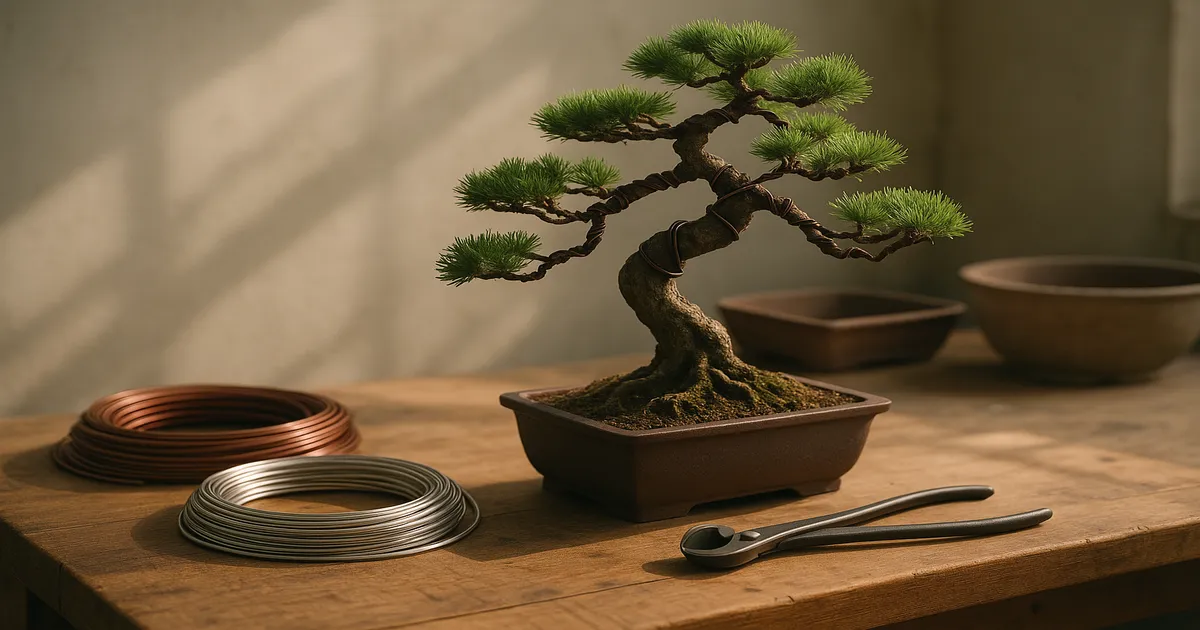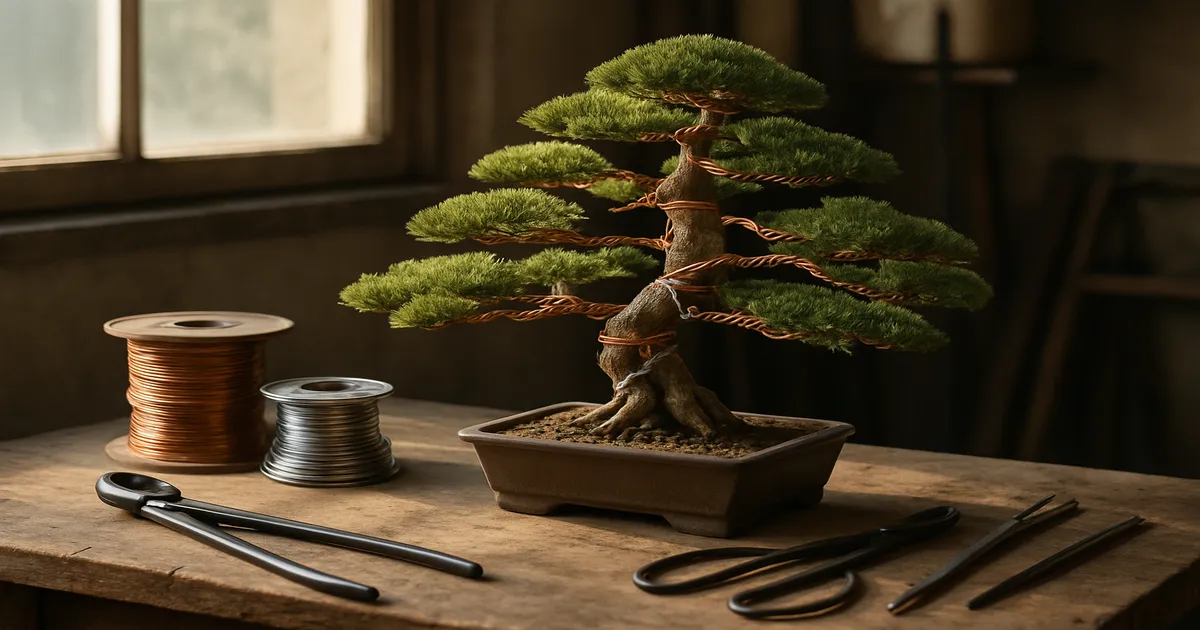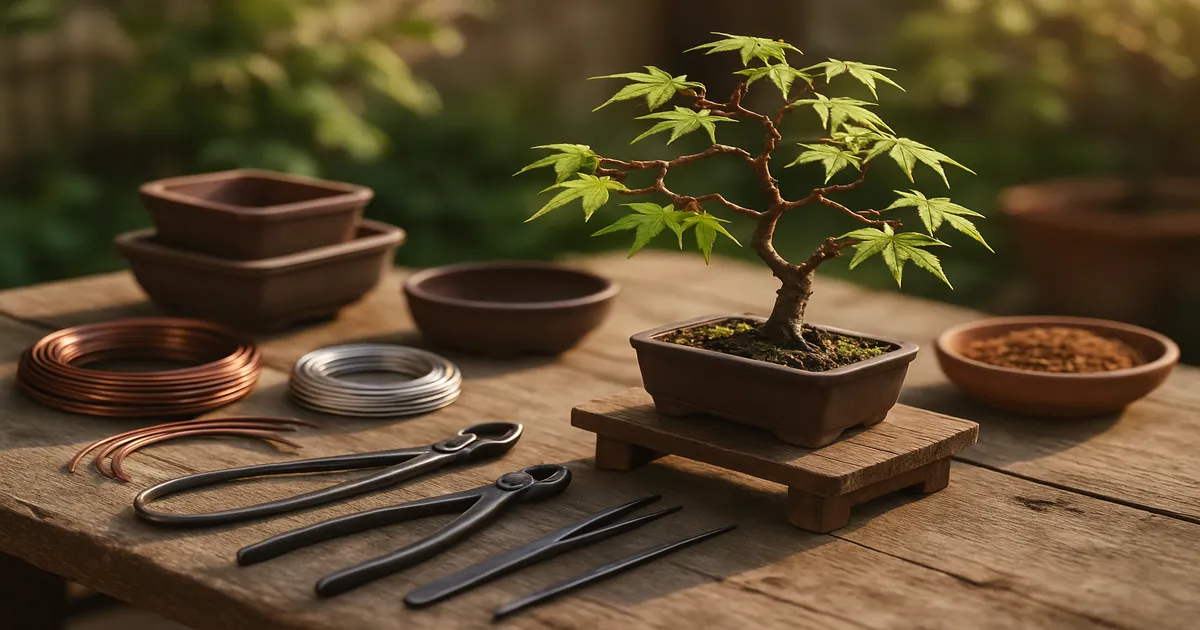
Quick Answer: Bonsai training wire works by holding a branch in a new position while the tree’s own cellular growth (lignification) locks in that angle — the wire is the scaffold, not the sculptor. Choose wire roughly 1/3 the branch diameter, anchor it before wrapping, spiral it at 45 degrees, and remove it before it bites into the bark — typically after one growing season. Juniper and Chinese Elm are the most forgiving species to start with.
Learning how to use bonsai training wire is the single skill that separates a styled bonsai from a trimmed shrub. Wire lets you place branches exactly where you want them, creating movement, depth, and that unmistakable sense of age. It looks intimidating at first, but the fundamentals are straightforward once you understand what the wire is actually doing.
The Science Behind Bonsai Training Wire
When you bend a branch and hold it in a new position, the tree doesn’t know it’s been moved. It just keeps growing — and new wood cells form along the branch walls in response to gravity and tension. Over time, those cells reinforce the bent angle. That process is lignification, and it’s what makes the position permanent.
The wire itself does nothing except hold the branch still long enough for the tree to do the real work. Once the wood has set, the wire has served its purpose and needs to come off.
How long does wire need to stay on?
- Young, flexible branches: One full growing season is usually enough
- Thick or mature wood: May need multiple seasons, or repeated wiring after the first wire is removed
- General rule: Check regularly and remove the moment the position has set — never leave wire on “just in case”
Species That Respond Best to Wiring
| Species | Wiring Responsiveness | Difficulty |
|---|---|---|
| Juniper | Excellent | Beginner-friendly |
| Chinese Elm | Very good | Beginner-friendly |
| Japanese Maple | Good | Intermediate |
| Japanese Black Pine | Excellent | Advanced |
Aluminum vs. Copper Bonsai Wire
Holding Power and Handling
Aluminum wire is soft, pre-annealed, and easy to work with bare hands — the right choice for most beginners and for deciduous species. Copper wire is roughly 2–3× stiffer, which means it holds heavier branches and structural bends that aluminum can’t manage. The tradeoff is that copper is less forgiving: bend it back and forth repeatedly and it work-hardens, becoming brittle and prone to snapping. Plan your positioning before you apply copper wire. Unlike aluminum, you don’t get many chances to adjust.
- Aluminum: Japanese Maple, Chinese Elm, most deciduous trees, fine branch work on any species
- Copper: Juniper, Japanese Black Pine, thick structural branches, any branch requiring maximum holding power
Annealing Copper Wire
New copper wire from a bonsai supplier is usually pre-annealed and ready to use. If you’re working with raw copper wire, heat it to a dull red with a torch and let it cool slowly in air — this softens the metal and makes it workable. Don’t quench it in water; air-cooling is what produces the soft, pliable result you need. Good pre-annealed copper wire makes a real difference here.
Recommended Wire Gauges
The core rule: wire gauge should be approximately 1/3 the branch diameter. When in doubt, go one size thicker — undersized wire just spins and holds nothing.
| Branch Diameter | Recommended Gauge |
|---|---|
| Under 2mm (very fine twigs) | 1.0mm aluminum |
| 2–4mm (fine branches) | 1.5mm aluminum |
| 4–7mm (medium branches) | 2.0–2.5mm aluminum or 1.5mm copper |
| 7–12mm (thick branches) | 3.0mm aluminum or 2.0mm copper |
| 12mm+ (heavy structural) | 4.0–6.0mm aluminum or 3.0–4.0mm copper |
| Trunk bending | 6.0mm+ aluminum or 4.0mm+ copper; often supplemented with guy wires |
When to Apply Bonsai Training Wire
Wiring during rapid growth is one of the most common beginner mistakes. Branches expand quickly when actively growing, which means wire bites into bark faster — sometimes within weeks.
Japanese Maple: Wire in late winter or early spring before bud break, or after leaf drop in fall. The bare branch structure is fully visible, and the slightly dormant wood is more cooperative. Avoid wiring in summer — heat stress combined with wire pressure is hard on these trees.
Juniper: The most forgiving species for timing. You can wire it any time of year, but late summer through fall is optimal — growth has slowed, branches aren’t in active extension, and the wire gets a full dormant season to set the position.
Chinese Elm: Can be wired almost any time, but its rapid growth demands vigilance. In summer, wire can bite in within two to three weeks on actively growing shoots. Stick to late winter or fall for heavier structural wiring, and check weekly during the growing season.
Japanese Black Pine: Has a narrow, non-negotiable wiring window — after needle hardening in late summer, typically August through September. Never wire during spring candle extension; branches are fragile, sap flow is high, and damage is likely. This precision is part of what makes Black Pine an advanced subject.
How to Apply Bonsai Training Wire: Step by Step
Prepare Before You Cut
Visualize the final position before cutting a single piece of wire. Then cut your wire to approximately 1.5× the length of the branch — this accounts for the diagonal spiral. Keep your wire cutters close throughout the process. A dedicated pair of bonsai wire cutters makes clean cuts without levering against the branch.
The Double-Branch Method (Preferred)
Whenever two branches of similar diameter grow from the same node or adjacent nodes, wire them together with one piece of wire.
- Cut one piece of wire long enough to cover both branches simultaneously
- Find the midpoint and position it at the trunk between the two branches
- Wrap the wire 1–2 times around the trunk to create a secure anchor
- Work outward along both branches at the same time, maintaining the 45-degree spiral
- The trunk wrap provides superior anchoring compared to any single-branch method
The Single-Branch Method
Use this when a branch has no suitable partner. Anchor by wrapping the wire 2 full turns around the trunk at the base of the target branch, then proceed outward. Without those two anchor turns, the wire will rotate under pressure and hold nothing.
Angle, Direction, and Spiral Spacing
The 45-degree angle is the sweet spot. Too steep and the wire provides almost no holding power. Too shallow and you risk crushing the bark. Space your spirals so they’re not touching — each loop needs a small gap to allow for branch thickening.
Wrap in the direction the branch will bend: if you’re bending a branch downward and to the right, wrap clockwise. This ensures the wire tightens slightly as you apply pressure rather than loosening.
Bending the Branch
- Do: Support the branch with both thumbs positioned close together on the outside of the bend; apply slow, even pressure from the base outward
- Do: Move incrementally — you can always bend further in a later session
- Don’t: Bend from the tip inward; this concentrates stress at one point and snaps branches
- Don’t: Force a bend if you hear cracking — stop and assess immediately
- Don’t: Try to reach the full desired position in a single session with stiff or mature wood
Preventing and Dealing With Wire Bite
Wire bite — wire cutting into bark as the branch thickens — is the most damaging wiring mistake. It can leave permanent spiral scarring that takes years to fade, if it fades at all.
How Often to Check
- Active growing season: Every 2–4 weeks minimum
- Chinese Elm in summer: Weekly — fast enough to cause wire bite within weeks
- Slower periods (fall/winter): Monthly checks are usually sufficient
Signs Wire Is Biting
- Wire appears to be sinking below the bark surface
- Bark bulging or swelling on either side of the wire coils
- The wire feels tight when you try to slide a fingernail under it
If you see any of these signs, remove the wire immediately.
How to Remove Wire Safely
Always cut wire in multiple places with wire cutters rather than unwinding it. Unwinding puts rotational stress on the branch and risks snapping it, especially if the wood has set around the wire. Cut every few coils, peel the sections away gently, and discard.
If wire bite has already occurred, remove the wire immediately and focus on keeping the tree in optimal health — good light, consistent watering, and balanced fertilization. The faster the tree grows, the faster it heals. Severe wire bite on a primary branch may leave a permanent scar, which is why prevention matters so much.
Species-Specific Tips
Japanese Maple: Young growth is flexible and takes wire well. Older branches can snap with surprisingly little force. For any branch thicker than about 8mm, wrap it with raffia first to protect the bark and distribute pressure. Raffia also helps when bending branches on any species that has thin or sensitive bark. The most common mistake with Maple is wiring in summer — stick to the late winter window.
Juniper: Branches stay flexible for extended periods, giving you time to adjust your work. This forgiveness makes it the ideal species for practicing wiring fundamentals. Copper wire is preferred for significant structural bending — aluminum may not hold heavy repositioning long enough for the position to set. Don’t rush Juniper bends; a branch moved 60% of the way to its target and held for a season is far better than one forced to the target and snapped.
Chinese Elm: Excellent for learning because it responds quickly and clearly to wiring. The downside is that same fast growth — it’s unforgiving of neglect. Use aluminum wire, check every week during summer, and don’t leave wire on longer than necessary.
Japanese Black Pine: Wiring goes beyond branch positioning — experienced growers wire individual needle units to fan them outward and create flat, pad-like branch structure. This is a distinct advanced skill. Start with branch positioning and work toward needle-unit wiring only once you’re comfortable with the basics. Always wire after needle hardening in late summer — this is not optional.
Integrating Wire With Pruning and Styling
Prune First, Then Wire
Wire only the branches you intend to keep. Structural pruning should always come first — remove crossing branches, bar branches (two branches at the same height on opposite sides), and any branch growing directly toward the viewer. Once those decisions are made, wiring becomes a much cleaner process. A sharp concave cutter makes flush cuts that heal cleanly and don’t interfere with your wiring plan.
Classic branch placement: first branch at roughly 1/3 the trunk height, extending left or right; second branch on the opposite side, slightly higher; third branch rear-facing to create depth.
Wire for Movement, Not Just Angle
The most common beginner error is wiring branches straight down — technically correct, aesthetically lifeless. Natural trees grow in gentle S-curves, responding to light, wind, and competition. Wire your branches in gentle curves. A slight upward sweep at the tip conveys life and energy that a flat downward angle never will.
Guy Wires for Heavy Bends
Standard wrap wire can only do so much. For heavy structural bends — repositioning a major branch or adding movement to a trunk — a guy wire anchored to the pot or a stake provides sustained directional force that wrap wire can’t deliver alone. Use a small pad of rubber or cloth where the guy wire contacts the bark to prevent cutting.
Frequently Asked Questions
How long do you leave wire on a bonsai tree?
One full growing season is the general guideline. Young branches on fast-growing species like Chinese Elm may set in as little as 8–12 weeks. Thick or mature branches may need rewiring for multiple seasons. Check every 2–4 weeks during active growth and remove the wire as soon as the branch holds its new position on its own.
What thickness of wire should I use for bonsai?
Choose wire approximately 1/3 the diameter of the branch. For very fine twigs under 2mm, use 1.0mm wire. For medium branches of 4–7mm, use 2.0–2.5mm aluminum or 1.5mm copper. When choosing between two gauges, go with the thicker one — undersized wire won’t hold the branch in position.
Can you wire a bonsai tree at any time of year?
It depends on the species. Juniper can be wired year-round, though late summer is optimal. Japanese Maple and Chinese Elm are best wired in late winter before bud break, or after leaf drop in fall. Japanese Black Pine has a strict window of late summer after needle hardening. Wiring during rapid spring growth on any species risks fast wire bite.
What happens if you leave bonsai wire on too long?
The wire cuts into the bark as the branch thickens — a problem called wire bite. This leaves spiral scars that can take years to fade and may be permanent on some species. In severe cases, wire bite can girdle a branch and kill it. Always remove wire as soon as the branch holds its new position, and check wired trees every 2–4 weeks during the growing season.
Is aluminum or copper wire better for bonsai beginners?
Aluminum wire is better for beginners. It’s softer, easier to apply and remove, less expensive, and works well on the most beginner-friendly species — juniper, Chinese Elm, and Japanese Maple. Copper wire’s superior holding power becomes relevant as you move into conifer work and heavy structural bending, but it requires more experience to apply without damaging bark.