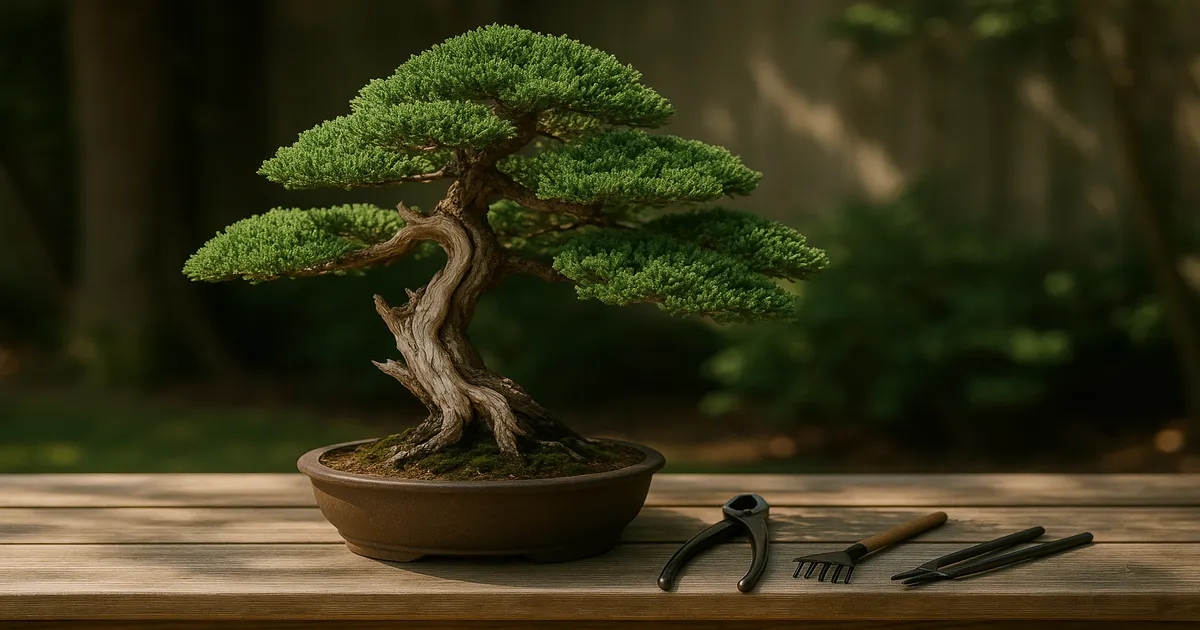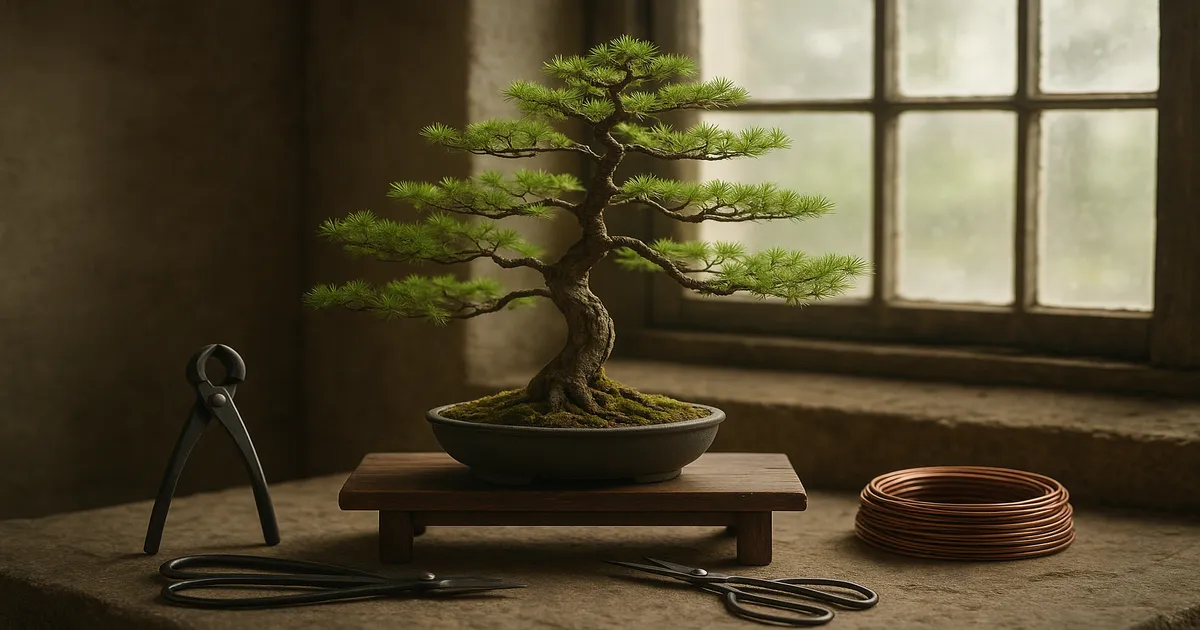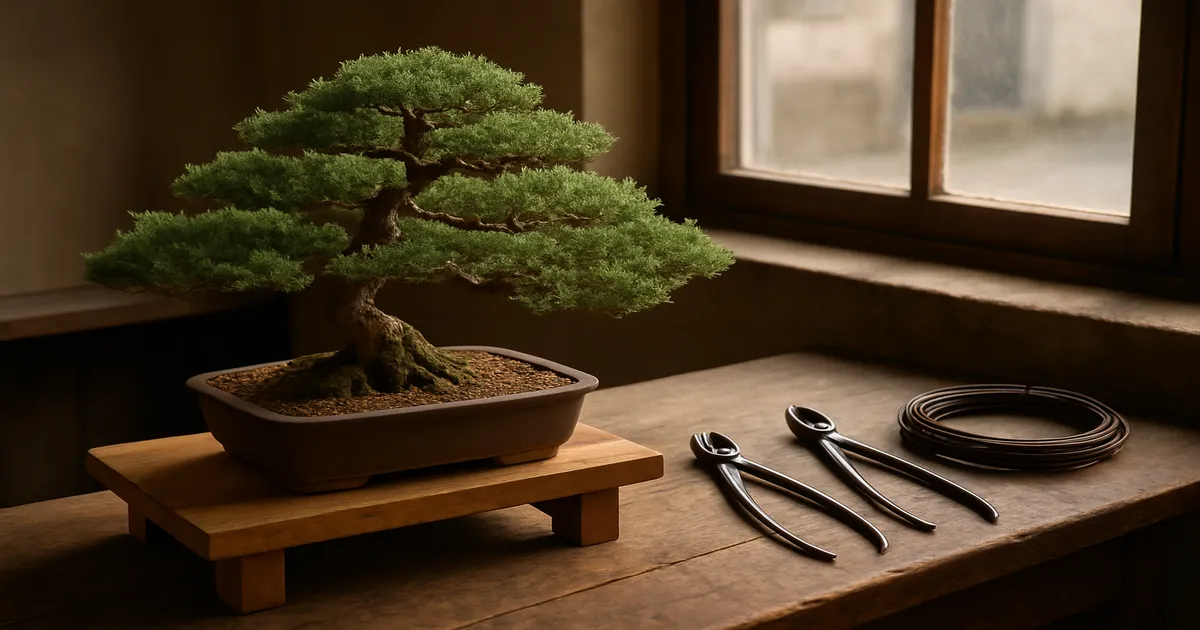
Quick Answer: Bonsai tree juniper pruning comes down to two non-negotiable rules: always leave green foliage on every branch you cut, and time major structural work to late winter/early spring or late summer. Get those two things right and junipers are surprisingly forgiving training subjects.
Juniper bonsai are the gateway tree for millions of enthusiasts — and for good reason. They’re tough, they reward patient shaping, and their natural deadwood character gives even young trees a sense of age. But bonsai tree juniper pruning trips up beginners more than almost any other task, mostly because junipers don’t follow the same rules as deciduous trees. This guide covers everything from a first maintenance trim to advanced deadwood work.
Juniper Pruning at a Glance
The Golden Rule: Always Leave Green Foliage
Unlike maples or elms, junipers will not reliably bud back from bare wood. Cut a branch past its last green shoot and that branch will almost certainly die. Every cut — whether a light trim or a major structural reduction — must leave at least some living foliage behind.
Best Times to Prune a Juniper Bonsai
Two windows matter most:
- Late winter to early spring (February–March): The prime window for heavy structural work. Wounds callus quickly as the tree wakes up and energy surges toward new growth.
- Late summer (August–early September): A secondary window for structural work. Growth has hardened off, and the tree still has enough season left to begin healing wounds before dormancy.
Light maintenance trimming can happen throughout the growing season (April–September). Avoid heavy pruning during peak summer heat in July, and again in late fall when the tree is heading into dormancy.
Maintenance vs. Structural Pruning
Maintenance pruning is the ongoing work of trimming new shoots to refine pad shapes and encourage denser ramification. Structural pruning is the deliberate removal or reduction of whole branches to define the tree’s primary architecture. Both require the same green-foliage rule, but structural cuts are heavier, less reversible, and demand more careful timing.
Know Your Juniper: Species, Foliage Types, and Growth Habits
Most Popular Juniper Varieties for Bonsai
| Variety | Common Name | Foliage Type | Beginner Suitability |
|---|---|---|---|
| J. chinensis | Chinese Juniper | Scale (mature) | ★★★★☆ |
| J. chinensis ‘Shimpaku’ | Shimpaku Juniper | Soft scale | ★★★★★ |
| J. procumbens ‘Nana’ | Dwarf Garden Juniper | Needle/scale | ★★★★★ |
| J. squamata ‘Blue Star’ | Blue Star Juniper | Needle-like | ★★★☆☆ |
| J. rigida | Needle Juniper (Tosho) | Sharp needle | ★★★☆☆ |
| J. californica | California Juniper | Scale | ★★☆☆☆ |
Shimpaku and J. procumbens ‘Nana’ are the best starting points. Both back-bud reasonably well and are widely available.
Juvenile vs. Mature Foliage
Junipers produce two distinct foliage types. Mature foliage is soft and scale-like — the refined, compact growth you see on a well-developed bonsai. Juvenile foliage is sharp and needle-like. It’s normal on young trees, but it can reappear on mature specimens under stress.
Over-pruning is one of the most common triggers for juvenile reversion. If spiky, awl-shaped needles appear on a tree that previously had soft scale foliage, the tree needs a break. Ease off trimming, improve light and feeding, and mature foliage usually returns within one or two growing seasons.
Apical Dominance and Pruning Strategy
Junipers are strongly apically dominant — the apex and outer tips receive the most energy, grow fastest, and will gradually starve lower and inner branches if left unchecked. Regular pruning isn’t just about aesthetics; it’s essential tree management. Trim the apex and outer tips more aggressively than the lower and inner branches to redirect energy downward and inward, keeping the whole tree alive and ramified.
Outdoor Placement and Winter Care
Junipers Must Live Outdoors
Junipers are outdoor-only bonsai. They need genuine winter dormancy — temperatures below 40°F (4°C) for six to ten weeks each year. Skip that dormancy and the tree weakens progressively, becoming susceptible to pests and disease within two or three years. If you want to display a juniper indoors, limit it to one or two days at a time.
Aim for a minimum of six hours of direct sun daily during the growing season. Trees grown in shade develop long, weak internodes and poor back-budding, which means fewer useful places to cut and less energy to recover from pruning. In very hot climates (USDA Zones 8–10), morning sun with afternoon partial shade is fine during the hottest weeks.
Winter Dormancy and Root Protection
The roots are the vulnerable point. A shallow bonsai pot offers almost no insulation compared to in-ground planting. When temperatures are forecast to drop below 15°F (-9°C), move the tree into an unheated but sheltered structure — an unheated garage, cold frame, or unheated greenhouse all work well. Target storage temperatures of 25–38°F (-4 to 3°C): cold enough for proper dormancy, warm enough to prevent root cell damage.
Cold hardiness by species:
- J. procumbens ‘Nana’: to -10°F (-23°C), Zones 4–9
- J. rigida: to -20°F (-29°C), Zones 3–8
- J. chinensis ‘Shimpaku’: to 0°F (-18°C), Zones 4–9
- J. californica: to 10°F (-12°C), Zones 7–10
Mulching the pot with straw or nesting it in a wooden box filled with wood chips adds meaningful root insulation for outdoor overwintering.
Soil and Watering Essentials
Juniper Bonsai Soil Mix
Junipers need fast drainage, good aeration, and enough moisture retention to stay hydrated between waterings. Standard potting soil compacts, reduces oxygen to roots, and creates the anaerobic conditions that kill junipers slowly from the roots up.
The mix most experienced growers use:
- Intermediate/advanced trees: 40% akadama, 40% pumice, 20% lava rock (Bonsai Jack Inorganic Bonsai Soil 3/8 Sifted)
- Beginners: Equal thirds — 1:1:1 akadama, pumice, lava rock
Use particle sizes of 3–6 mm for standard-sized trees, dropping to 1–3 mm for shohin specimens. Target soil pH of 6.0–7.0.
Watering
There’s no fixed schedule — water when the top half-inch of soil begins to dry, but before the soil dries out completely through the pot. In peak summer heat (85–95°F / 29–35°C), that can mean once or twice daily. In cool spring and fall conditions (50–65°F / 10–18°C), every two to three days is often enough. During winter dormancy, water just enough to prevent complete desiccation — roughly once every one to two weeks.
Always water thoroughly until water flows freely from the drainage holes. This saturates the entire root zone and flushes accumulated mineral salts.
Bonsai Tree Juniper Pruning: Techniques, Timing, and Tools
Maintenance Pruning: Pinching and Trimming
Once new shoots have extended one to two inches (2.5–5 cm), pinch or trim them back by one-third to one-half. Use your fingertips for soft new growth or sharp bonsai scissors for anything firmer.
Key habits to build:
- Work in sections over two to three weeks rather than trimming the whole tree at once. Mass trimming strips too much foliage and invites juvenile reversion.
- Remove upward- and downward-growing shoots from branch pads. Keep lateral growth that contributes to the horizontal, layered look.
- Thin interior pads periodically. Dense, unlit interiors cause inner branches to die back — open them up so light reaches the full branch structure.
Structural Pruning: Removing and Reducing Branches
Plan every structural cut before you make it. Unlike maintenance trimming, structural cuts are permanent. Stand back, identify the branches that genuinely need to go, and mark them mentally before picking up the cutters.
Remove branches in these categories:
- Bar branches — two branches at the same height on opposite sides of the trunk
- Front-facing branches — growing directly toward the viewer, flattening depth
- Crossing branches — passing over the trunk line or another primary branch
- Reverse-taper branches — thicker at the tip than at the base
Always use a concave branch cutter for structural cuts. The concave profile creates a slightly hollow wound that heals flush with the branch rather than leaving a raised knob.
Pruning Calendar
| Season | Activity | Notes |
|---|---|---|
| Late winter/early spring (Feb–Mar) | Heavy structural pruning | Best window; wounds callus as growth resumes |
| Spring through early fall (Apr–Sep) | Maintenance trimming | Active growth; tree recovers quickly |
| Late summer (Aug–early Sep) | Secondary structural work | Growth hardened; 6–8 weeks to callus before dormancy |
| Mid-summer (July) | Avoid heavy pruning | Heat stress combined with pruning stress can be fatal |
| Late fall/early winter (Oct–Nov) | Avoid heavy pruning | Wounds can’t callus before dormancy; cold damage risk |
Tools and Wound Care
The core kit for bonsai tree juniper pruning:
- Concave branch cutters — for all branch removal; creates clean, callus-friendly wounds
- Knob cutters — for removing old stubs; hollows the wound naturally
- Bonsai scissors — for foliage trimming and fine shoot work
- Jin pliers — for deadwood creation and refinement
Sterilize all cutting tools between trees using 70% isopropyl alcohol. This prevents transmitting fungal pathogens — particularly Phytophthora — from one tree to another. It takes thirty seconds and matters more than most growers realize.
Apply cut paste immediately to any wound larger than ¼ inch (6 mm) in diameter. It keeps wound tissue from drying out and reduces pathogen entry. Avoid petroleum-based products like Vaseline — they can damage cambium tissue. Junipers callus slowly; a wound half an inch across may take three to five years to close fully. Good light, consistent fertilization, and proper watering all accelerate the process.
Deadwood Styling: Jin and Shari
Junipers are the deadwood species in bonsai. Their heartwood is naturally rot-resistant and weathers to a beautiful silver-gray. Jin is a deadwood branch stub created by stripping the bark from a branch and allowing it to dry and bleach. Shari is a deadwood channel carved into the trunk itself, mimicking lightning-strike damage on wild mountain junipers. Both are a form of structural pruning — plan before you act, because deadwood cannot be reversed.
Creating a Jin
- Select a branch to convert — typically one that would otherwise be removed, or one whose taper makes it more interesting as deadwood than as live growth.
- Using jin pliers, grip the bark at the base and tear it away in strips, following the natural grain toward the tip.
- Work carefully — expose the wood cleanly while leaving the underlying structure intact.
- Allow the jin to dry for several weeks before applying lime sulfur.
Carving Shari
Shari work requires a clear vision of the deadwood channel before you start. Use a sharp carving knife or small rotary tool to remove bark in the planned area, then refine the edges with jin pliers. Keep the shari asymmetric and tapered — natural damage is never perfectly uniform. Never encircle the trunk, which would cut off vascular flow to the upper tree.
Lime Sulfur Application
Apply lime sulfur annually in late fall after the growing season ends. It bleaches wood to silver-white and provides antifungal protection. Dilute to roughly 1:10 with water for painted application (use less dilution for stubborn darkening), brush generously onto all deadwood surfaces, and allow to dry completely. Keep it off live bark — it will damage cambium tissue.
Wiring After Pruning
Aluminum wire in 1.5–4 mm gauge suits most juniper work. It’s soft enough to apply without bark damage, holds position well for the slow-growing juniper, and removes cleanly. Copper wire holds stiffer branches better but hardens as it’s worked and can bite into bark faster than you expect — use it selectively and check frequently.
Practical rules:
- Wire diameter should be approximately one-third the diameter of the branch.
- Wrap at a 45-degree angle to the branch axis for maximum hold with minimal bark contact.
- Use the double-wiring technique — anchor one length across two branches of similar thickness — and always work from trunk to tip.
- Wire in late fall through early spring. During the growing season, check wired branches every two to four weeks.
- Always cut wire off rather than unwinding it. Unwinding risks snapping brittle branches and tearing bark.
Troubleshooting Common Pruning Problems
Branch died after pruning. Almost certainly the branch was cut back to bare wood with no green foliage remaining. This is the single most common bonsai tree juniper pruning mistake, and the tree’s response is swift — the branch dies back from the cut point. There is no fix once it happens. Going forward, always leave at least one healthy shoot with green foliage on every branch you prune.
Foliage reverting to juvenile needle form. Spiky juvenile foliage on a tree that previously had soft scale growth is a stress signal. The most common causes are excessive pruning, poor light, or both. Ease off trimming for a full growing season, move the tree to a sunnier position, and maintain a consistent fertilization schedule. Mature foliage typically returns within one to two seasons.
Weak back-budding and poor ramification. If your juniper isn’t producing new buds along older wood after pruning, the usual culprits are insufficient light, over-pruning, or inadequate fertilization. Six hours of direct sun is a minimum, not a target. A healthy, well-fed juniper in full sun will back-bud reliably; a struggling one in shade will not.
Wire scars. Wire scars happen when wire is left on too long or applied during active summer growth. Check wired branches every two to four weeks during the growing season and remove wire the moment it begins to bite into bark. Scars on junipers fade slowly — deep ones may remain visible for years, which is why prevention matters far more than treatment.
Frequently Asked Questions
Can I prune a juniper bonsai in summer? Light maintenance trimming is fine throughout the growing season. Avoid heavy structural pruning in July, when heat stress combined with pruning stress can seriously weaken or kill the tree. If structural work is needed in summer, wait until August when temperatures ease and growth has hardened off.
How much foliage can I safely remove at one time? As a general rule, remove no more than one-third of the total foliage in a single session. Junipers recover from moderate pruning well, but stripping too much foliage at once depletes energy reserves and often triggers juvenile reversion.
Why is my juniper turning brown after pruning? Some interior browning is normal — old foliage naturally sheds as new growth develops. If browning is progressing from branch tips inward, the most likely causes are a cut made to bare wood, underwatering, or root stress. Check the soil moisture and inspect the cut points for any branches that may have been taken back too far.
Do I need to seal every cut on a juniper? Seal cuts larger than ¼ inch (6 mm) in diameter. Smaller cuts on healthy, vigorous trees will callus without assistance. In humid climates, cut paste is especially important because open wounds are more vulnerable to fungal infection.
How long does it take for a juniper bonsai to develop good ramification? With consistent maintenance pruning, good light, and regular fertilization, meaningful ramification develops over three to five years. Shimpaku and J. procumbens ‘Nana’ ramify faster than most other species. Patience is the main ingredient — there are no shortcuts.