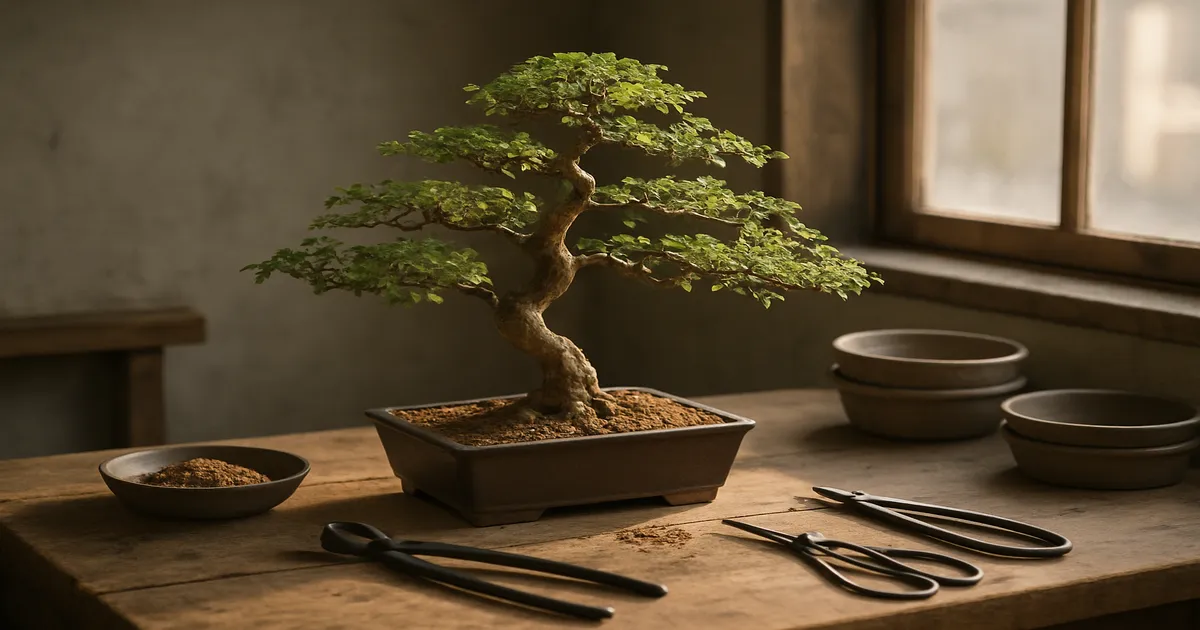
Quick Answer: Pruning bonsai Chinese elm (Ulmus parvifolia) involves two types of work — regular maintenance pruning using the clip-and-grow method throughout the growing season, and structural pruning done in late winter just before bud break. Chinese elm back-buds vigorously after almost every cut, making it one of the most forgiving species to prune for beginners and experienced growers alike.
Pruning Bonsai Chinese Elm: Key Facts at a Glance
Quick Reference Guide
- Maintenance pruning: Spring through early fall, 3–5 times per year
- Structural pruning: Late winter to early spring, just before bud break
- Primary technique: Clip-and-grow — let shoots extend 3–4 nodes, cut back to 1–2
- Back-budding: Vigorous; expect 2–3 new shoots per cut
- Essential tools: Concave cutters, bonsai scissors, knob cutters
- Wire check frequency: Every 2–4 weeks during the growing season
Pruning Calendar
| Season | Activity |
|---|---|
| Late winter (Feb–Mar) | Structural pruning, wiring bare branches |
| Spring (Mar–May) | First maintenance pruning as growth extends |
| Summer (Jun–Aug) | Clip-and-grow every 4–6 weeks; partial defoliation in early summer |
| Early fall (Sep–Oct) | Final maintenance pruning; secondary structural window |
| Winter (Nov–Jan) | Rest; inspect for deadwood; minimal intervention |
What Makes Chinese Elm So Good to Prune
Ulmus parvifolia is native to China, Japan, Korea, and parts of Southeast Asia, where it grows on rocky hillsides and riverbanks. In cultivation it behaves as semi-evergreen to fully deciduous depending on your climate — nearly evergreen in USDA Zones 9–10, fully deciduous in Zones 5–8.
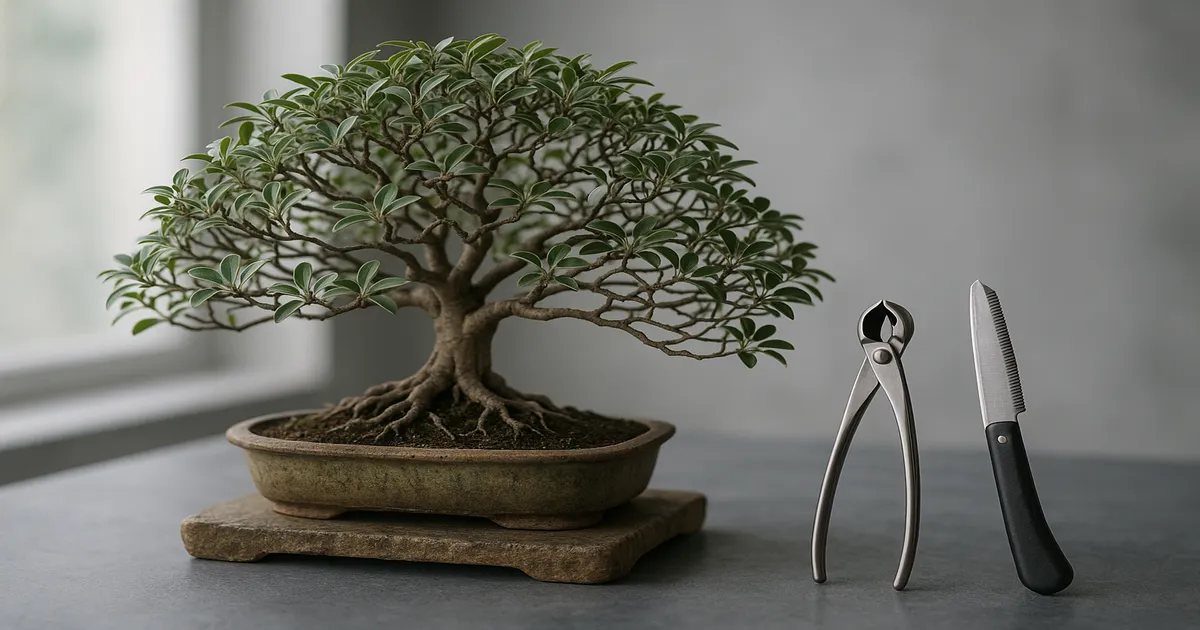
The tree’s greatest asset for bonsai work is its back-budding. Cut a branch and you’ll almost always see 2–3 new shoots emerge nearby within weeks. Mistakes are rarely fatal, and consistent pruning builds the dense, twiggy ramification the species is prized for. Mature specimens also develop exfoliating “lacebark” bark — patches of orange, gray, and green that make older trees beautiful even in winter. Leaves are naturally small (0.5–1.5 inches / 1.3–3.8 cm) and reduce further under cultivation, so convincing scale develops relatively quickly.
How Cultivar Choice Affects Pruning Frequency
- Standard species: Vigorous, fast-growing, larger leaves — prune frequently; excellent for beginners
- Seiju: Compact internodes, very small leaves — prune less often; focus on refinement
- Hokkaido: Extremely slow growth, tiny leaves — ideal for shohin and mame; minimal pruning needed
- Catlin: Dense, semi-dwarf habit — responds well to clip-and-grow; slightly less vigorous than the standard species
- True Green: Holds foliage longer; popular for indoor cultivation — same schedule, but expect less pronounced dormancy cues
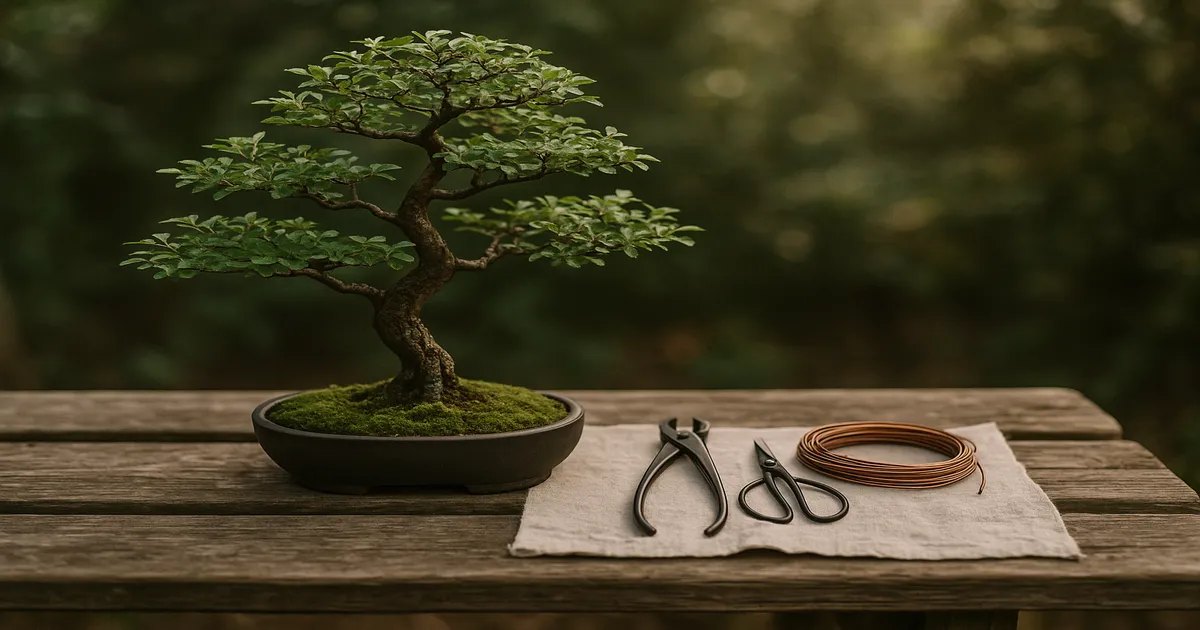
Essential Tools for Pruning Chinese Elm Bonsai
Good tools make a measurable difference on a species where you’re making dozens of cuts per season.
Concave cutters are the most important purchase. They remove a branch and leave a slightly hollowed wound that calluses flush with the surrounding bark, rather than leaving a raised bump. Over time, this produces noticeably cleaner bark texture. A quality pair like the Kaneshin 175mm Concave Branch Cutter will last decades with basic maintenance.
Bonsai scissors handle day-to-day work — trimming soft new growth, removing small shoots. For most maintenance sessions, scissors are the only tool you’ll pick up. The Tinyroots Professional Bonsai Scissors are a reliable mid-range option that holds an edge well on the frequent cuts Chinese elm demands.
Knob cutters clean up stubs after branch removal and create a rounded wound profile that heals more cleanly than a flat cut.
Sterilise all cutting edges with 70%+ isopropyl alcohol between trees — and between cuts on any tree showing signs of disease. Dull tools crush tissue rather than cutting it, which slows callus formation and invites infection. Sharpen regularly; a well-maintained Japanese tool will outlast a cheap replacement many times over.
Maintenance Pruning: The Clip-and-Grow Method
When to Start
Begin as soon as spring growth extends beyond 2–3 nodes — typically March to April in most temperate climates. Don’t wait for the spring flush to finish before you start; working progressively as growth extends gives you better control over the silhouette.
Step-by-Step Technique
- Allow new shoots to extend 3–4 nodes beyond the desired branch length
- Using sharp, clean scissors, cut back to 1–2 nodes above the branch junction
- Cut just above a leaf axil at a slight angle — not flat, not steeply angled
- Leave a tiny sliver of internode above the node; never cut into it
- Work from the apex downward to avoid dropping debris onto lower branches
- Expect 2–3 new shoots per cut point within 2–4 weeks
How Often Can You Prune?
Chinese elm handles 3–5 maintenance sessions per growing season without stress, provided the tree is healthy, well-watered, and well-fed. A rhythm of every 4–6 weeks from spring through early fall works well for most growers. Stop by early fall so the season’s growth can harden before winter.
Defoliation for Leaf Reduction
Defoliation is an advanced technique for healthy, vigorous trees only. In early summer, remove 50–75% of the leaves — prioritising the largest, oldest ones — then let the tree push a fresh flush of smaller, more numerous leaves. Allow 6–8 weeks of undisturbed recovery before any further significant work. Never defoliate a recently repotted tree, one recovering from pest damage, or any tree showing signs of weakness.
Structural Pruning: Building the Primary Framework
Best Timing
Late winter to early spring — just as buds begin to swell but before they open — is the ideal window. The leafless silhouette lets you see the branch structure clearly, wounds callus rapidly as the tree’s energy mobilises, and resources flow into the branches you’ve chosen to keep. Early fall is a workable secondary window after the summer flush has hardened off.
Avoid structural pruning in mid-summer (heat stress plus high water demand slows recovery) and avoid cutting trees held in cold storage during mid-winter dormancy.
Branch Selection Principles
Work systematically through the tree:
- Remove crossing branches that create visual confusion or rub against neighbours
- Remove parallel branches at the same height on the same side of the trunk
- Remove back-growing branches pointing directly toward the viewer, unless they serve a specific depth purpose
- Remove downward-growing branches on the lower trunk
- Favour branches with gentle taper and natural movement over straight, rigid ones
- Apply the rule of thirds: primary branches should decrease in thickness progressively from base to apex
Trunk Chopping for Taper
Chinese elm responds exceptionally well to trunk chopping — cutting the trunk at the desired height just above a suitable branch to force taper and redirect energy. Wounds typically callus within 1–3 growing seasons depending on diameter. Cut in late winter, position the cut just above a healthy branch that will become the new leader, and apply cut paste immediately.
Wound Care
Apply cut paste to any cut larger than about ¼ inch (6 mm) in diameter. Kiyonal is a reliable choice. It prevents desiccation and reduces pathogen entry during the early healing phase. Large wounds over ½ inch (12 mm) may take 2–5 years to fully callus. Concave cutters do most of the work here — a properly made concave cut heals dramatically faster than a flush or convex one.
Wiring Chinese Elm: Timing and Common Mistakes
Match wire diameter to roughly one-third the thickness of the branch being wired:
- 1.0–1.5 mm: Fine tertiary branches and young shoots
- 2.0–2.5 mm: Secondary branches
- 3.0–4.0 mm: Primary branches and trunk work
Aluminium wire is the right choice for Chinese elm. It’s softer than copper, easier to apply without damaging bark, and provides adequate holding power for deciduous work. A multi-gauge set like the Tinyroots Aluminum Bonsai Wire Set covers every situation you’ll encounter on this species.
Wire in late winter before bud break, when branches are bare and visible. Avoid wiring during the active spring flush — the bark is thin and tears easily at that stage.
Application: Anchor the wire with 1–2 wraps around the trunk or a larger branch. Wrap at 45 degrees to the branch. Keep it firm but not tight — you should be able to slide a fingernail underneath. Bend slowly with both hands supporting the branch.
The most common Chinese elm mistake is leaving wire on too long. Fast growth means wire can bite into bark within 4–8 weeks during the growing season. Check every 2–4 weeks from spring through summer. The moment you see the wire beginning to cut in, remove it. Wire marks on mature Chinese elm bark can take years to fade — on some specimens, they never fully disappear.
When removing wire, always cut it into short sections rather than unwinding it. Unwinding risks snapping a partially-set branch.
Soil, Watering, and Repotting After Pruning
A well-draining soil mix is the foundation that makes everything else work. The standard starting point for Chinese elm is 40% akadama, 30% pumice, 30% lava rock. This balance retains enough moisture for recovery while draining freely enough to prevent root rot — a real risk when a heavily pruned tree is processing fewer leaves and taking up less water. (Bonsai Jack Inorganic Bonsai Mix)
After heavy structural pruning, reduce watering slightly until new growth confirms the tree is actively recovering. Once shoots are extending, return to your normal schedule.
Young trees in development need repotting every 1–2 years; mature specimens every 2–3 years. Repot in early spring as buds begin to swell, removing 25–33% of the root mass with clean, sharp cuts. One rule worth following strictly: don’t combine heavy root pruning with heavy branch pruning in the same session. Both operations stress the tree’s water and energy balance simultaneously. If you need to do both, keep branch pruning light at repotting time and save structural work for the following late winter.
Troubleshooting Common Pruning Problems
Tree not back-budding after pruning. The most common cause is insufficient light. Chinese elm needs a minimum of 4–6 hours of direct sun to back-bud reliably. Move the tree to a brighter position first. If light isn’t the issue, check whether you pruned during full dormancy (the tree lacks active energy to respond) or whether poor soil drainage has compromised the root system.
Leggy growth and poor ramification. Long internodes are almost always a light problem, a pruning frequency problem, or both. Increase direct sun and apply clip-and-grow more consistently. Pruning every 4–6 weeks keeps growth tight; pruning once a season gives the tree time to extend long, weak shoots between cuts.
Dieback after structural cuts. Dieback usually means the cut was made into old wood without a live bud nearby, or the work was done during summer heat when the tree’s resources were already stretched. Always cut to a live node and time structural work for late winter. If dieback occurs, cut back to the nearest healthy wood and apply cut paste.
Wire marks and bark scarring. Remove wire immediately if it has already bitten in. Shallow marks on young bark may fade within a season or two. Deep marks on mature bark may be permanent. There is no treatment that speeds healing significantly — the only real answer is checking wire more frequently.
Frequently Asked Questions About Pruning Bonsai Chinese Elm
When is the best time to prune a Chinese elm bonsai?
It depends on the type of pruning. Maintenance pruning — trimming new shoots with clip-and-grow — runs throughout the growing season from spring through early fall. Structural pruning is best done in late winter just before bud break, when the bare structure is visible and the tree is ready to heal quickly.
How hard can you prune a Chinese elm bonsai without killing it?
A healthy, established tree can lose 30–50% of its foliage in a single structural session without serious harm, provided timing is right and the tree is otherwise healthy. Avoid removing more than a third of the root mass and branch mass at the same time — the two operations together create more stress than either one alone.
How do I get more ramification on my Chinese elm bonsai?
Apply clip-and-grow consistently — 3–5 times per growing season — and ensure the tree receives at least 6 hours of direct sun daily. Each pruning cut triggers 2–3 new shoots, so more sessions mean exponentially more branch tips over time. Partial defoliation in early summer on healthy trees can also accelerate ramification by triggering a fresh flush of smaller, more numerous leaves.
Can you prune a Chinese elm bonsai kept indoors?
Yes. Pruning technique and timing are the same whether the tree lives indoors or out. The bigger concern is that insufficient light weakens the tree’s ability to back-bud and recover. Make sure your indoor tree gets at least 4–6 hours of bright light daily — from a south- or west-facing window, or a full-spectrum grow light running at 5,000–6,500K for 10–16 hours per day — before doing any significant pruning work.
Should you use cut paste on every pruning cut?
No. Cut paste is worth applying to wounds larger than about ¼ inch (6 mm) in diameter. Smaller cuts from routine maintenance pruning heal quickly on their own and don’t need sealing. Save cut paste for structural work — branch removals, trunk chops, and any cut that exposes a significant area of cambium.