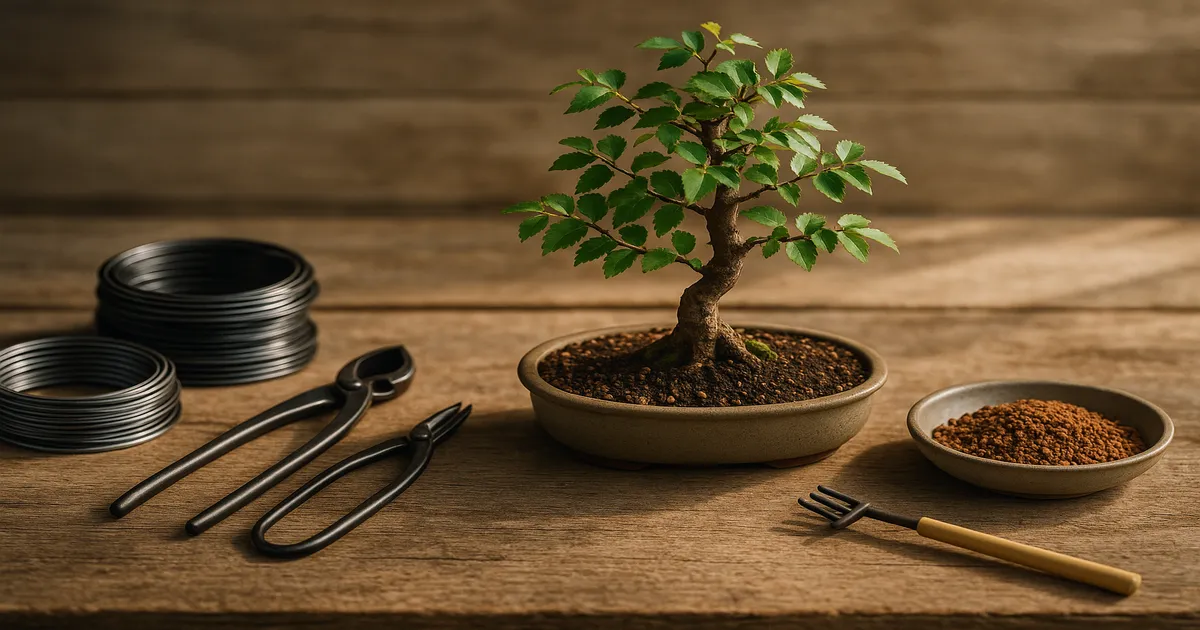
Quick Answer: Bonsai care for beginners comes down to five things: choosing the right species, providing adequate light, using fast-draining soil, watering correctly, and pruning at the right time. The single most important concept is the indoor/outdoor distinction — most bonsai sold in garden centers are temperate trees that must live outside, not on a windowsill. Get that right from day one and you’re already ahead of most beginners.
Bonsai care for beginners can feel overwhelming at first, but the fundamentals are surprisingly learnable. This guide covers species selection, light, soil, watering, pruning, wiring, and repotting — with specific numbers and actionable steps rather than vague advice.
Bonsai Care for Beginners: The Five Essentials
What Is a Bonsai Tree?
A bonsai is not a genetically dwarf plant. It’s any woody tree or shrub kept miniature through container restriction, root pruning, and deliberate shaping. Given the right techniques, virtually any tree species can become a bonsai.
The Five Pillars of Bonsai Care
- Species selection — The foundation of everything else
- Light and temperature — Matching your tree’s natural environment
- Soil and watering — Fast-draining mix, water when the top inch dries out
- Pruning — Maintenance cuts for shape, structural cuts for architecture
- Repotting — Root pruning every 1–5 years to keep the tree healthy
The indoor vs. outdoor distinction is the most critical concept for beginners. Temperate species like junipers and maples must live outdoors year-round. Tropical species like Ficus are the true indoor candidates.
Choosing the Right Species: The Most Important Decision in Bonsai Care for Beginners
Pick the wrong species for your environment and no amount of good care will save the tree. A juniper slowly dying on an apartment windowsill is one of the most common beginner heartbreaks — and entirely preventable.
The rule is simple: no outdoor space means you need a tropical species. If you do have outdoor space, temperate species reward you with more dramatic seasonal character.
Best Outdoor Bonsai Species for Beginners
Chinese Elm is the top pick for most beginners. It’s semi-evergreen in mild climates, develops fine branching quickly, and forgives inconsistent watering better than almost any other temperate species. Hardy to USDA Zone 5.
Other strong choices:
- Juniper (J. procumbens ‘Nana’ or J. chinensis ‘Shimpaku’) — Iconic silhouette, full sun, hardy to Zone 4–9. Must stay outdoors; no exceptions.
- Japanese Maple — Stunning autumn color, extremely responsive to pruning, hundreds of cultivars. Hardy to Zone 5–8.
- Trident Maple — Vigorous grower with excellent surface root development. Tolerates aggressive root pruning. Hardy to Zone 5–6.
Best Indoor Bonsai Species for Beginners
Ficus (F. retusa or F. microcarpa) is the most forgiving indoor bonsai available. It handles lower humidity, inconsistent light, and the occasional missed watering better than anything else on this list.
Other reliable indoor options:
- Jade Plant (Crassula ovata) — Near-indestructible succulent, ideal if you tend to forget watering
- Fukien Tea (Carmona retusa) — Small white flowers and red berries year-round; prefers 60–70% humidity
- Dwarf Umbrella (Schefflera arboricola) — Fast grower that develops impressive banyan-like aerial roots
Species Comparison at a Glance
| Species | Difficulty | Light Need | Indoor/Outdoor |
|---|---|---|---|
| Chinese Elm | Easy | 4–6 hrs direct | Outdoor (Zone 5–9) |
| Juniper ‘Nana’ | Easy–Medium | 6–8 hrs direct | Outdoor only |
| Japanese Maple | Medium | 4–6 hrs direct | Outdoor (Zone 5–8) |
| Ficus | Easy | 4–6 hrs bright indirect | Indoor |
| Jade Plant | Very Easy | 4–6 hrs bright indirect | Indoor |
| Fukien Tea | Medium | 5–6 hrs bright indirect | Indoor |
For beginners, the best size range is Shohin (5–8 inches) to Chuhin (8–24 inches). Large enough to work with comfortably, small enough to manage on a balcony or patio table.
Light, Temperature, and Seasonal Care
How Much Light Does a Bonsai Need?
Light requirements vary significantly by species:
- Junipers and pines: 6–8 hours of direct sun daily — south-facing outdoor placement
- Deciduous trees (maples, elms): 4–6 hours of direct sun; morning sun preferred to reduce heat stress
- Tropical indoor species (Ficus, Schefflera): 4–6 hours of bright indirect light — south or east-facing window
Insufficient light is the number one reason indoor bonsai decline slowly. If your brightest window doesn’t provide enough, a full-spectrum LED grow light (Mars Hydro TS600) running at 2,000–5,000 lux for 12–14 hours per day, positioned 6–12 inches above the canopy, is a practical fix. Rotate the tree 90° every one to two weeks to prevent lopsided growth.
Temperature and Winter Dormancy
Tropical indoor species thrive at 65–85°F (18–29°C) year-round. Most will drop leaves below 55°F (13°C), so keep them away from cold drafts and exterior doors in winter.
Temperate outdoor species need 30–90 days at 25–45°F (-4–7°C) to complete proper dormancy. This cold period triggers the hormonal reset that drives vigorous spring growth. Skip it for a season or two and the tree weakens; skip it long enough and it dies. An unheated garage, cold frame, or mulched outdoor storage all work well. When temperatures drop below 20°F (-7°C), protect the roots — container soil freezes far faster than in-ground soil.
Soil and Watering: The Foundation of Tree Health
Why Standard Potting Soil Kills Bonsai
Regular potting soil retains too much moisture, compacts over time, and suffocates roots. Bonsai soil needs drainage, aeration, and just enough water retention. Aim for a particle size of 1/8–3/16 inch (3–6 mm) for most species.
Recommended Soil Mixes by Species Type
Deciduous trees (maples, elms):
- 50% Akadama
- 25% Pumice
- 25% Lava rock
Conifers (junipers, pines):
- Equal thirds akadama, pumice, and lava rock — the faster drainage suits their drought tolerance
Tropical/indoor species (Ficus, Schefflera):
- 40% akadama, 30% pumice, 20% lava rock, 10% fine pine bark
If akadama isn’t available locally, mix equal thirds of calcined clay (Turface MVP works well), coarse perlite, and decomposed granite. It won’t perfectly replicate akadama’s root-supporting properties, but it’s a solid beginner mix that won’t compact.
How and When to Water
There is no universal watering schedule. Water when the top 1/2 inch (1.3 cm) of soil begins to dry — that might be daily in summer heat or every two to three days in cool weather. Always water thoroughly until water flows freely from the drainage holes, which moistens the entire root mass and flushes accumulated salts. Water in the morning when possible so foliage dries before evening, reducing fungal disease risk.
Signs of Overwatering vs. Underwatering
| Symptom | Overwatering | Underwatering |
|---|---|---|
| Leaves | Yellow, soft | Brown crispy edges, curling |
| Trunk base | Soft, mushy | Firm |
| Soil behavior | Stays wet 3–4+ days | Pulling away from pot edges |
| Pot weight | Heavy | Noticeably light |
| Other signs | Fungus gnats | Sudden leaf drop (tropicals) |
Humidity for Indoor Bonsai
Tropical species prefer 50–70% relative humidity. Most homes run 30–40%, especially in winter. A humidity tray — a shallow tray filled with gravel and water, with the pot sitting above the waterline — raises local humidity around the canopy effectively. Misting provides only temporary relief and can promote fungal issues if done in the evening, so a humidity tray is the better long-term solution.
Pruning: Maintenance Cuts and Structural Work
Maintenance Pruning
Maintenance pruning is ongoing. Pinch new growth back to 1–2 leaves as shoots extend beyond the canopy outline. For deciduous trees, let new shoots produce 4–6 leaves then cut back to 1–2. For junipers, pinch extending tips with your fingers rather than scissors — cut ends brown. This consistent work builds ramification, the fine branching network that gives mature bonsai their dense, cloud-like pads.
Structural Pruning
Structural pruning establishes the fundamental architecture of the tree. Timing matters:
- Deciduous trees: Late winter before bud break, or late autumn after leaf drop
- Conifers: Late summer to early autumn (August–September in the Northern Hemisphere)
- Tropical species: Any time, though spring is preferred for maximum healing time
As you work up the trunk, aim for an alternating left-right-back branching pattern. Remove branches that cross the front of the trunk, parallel “bar branches” at the same height, branches growing directly toward the viewer, and any reverse-taper branches (thicker above than below). The trunk should be visibly thicker at the base and taper toward the apex.
Any cut larger than 1/4 inch (6 mm) in diameter should be sealed with cut paste to prevent desiccation and fungal entry. Use concave branch cutters for all branch removal — the slightly hollow wound they leave heals flush with the trunk, minimizing visible scarring.
Wiring Bonsai Branches
Wire wrapped around a branch holds it in a new position until the wood sets — typically 1–6 months depending on species and season. Start with anodized aluminum wire . It’s softer, more forgiving on bark, and easier to apply cleanly than copper. Copper holds bends more firmly and suits conifers, but it’s unforgiving of application errors — not the right tool while you’re still learning.
Gauge rule: the wire should be approximately 1/3 the diameter of the branch.
Application steps:
- Anchor the wire at the trunk or a main branch before working outward
- Wrap at a consistent 45° angle with even spacing between coils
- Where possible, wire two branches of similar thickness from one piece (“double wiring”) — it anchors better and uses wire efficiently
- Apply wire before bending, never after
Wire deciduous trees in late winter when bare. Wire junipers in autumn or winter when growth has hardened. Avoid wiring during active spring growth — bark marks easily.
Check wire every 4–6 weeks during the growing season. Fast-growing species like Trident Maple can develop wire bite in weeks. Remove wire by cutting it in segments with wire cutters — never unwind it, as this risks snapping branches that have begun to set.
Repotting: Refreshing Roots for Long-Term Health
Repotting is about root pruning and soil refresh — not upsizing the pot. Most bonsai go back into the same container or one very similar in size.
- Young/developing trees: Every 1–2 years
- Mature/refined trees: Every 3–5 years
Tip test: Remove the tree from its pot. If roots are circling the bottom or forming a dense mat, it’s time.
Best Time to Repot
- Deciduous trees: Late winter as buds begin to swell
- Conifers: Late winter to early spring, or late August
- Tropical species: Spring or early summer preferred
Root Pruning Steps
- Remove the tree from its pot; use a root hook or chopstick to comb out the root mass
- Remove old, degraded soil from between the roots
- Cut away circling roots, downward-growing sinker roots, and thick roots crowding fine feeders
- Trim the overall root mass by no more than 1/3 in a single session
- Use sharp, clean scissors or root pruners — clean cuts heal faster than torn roots
Pot length should be approximately 2/3 of the tree’s height for most styles. Oval and rectangular pots suit most deciduous and conifer styles; round pots work well for formal upright trees. The pot should frame the tree, not compete with it.
Troubleshooting Common Bonsai Problems
Yellowing leaves have several distinct causes. Soft yellow leaves across the whole canopy point to overwatering — fix the soil mix and watering frequency. Yellowing with crispy edges suggests underwatering — soak thoroughly and reassess your schedule. Gradual overall pallor usually means insufficient light; move the tree or add a grow light. Uniform yellowing after months without fertilizing points to nutrient deficiency; apply a balanced liquid fertilizer.
Sudden leaf drop in tropical species signals stress. Check for cold drafts, a sharp drop in light, or a dramatic change in watering. Remove the stressor and the tree typically recovers within a few weeks.
Root rot is caused by overwatering combined with poor drainage. Unpot the tree, rinse the roots, and cut away all dark, soft roots back to healthy white tissue. Repot into fresh, fast-draining mix and reduce watering frequency. Caught early, most trees recover fully.
Common pests:
- Spider mites — Fine webbing and stippled leaves on indoor Ficus in dry air. Increase humidity; treat with insecticidal soap or neem oil.
- Scale insects — Brown bumps on branches. Remove manually with a soft brush and treat with horticultural oil.
- Fungus gnats — Larvae damage roots; a sign of persistently wet soil. Let soil dry more between waterings; yellow sticky traps catch adults.
Frequently Asked Questions About Bonsai Care for Beginners
Can bonsai trees be kept indoors?
Only tropical and subtropical species — Ficus, Jade, Fukien Tea, and Dwarf Umbrella — are true indoor bonsai. Temperate species such as junipers, maples, and pines are commonly sold as indoor bonsai but will slowly decline if kept inside year-round. They need outdoor conditions, seasonal temperature swings, and winter dormancy to survive long-term.
How often should I water my bonsai?
There is no fixed schedule. Water when the top 1/2 inch of soil begins to dry out. In summer heat that may mean daily; in cool weather, every two to three days. Always water thoroughly until it drains freely from the bottom of the pot.
What is the easiest bonsai tree for a complete beginner?
Ficus (F. retusa) is the easiest indoor option — it tolerates low humidity, inconsistent light, and occasional missed waterings. For outdoors, Chinese Elm is the top pick: forgiving of watering lapses, fast to develop fine branching, and hardy across a wide range of climates.
Do bonsai need fertilizer?
Yes. Because bonsai grow in small volumes of fast-draining soil, nutrients wash out quickly. Use a balanced fertilizer (such as 10-10-10 or a purpose-made bonsai fertilizer) every two to four weeks during the growing season. Reduce or stop feeding in winter when the tree is dormant.
Why is my bonsai losing leaves?
For deciduous trees, autumn leaf drop is completely normal. For tropical species kept indoors, sudden leaf loss usually points to a stressor — cold drafts, a sharp reduction in light, or a dramatic change in watering. Identify and remove the stressor and the tree typically recovers.