Quick Answer: Those three-pointed growths on your ficus are completely normal — and actually great news. Each cluster is a new leaf emerging between two small protective structures called stipules. They drop off naturally as the leaf matures. Seeing several at once means your tree is in an active growth flush and doing exactly what a healthy ficus should do.
If you’ve been staring at your ficus wondering what are these three points growing on my ficus, you can relax. This is one of the most reassuring things a bonsai grower can spot. Far from a problem, it’s a sign of vigour — and once you understand what’s happening, you’ll actually look forward to seeing them appear.
What Are These Three Points Growing on My Ficus?
The Three-Point Structure Explained
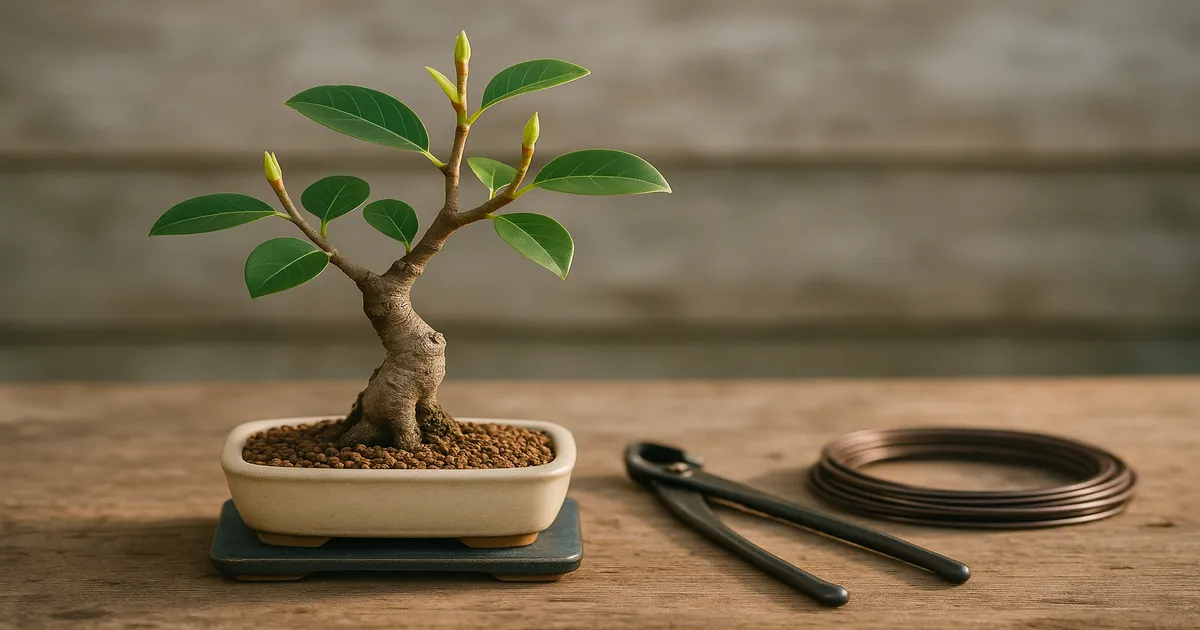
Each cluster is a terminal bud complex: one central emerging leaf flanked by two stipules. Stipules are small, leaf-like appendages whose sole job is to protect the developing bud while it’s still tightly rolled inside. On most ficus species they’re reddish, pink, or pale green — noticeably different in colour and texture from the leaf itself.
As the shoot extends, the stipule sheath splits open and falls away, revealing the new leaf underneath. Once they drop, they leave a faint ring scar on the stem. It’s a tidy, repeating process that happens at every active node and branch tip throughout the growing season.
Is This Normal — Should You Be Concerned?
Not only is it normal, it’s exactly what you want to see. When multiple three-point clusters appear simultaneously, your tree is in a full growth flush — a clear signal of good health and adequate conditions. Think of it as your ficus giving you a thumbs up.
Ficus Species and Growth Habits
Common Ficus Species Used in Bonsai
The genus Ficus belongs to the mulberry family (Moraceae) and contains around 850 accepted species. The ones you’ll most commonly encounter in bonsai are:
- F. retusa / F. microcarpa — the classic ginseng or Taiwan ficus, often sold interchangeably
- F. benjamina — weeping fig, highly responsive to training but sensitive to being moved
- F. religiosa — sacred fig, with distinctive triangular leaves and long drip tips
- F. salicaria — willow-leaf fig, prized for small narrow leaves and elegant branching
- F. carica — the edible fig, popular in Mediterranean-style bonsai
- F. rubiginosa — Port Jackson fig, widely used in Australian bonsai
Most bonsai ficus originate from tropical and subtropical regions of Southeast Asia, southern China, India, Africa, and Australia. Their natural environments — rainforests, rocky outcroppings, riverbanks — are warm, humid, and bright year-round. That context explains almost every care decision you’ll make.
Many species are hemiepiphytes, meaning they begin life growing on other trees before sending roots down to the ground. This origin explains why ficus develops such vigorous aerial roots and adapts so readily to the confined space of a bonsai pot. Cut any ficus branch and you’ll see milky white latex sap — a diagnostic trait of the genus. Wash it off your skin promptly, as it can cause mild irritation.
Light, Temperature, and Placement
How Much Light Does a Ficus Bonsai Need?
Ficus is the world’s most popular indoor bonsai, but “indoor” does not mean “tolerates low light.” For healthy, active growth you need 5,000–10,000 lux — roughly 6–8 hours of bright indirect to direct light daily. The survival minimum is around 1,000–2,000 lux, but at that level your tree is just hanging on, not thriving.
A south-facing window is your best option in the Northern Hemisphere. East or west-facing windows work with supplemental lighting. If natural light is limited, a full-spectrum LED grow light positioned 6–12 inches above the canopy for 12–14 hours a day can fully replace the sun. Insufficient light is the single most common reason ficus bonsai decline indoors — if you’re seeing elongated internodes, pale leaves, or unexplained leaf drop, start here.
Moving your ficus outside during warm months makes a dramatic difference. Better light, natural humidity swings, and air movement all encourage tighter internodes, smaller leaves, and stronger ramification. Acclimate gradually over two weeks to avoid leaf scorch when transitioning from indoors to full sun.
Temperature Ranges and Winter Protection
- Ideal growing range: 65–85°F (18–29°C)
- Minimum safe threshold: 55°F (13°C) — below this, growth stops and stress begins
- Damage threshold: 45°F (7°C) and below can cause leaf drop and root damage
- Frost: Fatal to virtually all ficus species, even briefly
- Year-round outdoor cultivation: USDA Hardiness Zones 10–12. F. carica is the exception, hardy to Zone 6 with protection.
When nighttime temperatures consistently fall below 55°F (13°C), bring your ficus indoors. Keep it away from heating vents and drafty windows — sudden temperature swings trigger leaf drop faster than almost anything else. Aim for at least 50% relative humidity and reduce watering by around 30–40% compared to your summer routine.
Soil and Watering
The Best Soil Mix for Ficus Bonsai
Ficus needs a fast-draining, well-aerated substrate that holds just enough moisture without staying wet. The standard mix is 40–50% akadama, 25–30% pumice, 20–30% lava rock. A pre-blended inorganic bonsai mix works well if you don’t want to blend your own.
- For drier climates or outdoor summer placement, shift toward 40% pumice to improve drainage.
- For indoor or low-light conditions, nudge akadama up to 50–55% to compensate for slower evaporation.
- Avoid standard potting soil or any peat-based mix — they retain far too much moisture in a small container and invite root rot.
Target a soil pH of 6.0–7.0. Akadama naturally sits in this range, but it does break down over 2–3 years into a muddy consistency, which is one of the main reasons repotting becomes necessary.
How Often to Water Your Ficus
There is no fixed schedule. Water based on what the soil is actually doing, not the calendar.
Finger test: Push your finger about an inch into the soil. Water when the top 1–1.5 inches feel barely moist to dry. In spring and summer this typically means watering every 1–3 days; in autumn and winter, every 3–7 days.
Always water thoroughly until it flows freely from the drainage holes, then discard any excess from the saucer after 30 minutes. Use room-temperature water — if you’re on tap water, let it sit 24 hours to off-gas chlorine, or use rainwater.
Ficus prefers 50–70% relative humidity. Indoor heating in winter can drop this to 20–30%, which stresses the tree and suppresses the growth flush you’re hoping to see. A humidity tray, a nearby room humidifier, or grouping several plants together all help. Regular misting is useful but not sufficient on its own.
Pruning: How to Use Those Three-Point Buds Wisely
Why the Three-Point Bud Is Your Pruning Cue
Those three-point terminal buds are your primary growth points, so every pruning decision you make here directly shapes how the tree branches over time. The good news: ficus back-buds readily on old wood and is more forgiving of hard pruning than most bonsai species.
Once a new shoot has extended to 4–6 leaves, prune it back to 1–2 leaves using sharp, clean bonsai scissors . Always cut just above a leaf node. For the finest ramification, try pinching instead — use your fingernails to nip out the central growing tip before the shoot has extended at all. This encourages back-budding without any cutting tool.
Structural work — establishing primary branches, adjusting taper, creating movement — is best done in late winter to early spring, just before the major growth flush. Use concave cutters for larger branches; the concave cut heals flush with the trunk rather than leaving a protruding stub. Apply cut paste to any wound larger than 5mm. Under good conditions, a healthy ficus can callus a 1cm cut in 6–12 months.
Complete or partial defoliation can be done on healthy, vigorous trees only in early summer, with the goals of leaf size reduction and better light penetration to interior branches. Never defoliate a stressed, recently repotted, or struggling tree.
Wiring Ficus Bonsai
Choosing Wire and Applying It Correctly
Wire diameter should be roughly one-third the diameter of the branch you’re wiring. Aluminium wire is the better choice for ficus — it’s softer, easier to apply, and far less likely to damage ficus’s relatively thin bark. Copper holds better for stubborn branches but must be applied carefully, as ficus bark scars easily.
Wrap at a 45-degree angle, working from the base of the branch toward the tip in the direction of the intended bend. Apply firm but not tight — you should be able to slip a fingernail between wire and bark. Late spring through summer is ideal, when branches are most flexible. Avoid wiring immediately after repotting; give roots 4–6 weeks to re-establish first.
How Long to Leave Wire On
Ficus sets branch positions in 4–8 weeks during active growing season — and wire bite can happen even faster during a growth flush. Check every 7–10 days without fail. When it’s time to remove wire, always cut it off in sections using wire cutters, snipping every second or third loop. Never unwind wire from a ficus; it risks snapping a set branch or tearing bark.
Repotting Ficus Bonsai
Timing and Frequency
- Young or developing trees: Every 1–2 years
- Mature or refined trees: Every 3–5 years
The optimal time is early spring, just as the first three-point buds begin to appear — that active growth energy supports fast root recovery. Signs it’s time: roots circling the pot or pushing out of drainage holes, water running straight through without being absorbed, or akadama that has broken down to a muddy consistency.
Prune roots by up to one-third, removing circling, dead, or overly long roots. Repot into fresh 1:1:1 akadama, pumice, and lava rock. Keep the tree out of direct sun for 2–4 weeks afterward and hold off on fertilising for 4–6 weeks — disturbed roots can’t process nutrients efficiently and fertiliser salts will cause more harm than good. Once you see those three-point buds pushing again, the roots have re-established.
Troubleshooting Common Ficus Problems
Leaf drop is the ficus’s all-purpose stress response. Common causes include temperature shock, low light, overwatering, underwatering, cold drafts, and relocation stress. Check light first, then watering, then temperature and drafts. When three-point growth flushes return after a period of leaf drop, it’s a reliable sign the underlying problem has been resolved.
Pale leaves and elongated internodes are almost always a light problem. Move the tree to a brighter position or add a grow light, and you should see tighter, darker new growth within a few weeks.
Aerial roots are completely natural. In high-humidity environments they’re actively desirable, particularly in banyan-inspired display styles. To encourage them, maintain humidity above 70%. To manage them, simply trim back any that disrupt the design.
Common pests: Scale insects (brown bumps on stems and leaf undersides — treat with neem oil or systemic insecticide), spider mites (fine webbing and stippled leaves, common in dry indoor air — increase humidity and treat with miticide), and fungus gnats (flying around soil, indicating consistently overwatered substrate — let soil dry more between waterings).
Frequently Asked Questions
What are the three points growing on my ficus bonsai?
They are terminal bud complexes — one central new leaf flanked by two stipules, which are small protective appendages. The stipules are often reddish or pale green, making them visually distinct from the leaf. As the shoot matures, the stipules fall away naturally, leaving a faint ring scar on the stem.
Should I prune the new three-point shoots on my ficus?
It depends on where the growth is and what stage your tree is in. During active development, let shoots extend to 4–6 leaves, then prune back to 1–2. On a tree you’re refining, pinch the central tip early to encourage back-budding and finer ramification. Only remove shoots entirely if they’re growing in a direction that conflicts with your design.
Why are my ficus three-point buds shrivelling before they open?
Shrivelling new growth usually points to underwatering, very low humidity, or root problems. Check the soil moisture first — if the top inch is bone dry, water thoroughly. If watering is correct, check humidity levels and inspect the roots at the next repotting for rot or severe circling.
How often will my ficus produce these three-point growth flushes?
Under good indoor conditions, a healthy ficus can push 3–4 growth flushes per year. Outdoors in a warm climate, growth is more continuous. Each flush is an opportunity to prune and refine the branching structure, so frequent flushes are something to welcome rather than manage.
Is it safe to touch the sap that comes out when I prune my ficus?
The milky white latex sap is a mild irritant for most people and can cause a more significant reaction in those with latex sensitivity. Wash it off your skin promptly with soap and water. Wear gloves if you’re doing heavy pruning, and keep the sap away from your eyes.