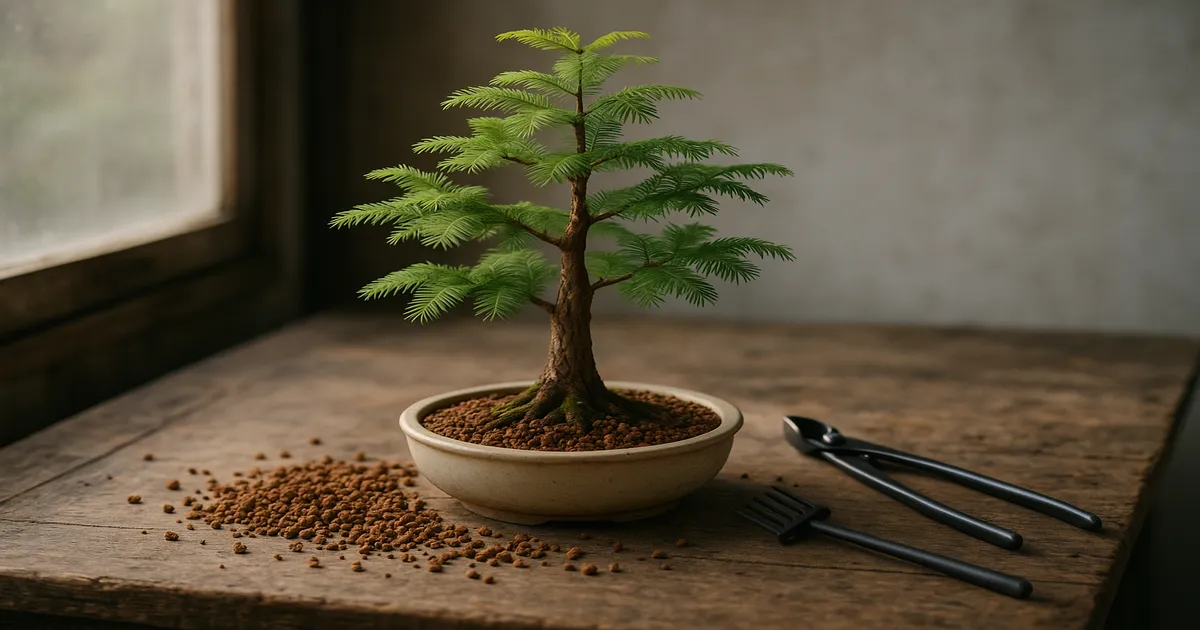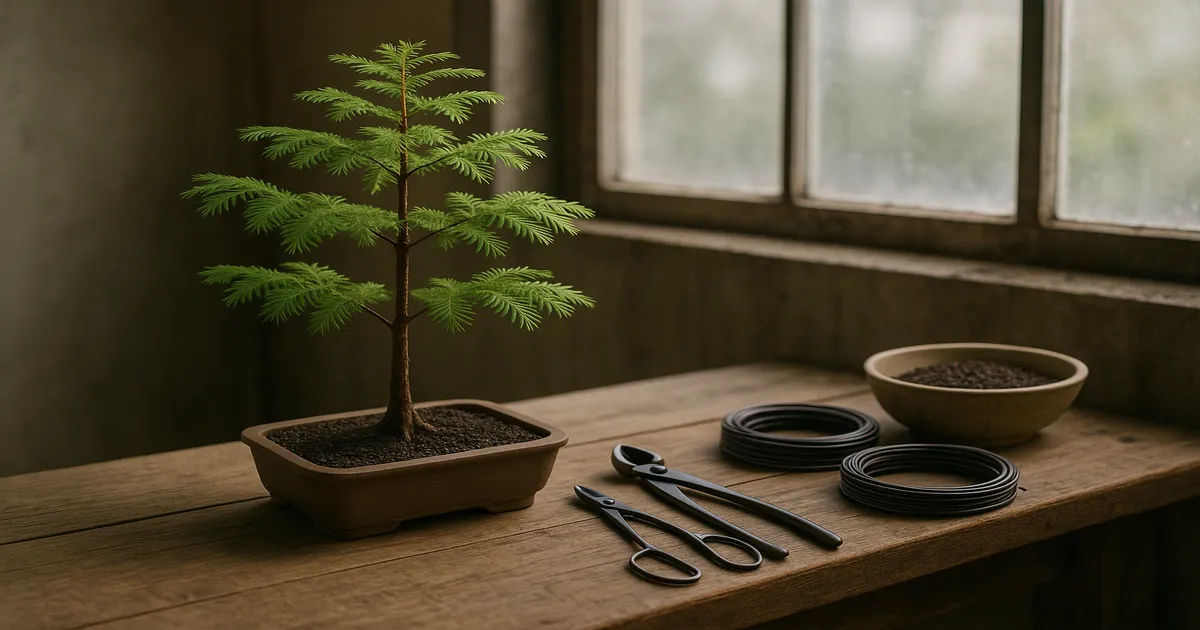
Quick Answer: Dawn redwood (Metasequoia glyptostroboides) makes an outstanding bonsai subject. It’s fast-growing, develops impressive fluted bark and nebari quickly, and delivers spectacular russet-orange autumn colour. It’s an outdoor-only species that needs genuine winter dormancy, but its forgiving nature and vigorous growth make it one of the better choices for intermediate growers ready to move beyond junipers and maples.
How to Bonsai a Dawn Redwood: Key Facts at a Glance
| Feature | Detail |
|---|---|
| Light | 6+ hours direct sun daily; afternoon shade above 95°F (35°C) |
| Water | Daily in summer; twice daily for small pots in heat |
| Hardiness (in ground) | USDA Zones 4–8 |
| Hardiness (container) | Treat as 1–2 zones less hardy |
| Repotting | Every 1–2 years (young); every 2–3 years (mature) |
| Best Styles | Informal upright, formal upright, twin-trunk, forest |
| Soil pH | 5.5–6.5 |
| Winter storage target | 25–38°F (-4–3°C) |
Dawn redwood is a deciduous conifer — one of only a handful in the world — and a genuine living fossil, unknown to science until a living population was discovered in China in the 1940s. It drops its feathery needles each autumn, giving you four visually distinct seasons in one tree.
Two things to stay on top of: its vigorous growth demands pruning every 2–4 weeks in summer, and wire cuts in fast. Manage both consistently and you’ll have a deeply rewarding tree.
Is Dawn Redwood a Good Bonsai for Beginners?
It’s more honest to call it a great second or third species. Dawn redwood is forgiving about watering, recovers well from pruning mistakes, and develops impressive trunk character faster than almost anything else. The frequent maintenance pruning and relentless wire monitoring can catch beginners off guard, though. If you’re comfortable with the basics and ready for a more active growing schedule, it’s an excellent choice.
Species Overview: What Makes Dawn Redwood Special
Botanical Background
Metasequoia glyptostroboides was known only from Cretaceous-era fossils until 1941–1944, when botanists discovered a living population in Lichuan County, Hubei Province, China. Seeds reached Western botanical gardens in 1948, and the tree quickly became one of the most widely planted ornamental conifers in the world. Fewer than 5,000 mature trees survive in the wild — yet it thrives in cultivation on every temperate continent.
Growth Habit and Bonsai-Worthy Features
In the wild, dawn redwood reaches 100–165 ft (30–50 m) with trunk diameters exceeding 6 ft (1.8 m). In open ground it can add 3–5 ft (0.9–1.5 m) per year — exceptional for a conifer. That speed translates directly into rapid trunk development during bonsai training.
Key features that make it so desirable:
- Naturally buttressed, fluted trunk that develops taper and character relatively quickly
- Pronounced nebari that forms without much encouragement
- Cinnamon-orange bark that becomes deeply fissured and fibrous with age
- Feathery, soft opposite foliage — lime-green in spring, deepening through summer, then russet-orange in autumn
- Opposite branching — unlike most conifers, branches grow in pairs, which has direct implications for pruning (covered below)
Best Cultivars for Bonsai
The straight species is almost always the best starting point — most vigorous, most reliable, fastest to develop trunk character. Cultivars have their uses but come with trade-offs:
- ‘Ogon’ – golden-yellow foliage; slower growing; prone to scorch in intense afternoon sun
- ‘Sheridan Spire’ – columnar form; suits formal upright styles
- ‘North Light’ – compact habit with shorter internodes; gaining traction in bonsai circles
- ‘Miss Grace’ – weeping form; rarely used in traditional bonsai but interesting for cascade experiments
Start with the species type. Explore cultivars once you understand the tree’s rhythms.
Light, Temperature, and Winter Protection
Outdoor Placement
Dawn redwood is strictly an outdoor bonsai. Permanent indoor cultivation leads to progressive decline — the tree needs genuine seasonal cycles, including cold dormancy, to stay healthy. Brief indoor display (two to three days maximum) is fine for exhibitions, but that’s the limit.
Aim for at least 6 hours of direct sun daily. A south- or east-facing position works well in the Northern Hemisphere. In climates regularly exceeding 95°F (35°C), afternoon shade prevents foliage scorch — especially important for ‘Ogon’.
Container Vulnerability and Zone Guidelines
In the ground, dawn redwood is hardy to USDA Zone 4, tolerating lows around -20°F (-29°C). In a container, the root mass is far more exposed, so treat it as roughly 1–2 zones less hardy.
- Zone 6 and warmer: A sheltered outdoor position, unheated garage, or cold frame is usually sufficient
- Zone 5: An unheated but frost-protected structure is strongly recommended
- Zone 4: Insulated cold storage targeting 25–38°F (-4–3°C) is advisable
How to Overwinter a Dawn Redwood Bonsai
The single most important principle: protect the roots, not the canopy. Branches handle cold far better than a root mass sitting in a shallow pot.
Dawn redwood needs 6–12 weeks of temperatures below 45°F (7°C) for healthy dormancy. Don’t short-circuit this by storing in a heated space — it weakens the tree significantly over time. Move it to winter storage after foliage has fully dropped (typically November), and return it to full outdoor conditions after the last frost risk has passed. During dormancy, check the soil monthly and water lightly only if it’s completely dry.
Soil and Watering
Recommended Soil Mix for Dawn Redwood Bonsai
Dawn redwood is a riparian species — it grows naturally along stream banks — so it has higher moisture needs than most bonsai. It still requires excellent drainage, though. Waterlogged soil causes root rot just as surely as drought does.
Standard mix: 40–50% akadama, 30–35% pumice, 20–30% lava rock
Use a particle size of 3–5 mm and target a pH of 5.5–6.5. Dawn redwood does not tolerate alkaline soils. A quality inorganic bonsai mix works well straight from the bag if you don’t want to blend your own.
Climate adjustments:
- Hot, dry climates (Southwest US, Mediterranean): Increase akadama to 50–60% for moisture retention
- Cool, humid climates (Pacific Northwest, UK): Drop akadama to 40% and increase pumice to 40% to prevent waterlogging
Avoid pure peat, standard potting compost, or any mix that compacts over time.
Watering Frequency and Technique
During the growing season, dawn redwood is thirsty. Daily watering is the norm in summer; small pots in hot weather may need water twice a day. Water thoroughly each time — soak until water flows freely from the drainage holes. This moistens the entire root mass and prevents salt buildup from tap water.
Rainwater or filtered water is preferred. Hard tap water raises soil pH over time; if you rely on tap water, flush the soil with rainwater every few weeks. In dry climates, a humidity tray filled with gravel and water (pot base sitting above the waterline) helps maintain ambient moisture around the foliage.
Overwatering signs: yellowing foliage starting at branch tips; mushy, sour-smelling roots; soil staying wet for more than 2–3 days; fungal growth on the soil surface.
Underwatering signs: needles turning brown and crispy from the tips inward; soil pulling away from pot edges; premature autumn colour; a noticeably lightweight pot.
Pruning Your Dawn Redwood Bonsai
Maintenance Pruning
This is the pruning you’ll do most often — every 2–4 weeks throughout the growing season. Once new shoots have extended 3–4 pairs of leaves, cut back to 1–2 pairs using sharp bonsai scissors. Don’t pinch with your fingers; dawn redwood’s opposite branching means pinching can damage the remaining bud pair.
Work apex-down and exterior-to-interior. This keeps lower and inner branches receiving enough light to stay vigorous. Letting the apex dominate and starving the lower structure is one of the most common mistakes growers make with this species.
Structural Pruning
Structural pruning — removing whole branches, significantly reducing the tree, reshaping the silhouette — is best done in late winter just before bud break (February–March in most of the Northern Hemisphere). The tree is dormant, all wounds are clearly visible, and the spring flush seals cuts quickly. A secondary window opens after the first spring flush hardens in late May to early June.
Apply wound sealant to any cut larger than 6 mm in diameter. (Kiyonal Cut Paste 100g) Dawn redwood calluses relatively quickly — large cuts can close within 2–3 growing seasons on a healthy tree.
Managing Opposite Branching
Because branches grow in opposite pairs, you’ll regularly need to remove one branch of each pair to create a more natural, alternating structure. Also prioritise removing crossing or rubbing branches, branches growing directly toward or away from the viewer, and bar branches (two branches at the same height on the same side).
Full defoliation isn’t recommended — dawn redwood doesn’t respond the way broadleaf deciduous species do. Cautious partial defoliation of the most vigorous areas (apex, outer tips) in midsummer can redirect energy toward weaker inner branches, but only on healthy, well-established trees.
Wiring Dawn Redwood Bonsai
Wire Type and Gauge
Always use aluminium wire on dawn redwood. The species is soft-wooded and grows rapidly; copper wire’s greater rigidity increases the risk of cutting in. Aluminium is gentler and far easier to adjust.
Gauge guide:
- Young trunks (training stage): 3.5–5 mm
- Primary branches: 2–3.5 mm
- Secondary branches: 1–2 mm
- Fine tertiary branches: 0.8–1 mm
A useful rule of thumb: wire diameter should be roughly one-third the diameter of the branch being wired.
Timing and Monitoring
The best windows for wiring are late winter before bud break and autumn after leaf drop. Avoid wiring during the rapid spring growth flush — branches can double in diameter within two to three weeks.
During the growing season, check wire every 1–2 weeks without exception. Dawn redwood sets position quickly — 4–8 weeks is often enough — but that same rapid growth means wire can bite in before you’ve noticed. Wire marks on this species’ attractive cinnamon bark are slow to fade, so prevention matters.
Always cut wire off in short sections using proper bonsai wire cutters. (Knipex 78 03 125 SB) Never unwind wire from a branch — you risk snapping wood or tearing bark.
Common wiring mistakes:
- Leaving wire on too long (the most damaging error with this species)
- Wiring too tightly at application
- Wiring during the spring growth flush
- Failing to anchor wire at a 45–60° angle before wiring smaller branches
Repotting Dawn Redwood Bonsai
How Often and When
Young trees in active training need repotting every 1–2 years — the vigorous root system fills a pot quickly. Once the tree has reached its target trunk size and basic structure, every 2–3 years is sufficient. You’ll know it’s time when roots are circling the pot, emerging from drainage holes, or when water runs off the surface rather than penetrating the soil.
Repot in late winter to very early spring — February to March — just as the buds begin to swell but before they open. The tree’s stored energy supports rapid root recovery, and the spring flush quickly compensates for root loss. Avoid repotting in summer heat, during active growth, or in autumn.
Root Pruning and Pot Selection
Remove the tree carefully, comb out the root mass, and trim circling and overly long roots. On young trees, removing up to one-third of the root mass is acceptable; be more conservative with mature specimens. Repot into fresh soil immediately — don’t leave roots exposed to air.
For pot selection, wider and shallower pots suit the species’ naturally spreading nebari. Unglazed earth tones — browns, greys, warm reds — complement the cinnamon bark well. Avoid glazed pots in colours that compete with the autumn foliage display.
Styling: Design Principles for Dawn Redwood Bonsai
Informal upright (moyogi) and formal upright (chokkan) are the most natural fits, reflecting the tree’s upright growth habit in the wild. Twin-trunk (sokan) and forest plantings (yose-ue) are particularly effective — dawn redwood grows naturally in dense riparian stands, and a group planting captures that essence beautifully.
The fastest way to develop impressive trunk girth is to grow the tree in the ground or a large training container for several years before potting up. Dawn redwood’s natural buttressing and fluting mean the trunk develops character faster than most species — you’re working with the tree’s tendencies rather than against them.
Deadwood features like jin and shari are less traditional here. The naturally ornamental bark is the star; carving into it generally reduces rather than enhances the aesthetic.
Four seasons of display:
- Spring – delicate lime-green foliage emerges from reddish buds; one of the most beautiful moments in bonsai
- Summer – full mid-green canopy; a period of vigorous growth and active management
- Autumn – russet-orange to brick-red colour; arguably the most spectacular display
- Winter – bare silhouette reveals branch structure and the full beauty of the fluted trunk
Troubleshooting Common Problems
Yellowing foliage: Yellowing starting at branch tips with mushy roots points to overwatering or poor drainage. General yellowing across the whole canopy with healthy roots suggests alkaline soil — check pH and flush with rainwater or apply a mild acidifying fertiliser. Note that the whole tree turning russet-orange in autumn is not a problem; it’s the point.
Weak or dying back branches: The most common cause is insufficient light reaching interior branches. Reinforce apex-down pruning discipline and thin the outer canopy to let light penetrate. Branches that have already died back to the trunk should be removed cleanly and sealed.
Pests: Dawn redwood is relatively pest-resistant. Watch for spider mites in hot, dry conditions (fine webbing, stippled foliage — treat with insecticidal soap or neem oil), scale insects at bark and branch junctions (treat with horticultural oil in late winter), and aphids on new spring growth (usually manageable with a strong water jet).
Poor autumn colour or failure to drop leaves: Both usually trace back to the same cause — the tree isn’t getting enough seasonal temperature drop or sufficient autumn sun. Keep it outside in full sun until the foliage drops on its own schedule. Moving it indoors too early disrupts dormancy and suppresses colour.
Frequently Asked Questions
Can you keep a dawn redwood bonsai indoors?
No. Dawn redwood is an outdoor-only species. Permanent indoor cultivation leads to progressive decline, increased pest susceptibility, and eventual death. The tree requires genuine winter dormancy — 6–12 weeks below 45°F (7°C) — to stay healthy. Brief indoor display of two to three days is acceptable for exhibitions, but no longer.
How fast does a dawn redwood bonsai grow?
Very fast by bonsai standards. In a training container with regular fertilising, expect 12–24 inches (30–60 cm) of new growth per season. This is what makes the species so rewarding for trunk development — and why maintenance pruning every 2–4 weeks is non-negotiable during the growing season.
When does a dawn redwood bonsai lose its leaves?
Typically October to November in the Northern Hemisphere, depending on your climate and how much sun the tree receives through autumn. Leaf drop is triggered by shortening days and falling temperatures. If your tree is holding leaves unusually late, it’s likely getting too much artificial warmth or shelter — move it to a more exposed position.
How do I thicken the trunk on a dawn redwood bonsai?
The most effective method is sacrifice growth — allow the tree to grow freely in a large training pot or in the ground for several years without heavy pruning. Feed generously with a balanced fertiliser through spring and summer. Once the trunk reaches your target diameter, pot up and begin refining the structure. Dawn redwood responds to this approach faster than almost any other bonsai species.
Why are the needles on my dawn redwood turning brown in summer?
Summer browning (as opposed to the expected russet colour in autumn) is almost always underwatering or heat stress. Check that you’re watering thoroughly and frequently enough — daily or twice daily in hot weather for small pots. If watering is adequate, check whether the tree is getting too much intense afternoon sun; move it to a position with afternoon shade during the hottest weeks.