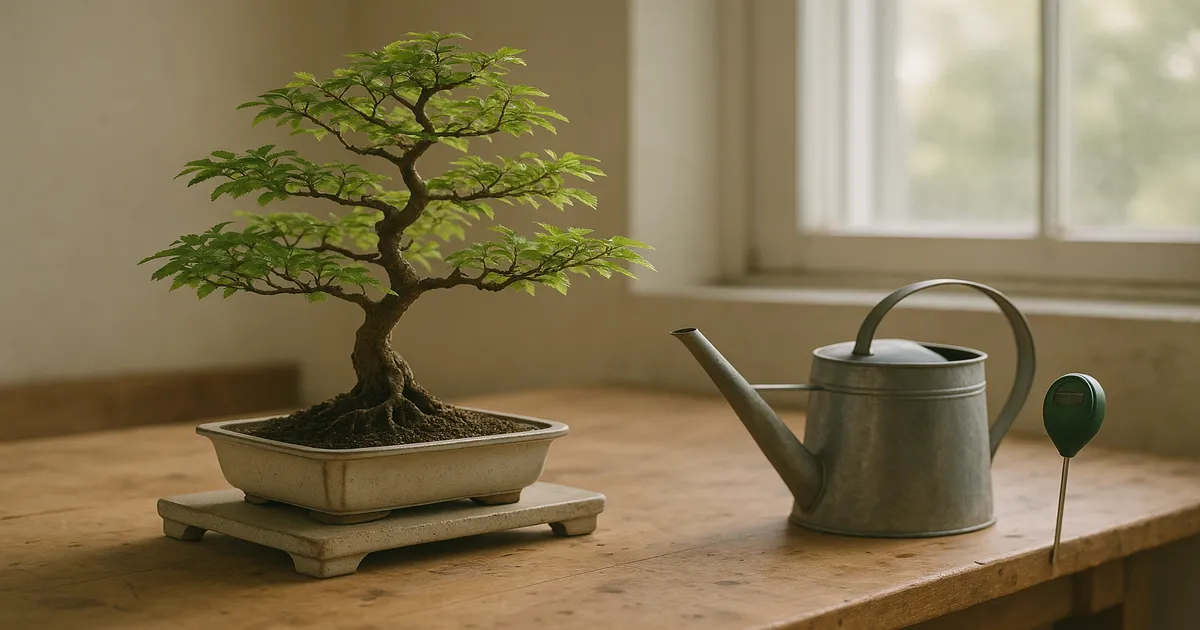
Quick Answer: There’s no fixed schedule for watering Chinese elm bonsai — water when the top ½ inch of soil begins to dry out, checking daily. In practice, that means roughly every 1–2 days in spring, daily (or twice daily) in summer, every 2–3 days in autumn, every 7–14 days during winter dormancy, and every 2–4 days for indoor trees year-round.
How often should you water Chinese elm bonsai is one of the most common questions beginners ask — and the honest answer is: it depends on your season, your pot, your soil, and your climate. What never changes is the method. Check the soil every day and water based on what you find, not what the calendar says.
How Often Should You Water Chinese Elm Bonsai: Seasonal Guide
The Golden Rule: Check Daily, Not the Calendar
The Chinese elm (Ulmus parvifolia) is forgiving compared to many bonsai species, but a rigid watering schedule will still get you into trouble. Soil dries at wildly different rates depending on temperature, pot material, root density, and humidity. A tree that needed water every day last week might only need it every three days this week if the weather turned cool and cloudy.
Check the soil daily and water when the top ½ inch (about 1.5 cm) starts to dry — not bone dry, but no longer moist at the surface. That simple habit will carry your tree through every season.
Seasonal Frequency at a Glance
| Season | Typical Frequency |
|---|---|
| Spring | Every 1–2 days |
| Summer | Daily to twice daily |
| Autumn | Every 2–3 days |
| Winter (dormant) | Every 7–14 days |
| Indoor (year-round) | Every 2–4 days |
These are starting points, not rules. Use them to calibrate your expectations, then let the soil tell you the rest.
Species Traits That Drive Watering Needs
Native Habitat and Moisture Preferences
Chinese elm grows naturally along riverbanks, forest margins, and rocky hillsides across China, Japan, Korea, and Vietnam — up to about 5,900 ft (1,800 m) elevation. Those riverbank origins are telling: this tree evolved with consistent moisture, but never stagnant, waterlogged roots. It wants steady hydration, not wet feet.
In bonsai, the goal is to keep the root zone cycling between “just drying at the surface” and “thoroughly saturated” — not swinging between drought and flood.
Deciduous vs. Semi-Evergreen Behaviour
Whether your Chinese elm drops its leaves in winter depends on where you live. In colder climates (USDA Zones 5–6), it goes fully deciduous. In mild climates or indoors, it often behaves as semi-evergreen, holding most of its foliage year-round. This matters because a leafy tree actively transpires — it pulls water through its system continuously. A fully dormant, leafless tree needs dramatically less water.
Cultivar Differences Worth Knowing
Cultivar choice affects how quickly your tree dries out. The straight species is vigorous and builds a dense root system fast, consuming water quickly. Dwarf cultivars behave differently:
- ‘Seiju’ — very small leaves, compact growth, dries out more slowly
- ‘Hokkaido’ — tiny leaves, extremely tight internodes, slower water consumption
- ‘Catlin’ — dense branching, moderately vigorous
- ‘True Green’ — semi-evergreen even in cool climates, retains leaves (and transpiration) longer into winter
If you’re growing a dwarf cultivar in a modest pot, don’t assume it needs water as often as a full-species tree.
Soil Mix: Your Most Important Watering Tool
Why Soil Composition Controls Watering Frequency
Soil is the foundation of your entire watering strategy. A good inorganic mix drains freely after watering, then holds just enough moisture in the particle pores to sustain the roots. You can water thoroughly every time without fear of root rot, and the soil dries predictably — making it easy to read.
Peat-based or standard potting mixes do the opposite. They hold water unevenly, stay wet in the center while drying at the edges, and compact over time, creating anaerobic pockets where root rot thrives.
Aim for a particle size of 3–6 mm (1–3 mm for mame and shohin). (Bonsai Jack Inorganic Bonsai Soil Mix)
Climate-Adjusted Soil Ratios
- Temperate climates (moderate humidity): 2:1:1 akadama, pumice, lava rock
- Hot, dry climates (e.g., Southwest US): 3:1:1 akadama, pumice, lava rock (more water retention)
- Humid climates or indoor growing: 1:1:1 akadama, pumice, lava rock for maximum drainage
If Japanese components aren’t available, Turface MVP works as an akadama substitute, perlite can replace pumice (though it floats when watering), and decomposed granite works as a partial lava rock stand-in. Keep soil pH between 6.0 and 7.0.
Standard potting soil is the single biggest watering mistake beginners make. It retains far too much moisture, compacts within a season, and suffocates roots. Neither it nor peat-based mixes belong in a bonsai pot.
How to Water Chinese Elm Bonsai Correctly
The Finger and Chopstick Moisture Test
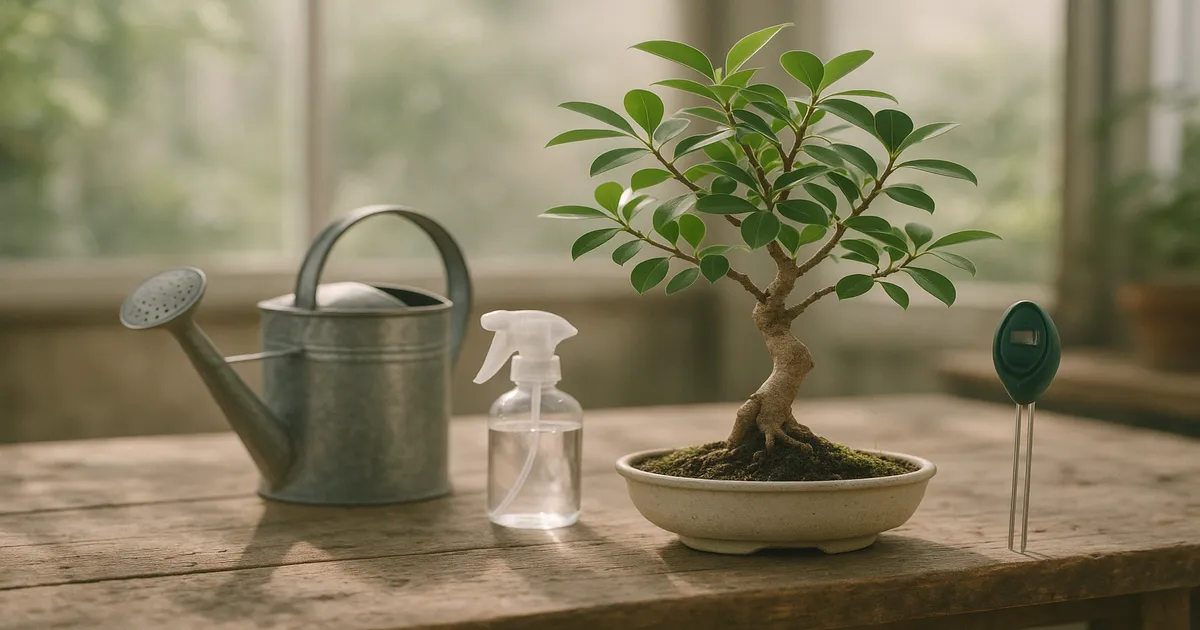
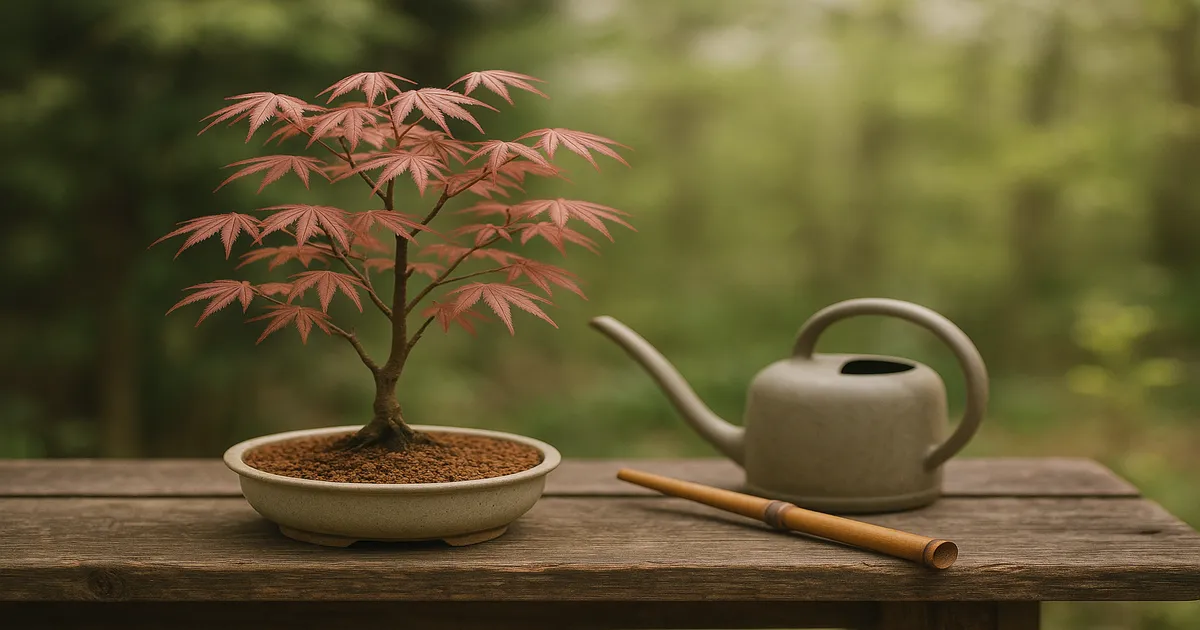
Push a wooden chopstick or your finger about 1–1.5 inches (2.5–4 cm) into the soil. If it comes out with moist particles clinging to it, wait. If it comes out clean and dry, water now. This low-tech test is more reliable than any schedule and takes about two seconds. Experienced growers also judge by pot weight — a dry pot feels noticeably lighter. Combine both methods and you’ll rarely get it wrong.
Step-by-Step Watering Technique
- Use a watering can with a fine rose head to apply water gently across the entire soil surface.
- Water until it flows freely from all drainage holes — this ensures the full root mass is moistened and flushes any salt buildup.
- Wait 2–3 minutes, then do a second pass. Akadama can initially repel water when very dry; the second pass ensures full saturation.
- Empty any saucers or trays after watering so the pot isn’t sitting in standing water.
Best Time of Day to Water
Morning is ideal. The soil has typically dried somewhat overnight, the tree is ready to drink as light levels rise, and any water on the foliage dries before evening — reducing fungal disease risk. In summer, avoid watering in the midday heat. Cold water hitting hot roots causes stress, and water droplets on leaves can intensify sunlight and cause scorch.
Factors That Speed Up or Slow Down Soil Drying
Soil dries faster when:
- The pot is small (less soil volume)
- The pot is terracotta or unglazed ceramic (porous walls allow evaporation)
- Temperatures are high and humidity is low
- The tree is in full sun or exposed to wind
- The root system is dense and actively consuming water
Soil dries slower when:
- The pot is glazed ceramic or plastic
- Temperatures are cool and humidity is high
- The tree is in a shaded location or fully dormant
- The soil mix is akadama-heavy
Seasonal Watering in Detail
Spring: Ramping Up as Growth Flushes Begin
As temperatures climb and buds break, water demand increases rapidly. Roots become active before you can even see new growth, so start checking soil daily as soon as nighttime temperatures consistently stay above 40°F (4°C). Most outdoor trees in temperate conditions will need water every 1–2 days — more if it’s warm and dry. Watch for the pot drying faster than it did the week before; that’s your signal the root system is waking up.
Summer: Peak Demand and Heat Management
Summer is when watering can become a twice-daily job. Small pots in full sun above 85°F (29°C) can dry out within hours. Check morning and evening, and don’t be surprised if both checks warrant watering. Above 95°F (35°C), move your tree to afternoon shade — not just to conserve water, but to protect roots from heat stress.
Autumn: Tapering Off as Growth Slows
As days shorten and temperatures drop, growth slows and water demand follows. Shift from daily checks to every-other-day, and reduce frequency gradually rather than abruptly. If your tree is deciduous and starts dropping leaves, cut back further — a leafless tree transpires very little. Don’t stop checking entirely, though. Autumn warm spells can dry soil faster than expected.
Winter Dormancy: Minimal but Critical Moisture
A dormant Chinese elm needs very little water — but “very little” is not zero. Water every 7–14 days during cold storage, checking the soil every 5–7 days to make sure it hasn’t dried completely. Roots that desiccate over winter may not recover when spring arrives.
The flip side matters equally: overwatering a dormant tree is a leading cause of root rot. Cold, wet soil with minimal root activity is the perfect environment for Phytophthora and Pythium. When in doubt, err slightly on the dry side — just never let the soil go bone dry.
Indoor Chinese Elm Watering: Special Considerations
Central heating drops relative humidity to 20–30% in winter — far below the 50–70% RH that Chinese elm prefers. That dry air pulls moisture from both the soil and the foliage, so your indoor tree may dry out just as fast as an outdoor summer tree even in a cool room. Check indoor trees every two days as a baseline.
Three strategies help with indoor humidity. A pebble tray (pot sitting above the waterline, not in it) raises local humidity as water evaporates. Grouping several plants together creates a shared microclimate. A room humidifier is the most effective option for serious indoor growers.
Light matters too. A tree in a dim corner transpires less and needs less frequent watering — but that’s not a good thing. Low light means reduced photosynthesis and eventual decline. Place indoor trees in the brightest available spot (south- or east-facing window). If natural light is limited, full-spectrum LED grow lights make a real difference. A healthy, well-lit tree that needs water every two days is in far better shape than a struggling tree that needs it every five.
Diagnosing Watering Problems
Signs of Overwatering
- Leaves yellowing, starting with older foliage lower in the canopy
- Leaves dropping while still green and soft
- Soil stays wet for more than 3–4 days without drying
- Foul smell from the soil or dark, mushy roots when you probe them
Signs of Underwatering
- Leaf edges browning and crisping (dry scorch, not soft yellowing)
- Leaves curling inward or looking dull rather than glossy
- Leaves dropping dry and crispy
- Soil visibly pulling away from the pot walls
- The pot feels unusually light when lifted
Paradoxical Wilting: When Wet Soil Causes Wilt
If your tree is wilting but the soil is wet, don’t water more — that’s the problem. Paradoxical wilting happens when root rot has progressed so far that the root system can no longer uptake water even though it’s available. This requires immediate action.
Recovery: Overwatered or Dried-Out Trees
For overwatering / root rot:
- Remove the tree from its pot and gently shake off the old soil.
- Cut away any dark, mushy, or foul-smelling roots with sterile scissors.
- Let the roots air-dry for 20–30 minutes.
- Repot in fresh inorganic mix with excellent drainage.
- Water sparingly for the next 2–3 weeks while the root system recovers.
For underwatering / severe dryness:
- Submerge the entire pot in a bucket of water for 10–15 minutes — this fully rehydrates soil that has shrunk away from the pot walls and is repelling surface watering.
- Allow it to drain completely, then return the tree to its spot.
- Resume daily moisture checks and water before the soil dries fully.
How Pruning and Repotting Affect Watering
After repotting, water thoroughly right away, then monitor closely for 4–6 weeks. The disturbed root system is less efficient at uptake, so keep the tree in partial shade and don’t let the soil dry out as much as you normally would.
After heavy structural pruning that removes a large portion of the canopy, transpiration demand drops. Scale back watering slightly in the weeks following a major prune and resume normal frequency as new growth emerges.
Spring wiring coincides with the most vigorous growth of the year, which means soil dries faster and wire bites into bark faster. Check wired branches every 2–3 weeks. A well-watered, vigorously growing tree can show wire marks within 3–4 weeks in peak spring conditions.
Frequently Asked Questions
How do I know when my Chinese elm bonsai needs water?
Insert a wooden chopstick or your finger about 1–1.5 inches into the soil. If it comes out dry and clean, water immediately. If it comes out with moist soil clinging to it, wait and check again tomorrow. You can also judge by pot weight — a dry pot feels noticeably lighter than a freshly watered one.
Can you overwater a Chinese elm bonsai?
Yes, and it’s one of the most common ways to kill one. Overwatering leads to root rot (Phytophthora and Pythium species), which destroys the root system and eventually kills the tree. Symptoms include green leaf drop, yellowing older foliage, and soil that stays wet for days. The fix is proper inorganic soil and checking moisture before watering — not following a fixed schedule.
Why are the leaves falling off my Chinese elm bonsai?
Leaf drop has several causes. Natural deciduous behaviour in autumn is normal. If leaves are dropping green and soft, overwatering or root rot is likely. If they drop dry and crispy, underwatering or low humidity is the culprit. Sudden indoor leaf drop is often caused by a dramatic change in light or temperature — for example, moving the tree inside for winter without a gradual transition.
How often should you water a Chinese elm bonsai in winter?
During dormancy, water every 7–14 days — enough to prevent the roots from desiccating, but not so much that the soil stays chronically wet. Check the soil every 5–7 days and water only when the top inch feels dry. Overwatering a dormant tree in cold conditions is a primary cause of root rot, so when in doubt, err slightly on the drier side.
Should Chinese elm bonsai be kept indoors or outdoors?
Outdoors during the growing season produces stronger trees with better ramification and bark development. Indoors is viable year-round only with supplemental lighting and humidity management — insufficient light is the most common cause of indoor Chinese elm decline. For growers in colder climates, the best approach is outdoors in warm months and cool indoor storage (unheated garage or shed) in winter.