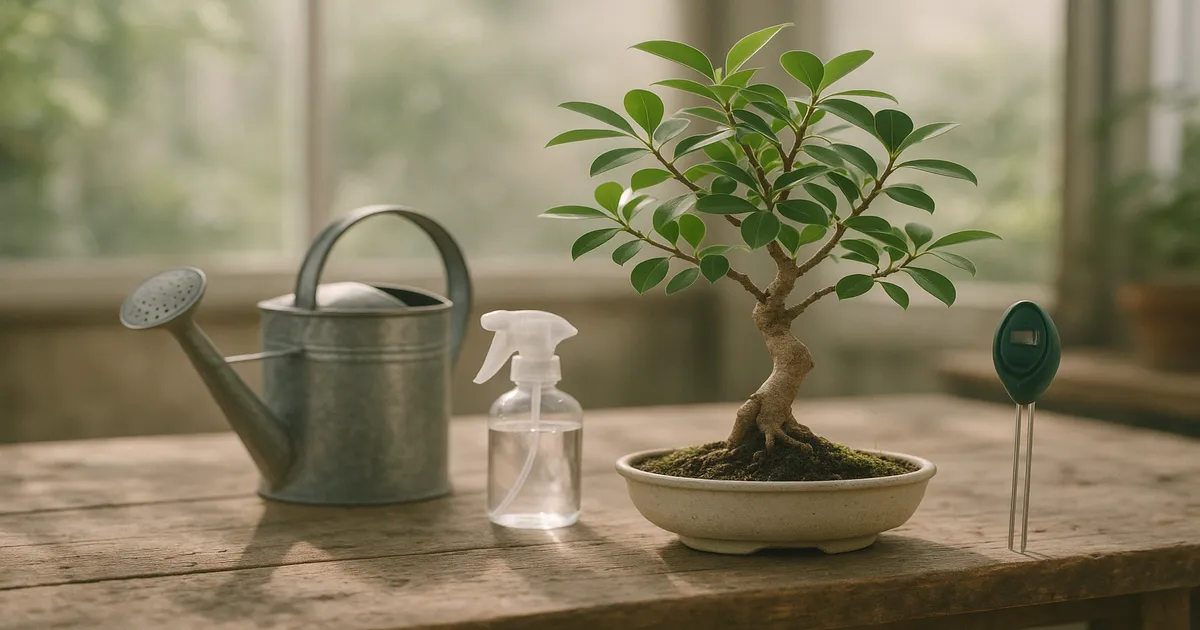
Quick Answer: There’s no single answer to how often you water a bonsai ficus — it depends on season, pot size, soil mix, and your indoor environment. The most reliable method is the finger test: water when the top ½–1 inch of soil is barely moist to dry. In summer, that might mean every 1–2 days; in winter indoors, every 5–7 days or longer.
Figuring out how often to water a bonsai ficus is the question that trips up more beginners than almost anything else. The ficus is forgiving in many ways — it tolerates low light, rebounds from stress, and grows vigorously indoors. But get the watering wrong consistently, and no amount of good intentions will save it. This guide covers everything you need to know: reading your tree’s signals, understanding the variables that shift your watering schedule, and building a soil mix that makes correct watering actually achievable.
How Often to Water a Bonsai Ficus: The Core Rule
No Fixed Schedule — Here’s Why
Watering on a calendar — “every three days, no matter what” — is one of the most common mistakes ficus owners make. A tree sitting near a sunny south-facing window in July has completely different needs than the same tree on a dim shelf in January. Your job is to read the conditions, not follow a clock.
The finger test is your best tool. Push your finger ½–1 inch into the soil near the edge of the pot. If it feels barely moist to dry at that depth, water now. If it still feels clearly moist, wait a day and check again.
Seasonal Watering Frequency at a Glance
| Season / Condition | Typical Watering Frequency |
|---|---|
| Spring–summer, outdoors | Every 1–2 days (daily in heat waves) |
| Spring–summer, indoors (good light) | Every 2–3 days |
| Fall, indoors | Every 3–5 days |
| Winter, indoors (slow growth) | Every 5–7 days or longer |
| Post-repotting | Every 3–5 days; monitor carefully |
These are ranges, not rules. The sections below explain the variables that push your tree toward one end or the other.
The 7 Variables That Determine How Often to Water a Bonsai Ficus
1. Pot Size and Material
Small pots dry out faster than large ones — there’s simply less soil to hold moisture. Material matters too. Unglazed terracotta wicks moisture through its walls and dries noticeably faster than glazed ceramic or plastic. If you’ve recently switched pot types, recalibrate your expectations. A quality unglazed bonsai pot will dry faster than a glazed equivalent of the same size, which is worth factoring into your routine.
2. Soil Composition and Drainage
Soil and watering are inseparable. A well-draining inorganic mix dries faster than one heavy in akadama or organic material — and that’s a feature, not a bug, because it gives you more control. Standard potting soil is the worst option: it compacts, suffocates roots, and stays wet far too long.
3. Light Intensity and Temperature
More light drives more photosynthesis, which drives more water demand. A ficus under a grow light running 14 hours a day needs water more often than one sitting in a dim corner. Higher temperatures accelerate both evaporation from the soil surface and transpiration through the leaves. In summer, this combination can mean daily watering for outdoor trees.
4. Indoor Humidity
This one surprises people. When indoor humidity drops below 40% — common in heated winter homes — water evaporates from the soil faster and the tree loses moisture through its leaves more rapidly. You may actually need to water more often in winter not because the tree is growing, but because your heating system is drying everything out.
5. Season and Growth Stage
During a spring growth flush, a ficus in active bud break can drink its pot nearly dry overnight. In winter, that same tree in slow growth may sit for a week before needing water. Pay attention to what the tree is doing, not just what month it is.
6. Tree Health and Root Mass
A healthy, root-bound tree has dense root mass that absorbs water efficiently and can drain a pot quickly. A recently repotted tree with reduced roots absorbs water much more slowly, raising the risk of overwatering even if your schedule hasn’t changed.
7. Post-Repotting Adjustments
After repotting, you’ve removed some root mass. The tree can’t take up water as fast as before, so err toward less frequent watering and always use the finger test rather than your previous schedule. Wet soil around damaged roots is a fast track to root rot.
How to Tell When Your Ficus Bonsai Needs Water
The Finger Test
- Push your finger ½–1 inch (1–2.5 cm) into the soil near the edge of the pot.
- Clearly moist: Wait one more day, then recheck.
- Barely moist to dry: Water now.
- Bone dry: You’ve waited too long — water immediately and watch for stress signs.
The challenge isn’t the technique; it’s building the habit of checking daily rather than watering on autopilot.
The Pot-Weight Method
Lift the pot right after watering and notice how heavy it feels. Lift it again a day or two later. Over time you’ll develop an intuitive sense for what a dry pot feels like versus a saturated one. Experienced growers often rely on this more than anything else — it takes two seconds.
Visual Cues
- Soil pulling away from pot edges: The soil is shrinking from desiccation — water soon.
- Dull, matte leaf surface: Healthy ficus leaves have a slight sheen; dullness often signals moisture stress.
- Slight leaf curl: Leaves curling inward along the midrib is an early underwatering signal.
- Lightweight pot: Confirms what the visual cues are suggesting.
Don’t wait for dramatic wilting. By the time a ficus is visibly wilting, it’s already under significant stress.
Proper Watering Technique
The Two-Pass Method
Water thoroughly until water flows freely from all drainage holes, then wait 2–3 minutes and water again. The first pass wets the soil surface and starts penetrating downward. The second ensures complete, deep saturation and flushes accumulated mineral salts. Shallow watering that only wets the top inch is one of the most common quiet killers of bonsai. A long-necked bonsai watering can makes it easy to water slowly and evenly without disturbing the soil surface.
Water Type and Temperature
Rainwater is ideal. Filtered water is excellent. Tap water is perfectly acceptable — let it sit in an open container for 24 hours to off-gas chlorine before using it. Avoid softened water entirely; it’s high in sodium and will damage roots over time.
Water temperature matters more than most people realize. Cold water below 55°F (13°C) can shock roots, especially in winter. Use room-temperature water as a habit.
Humidity Trays and Misting
Misting foliage does not substitute for watering the roots — it simply doesn’t get moisture where it needs to go. In still indoor air it can also promote fungal problems on leaves. Skip it as a hydration strategy.
Two methods actually work for humidity:
- Humidity tray: Place the pot on a tray filled with gravel and water, keeping the water level below the drainage holes so roots aren’t sitting in water.
- Room humidifier: The most effective solution. Target 50–70% relative humidity.
Grouping multiple plants together also raises local humidity through collective transpiration — a free solution worth using.
Choosing the Right Soil Mix
Why Standard Potting Soil Fails
The wrong soil makes correct watering nearly impossible. Standard potting soil compacts over time, suffocates roots, and holds moisture far too long in bonsai containers. An inorganic mix gives you the drainage and aeration that ficus roots need.
Recommended Mixes
General Purpose Mix:
- 40% akadama
- 30% pumice
- 30% lava rock (scoria)
Beginner / Drier Climate Mix (better moisture retention):
- 50% akadama
- 25% pumice
- 25% lava rock
High-Humidity Environment Mix (faster drainage):
- 25% akadama
- 40% pumice
- 35% lava rock
Aim for 3–5 mm particle size for most bonsai, and 2–3 mm for smaller shohin trees. If your home is very dry in winter, lean toward the beginner mix. If you tend to overwater or live in a humid climate, the high-humidity mix gives you more margin for error. You can add up to 10% fine pine bark for extra moisture retention in very arid conditions — but skip peat moss entirely, as it compacts quickly and acidifies the soil over time.
Diagnosing Watering Problems
Signs of Overwatering
- Yellowing leaves, especially on lower, older growth first
- Wilting despite wet soil (root rot prevents water uptake)
- Mushy roots visible at drainage holes
- Foul, sulfurous odor from the soil
- Fungus gnats hovering around the pot
- Green leaves dropping suddenly without yellowing first
Signs of Underwatering
- Leaves curling inward along the midrib
- Dry, crispy leaf edges
- Soil visibly pulling away from pot edges
- Pot feels unusually light
- Twig dieback starting from branch tips and working inward
How to Recover a Stressed Ficus
Overwatered: Stop watering and allow the soil to dry more between sessions. Check roots for rot — healthy roots are white or tan and firm; rotted roots are brown, mushy, and may smell. If root rot is present, repot into fresh inorganic mix, trim affected roots, and resume cautious watering.
Underwatered: Water immediately using the two-pass method. Move the tree to bright indirect light and keep temperatures in the 65–75°F (18–24°C) range. Most ficus recover quickly once moisture is restored — watch for new leaf buds within 1–2 weeks as a sign the tree is bouncing back.
Seasonal Adjustments and Special Situations
Spring and Summer
This is the most demanding period. Outdoor trees in full sun may need water every day or every other day. Indoor trees with good light typically need watering every 2–3 days. During heat waves, check soil daily — a small pot can go from moist to bone dry in 24 hours when temperatures exceed 90°F (32°C).
Fall and Winter
As growth slows in fall, gradually extend the interval between waterings. By mid-winter, indoor ficus in typical home conditions often need water only every 5–7 days. The risk here isn’t underwatering — it’s overwatering a slow-growth tree in low light. Keep trees away from heating vents, which blast dry air and can desiccate the soil surface while leaving the deeper root zone wet. That inconsistency makes the finger test even more important in winter.
Moving Ficus Outdoors in Summer
Moving your ficus outside for summer is one of the best things you can do for it — more light, better air circulation, faster growth. But it also means monitoring water daily. Wind, direct sun, and higher temperatures can dry a pot far faster than any indoor setup. Acclimate gradually: start with a shaded outdoor spot for one to two weeks before moving to full sun to prevent leaf scorch.
After Pruning or Repotting
After a significant prune, the tree has less foliage and therefore less transpiration demand — water needs may drop temporarily. After repotting, reduced root mass means slower water uptake. In both cases, use the finger test rather than your previous schedule, and lean toward slightly less frequent watering until vigorous new growth appears.
Frequently Asked Questions
How do I know if my bonsai ficus needs water?
Use the finger test: push your finger ½–1 inch into the soil. If it feels barely moist to dry at that depth, water now. Visual cues — dull leaf sheen, slight leaf curl, soil pulling away from pot edges — also signal that watering is due.
Can you overwater a bonsai ficus?
Yes, and it’s the most common way ficus bonsai die. Symptoms include yellowing lower leaves, green leaves dropping suddenly, wilting despite wet soil, and a foul odor from the pot. Let the soil dry more between waterings, and if root rot has set in, repot into fresh inorganic mix.
Why are leaves falling off my bonsai ficus after watering?
Sudden green leaf drop after watering usually means one of two things: the tree was already overwatered and root rot is preventing water uptake, or the water was too cold and shocked the roots. It can also happen when a ficus — especially F. benjamina — is moved to a new location. Check soil moisture, rule out root rot, and stabilize the tree’s environment.
Should I mist my bonsai ficus to keep it hydrated?
No. Misting foliage doesn’t hydrate the roots and can cause fungal problems in still indoor air. Use a humidity tray or a room humidifier targeting 50–70% relative humidity instead — both are far more effective.
How often should I water a ginseng ficus bonsai indoors?
Under good indoor light, a ginseng ficus typically needs water every 2–3 days in spring and summer, and every 5–7 days in winter. Always use the finger test rather than a fixed schedule — pot size, soil mix, and your home’s humidity all affect how quickly the soil dries out.