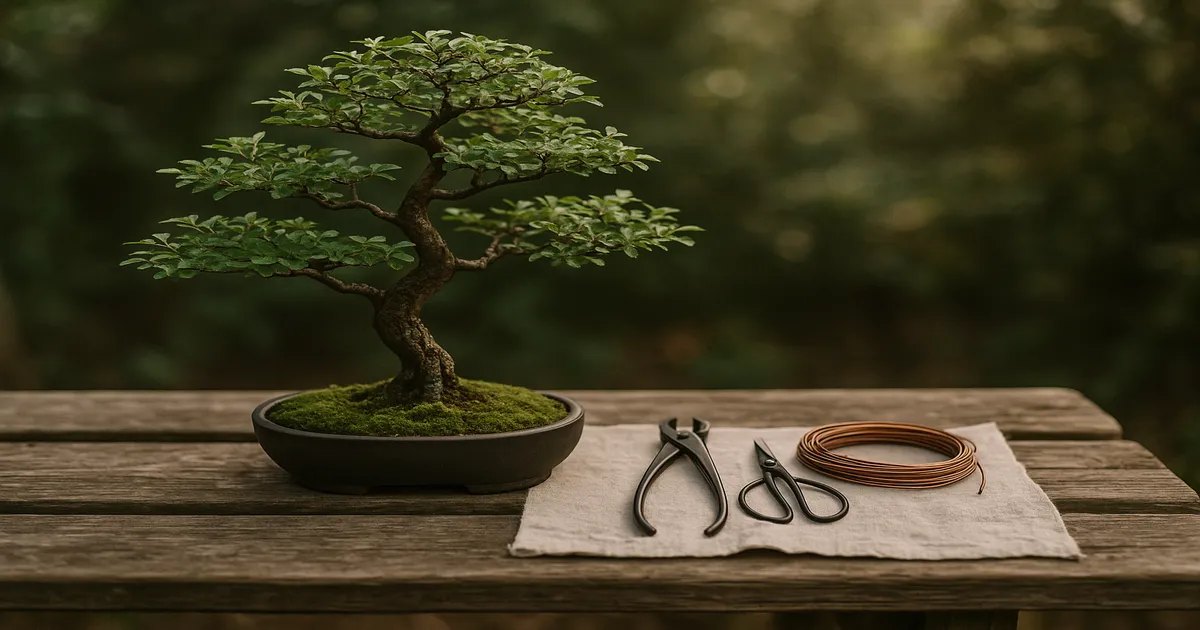
Quick Answer: Chinese elm (Ulmus parvifolia) uses two core pruning techniques — maintenance pruning (the clip-and-grow method) throughout the growing season from March to September, and structural pruning in late winter before bud break. It’s one of the most forgiving bonsai species for pruning, responding quickly with vigorous back-budding that builds fine ramification over time.
This Chinese elm bonsai pruning guide covers everything from seasonal timing and the clip-and-grow method to structural branch selection, defoliation, wiring, and troubleshooting. Once you understand the rhythm of the tree, pruning becomes one of the most satisfying parts of working with this species.
Chinese Elm Bonsai Pruning: Seasonal Calendar
What Makes Chinese Elm Ideal for Pruning
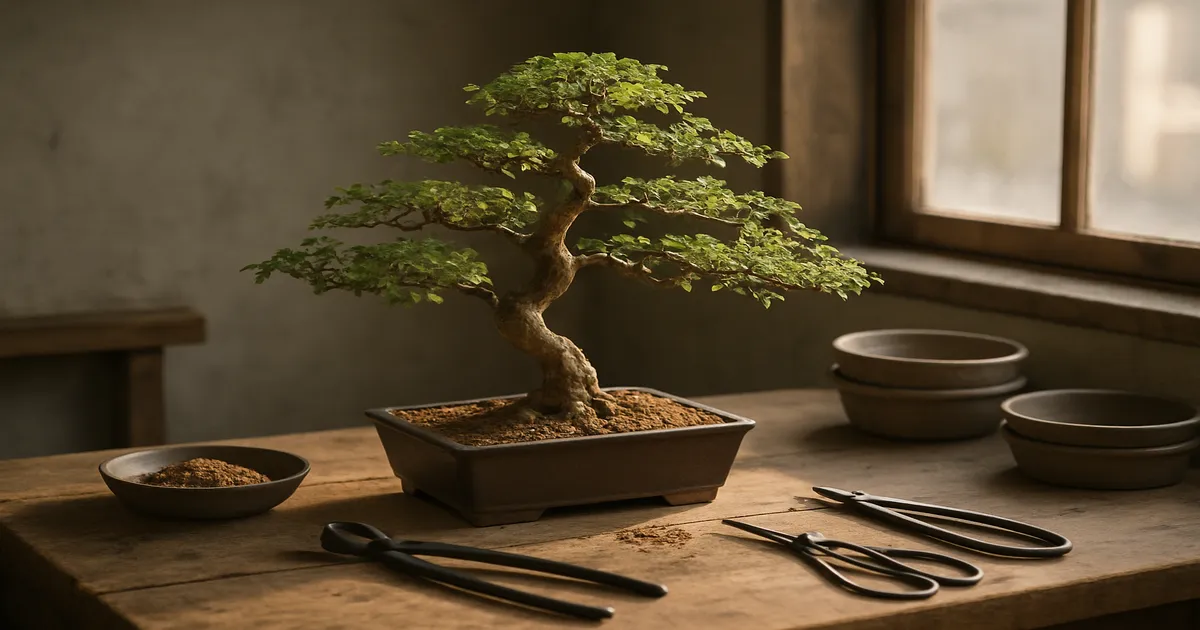
Ulmus parvifolia is arguably the best species for beginners learning to prune bonsai. Its rapid back-budding means mistakes are rarely fatal, and its naturally small, glossy leaves reduce in size with repeated clip-and-grow cycles. The mottled, exfoliating bark develops real character with age, rewarding long-term refinement work.
The signature technique for this species is clip-and-grow: allow a shoot to extend, cut it back, let it back-bud, and repeat. Over multiple seasons this builds the dense, fine ramification that defines a refined Chinese elm.
| Season | Pruning Activity |
|---|---|
| Late Winter (Feb–Mar) | Structural pruning before bud break; wiring |
| Spring (Mar–May) | Begin maintenance pruning as first flush extends |
| Summer (Jun–Aug) | Continue clip-and-grow; defoliation in June if needed; secondary structural window in August |
| Early Fall (Sep) | Final maintenance pruning; allow tree to harden before dormancy |
| Late Fall (Oct–Nov) | Wiring after leaf drop; no significant pruning |
| Winter (Dec–Jan) | Dormancy; avoid pruning outdoor trees |
Understanding Chinese Elm Growth Habits
Growth Flushes and Apical Dominance
Chinese elm grows in flushes — rapid bursts of extension followed by a brief pause. This rhythm tells you when to prune: as soon as a new shoot extends 3–4 nodes beyond your desired silhouette, cut it back.
Apical dominance is strong in this species. Upper and outer branches always outpace lower and inner ones, so you’ll need to prune the top and outer edges more aggressively to keep energy balanced throughout the canopy. Neglect this and lower branches gradually weaken and die back.
Species Identification: U. parvifolia vs. U. pumila
This matters more than most beginners realise. Ulmus pumila (Siberian elm) is frequently mislabelled as Chinese elm in nurseries, and it’s an inferior bonsai subject — coarser leaves, poor bark character, and sluggish back-budding.
The easy test: U. parvifolia has small, glossy, dark green leaves with single-serrated, asymmetrical margins. U. pumila has duller, more symmetrical leaves with double-serrated margins. If the bark doesn’t develop that attractive mottled, flaking character with age, you may have the wrong species.
Best Cultivars for Ramification Work
Some cultivars are significantly better suited to fine refinement:
- Seiju — dwarf habit, corky bark, very small leaves; highly prized for ramification work
- Hokkaido — ultra-compact, tiny leaves, ideal for mame and shohin sizes
- Catlin — small leaves, semi-evergreen, fine natural branching
- Yatsubusa — dense, dwarf habit with short internodes straight out of the ground
Standard U. parvifolia is widely available and works well — it just requires more consistent pruning to achieve the same leaf-size proportions as the dwarf cultivars.
Essential Tools and Wound Care
Must-Have Tools
- Concave branch cutters — the concave shape creates a hollowed wound that heals inward and eventually becomes flush with the trunk. This is the single most important tool for clean structural cuts.
- Bud scissors — for shoot pinching and clip-and-grow maintenance; fine-tipped bud scissors give better precision than standard scissors
- Knob cutters — for removing old stubs flush with the trunk without tearing bark
Sterilise cutting edges with isopropyl alcohol between trees — and ideally between major cuts on the same tree. Chinese elm isn’t especially disease-prone, but clean cuts heal faster.
Wound Sealing and Callus Development
Seal any cut larger than about ¼ inch (6 mm) in diameter immediately after cutting. Apply a thin, even layer of cut paste directly over the wound surface — just enough to cover the exposed cambium, not a thick glob.
Small cuts on healthy, actively growing trees often heal without sealant, but it’s good practice during structural pruning when you’re making multiple larger cuts in one session.
Check healing wounds each spring when the structure is visible. Cuts under ½ inch (12 mm) typically callus over within 1–2 growing seasons. Cuts over 1 inch (2.5 cm) can take 3–7 years to fully close. If dead bark around the wound edges is impeding callus growth, carefully remove it with a sharp knife to let the living tissue advance.
Maintenance Pruning: The Clip-and-Grow Method
This is the core technique for developing refined Chinese elm structure. Repeat it throughout the growing season:
- Allow the new shoot to extend 3–4 nodes beyond your desired branch point
- Cut back to 1–2 leaves above the desired branching point
- Wait 2–4 weeks — new buds will emerge from the leaf axils at and below the cut
- When those shoots extend 3–4 nodes, cut them back again
- Repeat from spring through early fall (March–September)
Each cycle adds a new branching point. Over multiple seasons the result is a dense, fine network of secondary and tertiary branches.
Shoot Pinching and Light Management
When you want back-budding closer to the trunk, pinch the growing tip when it has produced just 2–3 new leaves. Use fine scissors or your fingernails — never tear. This works best during the first spring flush when the tree’s energy is highest.
As the canopy fills in, large inner leaves shade interior branches and cause them to weaken. Remove individual oversized leaves periodically throughout the growing season, especially those blocking light to inner branch junctions. This keeps interior growth healthy and maintains the back-budding response.
Structural Pruning: Establishing Branch Architecture
Timing and Branch Selection
The primary window is late winter to very early spring (February–March), just before bud break. Energy reserves are intact, the structure is fully visible without foliage, and the incoming growing season drives rapid wound healing. A secondary window opens in late August after the first growth flush has hardened — wounds begin healing before winter without the stress of approaching dormancy.
Avoid structural pruning in late fall or winter. Removing significant branch mass then depletes energy reserves and leaves wounds exposed during the coldest period.
When selecting which branches to keep, work to this basic framework:
- First branch: Approximately one-third up the trunk; angled toward the viewer and to one side
- Second branch: Opposite side, slightly higher
- Back branch: Between the first and second, pointing away from the viewer to create depth
Alternate branch placement as you move up the trunk, with each successive branch slightly shorter than the one below.
Branches to Remove
Remove these decisively during structural pruning: crossing branches, bar branches (two parallel branches at the same height on the same side), downward-growing branches, reverse-taper branches (thicker at the tip than the base), inside-of-curve branches, and basal suckers unless you’re deliberately developing them as new trunk material.
Building Taper with Sacrifice Branches
Allow a sacrifice branch to grow freely and unchecked for one or more full seasons. The unrestricted growth thickens the trunk section below it. Once the desired thickness is achieved, remove the branch entirely. This takes 2–5 years per application but produces the most natural-looking taper.
Defoliation: Advanced Leaf Reduction
Full defoliation forces a second flush of leaves typically 20–40% smaller than the original set. It also improves light penetration and makes the ramification structure visible for assessment.
Only defoliate healthy, well-fed trees in early June. If the tree was repotted this year, is showing any stress, or hasn’t been on a consistent fertilisation programme, skip it or go partial. Partial defoliation — removing only the largest leaves, or defoliating only the most dominant canopy sections — is a safer alternative that still improves light distribution.
Process: Using fine scissors, remove the leaf blade only and leave the petiole attached. The petioles drop naturally within 1–2 weeks; new buds emerge within 3–6 weeks. After defoliation, move the tree to light shade for 1–2 weeks and apply a light balanced fertiliser rather than a heavy nitrogen dose.
Wiring Chinese Elm
Wire Type, Gauge, and Timing
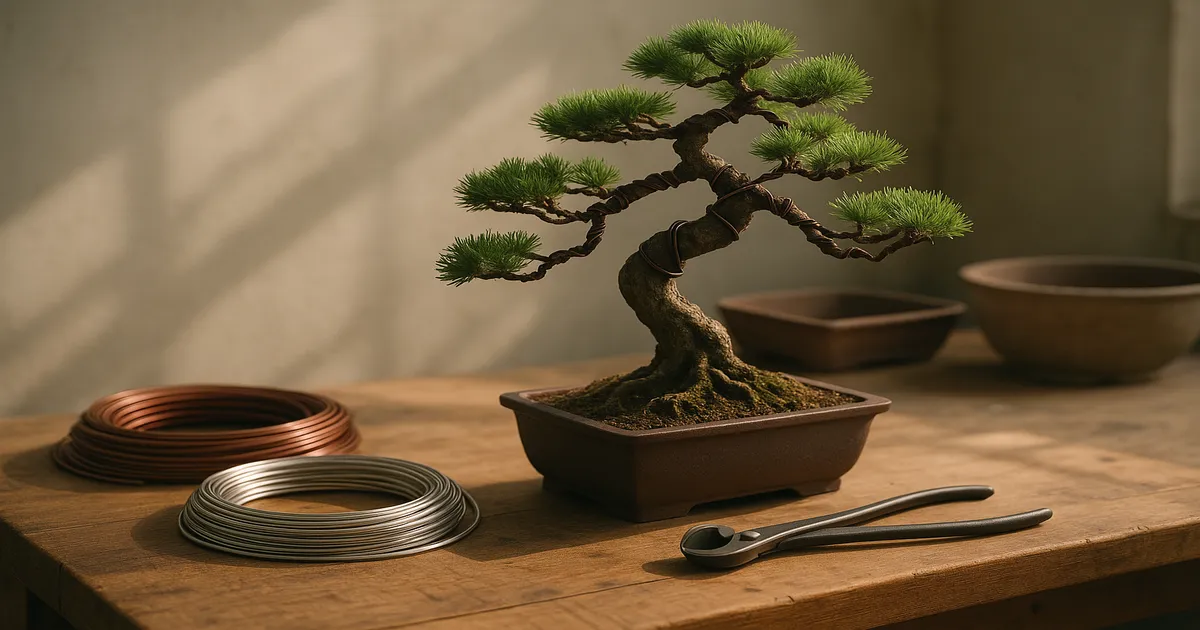
Anodised aluminium wire suits most Chinese elm work — the species has relatively thin bark that marks easily, and aluminium is more forgiving than copper. Use copper only on thick branches that need more holding power, and always wrap those branches with raffia first.
| Branch Diameter | Aluminium Gauge |
|---|---|
| ¾–1 in (2–2.5 cm) | 3.0–4.0 mm |
| ¼–½ in (6–12 mm) | 1.5–2.5 mm |
| Fine/tertiary branches | 0.8–1.5 mm |
Wire diameter should be approximately one-third the branch diameter. The two ideal wiring windows are late winter before bud break and late fall after leaf drop. Avoid wiring during the active spring flush — the tree extends rapidly and wire can scar bark within days.
Application and Removal
Anchor wire to a root, the pot rim, or an adjacent branch. Double-wire two branches of similar diameter simultaneously with one length of wire. Wrap at a 45-degree angle, bend slowly with both thumbs supporting the branch at the bend point, and check that the wire is snug but not biting.
Check wired branches every 5–7 days during summer. The moment wire begins to bite into bark, remove it. Always cut wire off in short segments — never unwind it from Chinese elm, as this risks snapping branches that have set in position.
Supporting Care: Soil, Water, and Fertiliser
A well-draining soil mix is directly linked to vigorous back-budding after pruning. A waterlogged root system produces a sluggish response to cuts. The standard mix for temperate climates is 40% akadama, 30% pumice, 30% lava rock. In hot, dry climates shift toward 50% akadama; in cool, wet climates reduce akadama to 30% and increase inorganic components.
After significant structural pruning, the tree has less leaf mass and lower water demand. Check soil moisture before watering rather than following a fixed schedule, and increase frequency again as the canopy rebuilds.
Use a higher-nitrogen fertiliser in spring to support vigorous growth through the clip-and-grow cycles, then shift to a balanced or low-nitrogen formula from August onward to harden new growth before winter.
Troubleshooting Common Pruning Problems
Tree not back-budding after pruning: Most often caused by pruning during dormancy, insufficient light, or a weakened root system. Indoors, you need at minimum 2,000 foot-candles (21,500 lux) — ideally supplemented with a full-spectrum grow light at 5,000–6,500K for 12–14 hours daily. If light is adequate, check root health at the next repotting.
Dieback after structural cuts: Usually caused by leaving a stub that dies back, or cutting too close and damaging the branch collar. Cut just outside the branch collar and seal large wounds immediately with cut paste.
Wire scarring: Happens when wire is left on too long or applied during active growth. Light surface scarring fades over 1–2 seasons as the bark exfoliates. Deeper spiral scars may remain visible longer but rarely harm the tree structurally. Check every 5–7 days in summer without exception.
Leggy growth despite regular pruning: Almost always an indoor light problem. Without sufficient light intensity, internodes extend long and soft regardless of pruning frequency. Add a full-spectrum grow light positioned within 12 inches (30 cm) of the canopy for 12–14 hours daily. Outdoor trees with adequate sun rarely show this problem.
Frequently Asked Questions
When is the best time to prune a Chinese elm bonsai?
For structural pruning, late winter to early spring (February–March) just before bud break is ideal — the structure is fully visible and wounds heal rapidly with the onset of the growing season. Maintenance pruning runs from spring through early fall, triggered whenever new shoots extend 3–4 nodes beyond the desired silhouette. A secondary structural window opens in August.
How do I get my Chinese elm bonsai to grow more branches?
Use the clip-and-grow method consistently: allow each shoot to extend 3–4 nodes, then cut back to 1–2 leaves above the desired branch point. Repeat every time new growth extends beyond the silhouette. Combined with adequate light and regular fertilising, this builds dense ramification over multiple seasons.
Can I prune a Chinese elm bonsai in winter?
For outdoor trees, avoid significant pruning during full dormancy (December–January). Energy reserves are low and wounds heal slowly in cold conditions. Late winter (February) is the earliest practical point for structural pruning — wait until you can see buds beginning to swell. Indoor trees that haven’t fully gone dormant can be lightly maintained year-round, but save structural work for when growth resumes.
How much can I prune at one time?
As a general rule, avoid removing more than one-third of the total foliage mass in a single session. Chinese elm is forgiving, but removing too much at once stresses the root system and slows recovery. If the tree needs heavy reduction, spread the work across two sessions — late winter structural pruning followed by maintenance pruning once the first flush has extended.
Why are my Chinese elm leaves getting larger instead of smaller?
Leaf size increases when the tree isn’t receiving enough light, when pruning intervals are too infrequent, or when nitrogen fertilisation is too heavy late in the season. Ensure the tree gets full sun outdoors (or strong supplemental light indoors), maintain consistent clip-and-grow cycles, and switch to a low-nitrogen fertiliser from August onward.