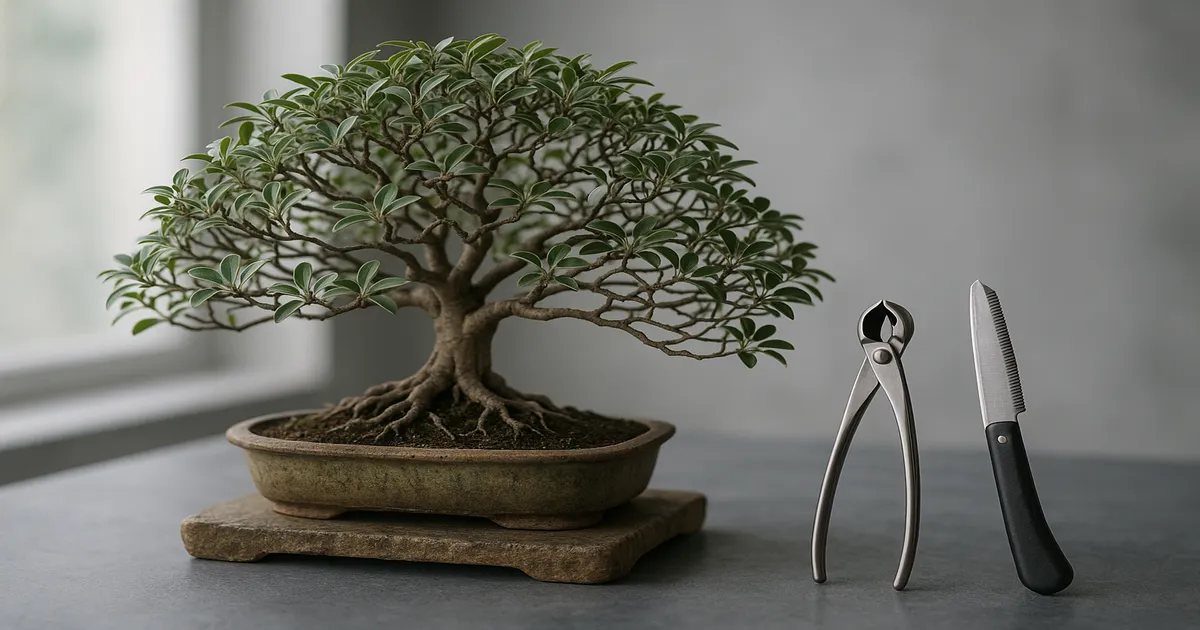
Quick Answer: Pruning bonsai ficus ginseng involves two types of cuts — maintenance pruning (trimming new shoots back to 1–2 leaves throughout the growing season) and structural pruning (removing or shortening major branches in late winter or early spring). Ficus microcarpa is one of the most forgiving species for beginners, healing quickly and responding to pruning with vigorous backbudding. Follow the steps below for a healthy, well-shaped tree year after year.
Pruning bonsai ficus ginseng is one of the most rewarding skills you can develop as a bonsai grower. Get it right and your tree develops dense foliage pads, a refined silhouette, and that unmistakable aged quality that makes bonsai so compelling. This guide covers everything from your first maintenance cut to advanced defoliation — with practical, species-specific advice you can act on today.
Pruning Bonsai Ficus Ginseng: Key Rules at a Glance
What Is a Ficus Ginseng Bonsai?
“Ginseng ficus” refers to Ficus microcarpa grown with swollen, tuberous surface roots (nebari) that resemble ginseng roots. It’s a horticultural presentation style, not a separate species. Most trees sold commercially are grafted — a F. microcarpa canopy grafted onto pre-grown tuberous rootstock — which has real implications for where you make structural cuts (more on that below).
The species goes by several names: Taiwan ficus, Indian laurel fig, pot-bellied ficus. Whatever the label on the nursery tag, care and pruning technique are essentially the same.
Core Pruning Rules
- Maintenance pruning (keeping shape): Cut new shoots back to 1–2 leaves once they’ve extended 4–6. Repeat throughout spring, summer, and early fall.
- Structural pruning (building the framework): Remove or shorten primary branches in late winter or early spring, just before new growth begins.
- Always use sharp, clean tools — crushed tissue heals poorly and invites disease.
- Ficus ginseng is beginner-friendly. It heals fast, backbuds readily, and tolerates mistakes better than most species.
Species Traits That Affect How You Prune
Growth Habit: Why Ficus Ginseng Is So Forgiving
Ficus microcarpa is vigorous by bonsai standards. It pushes new growth frequently, heals wounds relatively quickly compared to conifers, and responds to pruning with backbudding — new shoots emerging from older wood. Mistakes that would seriously set back a juniper are often shrugged off by a healthy ficus ginseng, which makes it an ideal species for anyone still developing their technique.
A few cultivars worth knowing:
- ‘Green Island’ — rounder, thicker leaves; compact growth; excellent for beginners
- ‘Golden Gate’ — smaller leaves; greater ramification potential
- Standard ‘Ginseng’ — the grafted tuberous-root form found in most garden centers
Milky Latex Sap: What to Expect When You Cut
Every cut releases a milky white latex sap. It’s mildly irritating to sensitive skin and toxic if ingested by pets or humans, so wear gloves if your skin is reactive and keep trimmings away from animals. The sap slows and stops on its own within a few minutes. Let it stop flowing before applying wound paste.
Grafted vs. Seed-Grown Trees
On a grafted ginseng bonsai, the graft union — usually a slight bulge or color change low on the trunk — marks the boundary between rootstock and canopy. Never make structural cuts below this line. Above it, you have full freedom to prune and develop the branch structure however you like.
When to Prune Ficus Ginseng Bonsai
Seasonal Timing Guide
| Season | Activity | Notes |
|---|---|---|
| Late winter / early spring | Structural pruning | Best callus formation; before growth flush |
| Spring (active flush) | Light pinching only | Avoid heavy cuts during rapid extension |
| Summer | Maintenance pruning; defoliation (advanced) | Active healing; ideal for ramification work |
| Fall | Minimal pruning | Let the tree harden before cooler months |
| Winter (indoor) | Avoid pruning | Reduced healing; risk of dieback |
Late winter to early spring is the sweet spot for structural work. The tree hasn’t yet pushed its spring flush, so it has maximum stored energy to channel into healing. For indoor trees where seasons blur, watch for buds beginning to swell — that’s your trigger.
Maintenance pruning runs spring through early fall, roughly every 4–6 weeks during active growth. Avoid heavy pruning during the rapid spring extension phase — the tree is pushing hard, and cutting back aggressively at that point wastes the energy it just spent. In fall, hold back so the tree can harden off. In winter, healing slows significantly and cuts carry a real risk of dieback.
Maintenance Pruning: Keeping Your Ficus Ginseng in Shape
The 4-to-6 Leaf Rule
The principle is simple: once a new shoot has extended 4–6 leaves, cut it back to 1–2. This forces the tree to produce multiple new shoots from lower nodes, gradually increasing ramification with each cycle. Don’t let shoots run — the longer they extend, the coarser the internodes become.
Pinching vs. Scissors
For very soft, newly emerged growth, finger-pinching is fine. As soon as the growth has any firmness to it, switch to sharp scissors or concave cutters. A quality pair of bonsai scissors makes a real difference here — clean cuts heal cleanly, while torn or crushed tissue slows healing and raises the risk of dieback.
Aim to prune every 4–6 weeks during active growth. Ficus ginseng can push new shoots fast when conditions are right, so staying ahead of the growth is easier than playing catch-up after shoots have run long.
Structural Pruning: Building a Strong Branch Framework
Which Branches to Remove
Structural pruning is about the long game — establishing primary, secondary, and tertiary branches, improving trunk taper, and creating the visual depth that makes a bonsai convincing. Remove branches that:
- Cross the trunk or other primary branches — visual clutter that eventually competes for space
- Grow directly toward or away from the viewer — these flatten the tree’s perspective
- Emerge at the same height on opposite sides (“bar branches”) — stagger branches vertically instead
- Cause reverse taper — a branch thicker than the one below it breaks the illusion of age
- Grow perfectly straight — slight bends and angles look far more naturalistic
How to Use Concave Cutters
A concave cutter creates a slightly hollowed wound that heals flush with the trunk, leaving minimal scarring. Position the cutter so the concave jaw faces the trunk and cut in a single clean motion — one deliberate cut is always better than several hesitant ones.
Think in thirds when selecting branches: primary branches ideally sit in the lower third of the tree’s height, with each successive branch thinner than the one below. Include at least one branch growing toward the back of the tree to create depth. Branches that angle slightly downward read as maturity and age.
Wound Care
For any cut over about 6mm (roughly ¼ inch) in diameter, apply wound sealant. Let the latex sap slow to a stop first — dab gently with a clean cloth if needed — then apply the paste in a thin, even layer. Good options include Kiyonal, Cut Paste, or Lac Balsam. Avoid petroleum-based products like Vaseline, which can trap moisture and promote rot. Check large wounds every 2–3 months for signs of dieback.
Advanced Technique: Defoliation for Smaller Leaves and Finer Ramification
Defoliation means removing leaves deliberately to force a fresh, smaller-leaved flush. It’s a powerful refinement tool, but only appropriate for healthy, vigorous trees. Never defoliate a recently repotted tree, a stressed specimen, or one recovering from pests or disease.
Full defoliation removes every leaf. Partial defoliation removes only the largest leaves while leaving smaller ones in place — a gentler approach that still improves light penetration to inner branches. If you’re unsure, start with partial.
Step-by-Step Defoliation
- Choose a healthy, vigorous tree in early summer (June in the Northern Hemisphere).
- Using sharp scissors, remove all target leaves by cutting the petiole (leaf stem) cleanly — don’t pull.
- Move the tree to a bright spot with good air circulation.
- Maintain humidity at 50–70% and keep watering consistent.
- Expect new buds within 1–2 weeks; full leaf emergence typically takes 2–4 weeks.
New leaves will be noticeably smaller than the previous set — that’s the whole point. Over successive defoliations, the result is a denser, more refined canopy with better light penetration throughout.
Wiring After Pruning: Shaping Ficus Ginseng Branches
Wire Gauge and Material
Wire diameter should be approximately one-third the diameter of the branch you’re wiring. For ficus ginseng in practice:
- 1.0–1.5mm — fine tertiary branches and young shoots
- 2.0–2.5mm — secondary branches
- 3.0–4.0mm — primary branches and trunk work
Anodized aluminum wire is the right choice for most hobbyists — softer, easier to apply, and forgiving of minor technique errors. Copper wire holds its shape better and suits heavy structural work, but it’s stiffer and more likely to damage bark if applied carelessly.
Application and Removal
Always wire two branches with a single piece, anchoring at the trunk or a larger branch first, then wrapping outward at a 45-degree angle. The wire should be snug but not digging in — you should just be able to slide a fingernail under it.
Ficus ginseng grows fast. During spring and summer, wire can bite into bark within 4–8 weeks, so check every 3–4 weeks without exception. When it’s time to remove wire, always cut it off — never unwind it. Use wire cutters to snip the wire into short sections, then carefully peel each section away. Unwinding risks snapping branches and tearing bark.
Supporting Care After Pruning
Light, Watering, and Soil
After any significant pruning, the tree needs strong light to fuel callus formation and backbudding. Aim for a minimum of 6 hours per day at 1,000–3,000 foot-candles. Indoors, that means positioning within 12–24 inches of a south- or west-facing window. Under grow lights, run full-spectrum LEDs at 5,000–6,500K for 12–16 hours daily. Insufficient light after pruning is one of the main reasons trees fail to backbud.
After heavy structural pruning, the tree has fewer leaves to transpire water, so it needs less of it. Check the top half-inch of soil before watering rather than sticking to a fixed schedule — but don’t let it dry out completely, since consistent moisture supports healing.
For soil, a well-draining inorganic mix is essential. A ratio of roughly 40% akadama, 30% pumice, and 30% lava rock (3–6mm particle size, fines sifted out) provides the drainage and aeration that healthy roots — and vigorous regrowth — depend on.
Temperature and Humidity
The ideal growing range is 65–95°F (18–35°C), with indoor comfort at 65–75°F (18–24°C). Keep humidity between 50–70% — a humidity tray or room humidifier makes a real difference indoors, especially in winter when central heating dries the air. Cold, dry conditions in winter are exactly why heavy pruning at that time of year is a bad idea: the tree simply doesn’t have the environment it needs to heal.
Frequently Asked Questions About Pruning Bonsai Ficus Ginseng
When is the best time to prune a ficus ginseng bonsai?
For structural pruning, late winter to early spring is optimal — before the spring growth flush, so stored energy goes directly into healing. Maintenance pruning can happen throughout spring, summer, and early fall, roughly every 4–6 weeks during active growth.
How do I encourage backbudding after pruning?
Backbudding is driven by three things: pruning itself (which signals the tree to produce new growth points), strong light, and consistent fertilizing. Move your tree to the brightest spot available after pruning and begin a balanced fertilizing routine if you haven’t already. Ficus ginseng backbuds readily — consistent maintenance pruning over multiple seasons is the most reliable way to build dense, ramified foliage pads.
Why is my ficus ginseng dropping leaves after pruning?
Some leaf drop after pruning is normal, especially after heavy cuts. The tree is redistributing resources toward new growth and wound healing. If leaf drop is severe or ongoing, check for stress factors: insufficient light, cold drafts, overwatering, or root problems. Ficus ginseng is also sensitive to sudden environmental changes — moving the tree after pruning can trigger leaf drop on its own.
Can I prune a ficus ginseng bonsai in winter?
Light maintenance pruning in winter is unlikely to cause serious harm, but it’s best avoided. Healing capacity drops when light levels are low and temperatures are cool, and cuts carry a higher risk of dieback. If you have an urgent reason to prune — a broken branch, for example — go ahead, but save planned structural work for late winter when buds begin to swell.
How do I handle the white sap that comes out when I cut?
The milky latex sap is normal and will slow on its own within a few minutes. Don’t try to wash it off — just let it stop flowing naturally. Once it has, dab the area gently with a clean cloth and apply wound paste to any cut larger than 6mm. Wear gloves if you have sensitive skin, and keep trimmings away from pets — the sap is mildly toxic if ingested.