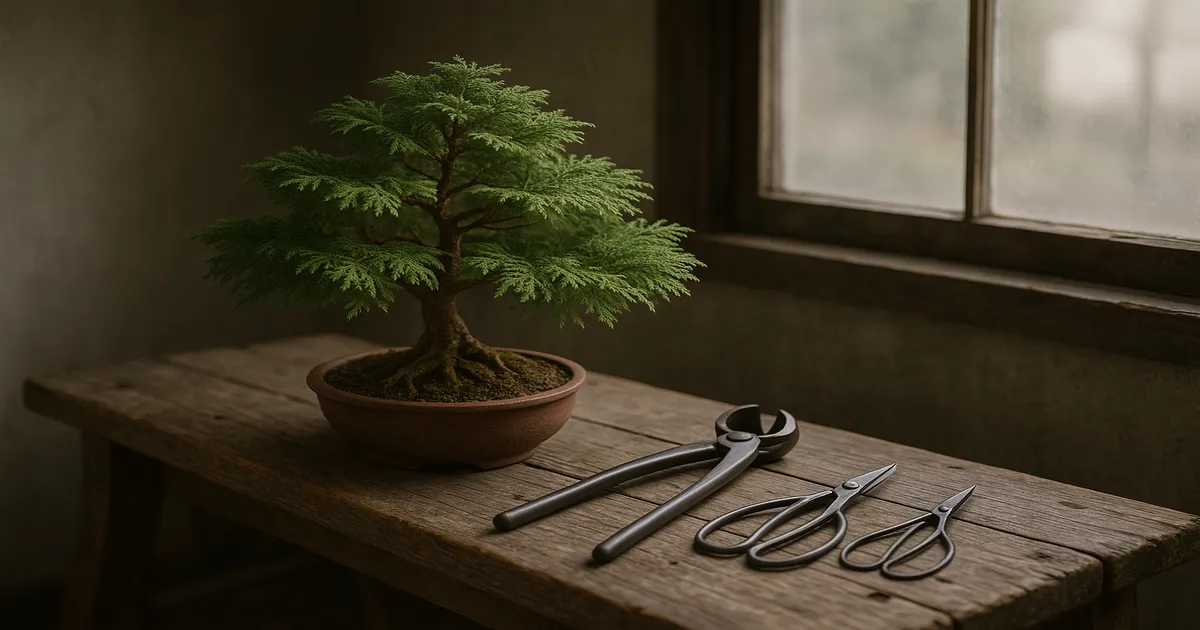
Quick Answer: Yes, you can absolutely prune Hinoki cypress — and you should. Regular pruning keeps foliage pads compact, encourages back-budding, and refines the silhouette that makes this species so prized in bonsai. Two rules are non-negotiable: never cut into bare wood, and always time your cuts to the tree’s natural growth cycle.
Hinoki cypress (Chamaecyparis obtusa) is one of the most rewarding bonsai species to work with — once you understand how it grows. The question “can you prune Hinoki cypress” comes up constantly from new growers, usually after they’ve heard horror stories about browning and dieback. Those problems are real, but they’re almost always caused by bad timing or cutting into leafless wood, not by pruning itself. Get those two things right and this species responds beautifully.
Understanding How Hinoki Cypress Grows
Native Habitat and What It Tells You
Hinoki cypress is native to the mountain forests of central and southern Japan — Honshu, Shikoku, and Kyushu — at elevations between 3,300 and 8,500 feet. Up there, it experiences cool temperatures, excellent drainage, and distinct seasonal change. That background tells you exactly what conditions the tree expects in your garden: bright light, fast-draining soil, and a genuine winter rest.
The foliage grows in flat, fan-shaped sprays with distinctive white X or Y markings on the undersides. The bark is reddish-brown and fibrous, peeling in thin vertical strips on mature specimens. Prune a branch and you’ll catch a pleasant lemony-cedar fragrance — one of the small joys of working with this species.
Apical Dominance and Flush Cycles
Hinoki is strongly apically dominant. The top and outer branches push hardest, and without regular pruning the apex and outer pads bulk up while interior and lower branches weaken from shade and competition. Left unchecked, you lose ramification and the silhouette deteriorates quickly.
Growth happens in two distinct flushes: a vigorous spring push and a lighter secondary flush in late summer or early autumn. Your pruning windows are built around these cycles, so understanding them is everything.
One critical limitation: Hinoki does not bud readily from old, bare wood. Unlike juniper or ficus, if you cut a branch back to a section with no foliage, that section will almost certainly die. Always retain at least one healthy foliage spray on every branch you intend to keep.
Best Cultivars for Bonsai
Most growers work with compact cultivars, and for good reason:
- ‘Nana Gracilis’ — shell-cupped foliage pads, naturally short internodes, the most popular choice by far
- ‘Kosteri’ — very dense and dwarf, excellent for shohin and mame sizes
- ‘Nana’ — true dwarf with extremely slow growth, ideal for very small bonsai
These cultivars need less aggressive reduction to achieve a refined look because their internodes are already compact. The straight species works well for larger bonsai and collected specimens but requires more effort to keep tight.
How to Prune Hinoki Cypress: Maintenance Pruning
Timing Windows
The primary pruning window opens in late spring to early summer, after the first growth flush has extended and hardened slightly — typically when new shoots are 1–2 inches long. This is when you do most of your foliage trimming.
A secondary window falls in late summer, after the second flush hardens. Avoid heavy pruning during midsummer heat, and don’t prune late in autumn — new growth won’t have time to harden before frost arrives.
Pinching and Cutting Technique
Use sharp, clean scissors or bonsai shears. Never tear foliage by hand — ragged wounds invite disease and look untidy.
The technique is straightforward:
- Identify new extension shoots that have pushed beyond the foliage pad’s silhouette.
- Cut or pinch them back by one-third to one-half of their new length.
- Cut just above a lateral spray that faces the direction you want the branch to develop.
On refined trees, pinching soft growing tips with your fingers is gentler than cutting and produces a slightly more natural result.
The Golden Rule: Never Cut Into Bare Wood
If a branch segment has no foliage on it, do not cut back to it. Hinoki lacks the latent bud reserves that let junipers and deciduous trees regenerate from old wood. Cut into bare wood and that section dies — always work back to a fork or a spray, never to a naked stem.
How Often to Prune
- Developing trees: 2–3 sessions per growing season
- Refined, mature specimens: 1–2 sessions per season
- Foliage pad thinning: Every 1–2 years as needed
After each session, clear all cut foliage from the pot surface. Decomposing material sitting on the soil invites fungal problems.
Structural Pruning: Building Branch Architecture
Best Timing for Heavy Cuts
Heavy branch removal is best done in late winter to very early spring, just before bud break, when wounds heal quickly as the tree moves into active growth. Early autumn — after summer heat has passed but before hard frost — is a solid second option. Avoid structural pruning in midsummer or during freezing temperatures.
Tools and Cutting Technique
For branches up to about ½ inch (12 mm) in diameter, concave cutters are the right tool. They create a slightly hollowed wound that calluses more smoothly than a flat cut. For larger branches, a pull saw gives cleaner control than a standard pruning saw.
Make cuts flush to the trunk or parent branch. The goal is minimal scarring and a wound profile that allows callus to roll in from all sides evenly.
Branch Selection Priorities
Remove branches in this order:
- Dead or dying branches — always first
- Crossing branches that create visual clutter or wound each other
- Branches that conflict with your design intent (downward-growing, back-growing, or breaking the triangular silhouette)
Favor branches with good taper, natural movement, and foliage distributed toward the tips. Leggy branches with bare inner sections are design liabilities — remove them or rebuild them through wiring and careful pruning over time.
Wound Care and Healing
Apply cut paste to any wound larger than about ¼ inch (6 mm) immediately after cutting. Hinoki heals slowly — large wounds can take 2–5 years to fully callus over, so monitor them annually and reapply sealant if it cracks or falls away before the wood is covered.
One silver lining: Hinoki’s aromatic, resinous wood resists rot well, making it an excellent candidate for deadwood features. Treat any exposed jin or shari with lime sulfur to preserve and whiten it.
Wiring Hinoki Cypress After Pruning
Wire Type, Gauge, and Timing
Anodized aluminum wire is the practical choice for most growers — gentler on bark and easier to work with than copper. Advanced practitioners often prefer copper for its superior holding power; copper wire needs to be roughly half the gauge of aluminum to achieve equivalent strength. As a general rule, wire should be about one-third the diameter of the branch.
The best wiring window is late autumn through early spring, when the tree is dormant or just emerging. During active growth flushes, wire can cut into bark within weeks.
Application and Removal
Anchor the wire to the trunk or a larger branch before wrapping, then work at a 45-degree angle to the branch axis. Where possible, use one piece of wire to wire two branches of similar diameter simultaneously — it’s more efficient and provides better anchorage.
Check wired branches every 2–4 weeks during the growing season. Most branches set in 3–9 months. When it’s time to remove wire, always cut it off in short segments — never unwrap it. Unwrapping risks snapping branches that have partially set.
Seasonal Care That Supports Pruning Recovery
Light and Temperature
Hinoki cypress is an outdoor bonsai, full stop. Aim for a minimum of 4–6 hours of direct sunlight daily during the growing season. In hotter climates (Zones 7–8), afternoon shade becomes important once temperatures regularly exceed 90°F (32°C) — a 30–50% shade cloth works well. The ideal active-season range is 55–75°F (13–24°C); growth slows noticeably above 85°F (29°C).
For dormancy, the tree needs 6–10 weeks of temperatures consistently between 25–45°F (-4–7°C). This cold period is non-negotiable for long-term health. Protect containers when temperatures drop below 15°F (-9°C), since container roots have far less insulation than in-ground trees.
Winter Protection
- Zones 6 and warmer: An unheated garage, cold frame, or sheltered porch is usually sufficient.
- Zones 4–5: A cold frame or minimally heated greenhouse held at 28–38°F (-2–3°C) is safer.
- Critical rule: Never bring trees into heated living spaces for winter storage. Temperatures above 50°F (10°C) during the dormancy period disrupt the seasonal cycle and weaken the tree.
Continue watering during dormancy — check every 2–3 weeks and water on days above freezing.
Soil and Watering
Soil Mix
A well-draining mix is a prerequisite for everything else. Standard potting soil holds too much moisture and compacts over time, causing root rot that undermines any pruning work you do.
The recommended mix is 40% akadama / 40% pumice / 20% lava rock. Akadama provides moisture retention and cation exchange for nutrient uptake. Pumice handles drainage and aeration. Lava rock adds long-term structural stability and mineral content. Use 3–6 mm particle size for most trees; drop to 1–3 mm for shohin and mame.
Watering Through the Seasons
- Spring and summer: Check morning and evening; may need watering once or twice daily in heat
- Autumn: Reduce to once daily or every other day as growth slows
- Winter dormancy: Every 5–14 days, always on days above freezing
Water thoroughly each time — pour until water flows freely from the drainage holes to ensure even saturation and prevent salt buildup.
Recognising Overwatering and Underwatering
Overwatering shows as yellowing or browning of inner foliage near the trunk, soft roots at the drainage holes, and soil that stays wet more than 24 hours after watering. Don’t confuse this with normal post-pruning foliage shed.
Underwatering looks different: foliage tips go brown and crispy, the foliage loses its glossy sheen and looks dull or grayish, and the pot feels noticeably light. Experienced growers learn to gauge moisture by pot weight alone — it’s a quick and reliable check.
Troubleshooting Common Pruning Problems
Branch Dieback After Pruning
The most common cause is cutting into bare wood. The second is pruning during midsummer heat stress, when the tree lacks the energy reserves for recovery. Stick to the established timing windows and always leave foliage on every branch you intend to keep.
Browning Foliage After Cuts
Some inner foliage browning after pruning is completely normal. When you open up a dense pad, interior needles that were already shaded and weakening will drop — the tree is rationalising its resources, not showing signs of disease.
Stress-induced browning looks different: it starts at the tips of outer foliage and progresses inward, often accompanied by dull color and drooping sprays. If you see that pattern, check your watering, light exposure, and whether the tree was pruned during a heat wave.
Interior Foliage Loss
As foliage pads thicken, interior branches lose light and gradually die. Every one to two years, go in and remove small branches that are crossing, downward-growing, or so shaded they’re contributing nothing. This restores air circulation and light penetration, keeping the inner structure alive over the long term.
Slow Wound Callusing
Check sealed wounds annually in early spring. If the cut paste has cracked, dried out, or fallen away, clean the wound and reapply. Remove all cut debris from the pot after each session, and wipe tools with isopropyl alcohol between trees. Neglecting these steps increases fungal and pest risk — spider mites in particular love stressed Hinoki cypress in dry conditions.
Frequently Asked Questions About Pruning Hinoki Cypress
When is the best time to prune Hinoki cypress?
The primary window for maintenance pruning is late spring to early summer, after the first growth flush has hardened. A secondary session can be done in late summer after the second flush. Structural pruning is best done in late winter to very early spring, just before bud break.
What happens if you cut Hinoki cypress back to bare wood?
That section almost always dies. Unlike many bonsai species, Hinoki cypress does not readily produce new buds from old, leafless tissue. Always retain at least one healthy foliage spray on any branch you intend to keep.
How do you encourage back-budding on Hinoki cypress?
Regular, timely pruning of outer foliage tips reduces apical dominance and redirects energy inward — that’s the primary driver of back-budding. Periodic thinning of dense pads also improves light penetration to inner buds. Back-budding is more reliable on compact cultivars like ‘Nana Gracilis’ than on the straight species.
Can Hinoki cypress be kept indoors after pruning?
No. Hinoki cypress is an outdoor species and should remain outdoors throughout its recovery. Low humidity, insufficient light, and the absence of seasonal temperature variation will cause progressive decline regardless of how well you prune. Brief indoor display of two to three days maximum is acceptable for exhibition purposes only.
How long does Hinoki cypress take to heal after pruning?
Small cuts from routine maintenance pruning heal within one growing season. Larger structural wounds — anything over about ¼ inch (6 mm) in diameter — can take two to five years to fully callus over. Applying cut paste immediately and monitoring wounds annually speeds the process and prevents complications.