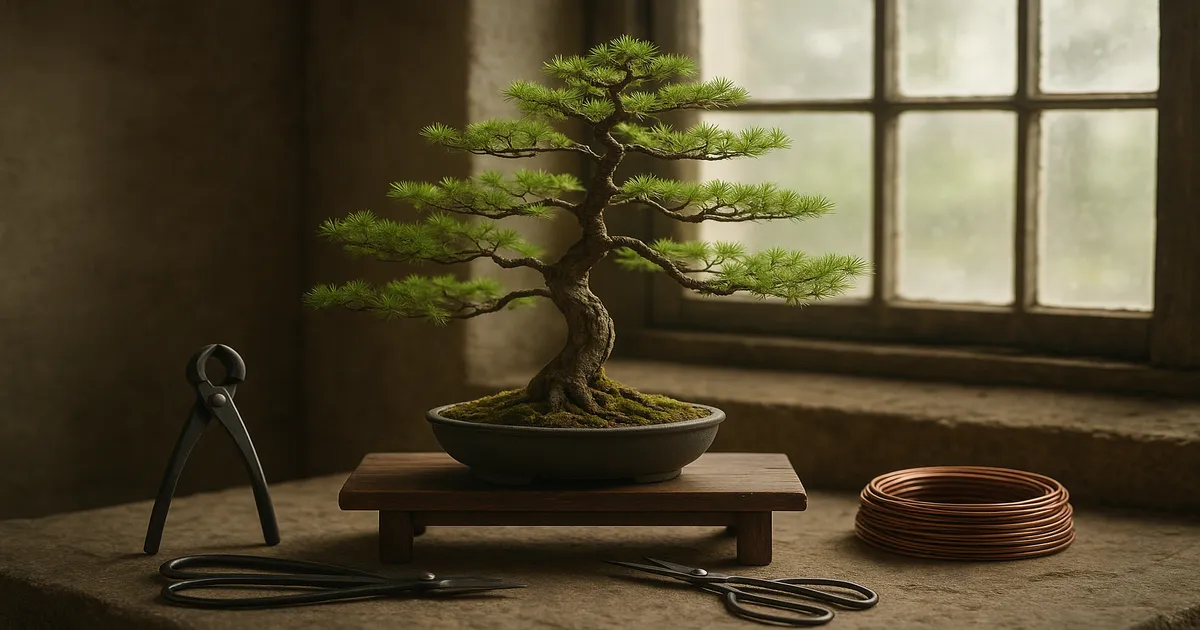
Quick Answer: Prune a larch bonsai in two distinct phases — maintenance pruning in late spring to early summer (pinching new shoots back to 2–3 needle pairs) and structural pruning during dormancy from late autumn through early spring when the tree is leafless. Larch back-buds readily, tolerates aggressive pruning, and rewards consistent seasonal work with exceptional fine ramification. Always use sharp, sterilised tools and seal any cut larger than 3–4mm immediately with cut paste.
Knowing how to prune a larch bonsai properly is the single biggest factor separating a tree with scraggly, uneven growth from one with the dense, layered branching that makes this species so spectacular. Larch (Larix spp.) is one of the rare deciduous conifers — it drops its needles every autumn — and that seasonal rhythm dictates exactly when and how you cut. Get the timing right and the tree rewards you. Get it wrong and you spend years correcting avoidable mistakes.
Larch Growth Habits That Drive Every Pruning Decision
Larch sits in a small club of conifers that shed their needles each winter. That single trait changes everything: you get a clear view of the branch structure during dormancy, and the tree’s energy resets in a way that evergreen conifers simply don’t experience. The result is four genuinely distinct seasonal displays — lime-green spring emergence, deep-green summer foliage, brilliant gold autumn colour, and an elegant bare silhouette in winter.
Common Species Used in Bonsai
| Species | Common Name | Key Bonsai Trait |
|---|---|---|
| Larix decidua | European Larch | Most widely used; excellent ramification |
| Larix kaempferi | Japanese Larch | Blue-green foliage; superb bark development |
| Larix laricina | Tamarack | Tiny needles; ideal for shohin and mame |
| Larix occidentalis | Western Larch | Impressive trunk development |
Larch is strongly apically dominant — the top grows fastest and will dominate if you let it. Upper branches need harder pruning than lower ones to keep the canopy balanced. The tree also produces two distinct shoot types: long extension shoots that push outward rapidly, and short spur shoots (brachyblasts) that carry the characteristic needle tufts. Your long-term pruning goal is to convert those extension shoots into dense spur clusters. Back-budding is reliable on wood up to about three or four years old, which makes larch genuinely forgiving — even for beginners who make imperfect cuts.
Essential Care: Light, Water, and Soil
Light
Larch is a strictly outdoor tree. It needs a minimum of six hours of direct sun daily, with eight to ten hours being ideal. Insufficient light produces elongated internodes and weak growth — exactly the opposite of the tight, refined structure you’re pruning toward. In regions where summer temperatures regularly exceed 95°F (35°C), light afternoon shade prevents needle scorch without sacrificing overall vigour.
Winter Dormancy and Cold Protection
Most larch species handle cold well — L. laricina survives down to -40°F (-40°C) in the ground. Container-grown trees are more vulnerable. Protect them when temperatures drop below 15°F (-9°C) by moving to an unheated garage or cold frame where temperatures stay between 25–40°F (-4 to 4°C). Never bring a dormant larch into a heated space. It needs those cold weeks to rest and return strong in spring.
Soil
Drainage is everything. Larch roots suffocate quickly in compacted or water-retentive mixes.
- Mature/refined trees: 40% akadama, 40% pumice, 20% lava rock
- Younger/developing trees: 50% akadama, 30% pumice, 20% lava rock
- Target pH: 5.5–6.5
- Particle size: 3–6mm for standard pots; 1–3mm for shohin and mame
Avoid garden soil, peat, or fine-textured compost entirely. A quality pre-mixed inorganic bonsai soil takes the guesswork out of getting the ratios right, particularly for beginners.
Watering
Spring is the highest-demand period — water daily, sometimes twice. Summer requires once or twice daily depending on heat and pot size. Taper off in autumn as growth slows. During dormancy, water just once every two to three weeks to prevent roots from completely desiccating.
Warning signs to watch for:
- Overwatering: yellowing needles from the tips, soil staying wet beyond 24 hours in summer, algae on the soil surface
- Underwatering: needles curling inward or browning at the tips, the pot feeling unusually light when lifted
How to Prune a Larch Bonsai: Maintenance Pruning
When to Prune for Maintenance
The primary window opens in late spring to early summer, once the first flush of new growth has extended to about one to two inches (2.5–5cm) but before the shoots harden off. A secondary opportunity comes in late summer or early autumn after growth has slowed. Avoid pruning in peak midsummer heat or within a few weeks of repotting.
Pinching and Shortening New Shoots
- Pinch new candles back to 2–3 needle pairs once they reach one to two inches. Leave the weakest shoots unpinched so they can build strength.
- Remove misdirected shoots — anything growing straight up, straight down, or directly toward the viewer — cleanly at their origin.
- Shorten extension shoots to one or two nodes above a node or needle tuft using sharp scissors. Avoid cutting mid-internode where possible.
Fine-tipped bonsai scissors handle this work cleanly without crushing the delicate tissue around the cut.
Balancing Vigour Across the Canopy
This is the principle beginners most often miss. Strong branches — especially those near the apex — get cut back harder. Weak lower branches are allowed to grow longer before you cut. Over time this levels out the tree’s energy distribution and prevents the top from dominating at the expense of the lower pads.
Building Spur Clusters for Fine Ramification
Each time you pinch an extension shoot, the tree responds by pushing multiple shorter shoots from the cut point. Repeat this over several seasons and those long shoots gradually transform into the dense, twiggy spur clusters that define a refined larch bonsai. It’s slow, satisfying work — the kind that compounds beautifully over years.
How to Prune a Larch Bonsai: Structural Pruning
Best Time for Structural Pruning
Late autumn through early spring is the window for all major branch work. The leafless state lets you see the skeleton clearly — no guessing about what’s crossing what. Early spring, just before bud break, is especially good because wounds begin healing almost immediately as sap starts to rise.
Branch Selection and the Rule of Thirds
Primary branches should emerge from the trunk at roughly 60–80° from vertical. Branches pointing directly toward or away from the viewer flatten the design and should be repositioned or removed. Apply the rule of thirds to branch length: longest and most horizontal in the lower third, progressively shorter through the middle, shortest and most upright near the apex.
Remove:
- Crossing branches (they create ugly contact points over time)
- Bar branches (two branches directly opposite each other at the same node)
- Parallel branches at the same height on the same side
- Any branch causing reverse taper on the trunk
Keep:
- Branches with natural movement and character
- Anything contributing to trunk taper
- Established spur clusters — these took years to build
Cutting Technique for Clean, Healing Wounds
- Use concave branch cutters flush to the trunk — the concave cut heals with minimal visible scarring.
- For branches thicker than ½ inch (12mm), make an undercut from below first before completing the cut from above. This prevents bark from tearing downward.
- Apply cut paste immediately to any wound larger than 3–4mm. Kiyonal is the standard choice.
- On large cuts, lightly carve the wound edges to encourage even callus formation around the perimeter.
Using Sacrifice Branches to Build Trunk Girth
If your tree needs a thicker trunk or needs to fill out a section, designate one or two branches as sacrifices. Let them grow freely and unpruned for one to two full seasons. The trunk section feeding those branches thickens noticeably. Once you’ve gained the girth you need, remove them cleanly and seal the wound.
Wound Healing Timelines
Small cuts under 5mm typically close in one to two seasons. Medium cuts of 5–15mm take three to five years. Large wounds can take a decade or more to fully occlude, so placement matters — try to make major cuts where the resulting scar will be hidden from the primary viewing angle. Inspect sealed wounds every spring and reapply cut paste if it has cracked or peeled.
For very large wounds, hollow carving is a legitimate option. It creates a jin-like feature that’s aesthetically appropriate for larch and reduces the visual impact of the scar rather than fighting it.
Deadwood: Jin and Shari on Larch Bonsai
Larch naturally develops deadwood in the wild — broken branches, lightning strikes, the kind of character that takes decades to acquire. On a bonsai, you can create that same quality intentionally.
Strip the bark from a selected branch using jin pliers, working with the grain to avoid splintering. Refine the shape with a carving knife or rotary tool, tapering the tip naturally. For shari on the trunk, map the line carefully before touching the wood. The non-negotiable rule: always preserve a living vein of bark connecting the roots to the foliage. Remove that vein and the branch above it dies.
Apply two to three coats of lime sulfur in late autumn after leaf drop, diluted 1:10 (lime sulfur to water). Wear gloves and eye protection — it stains everything it touches. Larch deadwood naturally develops a beautiful silver-gray patina over time, and lime sulfur accelerates and preserves that colour.
Wiring Larch Bonsai
Wire Gauge Reference
| Branch Diameter | Wire Gauge | Wire Type |
|---|---|---|
| Under 2mm | 1.0–1.5mm | Aluminum |
| 2–4mm | 2.0–2.5mm | Aluminum |
| 4–8mm | 3.0–3.5mm | Aluminum or copper |
| 8–15mm | 4.0–5.0mm | Copper |
| Trunk / major branches | 6.0mm+ or guy wires | Copper |
Wire should be roughly one-third the diameter of the branch. Aluminum works well for most larch work — it’s forgiving and easy to apply. Reserve copper for thick branches where you need serious holding power.
When and How to Wire
Late autumn through early spring is ideal — branches are fully visible and the bark is firm. If you wire during active growth, check the tree every two to three weeks without exception. Larch grows fast and wire can bite in within a month during peak growth.
Technique reminders:
- Anchor one wire to two branches of similar thickness at a 45° angle
- Spiral at 45° — too steep restricts sap flow; too shallow loses holding power
- Work from trunk outward: primary branches first, then secondary, then tertiary
- Always cut wire off in short segments — never unwind it from a set branch
The most damaging mistake with larch is leaving wire on too long. Scars on mature bark can be permanent. Set a reminder and check on schedule.
Frequently Asked Questions About Pruning Larch Bonsai
When is the best time to prune a larch bonsai?
Two windows. For maintenance pruning — pinching and shoot shortening — late spring to early summer is best, once new growth reaches one to two inches. For structural pruning and major branch removal, work during dormancy from late autumn through early spring when the tree is leafless.
Can you prune a larch bonsai in summer?
Light maintenance pruning is fine in early summer before shoots harden. Avoid heavy structural pruning in midsummer heat — wounds heal slowly, the tree is under stress, and you risk weakening branches that are actively supporting growth. Keep any summer pruning minimal and ensure the tree is well-watered before and after.
How do I encourage back-budding on a larch bonsai?
Cut extension shoots back hard during the maintenance window and give the tree maximum sunlight — at least six to eight hours of direct sun daily. Strong light is the biggest driver of back-budding. Larch back-buds most reliably on wood up to three or four years old, so don’t expect new buds from very old, thick wood.
Should I seal pruning cuts on a larch bonsai?
Yes — seal any cut larger than 3–4mm immediately after cutting. Larch heals more slowly than broadleaf deciduous trees, so sealing reduces moisture loss and disease entry. Inspect sealed wounds every spring and reapply if the paste has cracked or peeled away.
How often should I prune a larch bonsai each year?
Most growers do two maintenance sessions per year: one in late spring to early summer and a lighter pass in late summer or early autumn. Structural pruning happens once per dormant season as needed — not every year once the branch structure is established. Consistent light pruning across two sessions beats one heavy annual cut every time.