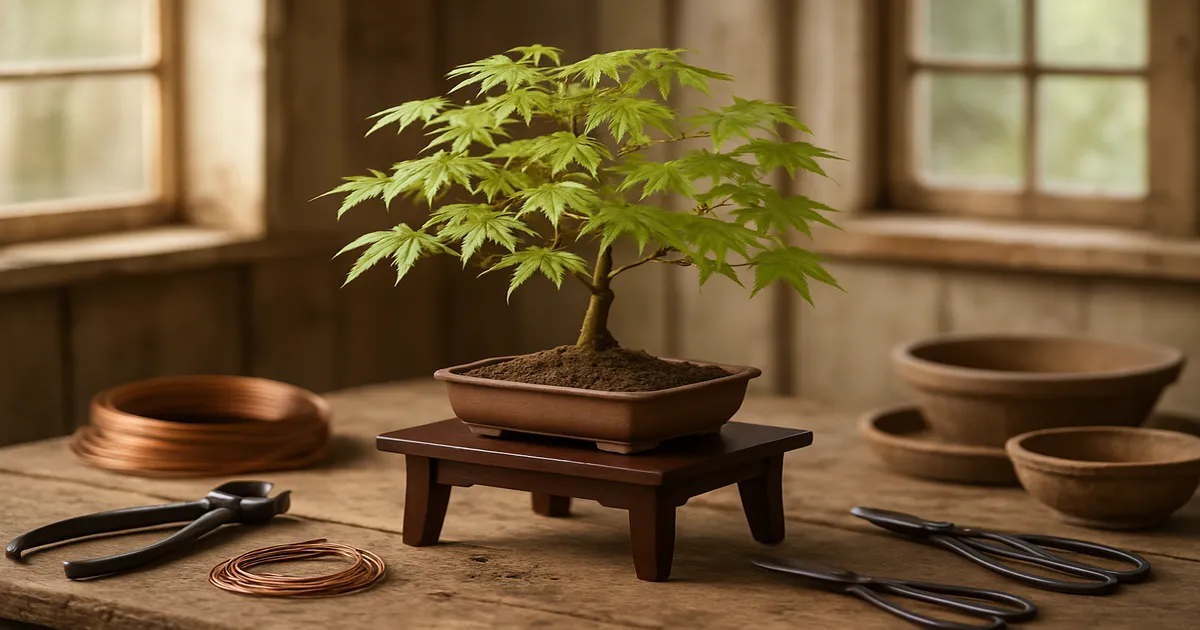
Quick Answer: Japanese maple (Acer palmatum) is one of the finest deciduous species for bonsai, offering stunning four-season interest, exceptional leaf reduction potential, and a long lifespan. It thrives outdoors in USDA Zones 5–8, requires genuine winter dormancy, and rewards attentive care with refined ramification and dramatic autumn color. This guide covers everything from cultivar selection to soil, pruning, wiring, and repotting.
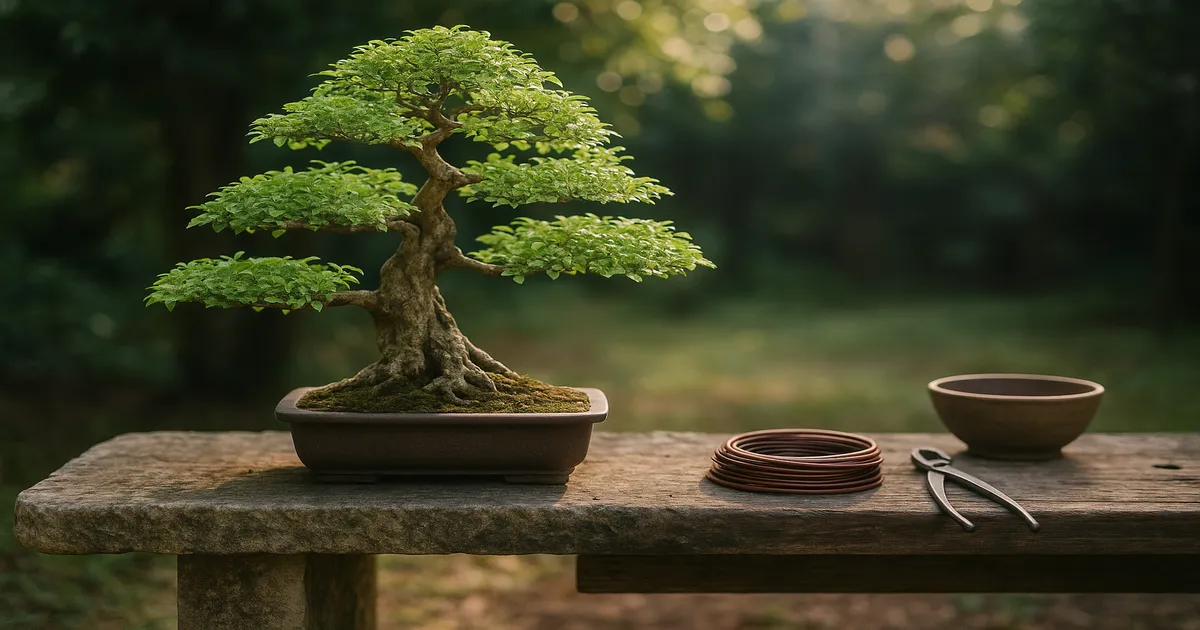
Few trees captivate enthusiasts the way a well-styled Japanese maple bonsai does. The delicate palmate leaves, fiery autumn color, and elegant winter silhouette make Acer palmatum a top choice for beginners and seasoned practitioners alike. It responds beautifully to pruning and wiring, and with the right care it can outlive its owner by generations.
Is Japanese Maple Good for Bonsai?
Japanese maple earns its reputation through traits few other deciduous species can match. Its naturally fine branching builds into dense, intricate ramification over time. Leaves reduce dramatically with proper training — sometimes by 30–50% — and the bark develops character and texture as the tree ages.
The four-season display is hard to beat: electric spring emergence (especially in red cultivars), a lush summer canopy, spectacular autumn color, and a refined skeletal silhouette through winter. Well-maintained specimens are known to survive well over a century.
| Attribute | Detail |
|---|---|
| Scientific name | Acer palmatum |
| Family | Sapindaceae |
| USDA Hardiness Zones | 5–8 (in-ground); treat container trees as 2 zones less cold-hardy |
| Ideal bonsai sizes | Shohin through medium (6–24 inches) |
| Difficulty rating | Beginner–Intermediate |
| Lifespan (bonsai) | 100+ years with proper care |
Best Japanese Maple Cultivars for Bonsai Style
The straight species, Acer palmatum, is vigorous, forgiving, and produces excellent ramification — a solid starting point for most growers. Named cultivars offer specific advantages in leaf size, bark texture, or color, but some require more exacting care.
Good choices for beginners:
- Species-type A. palmatum: Green leaves, reliable growth, tolerates mistakes well.
- ‘Deshojo’: Brilliant crimson spring foliage that softens to green by summer. One of the most popular show cultivars and forgiving enough for newcomers.
- ‘Arakawa’: Develops distinctive corky bark relatively quickly, giving even young trees an aged appearance.
Cultivars suited to refined miniature work:
- ‘Kiyohime’: Dwarf, dense, mounding habit with naturally short internodes — excellent for shohin and mame sizes, but slower to develop.
- ‘Kotohime’: Very small leaves and tight branching make it prized for miniature work. Rewarding, but demands precise watering and feeding.
- ‘Shishigashira’: The “lion’s head” maple, with crinkled, dense foliage and a naturally compact form — a strong ramification candidate.
- A. palmatum var. dissectum: Deeply cut, lace-like leaves and a weeping habit suit cascade and semi-cascade styles beautifully.
Acer japonicum ‘Aconitifolium’ is a related species worth considering for exceptionally vivid autumn color and deeply lobed leaves.
| Cultivar | Leaf Size | Growth Rate | Best Size | Bark Interest | Beginner-Friendly? |
|---|---|---|---|---|---|
| Species type | Medium | Fast | All sizes | Smooth | ✅ Yes |
| ’Deshojo’ | Medium | Moderate–Fast | Medium–Large | Smooth | ✅ Yes |
| ’Seigen’ | Small–Medium | Moderate | Small–Medium | Smooth | ✅ Yes |
| ’Arakawa’ | Medium | Moderate | Medium–Large | Corky/Rough | ✅ Yes |
| ’Shishigashira’ | Small | Moderate | Shohin–Medium | Smooth | ⚠️ Moderate |
| ’Kiyohime’ | Small | Slow | Shohin–Mame | Smooth | ⚠️ Moderate |
| ’Kotohime’ | Very small | Slow | Mame–Shohin | Smooth | ❌ Advanced |
| dissectum varieties | Lacy/Fine | Slow | Medium | Smooth | ⚠️ Moderate |
Light, Temperature, and Seasonal Care
Outdoor Placement Is Non-Negotiable
Japanese maple is a temperate deciduous tree that requires genuine seasonal dormancy to stay healthy. Keeping it indoors permanently disrupts this cycle and progressively weakens the tree. Brief indoor display — two or three days during peak autumn color — is fine, but that is the absolute limit.
Sunlight Through the Seasons
Aim for 4–6 hours of direct morning sun during the growing season, with protection from harsh afternoon light. Morning sun drives healthy growth and good color; afternoon sun above 85°F (29°C) scorches leaves, particularly on red-leafed cultivars and dissectum varieties. Target light intensity during active growth is roughly 25,000–40,000 lux.
Insufficient light is a surprisingly common mistake. Over-protected trees develop elongated internodes, pale foliage, and weak branching — the opposite of what you want.
Summer Heat Management
The tree handles temperatures up to about 95°F (35°C) if watered adequately and shaded in the afternoon. Above that threshold, growth stalls and leaf damage accelerates. In hot climates, a 50–60% shade cloth during July and August makes a real difference.
Winter Dormancy and Cold Protection
A. palmatum needs 6–8 continuous weeks below 45°F (7°C) to complete dormancy and set buds properly for the following spring. In containers, treat the tree as roughly two hardiness zones less cold-tolerant than an in-ground specimen — shallow pots offer almost no insulation for roots.
Reliable winter storage options include an unheated garage or shed (best in Zones 5–6), a cold frame with frost cloth, or burying the pot to its rim in a protected garden bed with mulch. Never bring the tree into a heated space during dormancy. Premature bud break followed by a cold snap causes severe dieback. Desiccating winter winds are an equally hidden threat, causing branch-tip die-back even at moderate temperatures.
Soil, Watering, and Feeding
The Right Bonsai Soil Mix
Japanese maple bonsai performs best in a free-draining, predominantly inorganic mix:
- Akadama: 40–50% — retains moisture, provides cation exchange capacity, anchors roots; breaks down over 2–3 years, which is one reason regular repotting matters
- Pumice: 25–30% — improves drainage and aeration, promotes healthy root development
- Lava rock: 20–30% — long-lasting structural component that prevents compaction
A small addition of decomposed pine bark (5–10%) can lower pH slightly, which A. palmatum appreciates. Target soil pH is 5.5–6.5. Use 3–6mm particle size for most trees; drop to 1–3mm for mame sizes. Standard potting soil and organic-heavy mixes compact over time, retain far too much moisture, and promote root rot — avoid them entirely.
Watering
There is no fixed watering schedule. Frequency depends on pot size, temperature, and season. The practical rule: water when the top 0.5 inch (1–1.5 cm) of soil begins to dry. In summer, small pots in hot climates may need watering twice daily. Always water thoroughly until water flows freely from the drainage holes. Never let the soil dry out completely, and never leave the pot sitting in standing water.
- Spring/autumn: Once daily or every other day
- Summer peak: Once to twice daily
- Winter dormancy: Every 1–2 weeks (just enough to prevent desiccation)
Soft water or collected rainwater is ideal. Hard tap water above 200 ppm dissolved solids gradually raises soil pH and can cause chlorosis. If tap water is your only option, letting it sit 24 hours off-gases chlorine and marginally improves quality.
| Overwatering Signs | Underwatering Signs |
|---|---|
| Yellow leaves, soft or mushy texture | Leaf edges browning and crisping inward |
| Soil stays wet 2–3+ days after watering | Leaves curling inward |
| Fungal growth on soil surface | Soil pulling away from pot edges |
| Wilting despite wet soil | Premature summer leaf drop |
| Brown, mushy roots at repotting | Brittle, dry branch tips |
Feeding
Feed with a balanced fertilizer (e.g., NPK 6-6-6 or similar) every two weeks from bud break through late summer. Taper nitrogen in late summer and switch to a low-nitrogen, higher-phosphorus feed (e.g., 0-10-10) in early autumn to harden growth before dormancy. Do not feed during winter dormancy or immediately after repotting — wait until new roots have begun to establish, typically 4–6 weeks post-repot.
Pruning Japanese Maple Bonsai for Shape and Ramification
Structural Pruning
Structural pruning establishes fundamental branch architecture and trunk movement. The best window is late winter to very early spring, just as buds swell but before leaves emerge. Sap flow hasn’t fully activated, reducing bleeding, and wounds callus most effectively when growth is imminent.
A secondary window opens in midsummer (late June–July) after the first growth flush has hardened. Avoid heavy pruning in autumn — wounds won’t callus before dormancy and become vulnerable to dieback and disease over winter.
Maintenance Pruning Through the Season
Throughout the growing season, pinch or cut new shoots back to 1–2 leaf pairs as they extend. Don’t wait for shoots to become woody before cutting — early pinching drives branching and keeps internodes short. Cut long internodes back to shorter ones lower on the branch to build fine twig structure over successive seasons.
Remove branches that cross the trunk or other branches. Eliminate bar branches (two branches emerging at the same height on opposite sides of the trunk) — keep the stronger one, or use the weaker temporarily to thicken the trunk before removing it. Prioritize branches that radiate outward in a balanced pattern when viewed from above.
Defoliation
Full defoliation — removing all leaves in early summer — can reduce leaf size by 30–50% in the following flush, increase ramification, and improve light penetration to inner branches. The timing window is late May to mid-June, after the first flush has fully hardened. Only defoliate trees that are fully healthy and well-fed. Never defoliate a stressed, recently repotted, or weak tree. Partial defoliation (removing only the largest leaves) is a gentler alternative for less vigorous specimens.
Wound Care
Use sharp concave cutters to create slightly concave cuts that callus flush with the branch. Apply cut paste to any wound larger than approximately 5mm in diameter; skip it on minor cuts where it can trap moisture. Large wounds may take 2–5 years to fully callus — monitor annually and reapply sealant if it cracks.
Wiring Japanese Maple Bonsai Branches
Use Aluminum, Not Copper
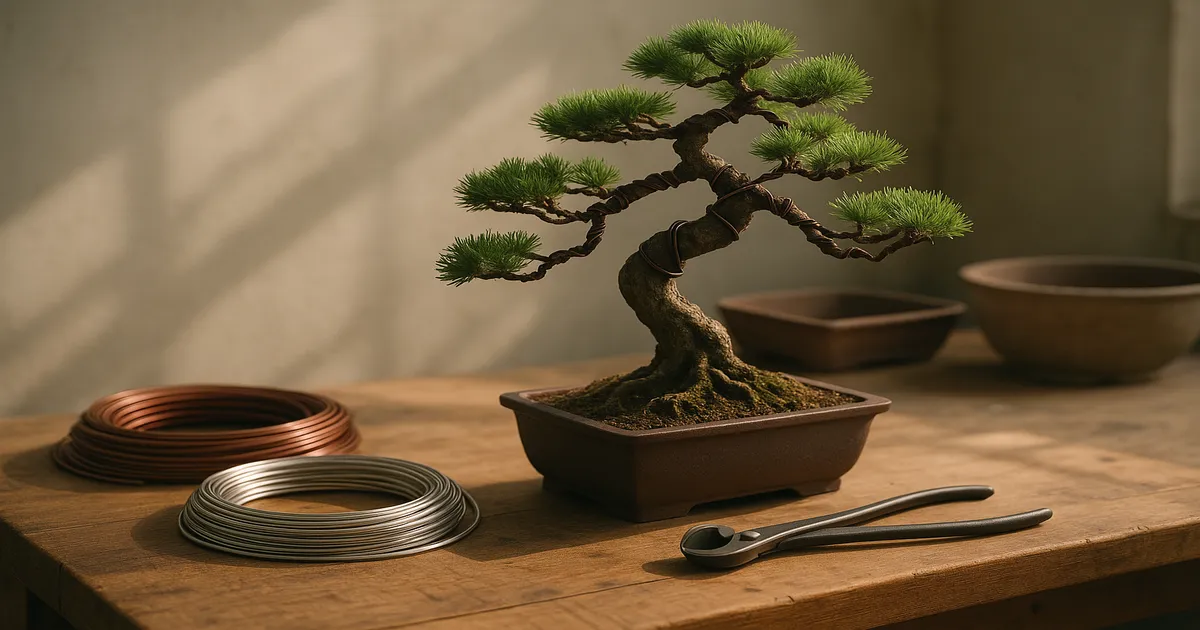
Aluminum wire is the right choice for Japanese maple. Its softer, more forgiving nature protects the tree’s thin, delicate bark. Copper wire is too rigid — during rapid spring growth it can cut into bark within days, leaving scars that persist for years.
Use these gauges as a guide:
- Trunk and primary branches: 3.0–4.0mm aluminum
- Secondary branches: 2.0–2.5mm aluminum
- Fine tertiary branches: 1.0–1.5mm aluminum
Wire diameter should be roughly one-third the diameter of the branch being wired.
Timing and Technique
The optimal wiring window is late winter before bud break, when bare branches give clear visibility of the structure. A second opportunity opens after summer defoliation. Avoid wiring during the active spring growth flush — branches thicken so rapidly that wire bites in within days.
Apply wire at a 45-degree angle, always wiring two branches of similar thickness with one piece of wire (the double-wire technique), anchored at their junction. Wire from base to tip with consistent spacing. An angle below 30° provides insufficient holding power; above 60° risks cutting into bark.
Check wired branches every 2–3 weeks during the growing season. Wire typically needs removal after 4–8 weeks during active growth. Always cut wire off in small sections with wire cutters — never unwind it from a set branch, as the motion can snap branches or damage bark.
Repotting Japanese Maple Bonsai
How Often
- Developing trees (under 10 years in training): Every 1–2 years
- Mature, refined specimens: Every 2–3 years
Repot sooner if roots are circling the pot or emerging from drainage holes, water drains unusually slowly, the tree dries out far faster than normal, or the akadama has broken down to a mud-like consistency.
Timing
Repot in very early spring, just as buds swell and show color but before they open. This leverages the tree’s natural surge of growth energy to regenerate pruned roots quickly. In Zones 7–8 this window may arrive in late February; in Zones 5–6, typically March to early April. Autumn repotting is risky — there isn’t enough time for root recovery before dormancy.
Root Pruning Technique
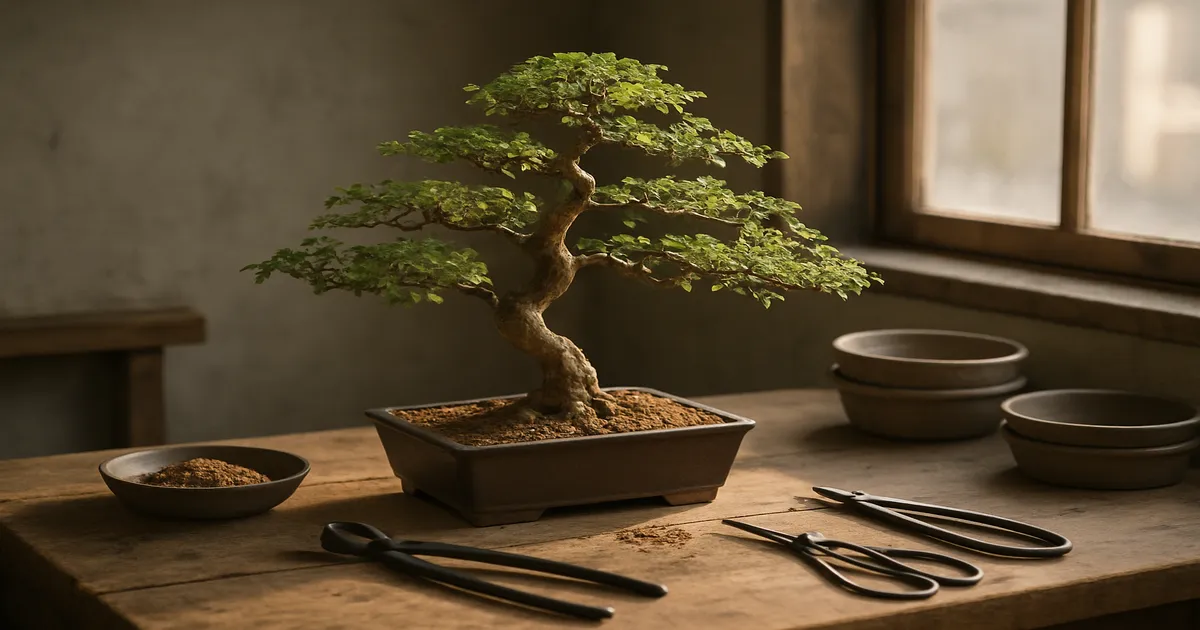
- Remove the tree from its pot and gently tease away old soil with a root hook or chopstick, working from the outside inward.
- Expose the root system fully and carefully preserve the nebari (surface roots).
- Remove no more than 25–30% of the root mass in a single session.
- Cut roots cleanly with sharp scissors or root shears — never tear or crush them.
- Remove any dead, rotting, or circling roots entirely.
- Trim long, thick tap roots to encourage finer feeder root development.
- Keep roots moist and shaded throughout — even brief drying causes damage.
Pot Selection
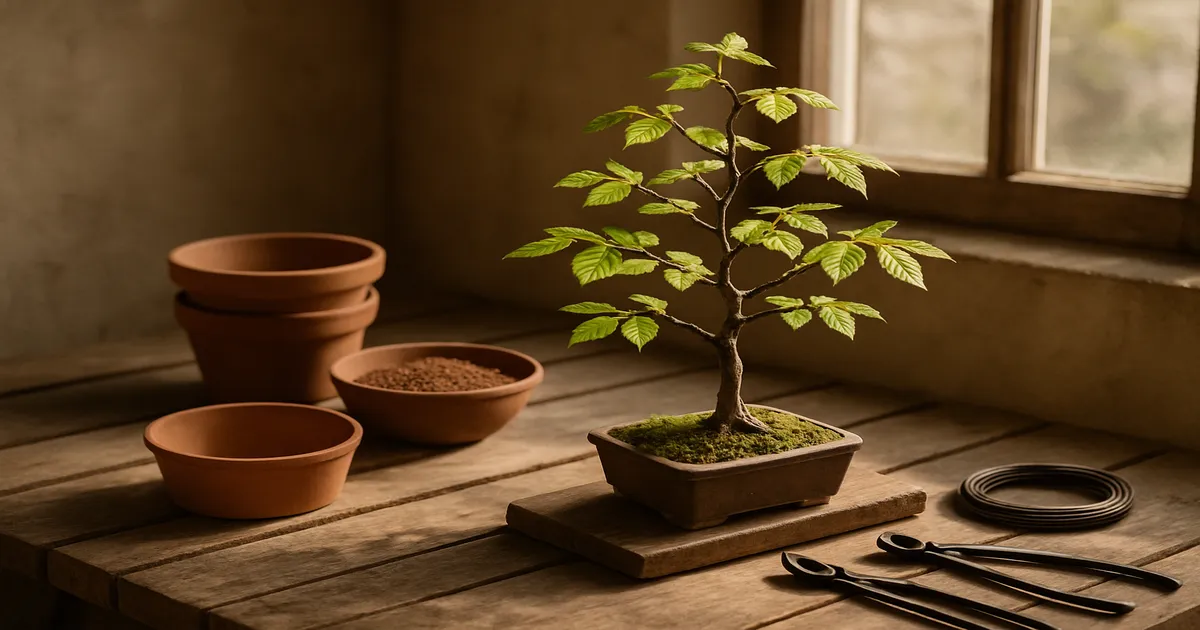
For upright styles, the pot should be approximately two-thirds the height of the tree, or two-thirds the width of the canopy — whichever is greater. Shallow pots suit mature, refined trees; deeper pots give developing trees the root room they need. Earth tones (brown, gray, buff) complement green-leafed varieties, while muted greens, blues, or unglazed earth tones pair well with red and purple-leafed cultivars.
Troubleshooting Common Problems
Leaf scorch: Brown, crispy margins almost always point to afternoon sun above 85°F (29°C). Move the tree to a spot with morning sun and afternoon shade, add shade cloth in hot climates, and increase watering frequency.
Branch dieback: Most often caused by large wounds left unprotected in autumn, late-season pruning, or desiccating winter winds. Always seal significant cuts and store the tree in a sheltered location over winter. Cut back to healthy wood in early spring and seal the wound.
Root rot: Almost always a soil and watering problem — organic-heavy mixes that stay wet too long are the culprit. Remove all affected roots cleanly at repotting, switch to the recommended inorganic mix, and adjust watering habits.
Wire marks: Wire marks on Japanese maple can persist for years because the bark is thin and the wood relatively soft. Prevention is the only real solution — check wired branches every 2–3 weeks and remove wire the moment it begins to bite in. Once marks appear, they do fade gradually with time.
Poor ramification: Weak, leggy growth with long internodes usually means insufficient light or over-protection. Move the tree to a brighter location with at least 4–6 hours of morning sun, and ensure consistent feeding through the growing season.
Frequently Asked Questions
Can you keep a Japanese maple bonsai indoors?
No. Japanese maple is strictly an outdoor bonsai. It requires genuine seasonal dormancy triggered by 6–8 weeks of temperatures below 45°F (7°C). Keeping it indoors year-round disrupts this cycle and will eventually kill the tree. Brief indoor display of two to three days during peak autumn color is acceptable.
How fast does a Japanese maple bonsai grow?
Growth rate depends heavily on cultivar and training stage. Species-type A. palmatum and ‘Deshojo’ are relatively fast, putting on several inches of new growth per season. Dwarf cultivars like ‘Kiyohime’ and ‘Kotohime’ grow much more slowly. During the development phase, allowing the tree to grow freely in a large container or garden bed significantly accelerates trunk and branch thickening.
When is the best time to style a Japanese maple bonsai?
Major structural work is best done in late winter, just as buds begin to swell. Wiring is also easiest at this time, when the branch structure is fully visible. Maintenance pruning and pinching continue throughout the growing season. Avoid heavy pruning or wiring in autumn, when the tree is preparing for dormancy.
What is the best bonsai style for Japanese maple?
Japanese maple is versatile enough to suit most classical bonsai styles. Informal upright (moyogi) is the most common and natural fit, showcasing the tree’s graceful trunk movement. Slanting (shakan) and twin-trunk (sokan) styles also work well. Dissectum varieties, with their weeping habit, are particularly well suited to cascade (kengai) and semi-cascade (han-kengai) styles.
Why are my Japanese maple bonsai leaves turning yellow?
Yellowing leaves have several possible causes. In summer, yellowing with a soft or mushy texture points to overwatering or poor drainage. Yellowing with crispy edges suggests heat stress or underwatering. Uniform yellowing across the whole canopy in late summer or autumn is normal — the tree is preparing for dormancy. If yellowing appears in spring alongside stunted growth, check soil pH and consider whether the tree needs repotting.