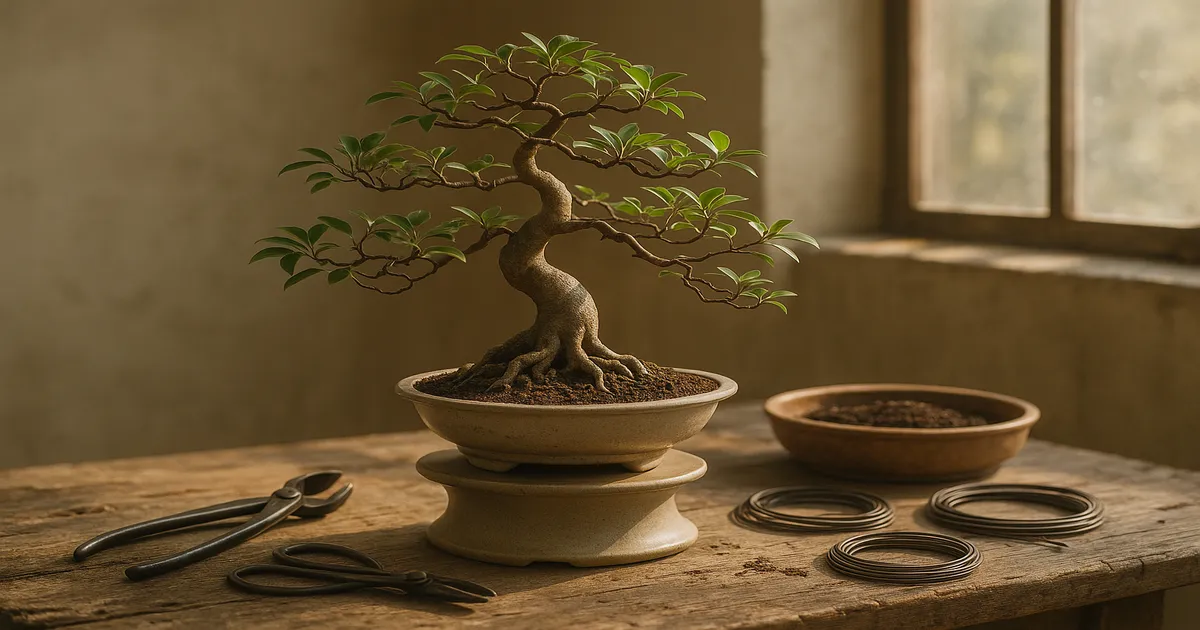
Quick Answer: A bonsai style ficus is a miniature tree created from one of roughly 850 Ficus species, trained using traditional pruning, wiring, and repotting techniques. Ficus are the world’s most popular indoor bonsai genus thanks to their tolerance of low light, vigorous growth, and ability to develop dramatic aerial roots. This guide covers species selection, care, styling, and troubleshooting — everything you need from first tree to refined specimen.
What Is a Bonsai Style Ficus?
Walk into almost any garden center and you’ll likely spot a gnarled little tree with thick, exposed roots sitting under a “bonsai” sign. Chances are good it’s a ficus. The bonsai style ficus dominates indoor bonsai worldwide, and for good reason. Members of the genus Ficus (family Moraceae, approximately 850 species) originate in tropical and subtropical regions across Southeast Asia, the Indian subcontinent, and tropical Africa, where they grow as towering canopy trees, creeping vines, and everything in between.
Their connection to bonsai runs deep. Chinese penjing artists were training ficus centuries before the Japanese formalized the aesthetic framework most Western practitioners follow today. What makes ficus so enduringly popular is a rare combination: they forgive beginner mistakes, respond beautifully to styling, and genuinely thrive on a windowsill.
Best Ficus Species for Bonsai Styling
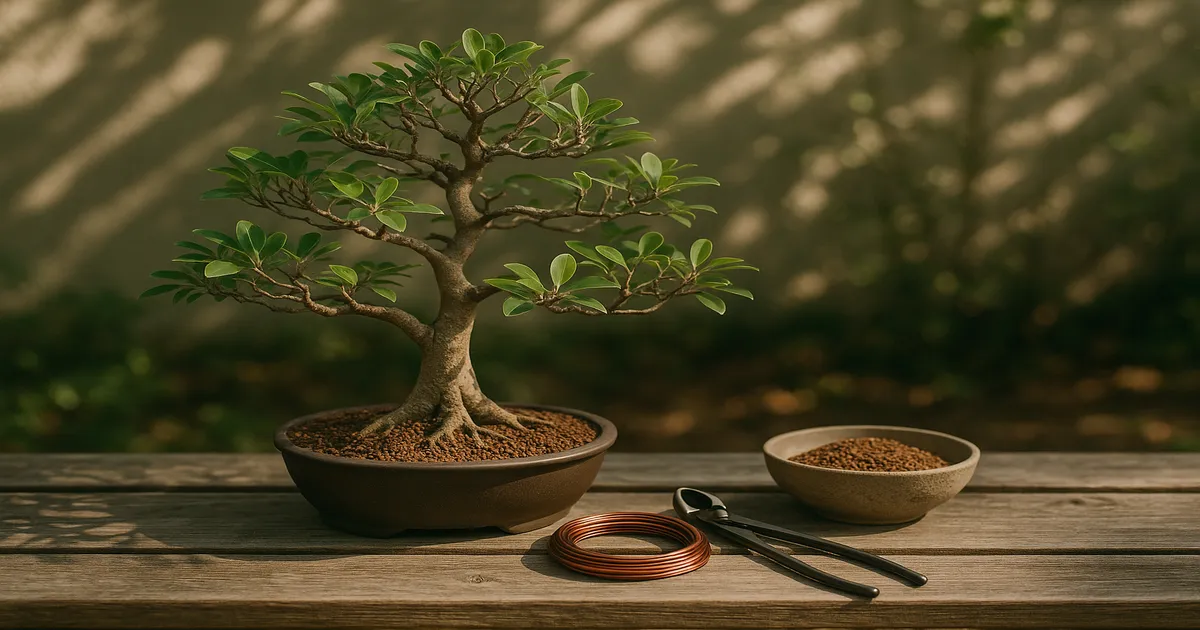
Ficus retusa and F. microcarpa: The Beginner’s Powerhouse
These two names are often used interchangeably in the trade — they’re closely related and share the same outstanding bonsai characteristics. Thick, buttressed trunks, excellent aerial root development, and an almost supernatural tolerance for indoor conditions make them the go-to recommendation for anyone starting out.
Ficus benjamina: Elegant Weeping Form
The weeping fig produces fine, delicate branching and graceful pendulous foliage that few other species can match. It responds exceptionally well to defoliation. One important caveat: F. benjamina is famously sensitive to being moved — even shifting it a few feet can trigger dramatic leaf drop. Find it a good spot and leave it there.
Ficus salicaria: Narrow Leaves and Fine Ramification
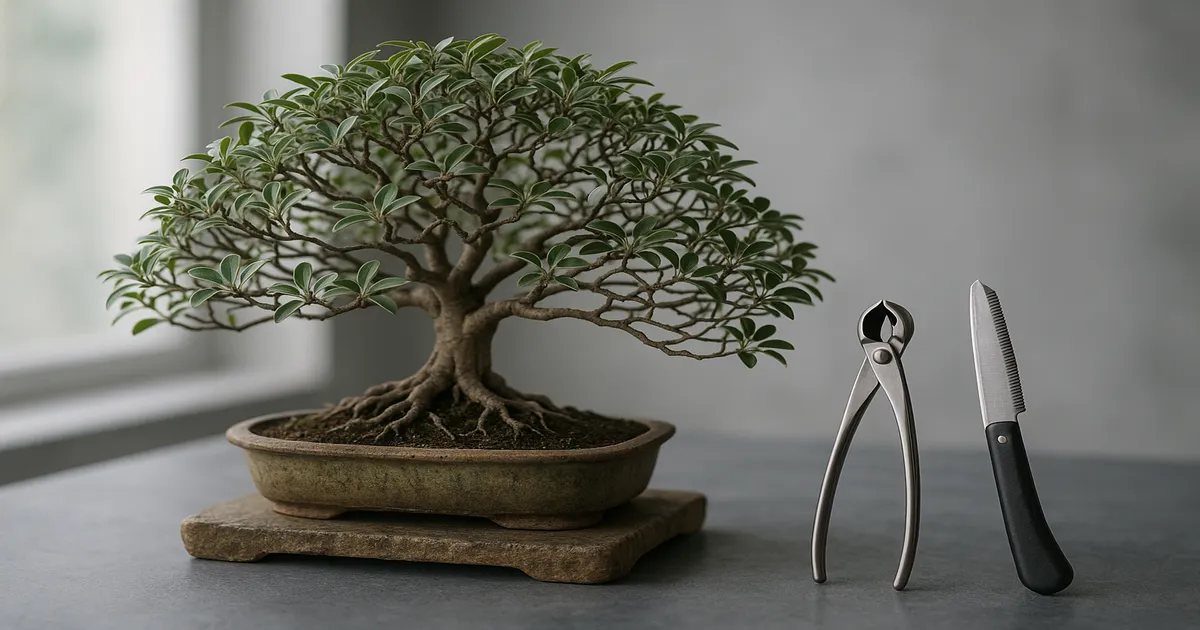
Also sold as F. nerifolia, the willow-leaf fig has become a staple in tropical bonsai circles. Its narrow leaves reduce readily with training, and it develops the dense, twiggy branching — called ramification — faster than most ficus species.
Other Notable Species
F. religiosa (the Sacred Fig or Bodhi Tree) carries cultural significance in Buddhism and Hinduism and brings distinctive heart-shaped leaves with elongated drip tips to bonsai design. F. benghalensis, the Indian Banyan, is prized for its aerial root columns — spectacular in forest and multi-trunk styles. F. rubiginosa (Port Jackson Fig) builds a robust trunk quickly and suits beginners who want to develop a substantial base fast.
F. pumila (creeping fig) is worth a brief mention: its tiny leaves make it charming as an accent plant in a bonsai display, but it isn’t well-suited as a standalone bonsai subject.
A Note on the Ginseng Ficus Cultivar
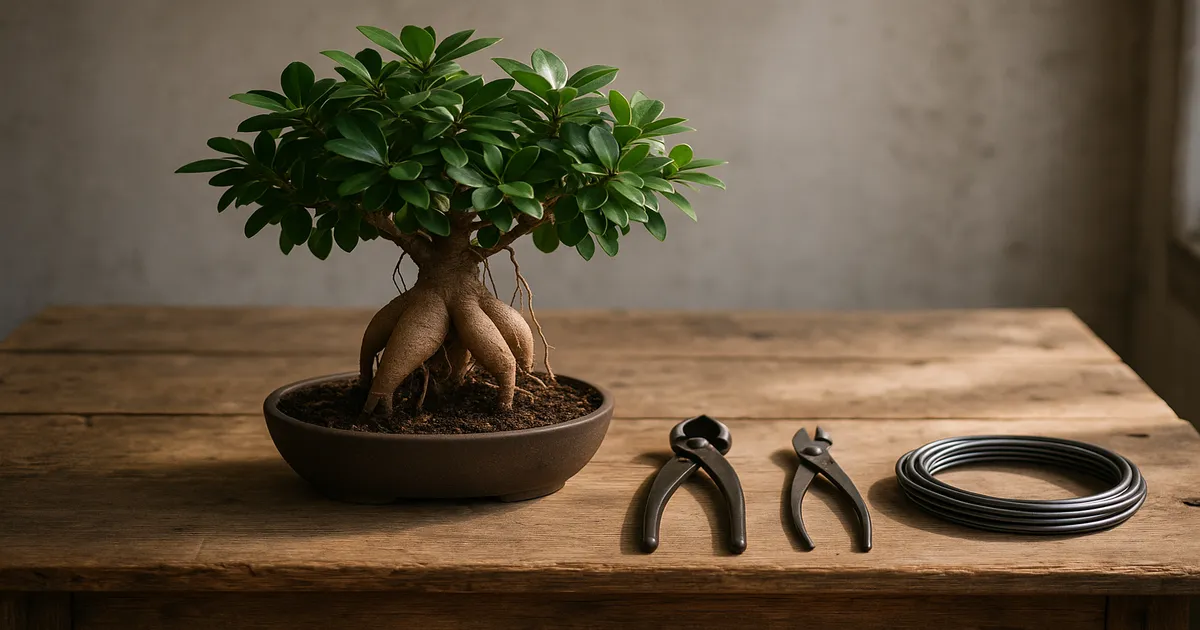
The Ficus microcarpa ‘Ginseng’ cultivar — with its dramatically swollen, tuberous-looking exposed roots — is everywhere in big-box stores. Be honest about what you’re buying: those roots are produced by propagation techniques, not years of patient development. That said, it’s a genuinely good starter tree. The root character is visually interesting, care requirements are forgiving, and you can develop the canopy into something beautiful over time.
Light, Temperature, and Humidity for Bonsai Style Ficus
Indoor vs. Outdoor Placement
In USDA Hardiness Zones 10–12, ficus bonsai can live outdoors year-round. Everywhere else, bring them inside before nighttime temperatures drop below 50°F (10°C). Cold damage begins around 45°F (7°C), and frost — 32°F (0°C) — is lethal to virtually every species used in bonsai.
How Much Light Does a Ficus Bonsai Need?
Six hours of bright light daily is the minimum. Indoors, position the tree within 1–3 feet of a south- or west-facing window. In low-light climates or during winter, a full-spectrum LED grow light running at 5,000–6,500K and delivering 2,000–3,000 lux at canopy level will keep your tree healthy. When moving a tree from indoors to outdoor sun in spring, acclimate it gradually over 1–2 weeks to prevent leaf scorch.
Temperature and Humidity
The ideal growing range is 65–95°F (18–35°C). What hurts ficus isn’t steady cool temperatures so much as sudden swings — a drop of more than 10–15°F (5–8°C) in a short period triggers stress and leaf drop. Keep trees away from heating vents, air conditioning units, and drafty windows.
Ficus evolved in habitats where humidity exceeds 70%. Most homes run at 30–50%, and heated winter air is drier still. A humidity tray filled with water and pebbles (pot sitting above, not in, the water) provides passive moisture around the canopy. A small room humidifier works even better. If you mist, do it in the morning so foliage dries before evening — wet leaves overnight invite fungal problems.
Soil, Watering, and Fertilizing
The Ideal Soil Mix
The recommended mix is 40% akadama / 30% pumice / 30% lava rock. Akadama provides moisture retention and cation exchange capacity; as it breaks down over 2–3 years, sluggish drainage signals that repotting is due. Pumice delivers aeration without ever breaking down. Lava rock anchors roots and improves drainage further. (Bonsai Jack Inorganic Bonsai Soil Mix Gritty Mix #111)
Avoid standard potting soil entirely. It retains too much moisture, compacts over time, and creates the anaerobic conditions that cause root rot.
If you can’t source all three components, a 1:1:1 mix of akadama, pumice, and coarse perlite performs well and is easier to find at garden centers.
How and When to Water
Never water on a fixed schedule. Push your finger ½ to 1 inch (1.3–2.5 cm) into the soil — water when that layer feels dry. In summer that might mean every 1–3 days; in winter, every 4–7 days is more typical. When you do water, pour until water flows freely from the drainage holes, let it drain completely, then return the pot to its display position. Never let the pot sit in standing water for more than 30 minutes.
Room-temperature water is best. Letting tap water sit uncovered for 24 hours off-gases chlorine — a simple but worthwhile habit.
Overwatering signs: yellowing lower leaves, soil staying wet beyond 5–7 days, fungus gnats, dark mushy roots, algae on the soil surface.
Underwatering signs: leaf curl, crispy leaf edges, green leaves dropping suddenly, soil pulling away from the pot walls.
Fertilizing
During the growing season (spring through early autumn), feed every two weeks with a balanced liquid fertilizer at half strength — something in the 10-10-10 or 7-9-5 NPK range works well. Reduce to once a month in winter. Avoid fertilizing for 4–6 weeks after repotting; fresh soil contains sufficient nutrients and stressed roots are vulnerable to chemical burn.
Pruning Your Ficus Bonsai for Shape and Health
Maintenance Pruning: Clip-and-Grow
Let new shoots extend to 4–6 leaves, then prune back to 1–2 leaves. Repeat over seasons to build dense, tapering branch structure. Use sharp concave cutters to create slightly hollowed wounds that heal flush rather than leaving unsightly bumps.
Structural Pruning
Save major structural work for late spring (May–June in the Northern Hemisphere), when growth energy is highest and wound healing is fastest. When selecting branches to keep:
- Remove any branch growing directly toward or away from the viewer
- Eliminate crossing branches and parallel branches at the same height
- Apply the rule of thirds: no two major branches should emerge at the same height on opposite sides of the trunk
- Favor branches with gentle taper and natural movement over straight, thick ones
Managing Latex Sap
Every Ficus species bleeds milky latex when cut. Let it dry naturally — it forms a reasonable seal, and wiping it away prolongs bleeding. For larger wounds, wait 15–30 minutes, then apply cut paste to protect against desiccation and fungal entry. Wash your hands after pruning; latex causes skin irritation in many people and can trigger allergic reactions in sensitive individuals.
Wiring Ficus Bonsai
Wire Gauge and Material
Follow the one-third rule: wire diameter should be roughly one-third the diameter of the branch.
- 1.0–1.5 mm for fine tertiary branches
- 2.0–2.5 mm for secondary branches
- 3.0–4.0 mm for primary branches and trunk work
Aluminum is the right choice for most ficus work. It’s softer, easier to handle, and less likely to damage ficus’s relatively soft bark. Copper holds a set with less wire and suits advanced practitioners making difficult bends, but it requires a practiced hand.
Application and Removal
Wrap at a consistent 45-degree angle, evenly spaced, without overlapping. Wire should hold the branch in position — not compress into the bark. Bend slowly from the base of the branch toward the tip.
This is where most beginners go wrong: ficus grow fast, and wire can bite into bark in as little as 4–8 weeks during the growing season. Check every 2–4 weeks from spring through summer. Most branch positions set within 6–12 weeks. When removing wire, always cut it off — never unwind it. Unwinding risks snapping the branch or peeling bark.
Repotting Ficus Bonsai
Timing and Frequency
Young trees (under 10 years) need repotting every 1–2 years. Mature specimens can go 3–5 years. The best indicator isn’t the calendar — it’s the soil. When your akadama has broken down and drainage is sluggish, it’s time.
Repot in early spring, just as buds begin to swell but before significant new growth extends. Ficus can technically be repotted any time of year in a warm indoor environment, but spring recovery is noticeably faster.
Root Pruning and Pot Selection
Comb out the root mass gently with a root hook or chopstick, working from the outside inward. On a healthy tree, remove up to one-third of the total root mass; on a weaker specimen, remove one-quarter or less. Cut away circling roots, downward tap roots, and any dead or rotted material. Preserve the fine white feeder roots — these handle water and nutrient uptake.
For most upright styles, pot depth should roughly equal the trunk diameter at the base, and width should be about two-thirds the tree’s height. Unglazed ceramic is the traditional choice and allows gas exchange through the walls. Glazed pots work well for tropical species — stick to earth tones (brown, gray, dark green) that support rather than compete with the tree.
After repotting, keep the tree in bright indirect light at 68–75°F (20–24°C) for 4–6 weeks. Some leaf drop is normal — it’s a stress response, not a sign the tree is dying.
Troubleshooting Common Ficus Bonsai Problems
Pest Identification and Treatment
| Pest | How to Spot It | Treatment |
|---|---|---|
| Scale insects | Brown shell-like bumps on branches | Manual removal with soft brush + 70% isopropyl alcohol; imidacloprid for severe cases |
| Spider mites | Fine webbing, stippled or bronzed leaves | Increase humidity; 2% neem oil spray; miticide if severe |
| Mealybugs | White cottony masses in leaf axils | Isopropyl alcohol on cotton swab; neem oil; systemic insecticide |
| Fungus gnats | Small flies around soil; larvae damage feeder roots | Let soil dry more; yellow sticky traps; beneficial nematodes (Steinernema feltiae) |
| Aphids | Soft clusters on new growth; sticky honeydew | Strong water spray; insecticidal soap; neem oil |
Root Rot
Root rot (Phytophthora, Pythium spp.) is caused by overwatering and poor drainage. Symptoms include yellowing, wilting despite moist soil, and dark mushy roots with an unpleasant odor. If caught early, remove the tree from its pot, cut away all affected roots, treat with a fungicide drench, and repot into fresh fast-draining soil. Prevention is far easier than treatment.
Leaf Drop
Leaf drop is the most common complaint from ficus owners, and the frustrating part is that it has multiple causes:
- Light change: Even moving the tree a short distance can trigger a drop, especially in F. benjamina. Stabilize its position.
- Cold draft: Check for nearby vents, windows, or doors and move the tree away from any cold airflow.
- Overwatering: Check roots for rot and adjust watering frequency.
- Repotting stress: Normal; provide good light and warmth and wait it out.
- Seasonal slowdown: Reduced winter light causes natural leaf reduction. Improve lighting and the tree will recover in spring.
In most cases, a ficus dropping leaves is not dying — it’s communicating stress. Identify the cause, address it, and give the tree time.
Frequently Asked Questions About Bonsai Style Ficus
Can a ficus bonsai be kept indoors permanently?
Yes — ficus are among the very few bonsai genera that genuinely thrive indoors long-term. The key requirements are at least 6 hours of bright light daily (supplemented with a grow light if needed), temperatures consistently above 55°F (13°C), and adequate humidity. Avoid heating vents and cold drafts, and your ficus can live happily on a windowsill indefinitely.
How do I encourage my ficus bonsai to grow aerial roots?
Aerial roots develop naturally in high humidity. To encourage them indoors, raise ambient humidity above 70% using a room humidifier, mist the trunk and exposed roots daily in the morning, and keep temperatures above 75°F (24°C). Some growers tent the tree loosely with clear plastic for a few weeks to create a humid microclimate. F. benghalensis and F. microcarpa respond best; F. benjamina rarely produces aerial roots indoors.
How fast does a bonsai style ficus grow?
Under good conditions — bright light, warm temperatures, regular fertilizing — ficus bonsai are among the fastest-growing indoor subjects. A young tree can add 12–18 inches of new growth per season. That vigour is an asset: it means faster trunk development, quicker wound healing, and more frequent styling opportunities than slower species like juniper or maple.
Why are my ficus bonsai leaves turning yellow?
Yellowing leaves most often point to overwatering, insufficient light, or a sudden temperature drop. Check the soil first — if it has been consistently wet, ease off watering and inspect the roots for rot. If the soil is fine, assess your light situation and check for nearby drafts or vents. Yellowing of older lower leaves alone, with new growth looking healthy, is often just natural leaf cycling and not a cause for concern.
Is a bonsai style ficus toxic to pets?
Yes. All Ficus species contain a milky latex sap that is toxic to cats and dogs if ingested, and can cause skin and eye irritation on contact. The ASPCA lists ficus as toxic to both cats and dogs. Keep your tree out of reach of pets, and wash your hands after pruning.