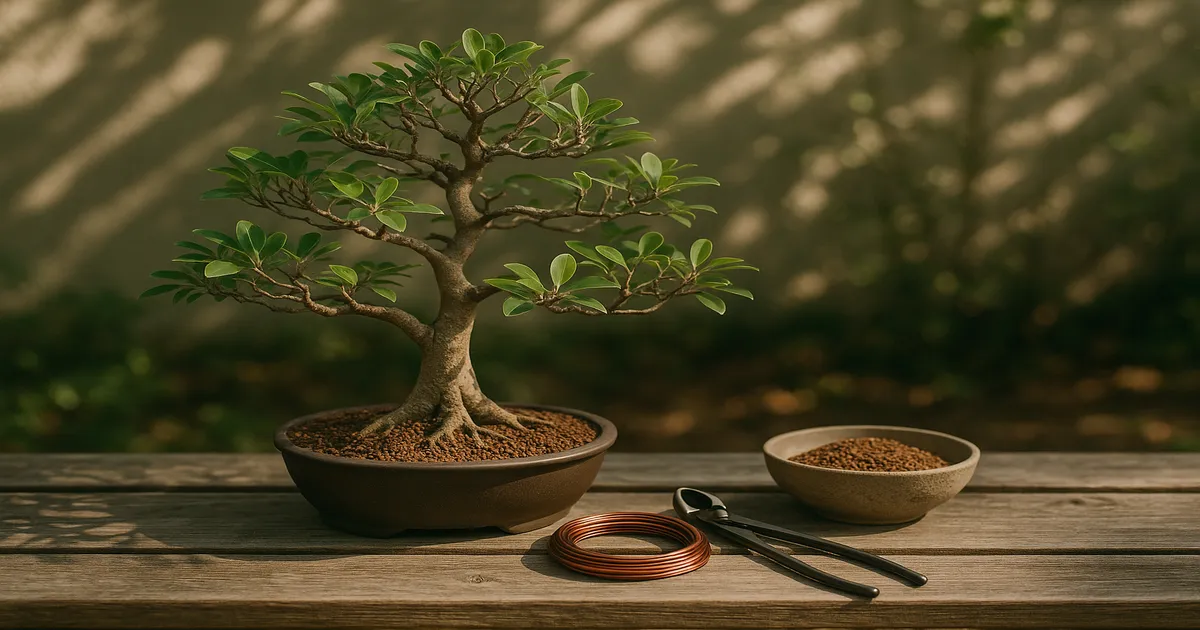
Quick Answer: After 20 years of shaping a Ficus bonsai, your focus shifts from building structure to refining it. Fix accumulated flaws like bar branches, crossing branches, and inverse taper. Improve nebari presentation, pad definition, and silhouette clarity. The major structural decisions are behind you — what remains is the painstaking, rewarding work of refinement.
If you’ve been shaping this Ficus for 20 years, you already know the basics — and then some. Asking “what should I fix?” is exactly the right question, and the fact that you’re asking it means you’re ready for the honest self-assessment that separates good bonsai from great ones. This guide is aimed squarely at experienced growers who want diagnostic and refinement advice, not a beginner’s primer.
After 20 Years of Ficus Shaping: Development vs. Refinement
Two decades in, your primary structure should be largely established. Trunk thickness, major branch placement, overall silhouette — those decisions were made years ago. The work now is fundamentally different: finer, more precise, and in many ways more demanding than the early years.
Refinement means developing secondary and tertiary ramification, tightening pad definition, and cleaning up the small compromises that accumulate in any long-term project. After two decades of incremental decisions, most mature specimens share a predictable set of problems:
- Bar branches — opposite pairs at the same height that create unnatural symmetry
- Crossing branches and parallel runs that muddy the silhouette
- Inverse taper on individual branches (thicker at the tip than the base)
- Obscured nebari from soil creep and surface root burial
- Weak pad definition — foliage masses that blob together rather than reading as distinct layers
Know Your Ficus: Species Traits That Affect Long-Term Shaping
Which Species Are You Actually Working With?
This matters more than most growers realise. The most common bonsai Ficus — often sold as F. retusa — is frequently F. microcarpa, the Chinese Banyan. Other species you may be working with include F. benjamina (Weeping Fig), F. religiosa (Sacred Fig), F. salicaria (Willow-Leaf Fig), and F. rubiginosa (Port Jackson Fig).
Each has distinct growth habits that affect your refinement strategy. F. benjamina is sensitive to environmental changes and produces elegant drooping ramification, but branches set faster and become brittle — check wire every three to four weeks. F. salicaria offers some of the finest leaf reduction potential of any Ficus. F. rubiginosa excels at nebari development and tolerates brief cold snaps down to around 28°F (-2°C) with protection — hardier than most Ficus, but still frost-sensitive.
F. microcarpa back-buds aggressively from old wood, making hard corrective pruning very forgiving. F. religiosa, with its distinctive heart-shaped leaves and drip tips, requires a different aesthetic framework — excessive ramification can actually undermine the style, since the leaf shape itself is part of the composition.
The latex sap system, fast callus formation, and strong back-budding response are your greatest allies at this stage. Cuts that would take years to heal on a juniper are manageable within a growing season on a healthy Ficus. High humidity encourages aerial root development — a unique aesthetic tool that few other genera offer.
Diagnosing Structural Flaws: A Critical Self-Assessment
Before you touch a pair of scissors, photograph your tree from all four cardinal points and then in silhouette against a plain background. You’ve been looking at this tree for 20 years — a fresh photographic perspective reveals problems that familiarity hides.
Bar Branches, Wheel-Spoke Growth, and Crossing Branches
Bar branches are opposite pairs emerging at the same height from the trunk. They create rigid, symmetrical structure that reads as artificial and stops the eye. Remove the weaker of the two, or the one that conflicts with the overall design. Wheel-spoke nodes — where multiple branches radiate from a single point at similar angles — create the same problem in three dimensions.
On a 20-year specimen, you may find several that were tolerated because removing them felt drastic at the time. Now is the time.
Crossing branches pass over the trunk line or over each other, creating visual chaos in the silhouette. Parallel branches on the same side at similar heights read as repetitive and flat. Both should be removed or repositioned.
Inverse Taper and Trunk-to-Branch Proportion
Inverse taper on individual branches — thicker at the tip than the base — is typically caused by years of cutting back to a thicker secondary shoot. There’s no easy fix. The affected section usually needs to be removed back to where proper taper resumes.
Twenty years of canopy growth can also quietly overwhelm a trunk that looked impressive a decade ago. Step back and assess whether your branch structure is still proportionate to the trunk’s visual weight. An overgrown canopy on a modest trunk is one of the most common proportion problems in long-term specimens.
Reading Your Silhouette: Negative Space and Pad Definition
A refined Ficus silhouette has distinct foliage pads separated by negative space — gaps that let the eye move through the tree and appreciate the branch structure beneath. If your canopy reads as a single undifferentiated mass, pad definition work is your top priority. This is achieved through selective thinning, not just outer pruning.
Pruning and Wiring for Refinement: What to Fix and How
Maintenance vs. Structural Pruning
Maintenance pruning — cutting back to one or two leaves beyond the last desired node — can be done year-round on Ficus. It keeps the tree in shape, encourages back-budding, and gradually refines ramification. Use sharp, clean scissors; a quality pair of bonsai scissors makes a real difference at this stage.
Structural pruning — removing major branches, correcting significant flaws — is a different matter. Reserve it for late winter to early spring, just before the main growth flush. This maximises healing time during the active season. For any cut over 1cm in diameter, apply cut paste immediately to prevent desiccation and infection while callus forms. When you make a cut, blot the latex sap with a clean cloth — don’t wipe, as smearing spreads sap into the wound.
Ficus can achieve complete callus rollover on cuts up to 2–3cm across within two to three growing seasons. Large old scars on a 20-year specimen may never fully close, however. The goal shifts from closure to aesthetic management: carve the callus edges to create a natural-looking transition, and consider whether the scar can be rotated to the back of the tree.
Defoliation as a Refinement Tool
Full defoliation on a mature Ficus is a legitimate and powerful technique — but only on healthy, vigorous trees, and only once per year maximum. Time it for early summer (June in the Northern Hemisphere) after the first growth flush has hardened off completely. Remove all leaves but leave the petioles attached; they drop naturally within one to two weeks. The result is improved light penetration to interior branches, stimulated back-budding, and gradual leaf size reduction.
Do not defoliate a tree that has recently been repotted, is under pest stress, or showing any signs of weakness.
Wiring: Precision Over Coverage
At 20 years, your wiring focus is on secondary and tertiary ramification, not primary structure. Aluminium wire is the right choice for almost all refinement-stage work — gentler on mature bark, easier to apply with precision, and more than adequate for this work. Use the one-third rule: wire diameter should be approximately one-third the thickness of the branch being wired.
- 1.0–1.5mm — fine tertiary branches and young shoots
- 2.0–2.5mm — secondary branches
- 3.0–4.0mm — any remaining primary branch repositioning
Wire marks on mature Ficus bark can be permanent. Check fine branches wired with 1–2mm wire after four to six weeks; medium branches at six to ten weeks. During summer, check every two to three weeks without exception. If wire has already bitten in, cut it away cleanly and leave the rest to work out naturally — forcing it out causes far more damage.
For repositioning a heavy primary branch, a guy wire anchored to the pot rim is often better than thick wrapping wire. It applies consistent directional force without the bite risk. Use rubber or foam tubing wherever the wire contacts the branch.
Soil, Repotting, and Growing Conditions
Soil Mix and Watering at the Refinement Stage
Shift your soil mix toward a 2:1:1 ratio of akadama, pumice, and lava rock — roughly 50% akadama, 25% pumice, 25% lava rock, at a particle size of 3–6mm. The higher akadama content supports fine feeder root development, which directly improves ramification quality. Avoid peat or anything that compacts over time — compaction suffocates feeder roots and undoes years of work. Target a soil pH of 6.0–7.0.
Water when the top half-inch of soil begins to dry, not on a fixed schedule. In summer this typically means daily; in winter, every two to four days. Water thoroughly until it flows freely from drainage holes. If you use tap water, let it sit 24 hours to off-gas chlorine, or switch to rainwater — hard water causes gradual mineral buildup that slowly raises soil pH.
Repotting a 20-Year Ficus
At 20 years, repot every three to five years. The diagnostic triggers are clear: roots circling the pot interior, roots emerging from drainage holes, or water draining immediately without being absorbed. Any one of these signals it’s time, regardless of when you last repotted.
Repotting is your primary opportunity to work on the nebari. Spread surface roots, remove any that cross or grow downward, and use a mica or wooden collar to encourage horizontal spread. At 20 years, nebari refinement can dramatically improve the perceived age and quality of the composition.
A 20-year specimen should be in or approaching its display pot. As a general guide, pot length should approximate two-thirds of the tree’s height for upright styles, or two-thirds of the canopy width for wider designs. The right pot adds perceived maturity instantly; the wrong one undermines decades of work.
Light and Humidity
Outdoor placement is one of the most impactful changes you can make. Indoor light typically provides 10,000–20,000 lux; outdoor placement delivers 30,000–50,000+ lux. The difference in ramification quality is dramatic — shorter internodes, smaller leaves, tighter pads. Move your Ficus outside once nighttime temperatures are reliably above 50°F (10°C), and bring it back in before they drop below that threshold. Acclimate gradually over two to three weeks in both directions to prevent leaf drop.
Optimal humidity for Ficus is 50–70%. Indoor heating in winter routinely drops this to 20–30%. Use a humidity tray with pebbles, a room humidifier, or regular foliage misting. To encourage aerial root development, a humidity tent over the target area can push local humidity above 80% and trigger root initiation within weeks.
Troubleshooting Common Problems
Sudden leaf drop after years of stability — Check for cold drafts, sudden light changes, or overwatering. Ficus often responds to stress with a delay of two to four weeks. Soft yellow leaves point to overwatering or root rot; green leaves dropping suddenly suggest cold or light shock.
Leggy growth and long internodes — Almost always caused by insufficient light. Move the tree to a brighter location before adjusting fertiliser or pruning timing. If light is adequate, switch to a balanced or lower-nitrogen fertiliser.
Persistent pests — Scale appears as brown or white waxy bumps; treat with neem oil and scrub affected areas manually. Spider mites thrive in hot, dry conditions — look for fine webbing and stippled leaves, increase humidity, and treat with insecticidal soap. Fungus gnats indicate consistently wet soil; allow the top inch to dry more thoroughly between waterings.
Stalled development — If the tree has stopped responding to styling with the vigour it once showed, the most likely causes are insufficient light, depleted soil, or a root-bound condition. Try outdoor placement, repotting with fresh soil, and a consistent fertilisation programme before concluding the tree has reached its ceiling. A single season outdoors with fresh soil often transforms a stalled specimen.
Frequently Asked Questions
How do I know if my mature Ficus bonsai needs repotting?
Look for three signs: roots visibly circling the interior of the pot, roots emerging from drainage holes, or water draining immediately without being absorbed. Any one of these is sufficient reason to repot. At 20 years, expect to repot every three to five years under normal conditions.
Can I defoliate a Ficus bonsai that is over 20 years old?
Yes — age alone is not a contraindication. The key requirements are that the tree is healthy, vigorous, and not under any other stress such as recent repotting or pest pressure. Time it for early summer after the first growth flush hardens, and limit defoliation to once per year.
Why are my Ficus bonsai branches not setting after wiring?
The most common reason is insufficient time. Ficus branches — especially thicker ones — need consistent pressure for weeks to months before the wood holds a new position. Check that your wire gauge is adequate (roughly one-third the branch diameter), and that the wire is anchored properly rather than just wrapped around the branch without a fixed point.
Is deadwood appropriate on a long-term Ficus specimen?
Deadwood features are non-traditional on Ficus for good reason — the tree’s rapid healing response works against you, and callus tissue quickly encroaches on exposed wood. If your specimen already has deadwood you value, maintain it with lime sulfur applications every six to twelve months to prevent rot. Don’t expect deadwood to last indefinitely without active maintenance.
My Ficus has a large ugly wound scar from an old cut. What can I do?
If the wound is too wide to close fully, shift your goal from closure to aesthetic management. Carve the callus edges to create a natural-looking transition, and consider rotating the scar to the back of the tree if the nebari and front allow it. Some scars, honestly assessed, become part of the character of the composition rather than a flaw to hide.