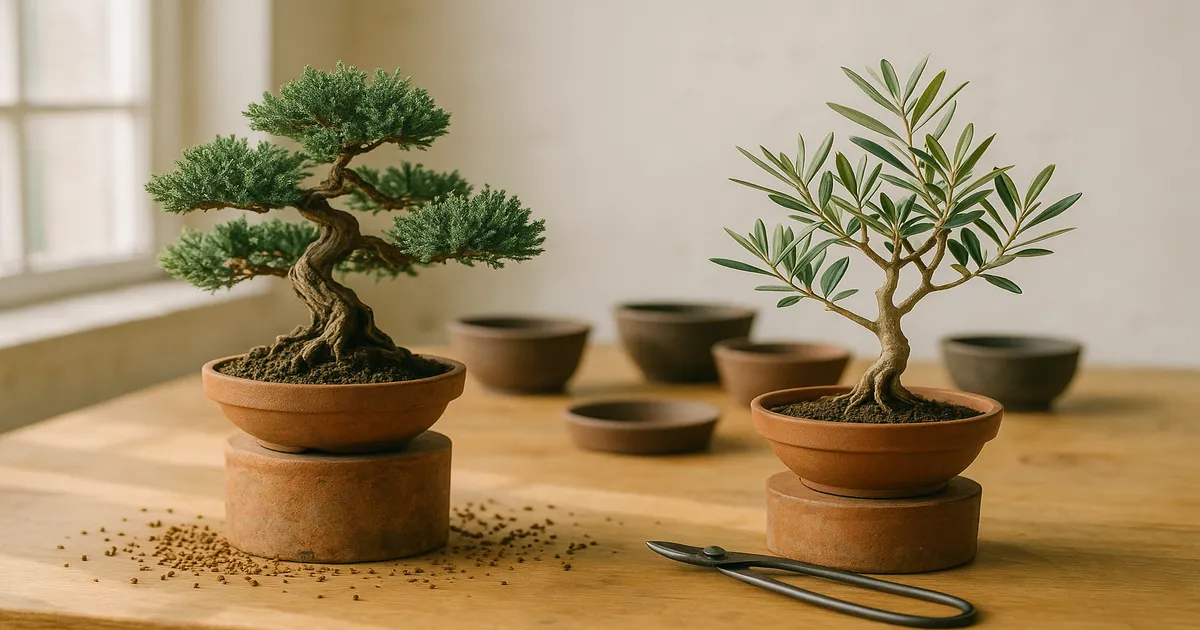
Quick Answer: The olive (Olea europaea) is the single best bonsai for dry climates — it evolved in the Mediterranean for hot, rainless summers and genuinely thrives under drought stress. For beginners, Portulacaria afra (Elephant Bush) is nearly indestructible, tolerates full desert sun, and forgives the inevitable watering mistakes while you find your rhythm.
Most bonsai advice is written for Japan, the Pacific Northwest, or the UK — places where humidity rarely drops below 50% and summer rain is a given. If you’re growing in a hot, dry climate, that advice can quietly lead you astray. The best bonsai for dry climate conditions share specific traits: thick or waxy leaves, drought-adapted metabolism, tolerance for intense UV radiation, and the ability to bounce back from soil that dries faster than you’d expect. This guide focuses on seven species that genuinely belong in arid and semi-arid gardens — and cuts through the generic recommendations that don’t.
What Makes a Great Dry-Climate Bonsai?
Drought Tolerance and Water Storage
The most reliable dry-climate species have evolved physical or metabolic tricks to survive water scarcity. Look for xerophytic traits: thick, furrowed bark that slows transpiration; waxy or leathery leaves; swollen caudex trunks that store water (Adenium, Portulacaria); and in true succulents, CAM metabolism that limits gas exchange to cooler nighttime hours. These aren’t just survival features — they’re often what makes these species beautiful as bonsai.
Leaf Size, Heat Resistance, and Cold Hardiness
Smaller leaves lose less water. Olive, Portulacaria, and Shimpaku juniper all have naturally compact foliage that reduces water loss without sacrificing the fine ramification that defines great bonsai. Desert sun is also far more intense than temperate sun — olives, junipers, and bougainvillea handle reflected heat well, while Ficus and Adenium benefit from afternoon shade once temperatures push above 105°F (40°C).
Dry-climate winters add another layer of risk: low humidity combined with freezing temperatures causes desiccation and freeze damage simultaneously. A wet freeze at 25°F (–4°C) is often less damaging than a dry desert freeze at the same temperature. Junipers and ponderosa pines handle this easily. Tropical and subtropical species — Adenium, Bougainvillea, Ficus — need frost protection below 32–40°F (0–4°C).
Best Bonsai for Dry Climate: At-a-Glance Comparison
| Species | Native Climate | USDA Zone | Summer Watering | Best For | Dry-Climate Rating (1–5) |
|---|---|---|---|---|---|
| Olive | Mediterranean | 8–11 | Every 2–4 days | Overall best; long-term styling | 5 |
| Portulacaria afra | South Africa (arid) | 10–11 | Every 3–7 days | Beginners; forgiving | 5 |
| Adenium obesum | Sub-Saharan/Arabian | 11 | Every 3–7 days | True desert zones; flowering | 5 |
| Juniper (Shimpaku) | Temperate/Arid Asia | 5–9 | Daily | Cold desert winters; traditional styling | 4 |
| Bougainvillea | Subtropical S. America | 9–11 | Daily (reduce to bloom) | Flowering display; frost-free zones | 4 |
| Ficus | Tropical/Subtropical | 10–12 | Daily | Indoor/outdoor flexibility | 3 |
| Ponderosa/Pinyon Pine | Arid western N. America | 4–7 | Every 1–2 days | Advanced collectors; native character | 4 |
Succulents and Mediterranean species dominate on drought tolerance; conifers and olive lead on styling complexity. Ficus scores lower on dry-climate rating because it needs more humidity management than the others — but its flexibility makes it worth including for beginners.
Olive Bonsai (Olea europaea)
The olive didn’t just adapt to hot, dry summers — it evolved specifically for them. Native to the Mediterranean basin, it actually performs better under moderate drought stress than with generous watering. Overwatering is a far more common mistake than underwatering. Centuries-old specimens develop hollow, tortured trunks and deeply fissured bark that no other species can replicate on a similar timeline.
Key specs:
- Hardy to Zone 8 (15–20°F / –9 to –7°C); established in-ground trees can briefly handle 10°F (–12°C), but pot-grown specimens need protection below 20°F (–7°C)
- 8+ hours full sun daily
- Water every 2–4 days in summer; reduce significantly in winter
- Soil: 35% akadama / 35% pumice / 30% lava rock
Pros
- Thrives on drought stress — one of the few species where less water means better performance
- Spectacular natural deadwood, hollow trunks, and silver-green foliage provide year-round interest
- Small-leaved cultivars like ‘Arbequina’ reduce naturally with bonsai training
- Centuries-long lifespan; yamadori specimens from Spain and California carry extraordinary character
Cons
- Slow growth demands patience — meaningful trunk development takes years, not months
- Frost-sensitive in pots; needs protection below 20°F (–7°C)
- Avoid structural pruning in peak summer heat; open wounds desiccate before callus can form in low humidity
Best for: Growers in Zone 8–11 who want the definitive best bonsai for dry climate conditions and are willing to play the long game.
Juniper Bonsai (Juniperus chinensis ‘Shimpaku’ / J. procumbens ‘Nana’)
Junipers are the world’s most practiced bonsai genus, and they handle low humidity and drought better than almost any other conifer. What most growers don’t realize is that dry air is actually an asset for juniper styling — the bleached jin and shari deadwood that defines classic juniper bonsai is better preserved in low humidity than in damp conditions, where it tends to rot or blacken.
Key specs:
- Hardy to Zone 5 (–20°F / –29°C)
- 6–8 hours full sun daily; must remain outdoors year-round
- Water daily in peak summer; every 1–2 days in cooler months
- Soil: 30% akadama / 40% pumice / 30% lava rock
Pros
- Cold-hardy through dry desert winters without any protection
- Deadwood styling (jin, shari, uro) is genuinely enhanced by dry, low-humidity conditions
- Widely available; huge international styling tradition to draw from
- Shimpaku produces fine, dense foliage pads that respond beautifully to clip-and-grow technique
Cons
- Must stay outdoors year-round — even brief indoor placement causes rapid foliage decline
- Small pots in full desert sun can overheat the root zone above 95°F (35°C); shade the pot, not the foliage
- Foliage can bronze in extreme reflected heat; light shade cloth during the most brutal weeks helps
Best for: Dry-climate growers who want a traditional bonsai aesthetic and a species that handles cold desert winters without fuss.
Portulacaria afra (Elephant Bush / Dwarf Jade)
Portulacaria afra is the species most desert bonsai growers wish they’d started with. It can survive weeks without water, tolerates full desert sun that would stress most other species, and builds trunk girth faster than true jade (Crassula ovata). The small, rounded leaves on reddish stems reduce naturally with training, and the plant responds well to every standard bonsai technique — wiring, pruning, repotting, all of it.
Key specs:
- Frost-sensitive; protect below 32°F (0°C)
- 4–8 hours sun; afternoon shade cloth recommended above 105°F (40°C)
- Water every 3–7 days in summer; once every 2–3 weeks in winter
- Soil: 20% akadama / 40% pumice / 40% lava rock
Pros
- Near-indestructible for beginners — survives the mistakes that kill other species
- Fast trunk development compared to most drought-tolerant bonsai subjects
- Responds to all standard bonsai techniques; the variegated form (‘Variegata’) adds visual interest
- Flexible enough to move indoors during cold snaps
Cons
- Frost-sensitive, limiting permanent outdoor placement in cold desert regions (high desert, Zone 7 and below)
- The succulent aesthetic — thick stems, rounded leaves — isn’t everyone’s idea of traditional bonsai
- Limited styling tradition compared to junipers or olives; you’ll be working more from first principles
Best for: Beginners in dry climates who want a forgiving species that teaches technique without punishing every mistake.
Adenium obesum (Desert Rose)
The desert rose is a true desert native — it evolved on the Arabian Peninsula and in sub-Saharan Africa, where rainfall is measured in inches per year. Its swollen, sculptural caudex is both a water reservoir and the primary aesthetic feature, making it a natural fit for pachycaul-style bonsai. Thai hybrid cultivars offer extraordinary flower colors ranging from deep crimson to candy-stripe white.
Key specs:
- Cold damage begins below 50°F (10°C); keep above 60°F (16°C) in winter
- 6–8 hours full sun; afternoon shade above 110°F (43°C)
- Water every 3–7 days in the growing season; withhold almost entirely during winter dormancy
- Soil: 40% pumice / 50% lava rock / 10% coarse sand (omit akadama — it retains too much moisture for this species)
Pros
- Spectacular flowers and dramatic caudex trunk — one of the most visually striking bonsai subjects available
- Genuinely thrives in desert heat; the hotter and sunnier, the better it performs
- Compact size suits small spaces; the caudex develops impressive girth relatively quickly
- Hundreds of cultivar choices for flower color and form
Cons
- Toxic milky sap — handle with gloves and wash hands thoroughly after any pruning or repotting
- Cold-sensitive; fully dormant in winter, which means months of a bare, leafless trunk
- Styling tradition is narrower than mainstream bonsai species; most resources focus on flower production rather than bonsai form
Best for: Growers in frost-free or near-frost-free desert zones (Zone 10–11) who prioritize flowering display and dramatic trunk form.
Bougainvillea Bonsai (Bougainvillea glabra / B. spectabilis)
Bougainvillea is one of the few bonsai subjects that blooms more under drought stress — deliberately reducing watering after a growth flush triggers a spectacular display of bracts. Its vigorous growth, dramatic surface roots, and vivid color make it a crowd-pleaser, and dry conditions suit it perfectly. ‘Torch Glow’, a compact and nearly thornless cultivar, is particularly well-suited to bonsai training.
Key specs:
- Frost-sensitive below 32°F (0°C); bring indoors or protect in frost-prone areas
- 6–8 hours full sun essential for flowering; less light means fewer bracts
- Water daily during summer growth flushes; reduce to every 4–7 days to trigger bloom cycles
- Soil: 35% akadama / 35% pumice / 30% lava rock
Pros
- Drought stress actively triggers flowering — a genuine dry-climate advantage
- Fast, vigorous growth builds trunk girth and nebari (surface roots) quickly
- Vivid bract colors from deep purple to orange-red; dramatic visual impact during bloom
- Responds well to clip-and-grow; aggressive pruning after each flush encourages the next bloom cycle
Cons
- Thorny branches make pruning and wiring uncomfortable — leather gloves are non-negotiable
- Frost-sensitive, limiting it to frost-free regions or requiring winter protection
- Aggressive root system can crack ceramic pots; use plastic training pots or thick-walled glazed pots
- Off-season appearance (bare or sparse green foliage) is unremarkable compared to bloom periods
Best for: Frost-free dry-climate growers who want maximum visual impact and a species that rewards the water restriction that desert conditions naturally provide.
Ficus Bonsai (Ficus microcarpa ‘Green Island’ / F. salicifolia)
Ficus is the most forgiving tropical bonsai for dry climates. It tolerates lower humidity than most tropicals, recovers quickly from drought stress, and when it drops leaves — which it will during temperature swings or humidity crashes — that’s a stress response, not a death sentence. F. salicifolia (willow-leaf fig) is particularly well-adapted to desert regions, with narrow leaves that reduce water loss and a natural tendency toward fine ramification.
Key specs:
- Cold damage below 40°F (4°C); keep above 55°F (13°C) at all times
- 4–8 hours bright light; full sun to bright indirect depending on acclimatization
- Water daily in summer; reduce to every 2–3 days in winter
- Soil: 40% akadama / 30% pumice / 30% lava rock
Pros
- Most beginner-friendly species on this list; leaf drop signals stress but rarely causes permanent damage
- Genuinely flexible — moves between indoor and outdoor placement as temperatures dictate
- Responds well to aggressive pruning; recovers quickly and back-buds reliably
- Develops impressive aerial roots in humid microclimates; grouping trees or using humidity trays encourages this
Cons
- Leaf drop in low humidity or during temperature swings can be alarming and may persist until conditions stabilize
- Milky latex sap is a skin irritant; wear gloves when pruning
- Needs frost protection in most dry-climate regions, limiting outdoor placement in winter
Best for: Dry-climate beginners who need the flexibility to move their tree indoors during temperature extremes and want a species that communicates stress clearly without dying from it.
Ponderosa Pine / Pinyon Pine (Pinus ponderosa / P. edulis)
Native to the arid mountain forests and high desert plateaus of western North America, ponderosa and pinyon pines are among the few conifers that are truly at home in dry climates rather than merely tolerating them. Yamadori-collected specimens from the Rockies and Southwest carry decades of natural character — twisted trunks, deeply furrowed orange-red bark, and movement that no nursery-grown tree can replicate. This is a species for growers who are serious about the long game.
Key specs:
- Hardy to Zone 4 (–30°F / –34°C)
- 6–8 hours full sun; requires year-round outdoor placement
- Water every 1–2 days in summer; reduce significantly in winter, but never allow the root ball to fully dry out
- Soil: 30% akadama / 40% pumice / 30% lava rock
Pros
- Native to the arid American West — no climate adaptation required
- Collected yamadori specimens offer unmatched natural character and trunk movement
- Deeply furrowed, orange-red bark develops with age into one of the most striking textures in bonsai
- Cold-hardy through the harshest dry-climate winters without any protection
Cons
- Advanced species only — requires experienced aftercare, precise watering, and a solid understanding of pine bonsai technique
- No indoor flexibility whatsoever; must remain outdoors year-round
- Development is slow even by bonsai standards; yamadori collection requires permits in many areas and raises ethical considerations
- Far fewer training resources available compared to Japanese black pine or juniper
Best for: Advanced dry-climate growers seeking a native western species with maximum character and a connection to the local landscape.
Our Verdict: Best Dry-Climate Bonsai by Use Case
Best Overall: Olive. It wins on every axis that matters — drought tolerance, styling potential, longevity, and genuine beauty. If you’re in Zone 8 or warmer and willing to be patient, start here.
Best for Beginners: Portulacaria afra. Nothing else on this list is as forgiving. It teaches watering discipline, pruning technique, and repotting without punishing every mistake. Start here, learn the fundamentals, then graduate to more demanding species.
Best Flowering Display: Bougainvillea. In frost-free zones, its habit of blooming harder under drought stress makes it a natural dry-climate performer. The color payoff is unmatched.
Best Cold-Hardy Option: Juniper. For high desert and cold semi-arid climates (Zone 5–7), juniper is the safest traditional bonsai choice. It handles dry freezes better than any other species on this list.
Best for True Desert Zones: Adenium. In Zone 10–11 where frost is rare and summer heat is extreme, Adenium is in its element. No other bonsai subject handles 110°F (43°C) days with such indifference.
Best Flexible Indoor/Outdoor: Ficus. When temperatures push to extremes in either direction, ficus moves inside without the rapid decline that junipers or pines would suffer. For beginners in unpredictable climates, that flexibility is invaluable.
Best for Advanced Collectors: Ponderosa or Pinyon Pine. Nothing else captures the spirit of the arid American West. For experienced growers, a collected specimen is the ultimate best bonsai for dry climate conditions.
A Note on Soil and Pots
Soil mix matters more in dry climates than in humid ones. The standard advice is to increase akadama slightly compared to published ratios — bumping a conifer mix from 30% to 35%, for example — to slow desiccation without sacrificing drainage. Never sacrifice drainage to chase moisture retention; root rot in a waterlogged pot is just as deadly as drought. Keep particle size between 1/8 and 3/16 inch (3–5mm) for most species.
For pots: unglazed ceramic cracks readily in the freeze-thaw cycles of arid climates. Beginners should use glazed ceramic or quality plastic training pots until they’re confident in their watering routine and winter protection setup.
Frequently Asked Questions
What is the easiest bonsai to keep alive in a hot, dry climate?
Portulacaria afra and Ficus are the two most forgiving options. Portulacaria can go weeks without water and tolerates full desert sun; Ficus communicates stress through leaf drop rather than sudden death, giving you time to correct course. Both can move indoors during temperature extremes — a genuine advantage in climates where summer and winter conditions can both be punishing.
Can I keep bonsai outdoors in a desert climate year-round?
It depends on the species. Junipers and olives can stay outside year-round in most dry climates and are actually better for it — natural UV and temperature cycling produce superior bark and ramification. Tropical and subtropical species (Adenium, Bougainvillea, Ficus) need frost protection once temperatures approach freezing. In cold desert regions (Zone 6–7), even olive will need protection during hard freezes below 15°F (–9°C).
How often should I water bonsai in hot desert summers?
Much more often than standard bonsai guides suggest. At 100°F+ (38°C+), small pots under 6 inches may need watering once or twice daily. Medium pots typically need daily watering; larger pots every one to two days. The rule is simple: water thoroughly until water flows freely from the drainage holes, then don’t water again until the top inch of soil is dry. Water early in the morning to reduce evaporation and get moisture to the roots before peak heat. Never pour cold water onto a sun-heated pot at midday.
Do I need to adjust my bonsai soil mix for a dry climate?
Yes, modestly. Standard mixes designed for humid climates can dry out dangerously fast in desert conditions. Increase akadama slightly — bumping a conifer mix from 30% to 35%, for example — to slow desiccation. But never sacrifice drainage; compacted, poorly draining soil causes root rot even in dry climates when watering is thorough. Keep particle size between 1/8 and 3/16 inch (3–5mm) for most species.
Which bonsai species handle low indoor humidity best?
Ficus and Portulacaria afra are the best indoor options for dry climates. Both tolerate the 20–30% relative humidity common in desert homes far better than most tropicals. Place pots on humidity trays — shallow trays filled with water and pebbles, with the pot sitting above the waterline — and group trees together to create a higher-humidity microclimate. These steps won’t transform your living room into a greenhouse, but they raise local humidity enough to reduce stress meaningfully.