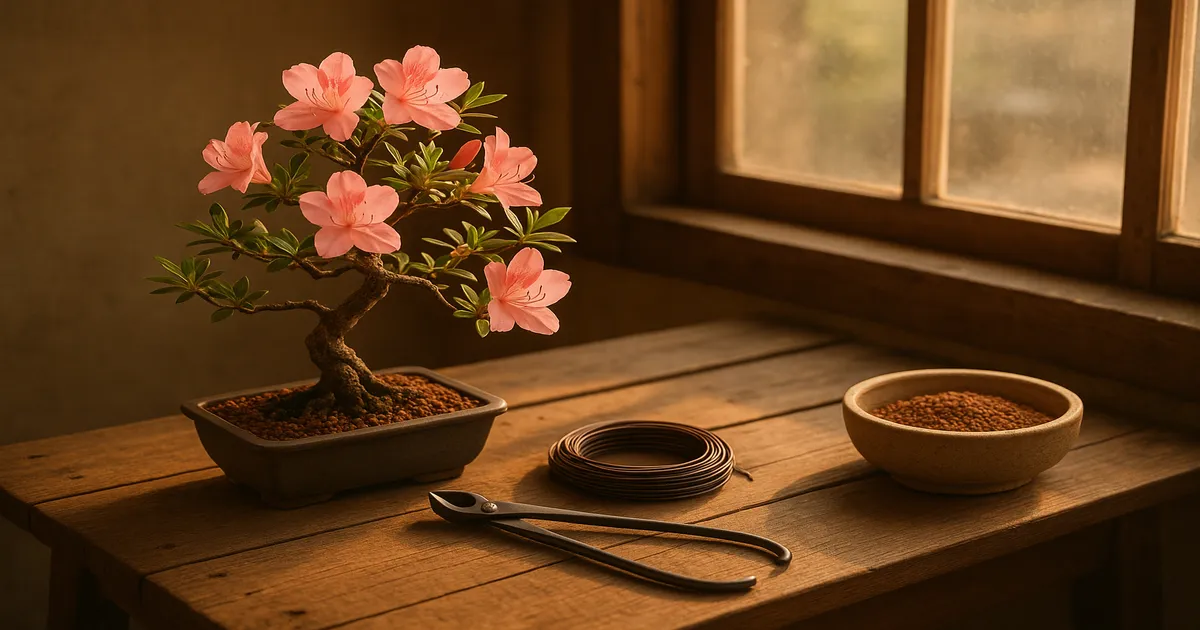
Quick Answer: Prune your azalea bonsai immediately after flowering ends — ideally June through mid-July for Satsuki azaleas. This single timing rule protects next year’s flower buds, which begin forming just 4–6 weeks after bloom. Miss that window and you’ll be deadheading a bloomless tree come spring.
Azalea bonsai pruning rewards patience and punishes guesswork. Get the timing right and you’ll have a tree that explodes into color every spring. Get it wrong and you’ll spend twelve months wondering why your azalea looks healthy but refuses to bloom. This guide covers everything you need: deadheading, maintenance pruning, structural work, wiring, and the supporting care that makes it all stick.
Azalea Bonsai Pruning at a Glance
The One Rule That Governs Everything
Azaleas bloom on the previous year’s wood. Once flowering ends, the tree immediately begins setting buds for the following spring. Any pruning done after mid-July risks removing those embryonic buds — and you won’t know until next April, when the flowers simply don’t appear.
Prune promptly after bloom. Everything else flows from that.
Seasonal Pruning Calendar
| Season | What to Do |
|---|---|
| Late Winter (Feb–Mar) | Light corrective work only; accept flower loss; remove dead wood |
| Spring (Apr–May) | Deadhead spent flowers as they fade; no shoot pruning yet |
| Early Summer (Jun–mid-Jul) | Primary window — maintenance and structural pruning post-bloom |
| Late Summer (Aug–Sep) | Hands off; buds are forming |
| Autumn (Oct–Nov) | No pruning; prepare for dormancy |
| Winter (Dec–Jan) | Tree is dormant; leave it alone |
Three types of pruning matter: deadheading (removing spent flowers), maintenance pruning (refining shape and encouraging ramification), and structural pruning (building or correcting branch architecture). Each has its own technique and urgency.
Azalea Species Best Suited to Bonsai
Satsuki Azaleas: The Gold Standard
Satsuki azaleas (Rhododendron indicum hybrids) are the most popular choice for bonsai worldwide. They bloom late May through June, produce spectacular flowers on compact growth, and respond well to training. Reliable cultivars include ‘Hakurei’ (pure white), ‘Eikan’ (deep red), ‘Gyoten’ (pink-and-white striped), and ‘Nikko’ (compact, excellent for shohin scale).
Their bloom timing defines the pruning window. For most Satsuki growers, June through mid-July is the single most important horticultural moment of the year.
Kurume Azaleas: Compact Scale and Early Bloom
Kurume azaleas (R. kiusianum hybrids) bloom earlier — typically April through May — so their pruning window opens earlier too: late May through June. ‘Hinodegiri’ (vivid crimson) and ‘Coral Bells’ (soft pink) are widely available. Their naturally small leaves and dense branching suit shohin and chuhin sizes particularly well.
Other Species Worth Knowing
Indica azaleas (R. simsii) are usable for bonsai, especially in warmer climates, but are less cold-hardy than Satsuki or Kurume. If you’re just starting out, begin with a Satsuki. For mame (miniature) bonsai, Rhododendron serpyllifolium — the wild thyme azalea — is worth seeking out. Its tiny leaves and fine branching are extraordinary at miniature scale.
Deadheading: Your First and Most Important Cut
Why It Matters
When a flower fades, the plant’s instinct is to form a seed pod. Seed production is energetically expensive — it pulls resources away from vegetative growth and bud formation. Remove the spent flower before the seed pod develops and you redirect that energy into strong new shoots and next year’s flower buds. The difference in bloom density between a well-deadheaded tree and a neglected one can be striking.
Step-by-Step Deadheading Technique
- As each flower cluster fades, locate the base of the bloom — you’ll see a small swelling (the ovary) just above the first set of leaves.
- Pinch or snip the entire flower cluster, including the ovary, cleanly at that point.
- Leave the leaves below intact — they’re already feeding the branch.
- Work through the tree every few days during bloom rather than waiting until all flowers have finished.
Sharp scissors work well here — a clean cut that includes the ovary is all that’s needed. Azalea flowers don’t all open simultaneously; a tree in full bloom may span two to three weeks. Deadhead progressively, and by the time the last flower drops, the earliest deadheaded shoots will already be pushing new growth.
Maintenance Pruning: Refining Shape and Building Ramification
Timing and Approach
For Satsuki azaleas, the maintenance pruning window runs from immediately post-bloom through mid-July. This is when you refine the silhouette, shorten extending shoots, and encourage the fine branching that makes azalea bonsai so visually rich. A light corrective pass is also possible in early spring before buds open, but you’ll sacrifice some flowers on any branch you cut.
How Far Back to Cut
Cut new shoots back to 2–4 leaves, always just above a leaf node — never between nodes, where the stub will die back anyway. Leave enough foliage to sustain the branch and support bud development while keeping growth compact. Avoid cutting into old, leafless wood during routine maintenance. Azaleas can back-bud from old wood, but it’s slow and unreliable.
Pinching vs. Cutting
Pinching — removing the softest new growth with your fingertips — works well in spring when shoots are still tender. It’s fast across a large canopy and minimises disturbance to adjacent buds.
Cutting is the right choice once growth has begun to harden. Use sharp bonsai scissors for shoot tips and concave cutters for anything over 3mm in diameter. Never tear or rip growth. A ragged wound browns, invites disease, and heals poorly.
Working Systematically
Start at the apex and work downward. The top grows most vigorously and needs the most reduction; lower branches need more foliage to stay healthy. Within each branch pad, remove inward-growing shoots first, then shorten the outer extensions. This preserves taper and keeps the silhouette clean.
Structural Pruning: Building and Correcting Branch Architecture
Timing and Which Branches to Remove
Structural pruning is best done immediately post-bloom. The tree has maximum energy reserves, wounds heal quickly in the warm months ahead, and you’ve already seen which branches contribute to the design and which fight it.
Remove branches that:
- Face forward and obscure the trunk line
- Cross each other or create visual confusion
- Show reverse taper (thickening toward the tip)
- Grow downward from the underside of a major limb without serving a design purpose
The goal is clarity. A well-structured azalea bonsai should read cleanly from the front — trunk visible, branch pads distinct, no clutter.
Cutting Technique and Wound Care
Use sharp concave cutters to create a slightly hollow wound. This profile heals flush with the surrounding bark rather than leaving a raised knob. Work with a single decisive cut. Apply cut paste to all wounds over 5mm immediately after cutting. Azaleas are moderate healers — a large wound may take two to five years to callus fully.
After heavy structural work, move the tree to dappled shade for one to two weeks and wait three to four weeks before resuming heavy fertilisation. Check cut sites weekly for die-back; if browning extends beyond the cut, re-cut to healthy tissue and reapply sealant.
Wiring Azalea Bonsai Without Damaging the Bark
Always Use Aluminum
Azalea bark is thin and soft. Copper wire bites in fast and leaves permanent scars. Aluminum provides enough holding power for azalea’s moderate branch rigidity without the same risk.
| Branch Diameter | Aluminum Gauge |
|---|---|
| Fine branches (<5mm) | 1.0–1.5mm |
| Secondary branches (5–10mm) | 2.0–2.5mm |
| Primary branches / trunk (>10mm) | 3.0–4.0mm |
When in doubt, go slightly lighter. You can always re-wire; you can’t un-scar bark.
Application and Monitoring
Wire immediately post-bloom, June through July, when branches are most flexible. Wrap at a 45-degree angle, using the one-wire-two-branches technique where possible. On delicate bark, wrap the wire in raffia first. Active summer growth means wire can bite into azalea bark in as little as 4–6 weeks — check every two to three weeks without exception.
Always cut wire in multiple places with wire cutters and unwrap the pieces gently. Never unwind wire from a set branch — the rotational force can snap brittle wood or strip bark.
Soil, Watering, and Light: The Foundation of Pruning Success
Soil Mix and pH
Azaleas need a soil pH of 4.5–6.0. Outside that range, nutrients lock out, new growth is weak, and the tree can’t recover from pruning the way it should. The standard professional mix is 60–70% Kanuma, 20–30% akadama, 10–20% pumice. Kanuma is a naturally acidic Japanese volcanic material that drains well, aerates roots effectively, and holds the pH azaleas need. Refresh the mix every two to three years as particles break down. Avoid limestone-based gravel and standard potting compost entirely.
Watering
After pruning, consistent moisture is critical — the tree is healing and pushing new growth simultaneously. Water when the top half-inch of soil begins to dry, never letting it go completely dry. In summer heat, that may mean watering once or twice daily. Alkaline tap water gradually raises soil pH, causing interveinal chlorosis and nutrient lockout. Use rainwater when possible. If you must use tap water, acidify it occasionally with one to two teaspoons of white vinegar per gallon.
Light
Azaleas want four to six hours of morning sun with afternoon shade. Full midday sun above 90°F (32°C) stresses the tree and slows post-pruning recovery. After heavy pruning, move the tree to dappled shade for one to two weeks while it redirects energy to healing and new growth.
Troubleshooting Common Azalea Bonsai Pruning Problems
Tree didn’t bloom after pruning. The most likely cause is late pruning — after mid-July for Satsuki azaleas. Other possibilities: insufficient winter chilling (Satsuki azaleas need 6–10 weeks between 28–45°F / -2–7°C to set buds) or soil pH that’s too high. Check your timing, winter protection routine, and soil pH.
Die-back after pruning. Browning beyond the cut usually means cutting into old leafless wood, using blunt tools, or skipping wound sealant. Re-cut to healthy tissue (white or pale green inside), apply fresh cut paste, and sharpen your tools.
Wire scars. There’s no fast fix — healing takes two years or more. Prevention is everything: check wire every two to three weeks in summer and remove it at the first sign of biting in.
Weak, sparse regrowth. Almost always traces to soil pH outside the 4.5–6.0 range, insufficient light (less than four hours of direct sun), or removing too much foliage at once. Aim to leave at least one-third of the foliage mass on any branch you cut.
Frequently Asked Questions About Azalea Bonsai Pruning
When is the best time to prune an azalea bonsai?
Immediately after flowering ends. For Satsuki azaleas, that’s typically June through mid-July. This window lets you deadhead, refine the shape, and do structural work before the tree begins setting next year’s flower buds.
Can I prune my azalea bonsai in winter?
Winter pruning is possible but not ideal. Next year’s flower buds are already formed, and any pruning removes them. Reserve winter work for clearly dead wood or urgent structural corrections you’re willing to sacrifice flowers for.
How do I prune an azalea bonsai without losing next year’s flowers?
Complete all pruning — deadheading, maintenance, and structural work — before mid-July. Flower buds begin forming 4–6 weeks after bloom ends. Work promptly once the last flower fades and next year’s display is safe.
How far back should I cut new shoots on an azalea bonsai?
Cut back to 2–4 leaves, always just above a leaf node. This retains enough foliage to sustain the branch and support bud development while keeping growth compact.
Why did my azalea bonsai not bloom after pruning?
The most common reason is pruning too late — after mid-July for Satsuki azaleas — which removes the forming flower buds. Other causes include insufficient winter chilling and soil pH above 6.0. Check your timing, cold exposure, and soil conditions.