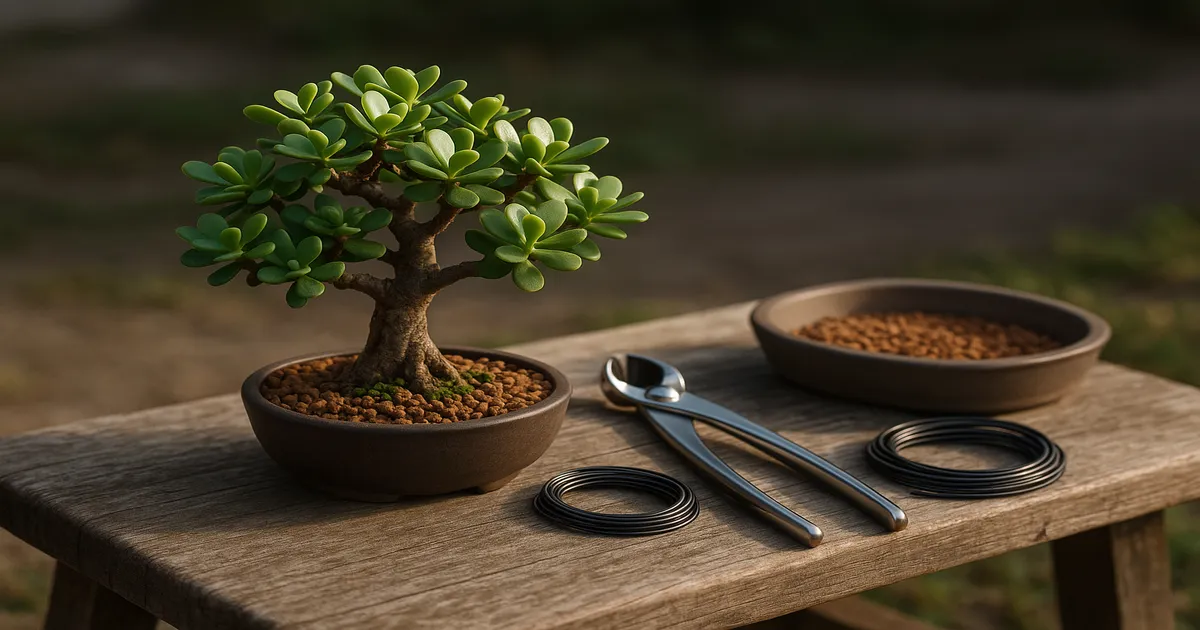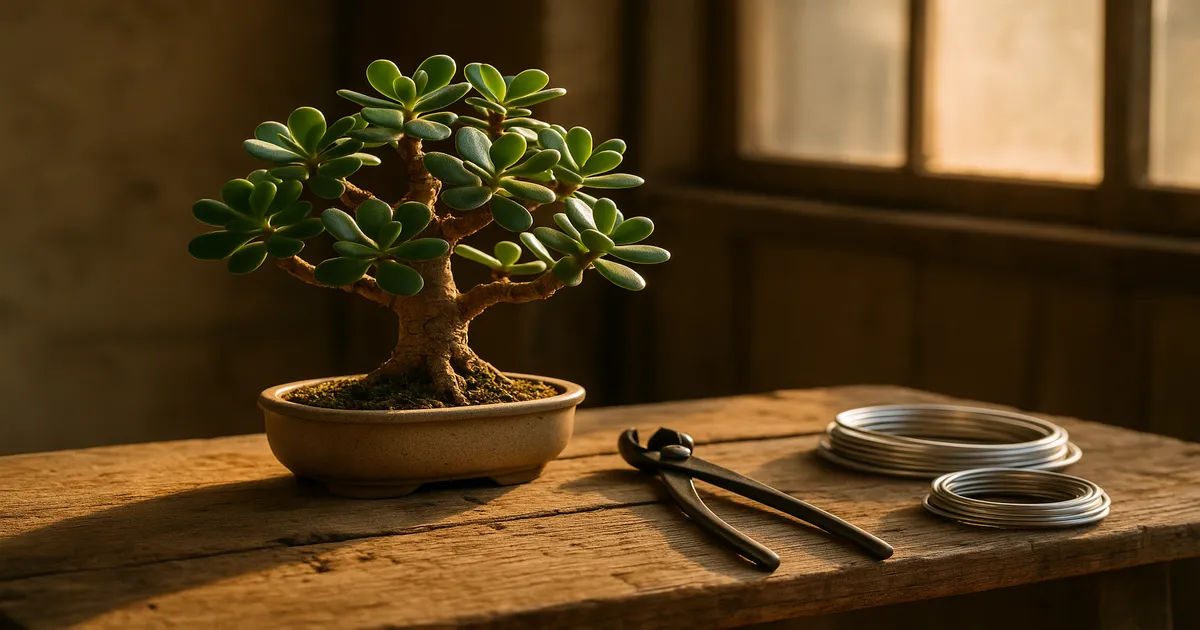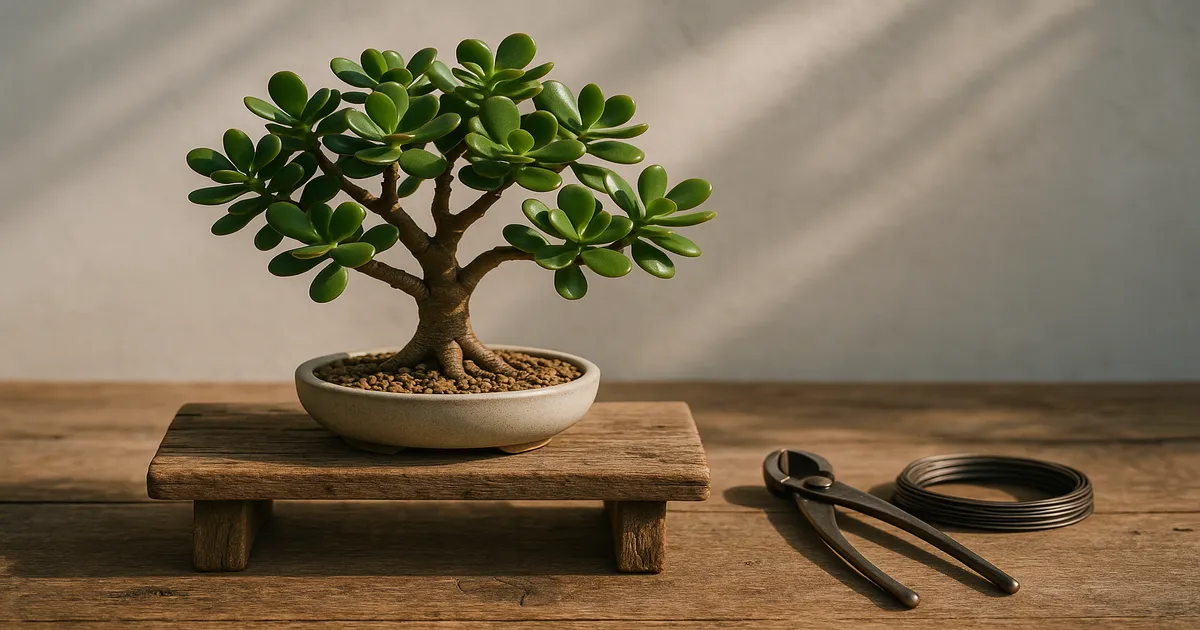
Quick Answer: Jade plant pruning is best done in spring, removing no more than 25–30% of foliage at once to keep the tree healthy and encourage back-budding. Two approaches matter most: light maintenance pruning to build ramification throughout the growing season, and structural pruning in late winter to establish your primary branch framework. Jade is forgiving and back-buds reliably, making it one of the best bonsai species for beginners.
Jade Plant Growth Habits: What You’re Working With
Crassula ovata is native to the rocky, well-drained hillsides of South Africa’s KwaZulu-Natal and Eastern Cape provinces — conditions that shaped a tough, drought-tolerant shrub with a naturally thick, gnarled trunk. In the wild it reaches 6–10 feet (1.8–3 m), which means bonsai training mimics what wind, drought, and poor soil do to it naturally. That’s a big part of why it works so well in a pot.
Jade’s woody stem thickens quickly, its leaves reduce over time with good technique, and it tolerates aggressive root pruning better than most species. The key challenge is apical dominance — jade channels energy to its topmost and outermost shoots. Without regular pruning you end up with a leggy, top-heavy plant that looks nothing like a tree. Pruning is how you override that instinct and redirect energy toward back-budding and finer branch structure.
Best Jade Varieties for Bonsai Training
- Standard C. ovata: Most vigorous, fastest trunk development, most reliable wound healing — the best all-around choice for beginners.
- ‘Crosby’s Compact’: Dense branching habit, red-edged leaves, excellent for refined shohin-scale work.
- ‘Minima’: Naturally smaller leaves reduce the leaf-size problem common in bonsai; compact internodes are a bonus.
- ‘Gollum’ and ‘Hobbit’: Sculptural, unusual foliage — popular for informal upright styles, though leaf reduction is more limited.
Light, Temperature, and Pre-Pruning Plant Health
A jade plant that doesn’t get enough light will etiolate — producing long, stretched internodes that undermine everything you’re trying to achieve with pruning. Aim for at least 4–6 hours of direct light daily. South- or west-facing windows are the sweet spot indoors. Under grow lights, target 2,000–5,000 lux for 12–14 hours per day — a compact LED panel such as the Mars Hydro TS600 works well for a single tree on a windowsill shelf.
The ideal growing temperature is 65–75°F (18–24°C) during the active season. Cooler nights around 50–55°F (10–13°C) in winter actually benefit the plant — they encourage flowering and help consolidate growth. Never prune a cold-stressed or frost-damaged jade; the plant won’t have the reserves to heal pruning wounds properly.
Recovery speed after pruning is directly tied to light and warmth. A jade sitting in a dim corner in January will take months to callus a wound that a plant in a bright south window closes in weeks. Before any significant pruning session, make sure your tree has been in strong light for at least a few weeks and shows active, healthy growth.
Soil and Watering: Setting Up for Pruning Success
Drainage is everything with jade. A reliable bonsai mix is roughly 25% akadama, 38% pumice, and 37% lava rock by volume. This keeps roots aerated and dries at a pace that matches jade’s water needs. Avoid peat-based or “moisture-retaining” potting soils — they stay wet too long in a shallow bonsai pot and invite root rot. A pre-blended succulent bonsai mix such as Bonsai Jack Succulent and Cactus Soil is a practical shortcut if you don’t want to source components separately.
During the active growing season, water thoroughly when the top ½–1 inch (1–2.5 cm) of soil is completely dry — typically every 3–7 days in summer. In winter, back off to every 10–21 days. After heavy pruning, root activity temporarily drops, so the soil dries more slowly than usual. Water conservatively for the first 2–3 weeks post-pruning to avoid sitting moisture around healing roots. Flush the soil thoroughly every 4–6 weeks to prevent fluoride and salt buildup, which jade is notably sensitive to.
Signs of overwatering: yellowing or mushy leaves, soft or blackened stem base, soil still wet after 10–14 days, fungus gnats around the soil.
Signs of underwatering: wrinkling or shriveling leaves, leaves dropping from lower branches, soil pulling away from pot edges, pot feels unusually light.
A stressed plant — from too much water or too little — should not receive heavy pruning. Stabilise it first.
Jade Plant Pruning Techniques: Step-by-Step
Tools and Sterilisation
- Sharp scissors or concave branch cutters for branches up to ½ inch (12 mm) in diameter — a quality concave cutter such as the Kaneshin No.2 creates slightly hollowed wounds that heal flush with the trunk
- Knob cutters for removing larger stubs flush to the trunk
- 70% isopropyl alcohol to sterilise tools between cuts
Wipe blades with an alcohol-soaked cloth before you start and between major cuts. Jade sap can irritate sensitive skin, so gloves are worth wearing.
Maintenance Pruning
This is the pruning you’ll do most often. The goal is to keep the silhouette compact, remove unwanted shoots before they waste energy, and gradually build finer branch divisions.
- Cut new shoots back to 1–2 leaf pairs above the desired branch point.
- Always cut just above a leaf node at a slight angle — new growth emerges from the axillary buds at that node.
- Remove any shoots growing straight up (water shoots) or straight down immediately; they disrupt the design and drain energy.
- Thin dense interior growth to improve light penetration and airflow.
Spring (March–May) is the best time for a thorough maintenance session, but light pinching can happen throughout the growing season whenever a shoot is getting out of hand.
Structural Pruning and Trunk Chops
Structural pruning — reducing height, establishing primary branches, or reshaping nursery stock — belongs in late winter to early spring (February–March in the Northern Hemisphere), just before the main growth flush when reserves are high and healing is fast.
Identify your first, second, and third branches (the lowest, most important structural limbs) and protect these while removing everything that competes with them. For a trunk chop, make the cut just above a healthy branch or leaf node — that node becomes the new apex. Never remove more than 25–30% of total foliage in a single session. On a stressed tree, be even more conservative.
Apply bonsai cut paste to any wound larger than ¼ inch (6 mm) in diameter — a product such as Kiyonal Bonsai Cut Paste prevents desiccation and keeps pathogens out while callus tissue forms. In a healthy, actively growing jade, callus starts forming within 2–6 weeks; full closure of a large wound can take 1–3 years.
Stimulating Back-Budding
Jade back-buds reliably — one of its best qualities for bonsai work. After pruning, move the tree to your brightest available position. Exposing the trunk to strong light is the single most effective way to stimulate dormant buds along the bark. Expect new buds within 3–8 weeks during the growing season.
Wiring Jade Plant Branches After Pruning
Always use aluminum wire on jade — copper is too rigid for the soft bark and will bite in before you notice. Match gauge to branch thickness: 1.0–1.5 mm for thin shoots, 2.0–2.5 mm for medium branches, 3.0–4.0 mm for primary structural branches. A general rule: the wire should be about one-third the diameter of the branch.
Wire in late winter to early spring, alongside structural pruning. After heavy pruning, wait 2–4 weeks before wiring to avoid stacking stress on the tree. Wrap at a 45-degree angle in the direction of the bend. Wire should be firm but not tight — you should be able to slide a fingernail under it after application. Bend branches slowly, supporting the base with your thumb to prevent snapping at the crotch.
Check wired branches every 3–4 weeks during the growing season. Wire can bite into jade’s soft bark in as little as 4–6 weeks during active growth. Remove wire by cutting it into sections — never unwind it around a live branch. Wire scars on jade are permanent, so prevention is everything.
Repotting: Timing It With Your Pruning Schedule
Developing trees benefit from repotting every 1–2 years; mature specimens can go 3–5 years between repots. Signs it’s time: roots circling the pot bottom, roots emerging from drainage holes, or soil drying unusually fast.
When root pruning, remove dead or rotted roots first, then trim healthy roots back by no more than 25–30% of total root mass. Use sharp, clean scissors or root cutters. Let cut surfaces callus for 30–60 minutes in open air before repotting — this succulent-specific step significantly reduces rot risk.
Terracotta pots suit jade well; their porosity helps soil dry at the right pace. For oval or rectangular pots, aim for a length roughly two-thirds the height of the tree. After repotting, keep the tree in bright shade for 2–4 weeks and withhold fertiliser for 4–6 weeks. Water sparingly for the first two weeks — just enough to keep soil barely moist — then resume normal care once new growth is actively emerging.
Troubleshooting Common Jade Plant Pruning Problems
Wounds not healing or showing rot: Check for overwatering first. Verify cut paste was applied to wounds over 6 mm and that the plant is getting strong light. If you see blackening around a cut, remove the affected tissue with a sterile blade and allow it to dry before resealing.
No back-budding after pruning: Almost always a light problem. If you pruned during winter dormancy, buds may simply be waiting for warmer temperatures and longer days. Move the tree to your brightest position and be patient.
Leggy growth returning quickly: Insufficient light is the underlying cause. More light plus regular pinching — cutting new shoots back to 1–2 leaf pairs as soon as they extend — is the fix. Pruning alone won’t solve etiolation if the light situation hasn’t changed.
Mealybugs and fungus gnats: Open wounds temporarily invite opportunistic pests. Mealybugs appear as white cottony masses in leaf axils; treat with a cotton swab dipped in 70% isopropyl alcohol or a neem oil spray. Fungus gnats signal overwatering — let the soil dry more thoroughly between waterings. Check new growth carefully for the first 4–6 weeks after heavy pruning.
Frequently Asked Questions About Jade Plant Pruning
When is the best time to prune a jade plant?
Spring (March–May) is optimal for both maintenance and structural pruning. The plant is entering its most vigorous growth phase, wounds heal quickly, and back-budding is most reliable. Light pinching can happen throughout the growing season, but avoid heavy pruning during winter dormancy when recovery is slowest.
How much can you cut off a jade plant without harming it?
The safe limit for a healthy jade is 25–30% of total foliage mass in a single session. If you need to make larger reductions, spread the work across two or three sessions spaced 6–8 weeks apart.
How do I make my jade plant bushier through pruning?
Pinch or cut each new shoot back to 1–2 leaf pairs above a node as soon as it extends. This forces the plant to branch from that node rather than continuing to elongate. Done consistently throughout the growing season — combined with strong light — this builds dense, bushy growth over one to two seasons.
Can I propagate jade plant cuttings from pruned branches?
Yes — jade propagates very easily from stem cuttings. Let the cut end callus in open air for 24–48 hours before placing it in a barely moist succulent mix. Most cuttings root within 3–6 weeks in warm conditions with bright indirect light. Spring pruning sessions are a great opportunity to propagate new plants from the material you remove.
Does pruning a jade plant encourage flowering?
Pruning itself doesn’t directly trigger flowering. Jade flowers in response to cool nights (50–55°F / 10–13°C) and reduced watering in late autumn and winter. Heavy pruning shortly before the flowering period can redirect energy away from blooms, so if flowering matters to you, complete any major structural work in late winter after the bloom cycle has finished.