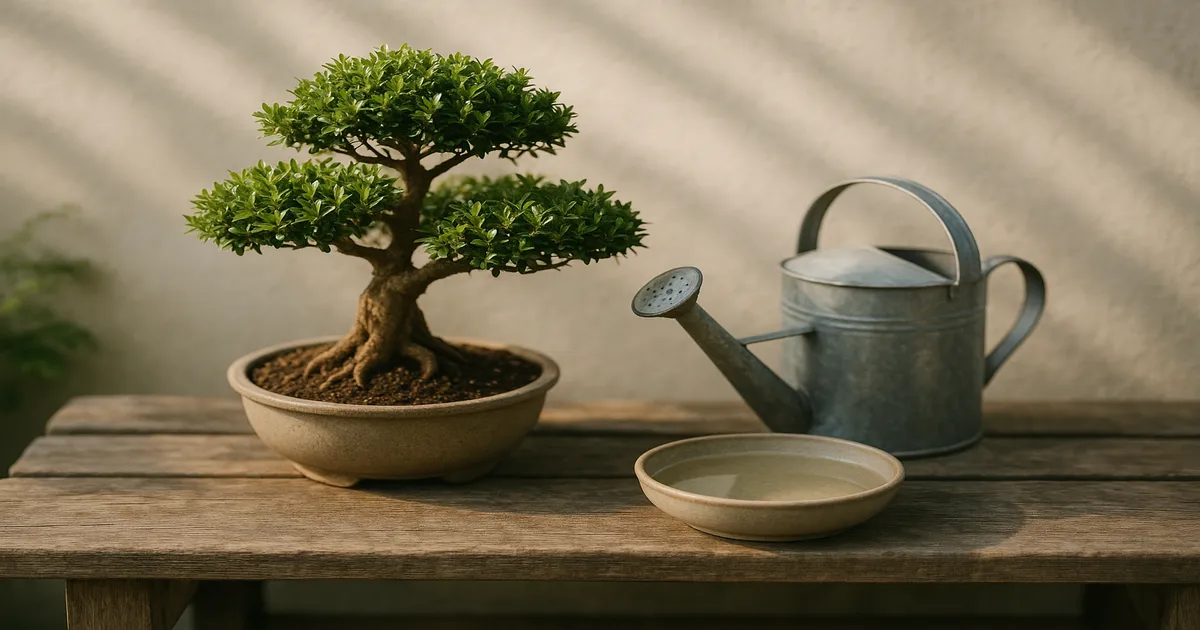
Quick Answer: How often you should water your boxwoods depends on the season, pot size, soil mix, and your local climate — there’s no single universal schedule. In peak summer, you may need to water once or twice daily; in winter dormancy, once every 2–3 weeks is typically enough. The most reliable method is always the finger test: water when the top half-inch of soil is approaching dryness, not on a fixed calendar.
If you’ve ever searched “how often should I water my boxwoods,” you’ve probably found wildly conflicting answers. That’s because boxwood watering frequency genuinely varies — sometimes dramatically — depending on conditions specific to your tree, your pot, and your climate. This guide explains the real variables behind the numbers so you can water with confidence rather than guesswork.
How Often Should You Water Boxwoods? The Honest Answer
Boxwood (Buxus spp.) is a tough, long-lived evergreen — some European specimens are 500+ years old — but it’s not forgiving of waterlogged roots. Its native habitat of rocky hillsides and woodland edges tells you something important: it evolved in well-drained soils where roots get moisture but never sit in it. In a bonsai container, maintaining that balance becomes your responsibility, and no calendar can replicate it perfectly.
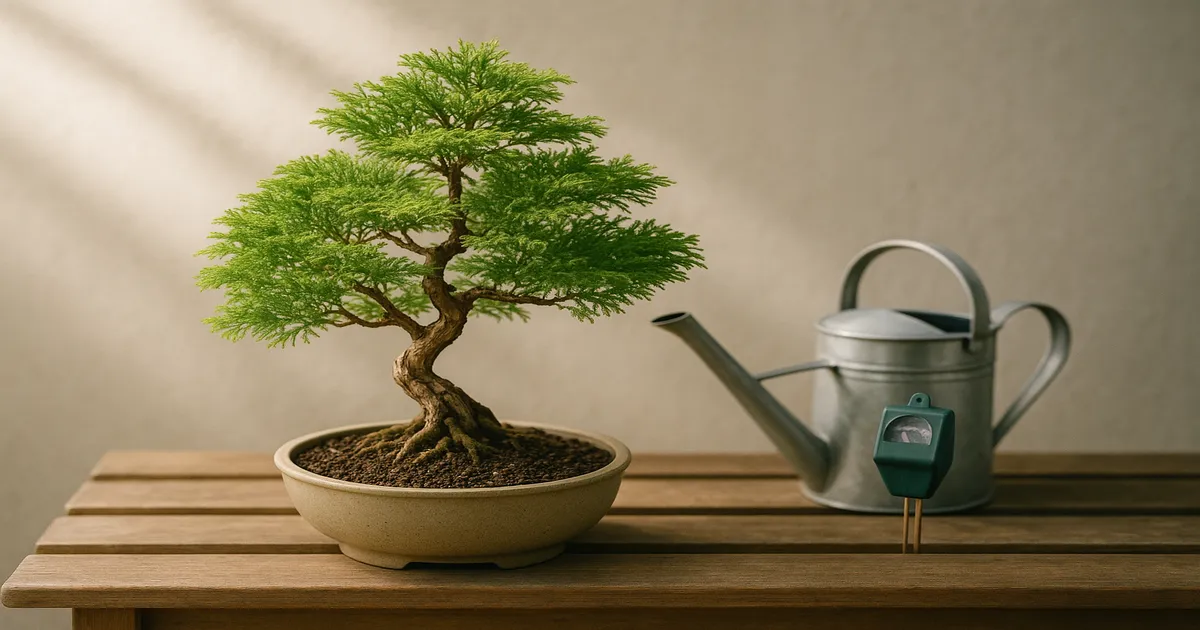
The finger test beats every fixed schedule. Push your finger about 1 inch into the soil. If the top half-inch is approaching dryness but you still feel slight moisture deeper down, it’s time to water. If it’s still clearly moist throughout, wait.
Seasonal Watering at a Glance
| Season | Typical Frequency | Key Note |
|---|---|---|
| Spring | Every 1–2 days | Growth accelerates fast — check daily |
| Summer | Once or twice daily | Never let the root ball dry completely |
| Autumn | Every 2–3 days | Reduce gradually as temps drop |
| Winter | Every 2–3 weeks | Just enough to prevent desiccation |
These are starting points, not rules. The sections below explain what pushes your tree toward the more or less frequent end of each range.
The 5 Variables That Determine How Often to Water Your Boxwood
1. Season and Ambient Temperature
Warmer temperatures accelerate evaporation from both the soil surface and the foliage. A tree that needs water every other day in mild spring weather may need it twice daily when temperatures push above 85°F (29°C). The relationship isn’t linear — a jump from 75°F to 95°F (24°C to 35°C) can more than double your watering frequency.
2. Container Size and Depth
This is the variable most beginners underestimate. A mame boxwood in a 3-inch shallow pot can dry out completely in a few hours on a hot summer day. The same species in a 14-inch oval pot might only need watering every other day in identical conditions. Less soil volume means less water reservoir — it’s that simple.
3. Soil Composition and Drainage
Your soil mix determines how long water stays available between waterings. A mix heavier in akadama holds moisture longer; a pumice- and lava-rock-dominant mix drains faster and requires more frequent checking. Your soil and your watering schedule are inseparable — change one and you change the other.
4. Climate, Humidity, and Wind Exposure
Low humidity and wind are silent killers. In an arid, windy environment, a pot can lose moisture two to three times faster than in a humid, sheltered one. If you garden on a rooftop, balcony, or in a region with dry summers, check your trees morning and evening. Coastal and humid-climate growers get more breathing room.
5. Tree Health, Vigor, and Root Density
A vigorously growing boxwood with a dense root mass transpires more water — roots and foliage are actively pulling moisture through the system. A recently repotted tree with reduced root mass, or one recovering from stress, will dry out more slowly. Match your checking frequency to the tree’s current state, not just the season.
How to Tell When Your Boxwood Needs Water
The Finger Test: Step-by-Step
- Insert your finger about 1 inch (2.5 cm) into the soil surface.
- Feel the moisture level at your fingertip.
- Water now if the top 0.5–1 inch feels approaching dryness but deeper soil retains slight moisture.
- Wait if the soil feels clearly moist throughout.
- Water immediately if the soil is completely dry — don’t wait for visual stress symptoms.
Do this every morning during the growing season. It takes five seconds and tells you more than any schedule ever could.
Pot Weight as a Watering Indicator
Lift your pot immediately after a thorough watering and memorize how heavy it feels — that’s your “fully watered” baseline. As water evaporates and the tree transpires, the pot gets noticeably lighter. When it feels dramatically lighter than that baseline, it’s time to water. This method becomes second nature after a season or two.
Visual Cues to Watch For
Visual signs appear after the soil has already been dry for a while, so treat them as backup confirmation rather than your primary signal:
- Foliage takes on a slightly dull, matte appearance rather than its usual glossy look
- Soil begins pulling away from the pot edges as it shrinks
- The soil surface looks lighter in color than usual
If you’re seeing leaf curl or crisp brown edges, you’ve waited too long. The finger test catches dryness before it reaches that point.
Proper Watering Technique for Boxwood Bonsai
The Soak-and-Drain Method
Water slowly and thoroughly until water flows freely from every drainage hole. This ensures the entire root ball is saturated — not just the top layer — and flushes accumulated mineral salts that build up over time. Never stop at the first trickle from a single hole; that often means water has found a channel through the soil rather than saturating it fully. Let the pot drain completely before returning it to its display position. A pot sitting in standing water is a fast track to root rot.
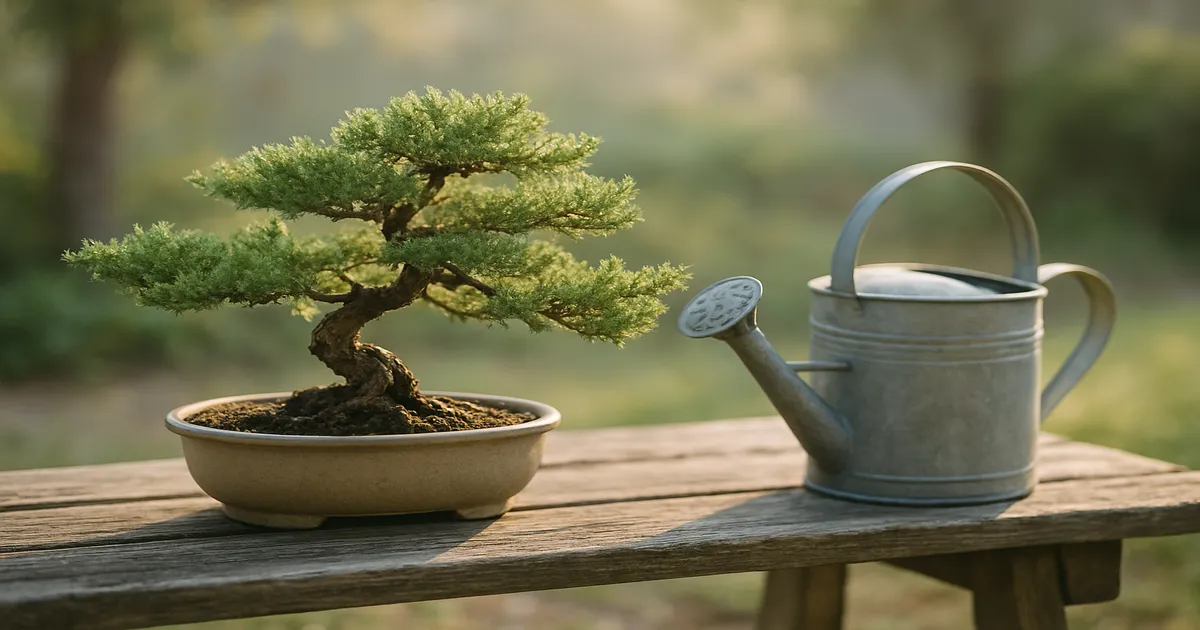
A fine-rose watering can (Haws Slimcan 1L) or a hose fitted with a gentle breaker nozzle gives you the control you need. High-pressure water disturbs the soil surface, exposes surface roots, and can dislodge the fine feeder roots that boxwood depends on. The goal is a gentle, even shower.
Best Time of Day to Water
Morning is ideal. Watering early gives foliage time to dry before evening, which significantly reduces fungal disease risk. Avoid evening watering whenever possible — prolonged leaf wetness overnight creates exactly the conditions that fungal pathogens love.
Foliar Misting: Helpful but Limited
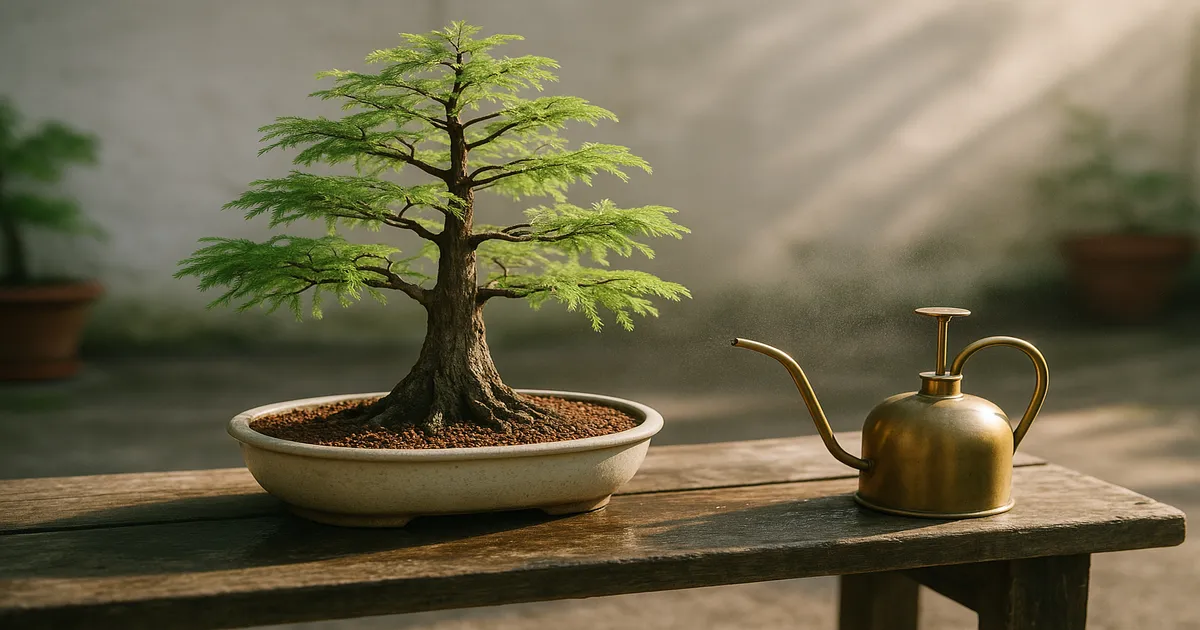
Misting the foliage two or three times per week in dry conditions raises local humidity and helps deter spider mites, which are a genuine nuisance for boxwood in hot, dry summers. That said, misting is a supplement — it doesn’t replace thorough soil watering and won’t save a tree whose root ball has dried out. And again: don’t mist in the evening.
Choosing the Right Soil Mix
Why Standard Potting Mix Fails Boxwood Bonsai
Standard potting compost compacts over time, restricts oxygen to the roots, and retains far too much moisture for a species that evolved in free-draining soils. It also becomes hydrophobic when dry — water runs off the surface rather than penetrating. Getting your soil right isn’t optional; it’s the foundation that makes correct watering even possible.
Recommended Soil Components and Ratios
Each component in a bonsai mix has a specific job:
- Akadama — fired clay granules that retain moisture, support cation exchange, and anchor roots. Use 40–50% of your mix.
- Pumice — improves drainage and aeration, encourages fine root development. Use 25–30%.
- Lava rock (scoria) — provides long-term drainage structure and prevents compaction. Use 20–30%.
Aim for a particle size of 3–6 mm for standard bonsai; drop to 1–3 mm for mame and shohin sizes. Avoid peat moss entirely — it becomes hydrophobic when dry and creates inconsistent moisture levels throughout the pot.
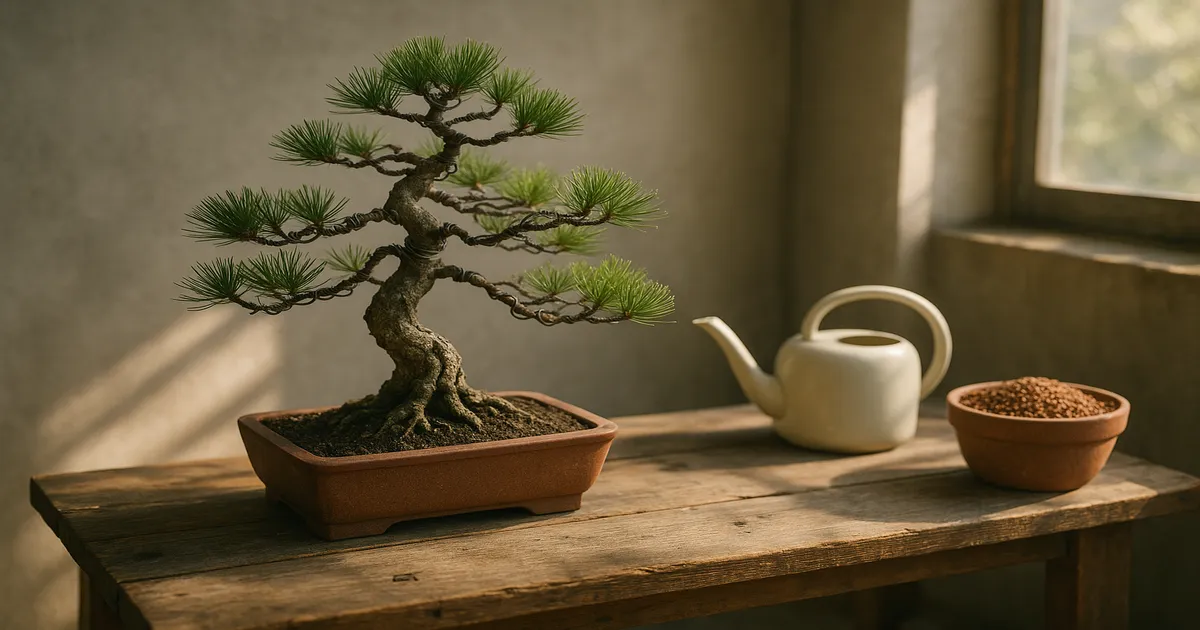
If you’re just starting out, a simple 1:1 akadama/pumice mix is forgiving, widely available, and works well for boxwood. It retains enough moisture to be manageable while draining freely enough to prevent root rot. A higher akadama ratio means the soil holds moisture longer and you’ll water less frequently; a pumice- and lava-heavy mix drains faster, so you’ll need to check more often. Neither is wrong — they just require different habits.
Diagnosing Watering Problems
Signs Your Boxwood Is Overwatered
- Yellowing leaves, especially older interior foliage
- Soft or mushy stems near the base
- Soil that stays wet for days longer than expected
- White mold growing on the soil surface
- Roots that are brown, soft, and smell unpleasant rather than firm and white or tan
- Wilting despite wet soil — a classic sign that roots can no longer function
Signs Your Boxwood Is Underwatered
- Leaves curling inward or developing a dull, matte surface
- Crisp, brown leaf edges (distinct from the soft yellowing of overwatering)
- Soil visibly shrinking and pulling away from the pot walls
- Pot feels dramatically lighter than its watered baseline
- In severe cases: tip dieback progressing inward from branch ends
How to Recover a Severely Dry Boxwood
If the root ball has dried out completely, surface watering often isn’t enough — water beads off a hydrophobic dry root mass rather than penetrating it. Instead, submerge the entire pot in a bucket of water for 10–15 minutes. You’ll see bubbles rising as air in the soil is displaced by water. Once bubbling stops, lift the pot, let it drain fully, and move the tree to a sheltered spot out of direct sun while it recovers.
How to Address Root Rot from Overwatering
Act quickly — root rot progresses fast.
- Remove the tree from its pot and gently shake away the old soil.
- Inspect the roots: healthy roots are firm and white or tan; rotted roots are brown, soft, and may smell.
- Trim all affected roots back to healthy tissue with sharp, sterilized root scissors.
- Repot immediately into fresh, well-draining soil mix in a pot with adequate drainage holes. (Tokoname Yamaaki Oval Training Pot)
- Reduce watering frequency and keep the tree in partial shade while it recovers.
- Do not fertilize until you see new healthy growth emerging.
Seasonal Watering Guide for Boxwood Bonsai
Spring: Ramping Up as Growth Accelerates
Spring is when boxwood wakes up fast. New growth can push quickly, and the tree’s water demand ramps up almost overnight. Check daily and be ready to water every 1–2 days. Don’t let a cool morning lull you — afternoon temperatures can dry a shallow pot much faster than you’d expect.
Summer: Peak Demand and How Often to Water Boxwoods in Heat
In summer, check your trees morning and evening. Once-daily watering is common; twice daily is normal for small pots or during heat waves. If root zone temperatures spike above 95°F (35°C) — which can happen in dark or shallow pots in direct sun — roots can be damaged even when the foliage looks fine. Shade the pot itself if needed, or move the tree to a spot with afternoon shade. A light overhead spray in the morning also helps deter spider mites, which thrive in hot, dry conditions and love boxwood.
Autumn: Gradually Reducing Frequency
As temperatures drop and growth slows, ease back gradually. Every 2–3 days is a reasonable autumn rhythm, but keep using the finger test — a warm spell can still dry pots quickly. The goal is to let the tree slow down naturally, not to starve it of water abruptly.
Winter Dormancy: Minimal Watering in Cold Storage
A boxwood in cold storage at 25–40°F (-4–4°C) needs water roughly every 2–3 weeks. The point is simply to prevent the root ball from desiccating completely — not to keep the soil moist in any growing-season sense. Check by feel: if the soil is bone dry, water lightly. If it still has any moisture, leave it.
Overwatering a dormant boxwood in cold storage is one of the most common and serious mistakes beginners make. Cold, wet soil has almost no oxygen and roots cannot function — it’s a recipe for rot. When in doubt, water less.
Frequently Asked Questions About Watering Boxwoods
How often should I water my boxwoods in summer?
Check your boxwood bonsai at least once in the morning and once in the evening. Small pots may need watering twice daily during heat waves; larger specimens might only need it once. Always use the finger test rather than watering on autopilot — conditions change day to day.
Can you overwater a boxwood bonsai?
Yes, and it’s one of the most common causes of boxwood bonsai decline. Overwatering deprives roots of oxygen, leading to root rot — symptoms include yellowing interior leaves, mushy stems, and wilting despite wet soil. The fix is better-draining soil and watering only when the top half-inch is approaching dryness.
How do I know if my boxwood needs water?
The most reliable method is the finger test: insert your finger about 1 inch into the soil. Water when the top half-inch is approaching dryness but deeper soil still retains slight moisture. Secondary signs include a lighter-than-usual pot, soil pulling from the pot edges, and foliage with a slightly dull appearance.
Why are my boxwood leaves turning yellow?
Yellowing leaves — especially older interior foliage — are the most common symptom of overwatering and root rot. However, yellowing can also result from nutrient deficiency (particularly nitrogen or iron), pest infestation, or natural seasonal leaf drop in autumn. Check your soil moisture first: if the soil has been consistently wet, overwatering is the most likely culprit.
How do I water a boxwood bonsai that has completely dried out?
Don’t just pour water over the surface — a completely dry root ball often repels water rather than absorbing it. Submerge the entire pot in a bucket of water for 10–15 minutes until bubbling stops, then lift it out and let it drain fully. Move the tree to partial shade while it recovers, and check again within a few hours to confirm moisture has penetrated throughout.