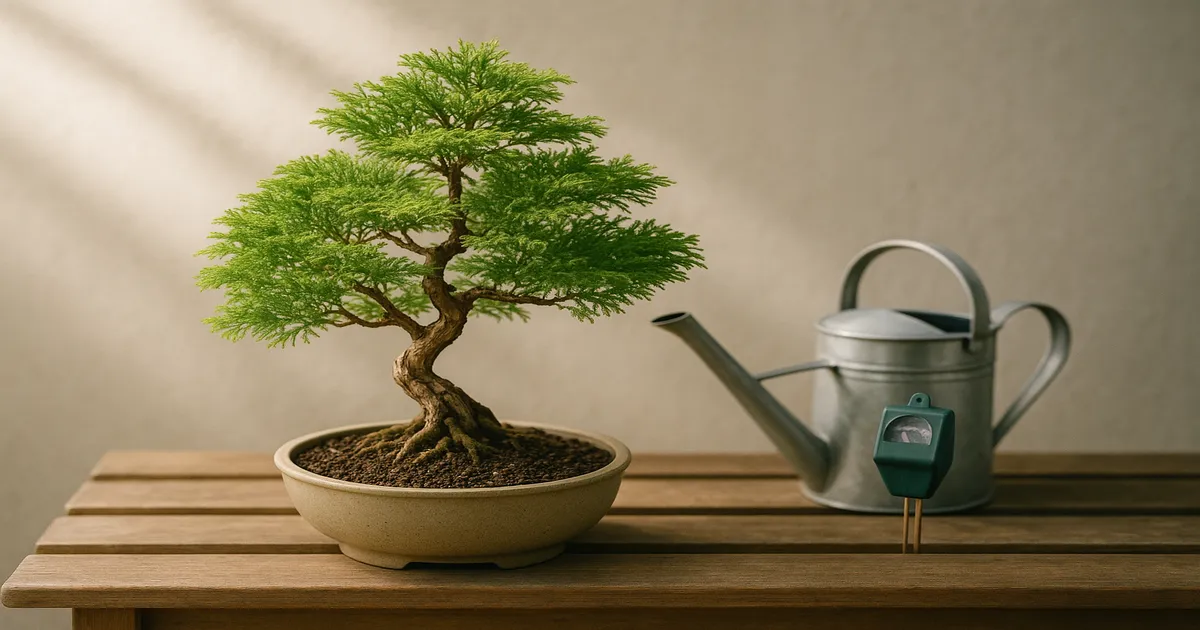
Quick Answer: A Hinoki cypress needs water when the top ½ inch of soil begins to dry but before it dries out completely. In practice, that means watering once or twice daily in summer, every other day in spring and autumn, and just every 7–14 days in winter. Exact frequency depends on pot size, soil mix, climate, and season — all covered in detail below.
Figuring out how much water a Hinoki cypress needs is one of the first questions new owners ask — and for good reason. Get it wrong in either direction and the foliage tells you immediately. Unlike junipers or pines, Chamaecyparis obtusa comes from cool, humid Japanese mountain forests where moisture is consistent and drainage is excellent. That origin shapes everything about how you water it as a bonsai.
How Much Water Does a Hinoki Cypress Need? The Core Rule
Water when the top ½ inch (1.3 cm) of soil starts to feel barely moist to dry — but always before the soil dries out completely. The finger test is your most reliable tool: push a finger about ½–1 inch into the soil. Dry or just barely damp means water now. Still clearly moist means wait.
When you do water, do it thoroughly. Pour slowly until water runs freely from every drainage hole, wait five minutes, then water again. This double-watering technique ensures the entire root mass gets moistened, not just the surface layer.
Seasonal Frequency at a Glance
| Season | Typical Frequency | Key Trigger |
|---|---|---|
| Spring | Daily to every other day | Rising temps, active growth flush |
| Summer | Once to twice daily | Heat above 85 °F (29 °C) |
| Autumn | Every 2–3 days | Slowing growth, cooling temps |
| Winter | Every 7–14 days | Dormancy; prevent desiccation only |
These are starting points, not rigid rules. A small terracotta pot in Phoenix in July will need water twice a day without question. A large glazed pot in Seattle in October might go three days between waterings. The variables that matter most — soil mix, pot type, climate, and placement — are all explained below.
Species Background: Why Hinoki Cypress Has Specific Water Needs
Chamaecyparis obtusa grows naturally on the mountain slopes of central and southern Japan, at elevations between roughly 1,000 and 2,600 metres. These forests are cool, consistently humid, and well-drained — the slopes ensure water moves through rather than pooling around roots.
That habitat is the key insight. Hinoki cypress evolved with reliable moisture and excellent drainage working together. It has no deep drought-tolerance mechanism the way a juniper does. It wants even, steady moisture — never waterlogged, never bone dry.
Cultivars and How Growth Rate Affects Watering
The most popular bonsai cultivar is C. obtusa ‘Nana Gracilis’, valued for its compact, shell-like foliage sprays and slow, refined growth. Other common choices include ‘Kosteri’ (very dense, ideal for shohin) and the straight species for larger, more vigorous styling.
Compact, slow-growing cultivars like ‘Nana Gracilis’ have smaller leaf surface area and therefore slightly less transpiration — meaning marginally less frequent watering than the straight species. The difference is modest, but worth knowing if you’re growing multiple cultivars side by side.
Soil Mix: The Foundation of Correct Watering
Soil choice is the single biggest variable controlling how much water your Hinoki cypress needs. The right mix drains fast enough to prevent waterlogging yet holds just enough moisture to keep roots consistently damp between waterings.
The recommended mix is:
- Akadama: 40–50% — retains moisture, supports cation exchange, anchors roots
- Pumice: 25–30% — improves drainage and aeration, adds structural stability
- Lava rock: 20–30% — long-term drainage, prevents compaction
A quality pre-blended option is Boon’s Mix, which follows these proportions closely. For growers who prefer to blend their own, Ibaraki double-fired akadama is a reliable starting point.
In hot, dry climates — the American Southwest or Mediterranean regions — lean toward 50–60% akadama to improve moisture retention. In cool, humid climates like the Pacific Northwest or the UK, push pumice and lava rock up to around 60% combined so the mix drains faster and roots don’t stay wet too long.
Avoid peat-based potting mixes entirely. They retain too much water, become hydrophobic when dry, and compact badly in containers over time. Standard garden soil is equally unsuitable.
Use 3–6 mm particle size for standard bonsai, and drop to 1–3 mm for shohin and mame sizes. Pot material also matters. Terracotta and unglazed pots are porous — they breathe, speeding up evaporation and meaning you’ll water more frequently. Glazed or plastic containers hold moisture longer. Neither is wrong; just factor it into your schedule.
Hinoki Cypress Watering Season by Season
Spring: Supporting the Growth Flush
As temperatures climb above 50 °F (10 °C) and new growth emerges, water demand increases steadily. Start with every-other-day watering in early spring and move toward daily as temperatures rise and the growth flush accelerates. The foliage pads are expanding and the tree is actively pushing energy into new shoots — this is the season to be attentive, not relaxed. Check the soil every morning.
Summer: Managing Heat and Transpiration
Summer is the most demanding season. When temperatures exceed 85 °F (29 °C), water once in the morning and check again by late afternoon — many trees will need a second watering. On hot, windy days, twice-daily watering is the norm rather than the exception.
Always use the double-watering technique in summer. Heat causes the top layer of soil to dry and sometimes crust slightly, and a single pass may not fully saturate the root zone.
Factors that push you toward twice-daily watering in summer:
- Temperatures above 85 °F (29 °C)
- Wind exposure
- Small pot size
- Terracotta or unglazed container
- Humidity below 40%
Autumn: Tapering Off as Growth Slows
Once growth slows and nighttime temperatures drop consistently below 60 °F (15 °C), ease back to watering every 2–3 days. The tree’s metabolic rate is slowing, transpiration drops, and the soil stays moist longer. Don’t be tempted to keep watering at summer frequency into autumn — consistently wet soil in cooler temperatures is a fast track to root rot.
Winter: Keeping Roots Alive During Dormancy
During dormancy, the goal is simple: prevent desiccation without keeping the roots wet. Check soil moisture every 7–14 days and water only when the soil has clearly dried out. A light watering is usually sufficient — you’re not trying to fully saturate the root zone the way you would in summer. If you’ve moved the tree to a cold garage or cold frame, check even less frequently, since lower temperatures and reduced light mean the soil dries very slowly.
Water Quality and Humidity
Best Water Types for Hinoki Cypress
Rainwater is ideal — naturally slightly acidic, free of chlorine and fluoride, and close to what these trees receive in their native habitat. Collect it whenever you can.
Tap water works fine for most growers. Let it sit in an open container for 24 hours to allow chlorine to off-gas. The bigger concern is alkalinity. If your water consistently reads above pH 7.5, long-term use will gradually raise soil pH and cause nutrient lockout — most visibly as yellowing foliage despite regular fertilising. Flush the soil thoroughly with fresh water monthly and consider an acidifying fertiliser if alkaline tap water is your only option.
Managing Humidity
Hinoki cypress thrives in 50–70% relative humidity, reflecting its mountain forest origins. In dry climates or during winter when indoor heating drops humidity sharply, a humidity tray helps considerably. Fill a shallow tray with gravel and water, set the pot on top of the gravel (never in the water), and the evaporation raises humidity around the foliage.
Morning misting is beneficial in very dry conditions, but always mist early enough that foliage dries before evening — wet foliage overnight invites fungal problems. Grouping bonsai together also creates a natural microclimate with slightly elevated humidity.
Diagnosing Watering Problems
Both overwatering and underwatering cause brown foliage — but the pattern and the soil condition tell you which one you’re dealing with.
Signs of Too Much Water
- Foliage yellowing from the interior outward, progressing to brown
- Soft, mushy roots when you gently probe the root zone
- Soil that never seems to fully dry between waterings
- White mould or green algae on the soil surface
- Wilting despite obviously wet soil
- Foul, sour odour from the pot
Signs of Too Little Water
- Foliage browning from the tips inward, starting at branch extremities
- Crispy, brittle foliage that crumbles when touched
- Soil visibly pulling away from the pot edges
- Pot feels surprisingly light when lifted
- Foliage losing its deep green lustre and appearing dull or greyish
Reading the Pattern
Tip browning + dry soil = underwatering. The foliage is desiccating from the outside in.
Interior yellowing or browning + wet soil = overwatering or root rot. The roots are failing to deliver moisture even though water is present.
Always check the soil before you react. Watering an already-overwatered tree to “fix” browning is one of the most common and damaging mistakes in Hinoki cypress care.
A soil moisture meter takes the guesswork out of this entirely, especially for beginners.
Placement and Light: How They Drive Watering Frequency
Hinoki cypress is an outdoor bonsai — full stop. It requires genuine winter dormancy with sustained cold temperatures, and indoor environments cannot provide the light intensity, air movement, or seasonal variation this species needs. Most trees kept indoors permanently decline within one to three years.
Aim for a minimum of 4–6 hours of direct sun daily during the growing season. In cooler zones (USDA 4–6), full sun all day is beneficial. In warmer zones (7–9), afternoon shade becomes important once temperatures regularly exceed 95 °F (35 °C) — without it, foliage browns and heat stress accumulates.
Full sun and wind exposure dramatically increase water demand. A tree moved from a sheltered, partially shaded spot to a sunny, breezy position may need watering twice as often. Adjust your schedule whenever you change placement.
Winter Protection
Protect the root ball — not the foliage — from temperatures below 20 °F (-7 °C), which can damage roots in containers.
- Zones 4–5: Move to an unheated garage or cold frame once temperatures consistently drop below 15 °F (-9 °C)
- Zones 6–7: Cluster pots together, mulch around them, or place against a south-facing wall
- Zones 8–9: Minimal protection needed; watch for unusual cold snaps
Never store in a heated space. Warmth breaks dormancy prematurely and exhausts the tree’s energy reserves before spring arrives.
Frequently Asked Questions
How often should I water a Hinoki cypress bonsai in summer?
Most Hinoki cypress bonsai need watering once or twice daily in summer. When temperatures exceed 85 °F (29 °C), check the soil morning and late afternoon — on hot, windy days, a second watering is often necessary. Always use the double-watering technique to ensure the full root mass is saturated.
Can Hinoki cypress tolerate dry soil?
No. Hinoki cypress has very limited drought tolerance compared to junipers or pines. Allowing the soil to dry out completely, even once, can cause significant tip dieback and stress the root system. It needs consistent, even moisture and should never be allowed to dry out fully between waterings.
Why are the leaves on my Hinoki cypress turning brown?
The pattern tells you the cause. Browning that starts at the tips and moves inward with dry soil points to underwatering or low humidity. Yellowing or browning that starts in the interior of foliage pads with consistently wet soil suggests overwatering or root rot. Always check the soil condition before changing your watering routine.
What is the best soil mix for Hinoki cypress bonsai?
The recommended mix is 40–50% akadama, 25–30% pumice, and 20–30% lava rock, using 3–6 mm particle size for standard trees. This combination drains quickly while retaining just enough moisture. Avoid peat-based mixes or garden soil — both compact in containers and hold too much water for healthy Hinoki roots.
Should I mist my Hinoki cypress to increase humidity?
Yes, but timing matters. Mist in the morning so the foliage has time to dry completely before evening — wet foliage overnight increases the risk of fungal disease. For more consistent humidity management, a gravel-filled humidity tray under the pot is more reliable than misting alone.