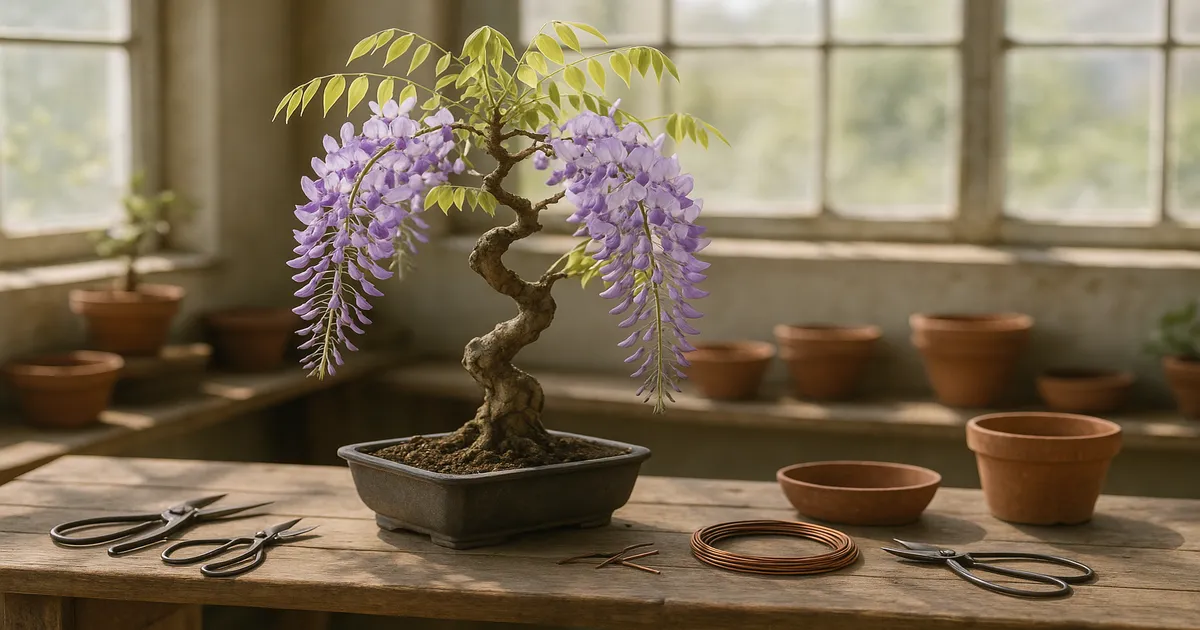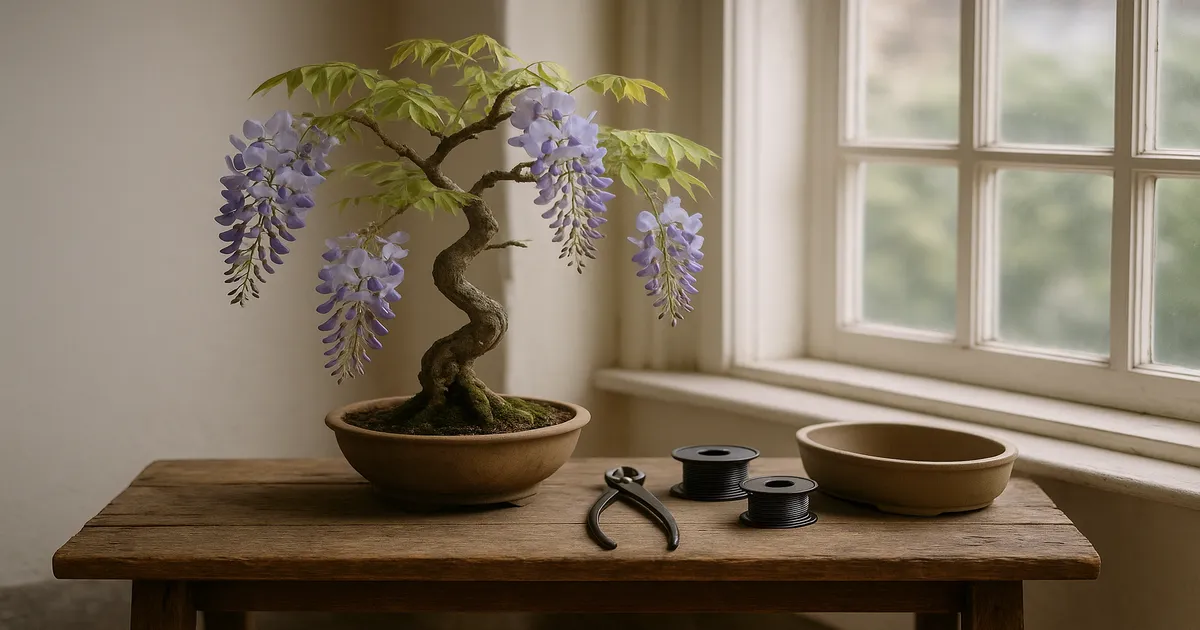
Quick Answer: Wisteria bonsai cannot thrive indoors permanently. As a temperate outdoor species, wisteria needs 30,000–50,000+ lux of direct sunlight and a genuine winter dormancy of 6–12 weeks at 32–45°F (0–7°C) — conditions no indoor environment can reliably provide. Short-term indoor display during bloom is possible, but long-term indoor keeping leads to decline and death within 3–5 years.
If you’ve ever asked whether you can grow wisteria bonsai indoors, you’re in good company — it’s one of the first questions new enthusiasts ask after seeing those cascading purple blooms. The honest answer is no, not permanently. Wisteria is a temperate outdoor plant, and keeping one inside full-time is a slow road to a dead tree. Understanding why it belongs outside, though, helps you make smarter decisions about display, winter care, and long-term development.
Can You Grow Wisteria Bonsai Indoors? The Core Problem
Two physiological realities make permanent indoor cultivation impossible. First, the light gap is enormous: even the brightest south-facing window delivers only 500–2,000 lux, while wisteria needs 30,000–50,000+ lux to grow well and bloom. Second, wisteria is a deciduous temperate species that requires a true winter dormancy — 6–12 weeks at 32–45°F (0–7°C) — to set flower buds and replenish carbohydrate reserves. No heated living room can provide either of these things.
What Happens If You Keep Wisteria Indoors Long-Term
Skipping dormancy doesn’t just cost you next year’s flowers. The tree exhausts its stored energy trying to maintain a semi-active metabolism through winter, and without adequate chilling hours, flower buds simply won’t open. Repeat this for a few seasons and you’ll see progressively weaker growth, rising pest pressure, and eventually a tree that can’t recover. Most wisteria kept indoors year-round decline visibly within two to three years and die within five.
Short-term indoor display during peak bloom — one to two weeks maximum — is perfectly fine with some precautions. Beyond that, get it back outside.
Wisteria Bonsai Species Overview
The Four Main Species Used in Bonsai
Wisteria is a genus of roughly ten deciduous woody vines in the Fabaceae (legume) family, native to East Asia and eastern North America. Four species are regularly used in bonsai:
| Species | Common Name | Origin | Raceme Length | Key Traits |
|---|---|---|---|---|
| W. sinensis | Chinese Wisteria | China | 12–18 in (30–45 cm) | Most vigorous; blooms before leaves emerge; counterclockwise twining |
| W. floribunda | Japanese Wisteria | Japan | 18 in–4 ft (45 cm–1.2 m) | Most popular for bonsai; blooms with leaves; clockwise twining |
| W. frutescens | American Wisteria | Eastern USA | 4–6 in (10–15 cm) | Compact growth; excellent for smaller bonsai |
| W. macrostachya | Kentucky Wisteria | Central/Eastern USA | 6–12 in (15–30 cm) | Extremely cold-hardy; re-blooms in summer |
Best Cultivars for Bonsai Growers
A few standouts are worth knowing by name:
- ‘Blue Moon’ (W. macrostachya) — re-blooms two to three times per season and is hardy to USDA Zone 3; ideal for northern growers
- ‘Amethyst Falls’ (W. frutescens) — compact, blooms young (often in its first or second year), perfect for smaller compositions
- ‘Prolific’ (W. sinensis) — reliable heavy bloomer even on younger specimens; a solid beginner choice
- ‘Rosea’ (W. floribunda) — soft pink flowers with excellent color contrast against aged bark
One thing that makes wisteria special as a bonsai subject is its longevity — Japanese specimens over 1,200 years old are documented, and the deeply furrowed, gnarled bark that develops with age is genuinely stunning. Wisteria also has nitrogen-fixing root nodules formed through Rhizobium symbiosis, meaning the plant manufactures some of its own nitrogen. This matters for fertilization: excess nitrogen fertilizer pushes leafy growth at the direct expense of flowering.
Light, Temperature, and Why Wisteria Bonsai Belongs Outside
How Much Light Wisteria Bonsai Actually Needs
Wisteria wants full sun — ideally eight to ten hours of direct sunlight daily during the growing season. Outdoors on a bright summer day, light levels reach 30,000–50,000+ lux. A sunny south-facing windowsill delivers perhaps 500–2,000 lux on a good day. That gap isn’t bridgeable with a windowsill or a standard houseplant grow light. The result of insufficient light is predictable: no flowers, weak etiolated growth with stretched internodes, and a tree that becomes progressively more susceptible to pests.
A quality full-spectrum LED grow light (Mars Hydro TS 1000) running 14–16 hours a day can reach 10,000–20,000 lux at canopy level. That’s useful for keeping a tree stable during a short indoor display, but it is not a substitute for outdoor sun — and it does nothing to address the dormancy requirement.
The Dormancy Requirement You Cannot Skip
Dormancy is triggered by falling day length and temperatures dropping below 45°F (7°C). Once dormant, the tree needs to stay cold — between 32–45°F (0–7°C) — for at least six to eight weeks. Many experienced growers recommend ten to twelve. This chilling period allows flower buds to break properly in spring and resets the tree’s internal carbohydrate cycle. There is no workaround.
Because bonsai pots are shallow, roots are far more exposed than those of in-ground plants. Recommended winter storage options, roughly in order of preference:
- Unheated garage or shed — keep temperatures between 25–40°F (-4–4°C); protects from the worst freezes without warming the tree
- Cold frame or unheated greenhouse — ideal for monitoring while providing wind and frost protection
- Buried in the ground to the pot rim — the traditional Japanese method; excellent root insulation
- Mulched outdoor placement — surround the pot with straw or wood chip mulch; suitable for Zone 6 and warmer
Never bring a dormant wisteria into a heated room. Even a few weeks of warmth can break dormancy prematurely and wipe out next year’s bloom.
USDA Hardiness Zones at a Glance
| Species/Cultivar | Minimum Zone | Minimum Temperature |
|---|---|---|
| W. sinensis | Zone 5 | -20°F (-29°C) |
| W. floribunda | Zone 4–5 | -20 to -30°F (-29 to -34°C) |
| W. frutescens | Zone 5 | -20°F (-29°C) |
| W. macrostachya ‘Blue Moon’ | Zone 3 | -40°F (-40°C) |
Soil, Watering, and Feeding
The Ideal Bonsai Soil Mix
Wisteria roots need good drainage and aeration — partly to prevent rot, partly to support the nitrogen-fixing nodules that need oxygen to function. The standard recommended mix is akadama, pumice, and lava rock in a 5:3:2 ratio :
| Component | Ratio | Function |
|---|---|---|
| Akadama (3–6 mm) | 50% | Moisture retention, cation exchange, root anchorage |
| Pumice (3–6 mm) | 30% | Drainage, aeration, structural stability |
| Lava rock (3–6 mm) | 20% | Drainage, mineral content, long-term structure |
Adjust for your climate: in hot, dry regions increase akadama to 60% and reduce pumice and lava rock proportionally; in humid or wet climates drop akadama to 40% and raise pumice to 35%. Wisteria prefers a slightly acidic to neutral pH of 6.0–7.0. Anything above 7.5 causes iron chlorosis.
Watering Through the Seasons
- Peak summer: Water once or twice daily when the top half-inch of substrate dries out
- Spring and autumn: Every one to three days, depending on temperature and pot size
- Dormancy: Once a week or less — just enough to prevent roots from desiccating completely
Always water thoroughly until it flows freely from the drainage holes. Never let the pot sit in standing water.
Fertilizing Without Killing Your Bloom
Because of those nitrogen-fixing nodules, high-nitrogen fertilizers are counterproductive — they produce lush green growth at the expense of flowers. Use a balanced or low-nitrogen fertilizer (such as 0-10-10 or a balanced 6-6-6) from bud break through midsummer, then switch to a low-nitrogen, phosphorus-forward feed in late summer to harden growth and support bud set.
Pruning for Maximum Flowering
Extension Shoots vs. Flowering Spurs
Wisteria produces two distinct growth types. Long extension shoots are vigorous, whip-like growth that can extend several feet in a season — they build structure but don’t flower. Short flowering spurs are stubby laterals on older wood where racemes actually emerge. Encouraging spurs while managing extensions is the core skill in wisteria bonsai.
In-Season Maintenance Pruning
Starting when new shoots reach six to eight leaves, cut extension shoots back to two to three leaves from their base. Repeat every two to three weeks throughout summer. After late July (Northern Hemisphere), allow a few shoots to extend slightly longer to build carbohydrate reserves for winter.
Structural Pruning and Wound Care
Do major structural work in late winter, just before bud break, when the architecture is fully visible. Select branches with visible flower buds (swollen and rounded, versus the flatter, pointed vegetative buds), remove water shoots, and favor branches growing at 45–60° angles from the trunk. Never leave stubs — they die back and invite disease.
After flowering, remove all spent racemes immediately. Seed pod formation is energetically expensive and will noticeably reduce the following season’s vigor. For any cut larger than about ¼ inch (6 mm) in diameter, apply a wound sealant (Kiyonal Cut Paste). Wisteria has thin bark, so always use sharp, clean tools — a quality concave cutter (Kaneshin No. 815 175mm) makes clean cuts that heal faster than those left by general-purpose scissors.
Wiring, Repotting, and Long-Term Development
Wiring Wisteria Bonsai
Aluminium wire is the default for wisteria because the wood is relatively soft and flexible. Use 3.0–4.0 mm for primary branches, 2.0–2.5 mm for secondary branches, and 1.0–1.5 mm for fine ramification . The best time for structural wiring is late winter before bud break. Wrap at a 45–55° angle and check wired branches every two to four weeks during the growing season — wisteria scars heal slowly and marks can be permanent.
Repotting
Young trees need repotting every one to two years; mature specimens can go three to four years between repottings. Repot in early spring just as buds begin to swell. When pruning roots, preserve the small, rounded nitrogen-fixing nodules on the fine roots — they are beneficial, not a sign of disease. Remove no more than one-third of the total root mass in a single session. Expect reduced blooming in the season immediately following repotting; this is normal.
Troubleshooting: Why Your Wisteria Bonsai Isn’t Flowering
Failure to bloom almost always comes down to one of these causes:
- Insufficient light — fewer than six hours of direct sun daily
- Skipped or inadequate dormancy — warm winter storage breaks the chilling requirement
- Over-fertilization with nitrogen — pushes vegetative growth at the expense of flower buds
- Extension shoots not pruned — energy stays in vegetative growth rather than spurs
- Late frost damage — emerging buds are killed at 28–32°F (-2–0°C)
Work through this list before assuming the tree is unhealthy. Spider mites are the most common pest problem, particularly on trees kept in low-humidity conditions. Treat with insecticidal soap or neem oil at first sign.
If your wisteria has been kept indoors for an extended period, move it outside gradually — a few hours of morning sun to start, building up over two weeks to avoid sunburn on leaves adapted to low light. Ensure it gets a proper dormancy the following winter. It typically takes one to two full growing seasons before a recovering tree blooms reliably again.
Frequently Asked Questions
Can you grow wisteria bonsai indoors permanently?
No. Wisteria requires outdoor light levels (30,000–50,000+ lux) and a genuine winter dormancy at 32–45°F (0–7°C) that no heated indoor environment can provide. Trees kept indoors year-round typically show progressive decline and die within three to five years. Short-term indoor display during bloom — one to two weeks — is fine with supplemental lighting.
How do I get my wisteria bonsai to flower?
Four essentials: full outdoor sun (eight-plus hours daily), a proper dormancy every winter, consistent summer pruning of extension shoots back to two to three leaves every two to three weeks, and low-nitrogen fertilizer. If you’re meeting all four and still not getting flowers, check for late frost damage to emerging buds in spring.
What is the best wisteria species for bonsai beginners?
W. frutescens ‘Amethyst Falls’ and W. sinensis ‘Prolific’ are the two most beginner-friendly choices. ‘Amethyst Falls’ blooms young, stays compact, and is easier to manage than the more vigorous Japanese species. ‘Prolific’ is a reliable bloomer even on younger trees and tolerates beginner pruning mistakes better than most.
Can I bring my wisteria bonsai inside during winter?
Only if you’re storing it in an unheated space — an unheated garage, shed, or cold frame where temperatures stay between 25–45°F (-4–7°C). Bringing it into a heated room will break dormancy prematurely, eliminating next year’s flowers and stressing the tree. It needs cold, not warmth, to survive winter successfully.
How long does it take for a wisteria bonsai to bloom?
Grown from seed, wisteria can take 10–15 years to bloom reliably. Trees started from cuttings or grafts of a blooming parent typically flower within 3–5 years. Cultivars like ‘Amethyst Falls’ and ‘Blue Moon’ are selected for early flowering and may bloom in their first or second year from a cutting. Consistent pruning, proper dormancy, and low-nitrogen feeding will bring that timeline forward.