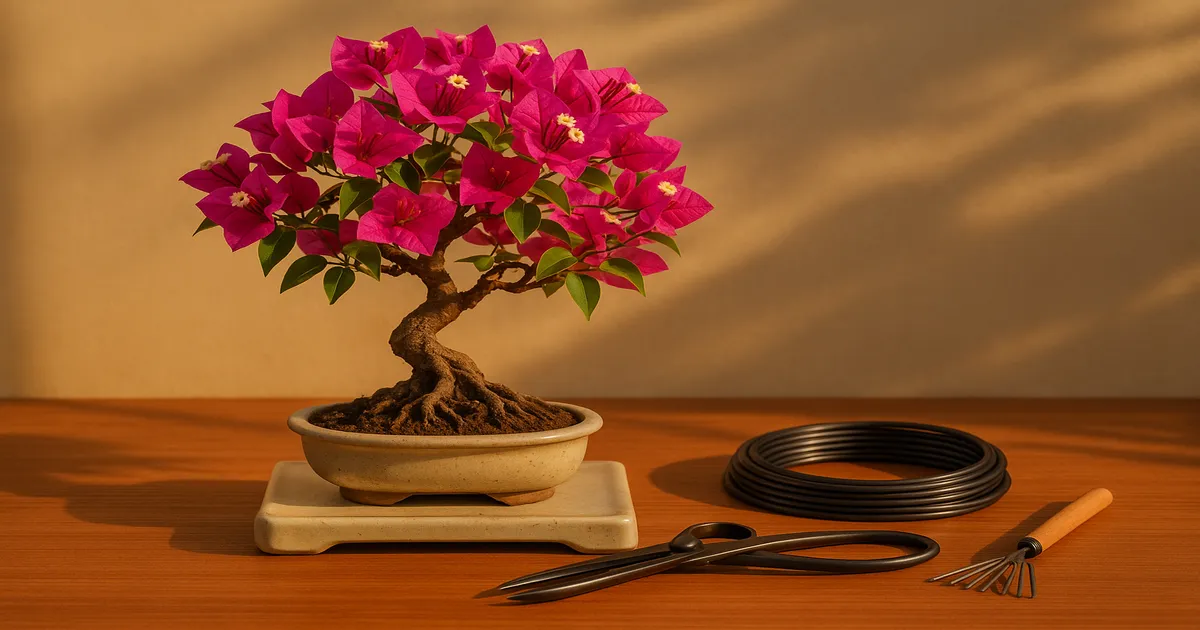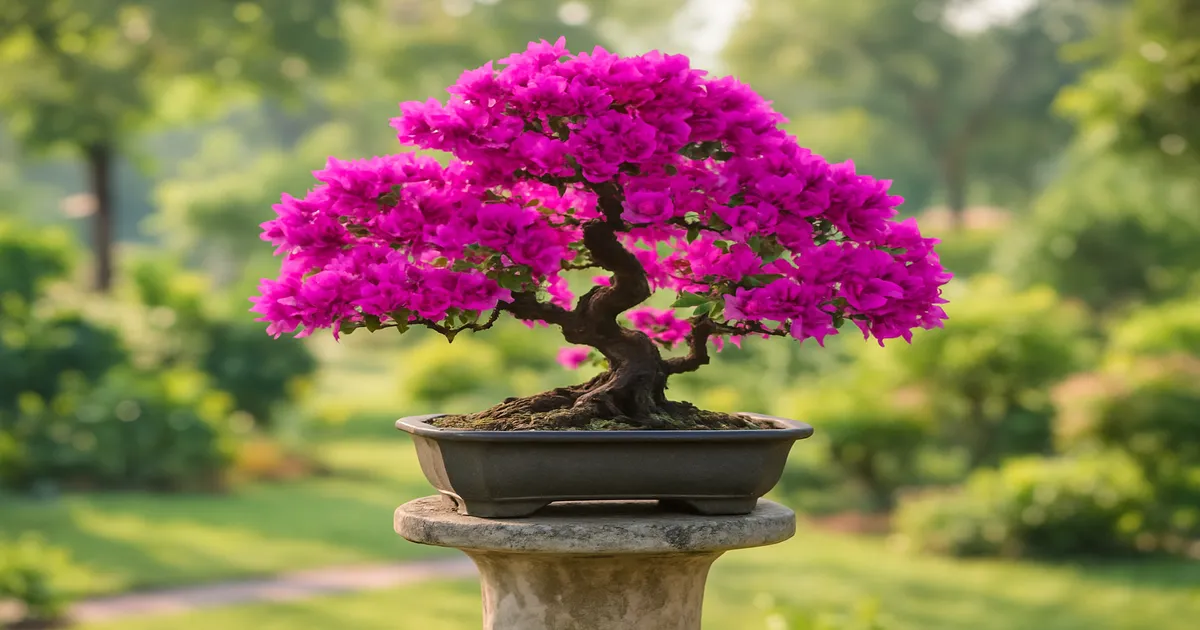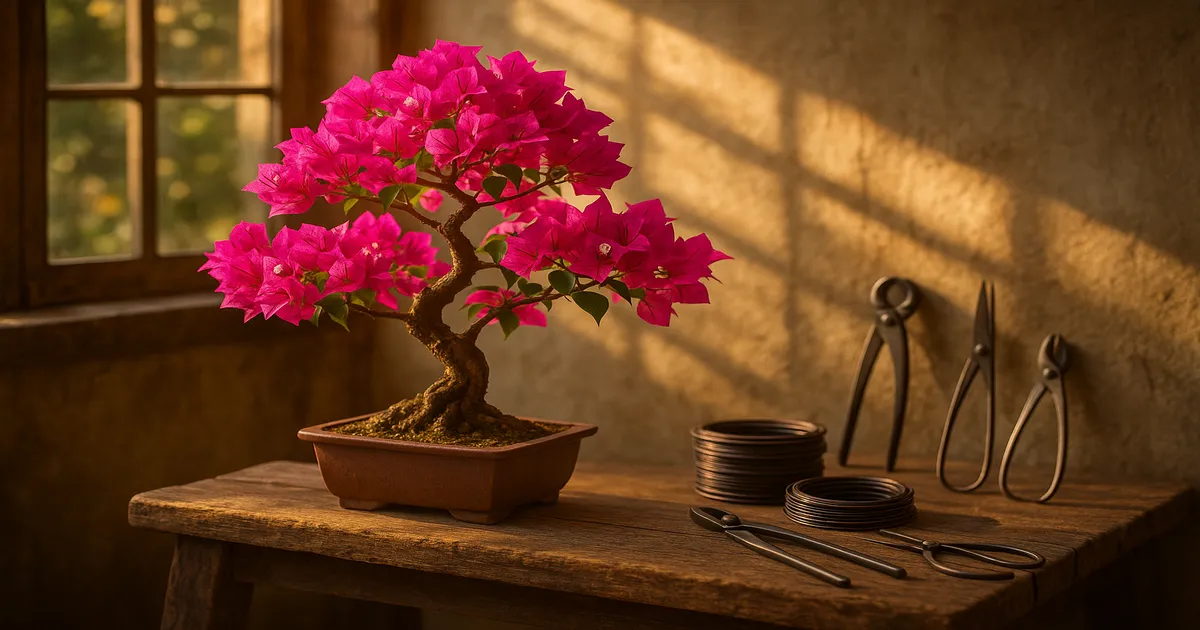
Quick Answer: Yes, you can absolutely bonsai a bougainvillea — and it’s one of the most rewarding tropical species you can choose. Bougainvillea responds beautifully to hard pruning, develops thick trunks with attractive bark, produces stunning proportional bracts even in miniature, and tolerates root restriction well. With the right light and frost protection, it can thrive as a bonsai for decades.
Can You Bonsai a Bougainvillea? What Makes It a Great Choice
Bougainvillea checks nearly every box for an ideal bonsai subject. It back-buds aggressively after hard pruning, builds impressive trunk girth relatively quickly, and develops flaking reddish-brown bark that looks ancient even on younger specimens. The thorns add a wild, untamed quality that’s hard to replicate with other species.
One thing worth knowing upfront: those brilliant “flowers” are actually bracts — modified leaves surrounding the tiny true flowers. Bract production is triggered by specific environmental conditions, not simply by the calendar.
Bougainvillea is a vigorous grower, which is both a gift and a challenge. Branches extend fast, wire can bite in before you notice, and the tree demands consistent attention during the growing season. But it’s also forgiving of hard pruning, tolerates root restriction better than most species, and is extremely long-lived. The non-negotiables are full sun and frost protection. Without them, bougainvillea bonsai is a losing battle from the start.
Best Bougainvillea Species and Cultivars for Bonsai
Bougainvillea glabra: The Top Choice for Beginners
B. glabra is the go-to species for bonsai. It has naturally smaller leaves, shorter internodes, and a more compact growth habit than other species — qualities that translate directly into better bonsai aesthetics with less effort. The classic cultivar ‘Sanderiana’ produces deep purple bracts and is widely available.
Bougainvillea spectabilis: Best for Trunk Development
If your priority is building a thick, impressive trunk quickly, B. spectabilis is worth considering. It grows more vigorously and responds exceptionally well to the grow-and-chop technique. The trade-off is larger leaves and longer internodes that require more work to miniaturize.
Popular Cultivars and Their Bract Colors
| Cultivar | Bract Color | Best For |
|---|---|---|
| ’Barbara Karst’ | Bright red | Heavy blooming; widely available |
| ’Singapore Pink’ | Soft pink | Compact habit; smaller bonsai |
| ’Torch Glow’ | Deep pink-red | Naturally upright; minimal thorns |
| ’Helen Johnson’ | Brick orange | Dwarf habit; ideal for shohin scale |
| ’Raspberry Ice’ | Magenta, variegated foliage | Unique appearance; slower growth |
| B. × buttiana ‘Mrs. Butt’ | Crimson | Good branching structure |
Start with B. glabra or ‘Helen Johnson’ if you’re new to bonsai. For fast trunk development, ‘Barbara Karst’ or B. spectabilis delivers results sooner. For shohin work, ‘Helen Johnson’ and ‘Singapore Pink’ are standouts.
Light, Temperature, and Placement
How Much Sun Does a Bougainvillea Bonsai Need?
Aim for 6–8 hours of direct sun daily, minimum. South- or west-facing outdoor placement works best. Drop below 5 hours consistently and you’ll get leggy growth with stretched internodes — the opposite of what bonsai demands — and bracts simply won’t appear.
How to Get Your Bougainvillea Bonsai to Flower
Blooming is triggered by two conditions working together: short-day photoperiod (nights longer than 12 hours) and deliberate drought stress. When autumn days shorten, reduce watering for 3–4 weeks. The tree interprets this as a signal to reproduce. Keep it in full sun throughout, and bracts typically appear within a few weeks of buds forming.
Outdoor vs. Indoor Placement
Bougainvillea is fundamentally an outdoor bonsai. Indoor conditions almost never provide sufficient light without supplemental grow lights delivering 2,000–5,000 foot-candles for 12–14 hours daily. In USDA Zones 9b–11, it can live outside year-round. Everywhere else, plan to move it outdoors from late spring through early fall.
Winter Protection
Foliage suffers below 40°F (4°C), and a sustained freeze below 28°F (-2°C) can kill stems back to the root crown. Shallow bonsai pots offer roots almost no insulation, so don’t gamble with frost.
Overwinter in a cool, bright room at 45–55°F (7–13°C). Reduce watering significantly but never let the soil dry out completely. If leaves drop during this period, don’t panic — bougainvillea is semi-deciduous and will re-flush vigorously in spring.
Soil, Watering, and Feeding
The Best Soil Mix for Bougainvillea Bonsai
Bougainvillea evolved on rocky, fast-draining coastal slopes and expects its roots to dry out between waterings. The standard mix is:
- Akadama 40% — water retention, cation exchange, root anchorage
- Pumice 40% — drainage, aeration, root oxygenation
- Lava rock 20% — long-term structural stability
Avoid peat-based potting mixes entirely. High organic content retains too much moisture and is the fastest route to root rot with this species.
Climate adjustments:
- Hot/dry climate: 30% akadama / 50% pumice / 20% lava rock
- Cool/wet climate: 50% akadama / 30% pumice / 20% lava rock
Use 3–6mm particle size for most bonsai; drop to 1–3mm for shohin specimens.
How Often to Water
During the growing season, water thoroughly when the top ½–1 inch of soil begins to dry. In a small pot in full summer sun, that can mean daily or even twice-daily watering. Always water until it flows freely from the drainage holes, and never let the pot sit in standing water.
In winter, ease back to roughly every 7–14 days depending on temperature and pot size. For bloom induction in autumn, allow the soil to dry more completely between waterings for 3–4 weeks — you want stress, not damage, so stop before the tree wilts.
Rainwater is ideal. If you’re using tap water, let it sit overnight to off-gas chlorine.
Fertilizing
Feed with a balanced fertilizer (e.g., 10-10-10) every two weeks during active growth. In late summer, switch to a low-nitrogen, high-phosphorus formula to encourage bract production rather than leafy growth. Hold off on fertilizing for 4–6 weeks after repotting to avoid burning freshly pruned roots.
Pruning Your Bougainvillea Bonsai
Maintenance Pruning
Blooms appear on new growth, so hard pruning doesn’t sacrifice flowering — it encourages it. After each bloom cycle ends and bracts begin to drop, cut new growth back to 2–3 nodes from the base of that flush. Each pruned tip typically produces 2–3 new shoots, steadily building ramification over successive seasons. Use sharp, clean bonsai scissors and sterilize between trees.
Structural Pruning and Grow-and-Chop
Structural work is best done in late winter to early spring, just before growth resumes. Use concave cutters on any branch thicker than a pencil — the slightly hollow wound heals flatter than a straight cut.
For trunk development, the grow-and-chop method works well: let the tree grow freely in a large container or in the ground until the trunk reaches the desired girth, then cut hard to a low branch. The resulting taper and movement are difficult to achieve any other way.
Wound Care
Apply cut paste to any wound larger than 5mm. Bougainvillea heals reasonably well, but large wounds can take 2–5 years to fully close. Full sun and regular fertilization maximize healing speed.
Wiring Bougainvillea Bonsai
Wire Choice and Gauges
Aluminum wire is the right choice for most bougainvillea work. The bark is attractive but sensitive, and copper’s greater rigidity increases the risk of scarring. Recommended gauges:
- Primary branches: 2.0–3.5mm
- Secondary branches: 1.0–2.0mm
- Fine ramification: 0.8–1.5mm
Wire diameter should be roughly one-third the thickness of the branch.
Timing and Technique
The best window is late spring to early summer, after the first growth flush has hardened slightly. Avoid wiring during active bloom, immediately after repotting, or in winter when wood is more brittle. Water the tree the day before — slightly hydrated wood bends more cleanly.
Key technique points: anchor wire at the trunk before working outward, maintain a consistent 45° angle, and apply firmly but not tightly — you should be able to slip a fingernail between wire and bark. For significant bends, wrap the branch in raffia first to protect the cambium.
How Long to Leave Wire On
Check every 3–4 weeks during the growing season. Bougainvillea grows fast and wire scars are slow to heal. Typical duration is 6–12 weeks. Always cut wire off in short segments — never unwind it — working from the tip back toward the trunk to avoid levering against the bark.
Repotting Bougainvillea Bonsai
How Often and When
Young trees in active development need repotting every 1–2 years. Mature specimens can go 2–3 years between repots. Let the tree tell you when it’s time: roots circling the pot base, water running straight through without absorbing, or roots pushing out of drainage holes are your signals.
Early spring — just as new buds begin to swell but before significant growth has emerged — is the ideal window. Alternatively, repot after the first major bloom flush when the tree has good energy reserves.
Repotting Steps
- Remove the tree and gently comb out the root mass with a root hook
- Trim healthy white-to-tan roots back by no more than one-third of the total root mass; remove any brown, black, or mushy roots entirely
- Place fresh soil in the pot, position the tree, and work soil into the root mass to eliminate air pockets
- Water thoroughly, then move to bright indirect light for 2–3 weeks before returning to full sun
Troubleshooting Common Problems
Not Flowering
Almost always one of three causes: insufficient sun, no drought stress period, or days aren’t short enough yet. Check the list — 6+ hours of direct sun, reduced watering for 3–4 weeks in autumn, and natural shortening days. Indoor trees without grow lights are the most common culprit.
Leaf Drop
Autumn and winter leaf drop is normal semi-deciduous behavior. Leaf drop during the growing season is a warning sign — check for overwatering, root rot, pest infestation, or a sudden temperature drop.
Pests
Aphids cluster on new growth tips; treat with insecticidal soap or a strong water spray. Mealybugs hide in branch crotches and leaf axils; dab with isopropyl alcohol on a cotton swab or apply neem oil. Spider mites thrive in hot, dry conditions — increase air circulation and treat with neem or a miticide if the infestation is heavy.
Root Rot
Recoverable if caught early. Remove the tree from its pot, trim all affected roots back to healthy tissue, dust cuts with sulfur powder or cinnamon as a natural fungicide, and repot into fresh, fast-draining soil. Wait 24–48 hours before watering to allow cut surfaces to callus, then resume with careful, conservative watering.
Leggy Growth
Long internodes are almost always a light problem. Move the tree to a sunnier position and prune back the stretched growth. Pruning alone won’t fix it if the underlying light deficiency isn’t addressed.
Frequently Asked Questions
How long does it take to grow a bougainvillea bonsai?
A presentable bougainvillea bonsai with decent trunk thickness and basic structure typically takes 5–10 years of active training. Using the grow-and-chop method in a large container or in the ground can cut the structural phase roughly in half. Refinement — tight ramification, fine branching, proportional foliage — is an ongoing process that continues for the life of the tree.
Can bougainvillea bonsai be kept indoors?
Technically yes, but results are almost always disappointing without serious supplemental lighting. Bougainvillea needs 6–8 hours of direct sun daily to bloom and stay compact — a level standard indoor conditions can’t provide. If you’re committed to indoor cultivation, full-spectrum LED grow lights delivering 2,000–5,000 foot-candles for 12–14 hours daily are the minimum requirement.
How do I get my bougainvillea bonsai to bloom?
The two-key trigger is short days plus drought stress. In autumn, when nights exceed 12 hours, reduce watering so the soil dries more completely between sessions for 3–4 weeks. Keep the tree in full sun throughout. Once buds appear, resume normal watering.
What is the best soil mix for bougainvillea bonsai?
A 40% akadama / 40% pumice / 20% lava rock mix is the standard recommendation. It drains fast while retaining enough moisture to support active growth. Avoid any peat-based or high-organic potting mix — these stay too wet and invite root rot. Adjust ratios slightly toward more pumice in hot, dry climates or more akadama in cool, wet ones.
How do I overwinter a bougainvillea bonsai?
Move it indoors before temperatures drop below 40°F (4°C). Keep it in a cool, bright room at 45–55°F (7–13°C) — a south-facing window or unheated greenhouse works well. Reduce watering to every 7–14 days but never let the soil dry out completely. Some leaf drop is normal. Resume normal care and move it back outdoors once nighttime temperatures stay reliably above 45°F (7°C) in spring.