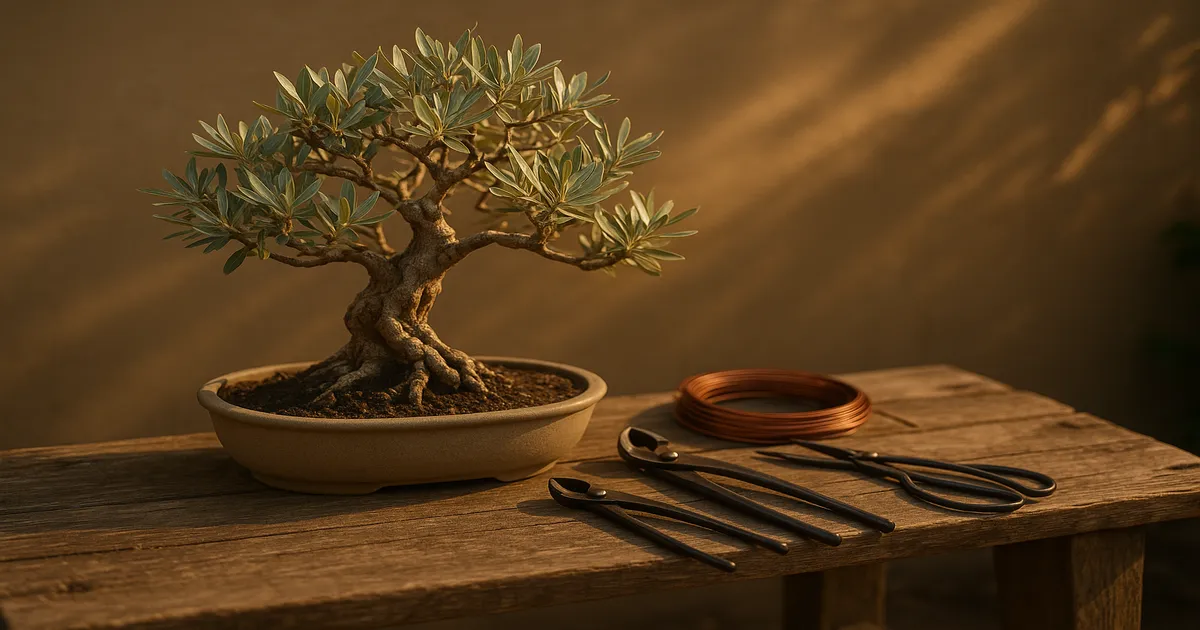
Quick Answer: Olive bonsai (Olea europaea) thrive outdoors in full sun with fast-draining soil and careful watering — they’re drought-tolerant but rot quickly in waterlogged conditions. Their naturally gnarled trunks and silver deadwood make them one of the most rewarding bonsai subjects available. Beginners can succeed with olive bonsai if they can provide outdoor conditions; indoor growing is significantly harder without supplemental lighting.
Few trees combine ancient character with practical resilience quite like the olive. Learning how to grow an olive bonsai tree means working with a species that can live over 2,000 years in nature — one that rewards patience with some of the most dramatic, age-suggesting trunk movement in all of bonsai. Here’s everything you need to know to grow one well.
Olive Bonsai at a Glance
| Feature | Details |
|---|---|
| Species | Olea europaea (European olive) |
| Light | 6–8 hours direct sun minimum; 8–12 hours ideal |
| Temperature | 65–95°F (18–35°C) growing season; protect below 25°F (-4°C) |
| Soil | 40% akadama / 30% pumice / 30% lava rock |
| Watering | When top 0.5–1 inch of soil dries; never on a fixed schedule |
| Repotting | Every 2–3 years (young); 3–5 years (mature) |
| Hardiness | USDA Zones 8–11; Zone 7 with protection |
Is Olive a Good Bonsai for Beginners?
Yes — with one important caveat. Olive bonsai are forgiving of drought, tolerant of heat, and hard to kill if you get the basics right. The challenge is light. These are Mediterranean trees that want intense, direct sun for most of the day. Grow it outdoors and olive is an excellent beginner species. Plan to keep it on a windowsill and expect a much steeper learning curve.
Choosing the Right Olive Species and Cultivar
European Olive vs. African Wild Olive
Olea europaea is the go-to species for bonsai worldwide. It offers naturally small leaves, dense wood, and that iconic gnarled growth habit that develops beautifully over time. The African wild olive (Olea europaea subsp. cuspidata) produces even smaller leaves and is popular in South African bonsai traditions — worth seeking out if you can find it, but less commonly available outside specialist nurseries.
Best Cultivars for Bonsai
Compact, small-leaved cultivars are the clear winners for bonsai aesthetics. Larger leaves can look out of proportion on a small tree, especially in early development.
| Cultivar | Why It Works for Bonsai |
|---|---|
| Arbequina | Small leaves, compact habit, widely available |
| Montra / Little Ollie | Dwarf, non-fruiting, exceptionally dense branching |
| Cipressino | Columnar growth — interesting for literati styles |
| Frantoio | Slightly larger leaves but excellent fine ramification |
Wild-Collected Specimens (Yamadori)
Old olive trees collected from Mediterranean hillsides or California olive groves are genuinely exciting bonsai material. The trunk character that takes decades to develop artificially is already there. The trade-off: collection is legally restricted in many regions, established trees can be slow to recover, and ethical sourcing matters. If you can find legally collected yamadori from a reputable source, it’s worth the premium.
How to Grow an Olive Bonsai Tree: Light and Temperature
How Much Sunlight Does an Olive Bonsai Need?
Olive bonsai need a minimum of 6–8 hours of direct sunlight daily, with 8–12 hours being ideal through the growing season. Outdoors on a sunny bench, your tree receives 30,000–100,000 lux. A bright indoor windowsill delivers maybe 200–500 lux. That gap explains why so many indoor olive bonsai slowly decline despite seemingly attentive care.
Outdoors vs. Indoors
Outdoors is always the first choice. Move your tree outside as soon as nighttime temperatures hold reliably above 28°F (-2°C), transitioning it gradually over a week or two if it’s been overwintered inside — sudden intense sun after low-light conditions can cause sunscald on the foliage and bark.
If indoor growing is unavoidable, here’s what actually works:
- Position at the brightest south-facing window you have
- Supplement with full-spectrum LED grow lights at 5,000–6,500K, targeting 10,000–20,000 lux at canopy level
- Run lights for 12–14 hours per day
- Rotate the tree 90° every 1–2 weeks for even light coverage
Cold Hardiness and Winter Dormancy
Container-grown olive bonsai are more frost-vulnerable than their in-ground counterparts because the root ball is exposed on all sides. Protect any container tree when temperatures drop below 25°F (-4°C) — it’s the roots freezing that causes the real damage, not cold air on the foliage. An unheated greenhouse, cold frame, or bright garage all work well.
Don’t skip winter dormancy entirely. A cool, bright rest period at 35–50°F (2–10°C) for 6–8 weeks promotes better flowering and overall vigor the following season. The key word is bright — olives need light even when dormant, so a dark shed is not a suitable option.
Heat Tolerance and Summer Care
Olive handles serious heat well — up to 110°F (43°C) — provided you keep up with watering and the tree has good airflow. In peak summer, small pots can dry out fast. Check moisture levels morning and evening rather than relying on a set schedule.
Soil, Watering, and Feeding
The Ideal Olive Bonsai Soil Mix
The standard mix is 40% akadama / 30% pumice / 30% lava rock. Akadama provides moisture retention and nutrient exchange; pumice improves drainage and aeration without breaking down; lava rock adds further drainage and gives the pot some ballast. Good quality akadama makes a real difference here — it’s worth sourcing from a reputable supplier.
In hot, dry climates — or if you tend to overwater — shift to 30% akadama / 40% pumice / 30% lava rock to increase drainage further. Aim for a soil pH of 6.5–7.5. Avoid peat-based composts and standard potting soil entirely; they hold far too much moisture and will cause root rot.
How Often to Water an Olive Bonsai
Forget fixed schedules. Water when the top 0.5–1 inch (1.5–2.5 cm) of soil begins to dry out. In summer, a small pot in full sun may need watering once or twice a day. In winter, once every 7–14 days might be plenty. When you do water, go deep — water until it flows freely from the drainage holes, ensuring the whole root mass gets moisture and preventing salt buildup in the soil.
Signs of Overwatering and Underwatering
Overwatering signs:
- Yellowing leaves, especially older interior foliage
- Soil staying wet for days with no apparent evaporation
- Mushy roots visible at repotting
- Fungal growth on the soil surface
Underwatering signs:
- Leaves curling inward or looking dull and matte
- Leaf tips browning and crisping
- Soil pulling away from pot edges
- New growth wilting before older foliage
Fertilizing Olive Bonsai
Feed with a balanced fertilizer (NPK around 10-10-10 or similar) every two to four weeks from spring through late summer. Switch to a low-nitrogen, high-potassium feed in early autumn to harden growth before winter. Organic fertilizers such as rapeseed cake work well and reduce the risk of over-fertilizing. Suspend feeding entirely during winter dormancy.
Pruning and Wiring Your Olive Bonsai
Maintenance Pruning
Through spring and early autumn, cut new shoots back to 2–4 pairs of leaves once they’ve extended to 6–8 pairs. Olive back-buds readily on old wood, so you can cut back hard without fear. Use sharp, clean scissors and remove crossing branches, downward shoots, and anything disrupting the silhouette as you go.
Structural Pruning
Save major structural work for late winter to early spring (February–March in the Northern Hemisphere), just before bud break. Wounds heal fastest when carried along by the surge of spring growth. When selecting branches to keep:
- Choose branches that radiate around the trunk at different heights and angles
- Target 45–60° from vertical for lower branches
- Remove bar branches (two branches at the same height on opposite sides of the trunk)
- Eliminate branches growing directly toward or directly away from the viewer
Use concave cutters to create slightly hollow wounds that callus more flush with the trunk than straight cuts. Apply cut paste to any wound over 6 mm in diameter — olive’s dense wood dries out slowly, and sealing cuts keeps pathogens out while healing begins.
Wiring Olive Bonsai
The best wiring windows are late winter before bud break and after the first flush of growth hardens in early summer. Avoid wiring during peak summer heat when bark is most vulnerable.
Wire diameter should be roughly one-third the branch diameter. Aluminum wire suits beginners; copper holds better on olive’s stiff, dense wood and is worth the upgrade once you’re comfortable with technique. Wrap at a 45° angle, use the double-wiring method across two branches of similar thickness wherever possible, and check for wire bite every 3–4 weeks during the growing season. When removing wire, always cut it off in short sections — never unwind it, which risks snapping branches or tearing bark.
Repotting Olive Bonsai
How Often and When
Young trees need repotting every 2–3 years; mature specimens can go 3–5 years between repots. The real indicator is root behavior — if roots are circling the pot base or pushing densely through drainage holes, it’s time regardless of the calendar.
Repot in early spring as buds begin to swell, typically February through April depending on your climate. The incoming growth surge helps the tree recover from root disturbance quickly.
Root Pruning and Aftercare
Remove the tree from its pot and tease the root ball apart gently with a root hook, working from the outside in. Remove no more than 25–30% of the root mass in a single session, cutting roots cleanly with sharp scissors. Tearing damages tissue unnecessarily. Remove all dead, rotting, or tightly circling roots, and trim long coarse roots back to encourage fine feeder root development near the nebari.
After repotting, keep the tree in partial shade for 4–6 weeks and hold off fertilizing for the same period. Water carefully — a reduced root system can’t absorb water as efficiently, so the risk of overwatering temporarily increases.
Choosing the Right Pot
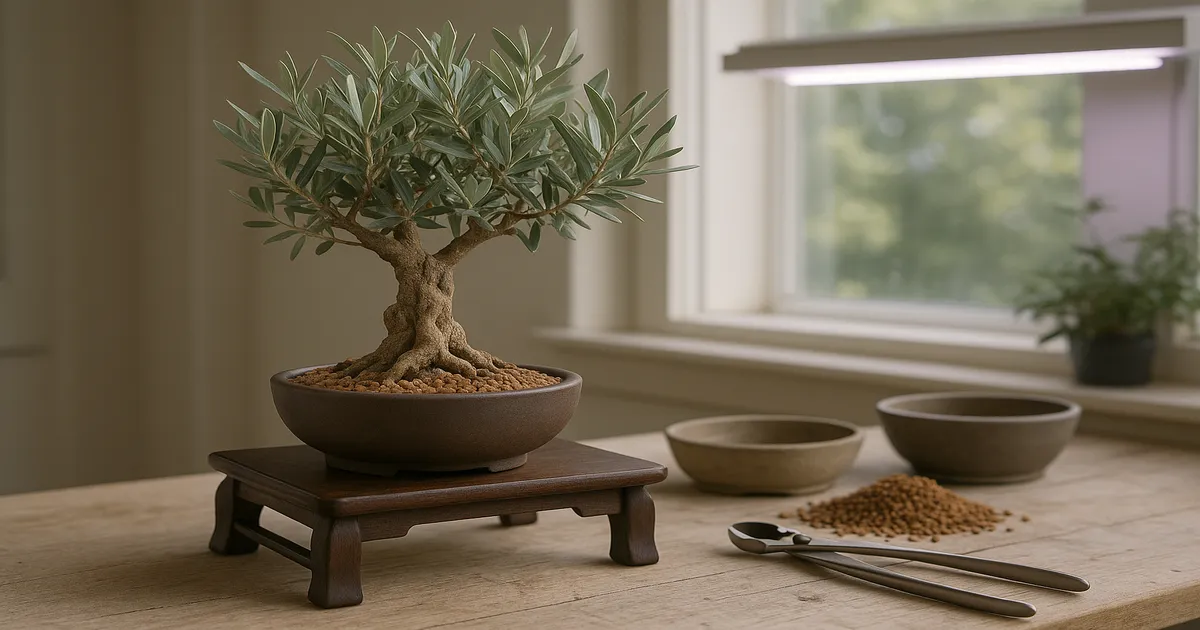
Unglazed ceramic or terracotta allows some evaporation through the pot walls, which suits olive’s preference for drier conditions. Ensure at least two drainage holes. For upright styles, aim for a pot roughly two-thirds the height of the tree; for spreading forms, two-thirds the canopy width. Earth tones — browns, grays, ochres — complement olive’s silver-green foliage beautifully.
Common Pests and Problems
Olive Scale
Olive scale (Saissetia oleae) appears as brown, dome-shaped bumps on branches and stems, often accompanied by sticky honeydew and sooty mold. Catch it early and scrub off manually with a soft brush and soapy water. For established infestations, horticultural oil spray works well; severe cases may need a systemic insecticide such as imidacloprid.
Spider Mites
Fine webbing on leaf undersides and stippled, bronzed foliage — especially in hot, dry conditions — signal spider mites. Increase airflow first, then treat with neem oil or insecticidal soap. Severe infestations may need a miticide like spiromesifen. Regular inspection during summer heat is your best prevention.
Root Rot
Root rot is the most common non-pest problem with olive bonsai, and it’s almost always caused by poor drainage or overwatering. By the time you see yellowing leaves and mushy stems, the roots are already compromised. Repot immediately into fresh, fast-draining mix, remove all rotted roots cleanly, and adjust your watering habits going forward.
Other Issues
- Sudden leaf drop: Usually cold drafts, overwatering, or a dramatic change in environment
- Yellowing leaves: Check light levels first — insufficient sun is the most common culprit; also consider under-fertilizing
- Poor, weak growth: Often a sign of under-fertilizing or a root system too congested to function well
Styling and Deadwood Techniques
Best Bonsai Styles for Olive Trees
Olive’s naturally twisting, irregular trunk lends itself to informal upright (moyogi), slanting (shakan), and literati (bunjin) styles. Semi-cascade works well for trees with strong directional movement. Formal upright rarely suits olive — the species simply doesn’t grow that way naturally, and forcing it looks contrived.
Creating Jin and Shari Deadwood
Olive’s dense, decay-resistant wood makes it one of the finest deadwood species in bonsai. Jin (branch deadwood) and shari (trunk deadwood) hold their shape for decades and bleach to a stunning silver-white. To create jin, strip bark from a selected branch stub using jin pliers, then refine the shape with a carving knife or Dremel to create natural-looking texture and taper. For shari on the trunk, plan the design carefully before cutting — it’s permanent.
Apply diluted lime sulfur (1:10 with water) to dry, carved deadwood with a brush. It bleaches the wood to that characteristic silver-white and preserves it against fungal decay. Apply annually or whenever the color begins to fade. Work outdoors — the sulfur smell is strong.
Frequently Asked Questions About Growing Olive Bonsai
Can you grow an olive bonsai tree indoors?
You can, but it’s genuinely difficult. Olive bonsai need intense light — 30,000 lux or more — that a typical indoor environment can’t provide. If you’re committed to indoor growing, place the tree in the brightest south-facing window available and supplement with full-spectrum LED grow lights running 12–14 hours a day. Without adequate light, the tree will slowly decline regardless of how well you manage everything else.
How fast does an olive bonsai tree grow?
Olive is a slow to moderate grower. In active development with good sun, regular fertilizing, and generous pot space, expect 6–12 inches of new shoot growth per season. In a refined bonsai pot with restricted roots, growth slows considerably — which is partly the point, but means you need to be patient with ramification development.
How do you thicken the trunk of an olive bonsai?
Trunk thickening requires sacrifice. Grow the tree in a large nursery container or directly in the ground, allow branches to extend freely without pruning, and fertilize generously through the growing season. Trunk girth increases fastest when the tree is not restricted. Once you’ve achieved the trunk diameter you want, move it back into a bonsai pot and begin refining the branch structure.
When should I repot my olive bonsai?
Early spring, just as buds begin to swell, is the ideal window — typically February through April depending on your climate. Repotting at this time lets the surge of spring growth drive recovery. Avoid repotting in summer heat or during winter dormancy.
Why are my olive bonsai leaves turning yellow?
Yellowing leaves most commonly point to insufficient light, overwatering, or under-fertilizing — in that order of likelihood. Check your watering frequency and soil drainage first, then assess how many hours of direct sun the tree is actually receiving. If both look fine, try a balanced fertilizer and see whether new growth comes in healthy.