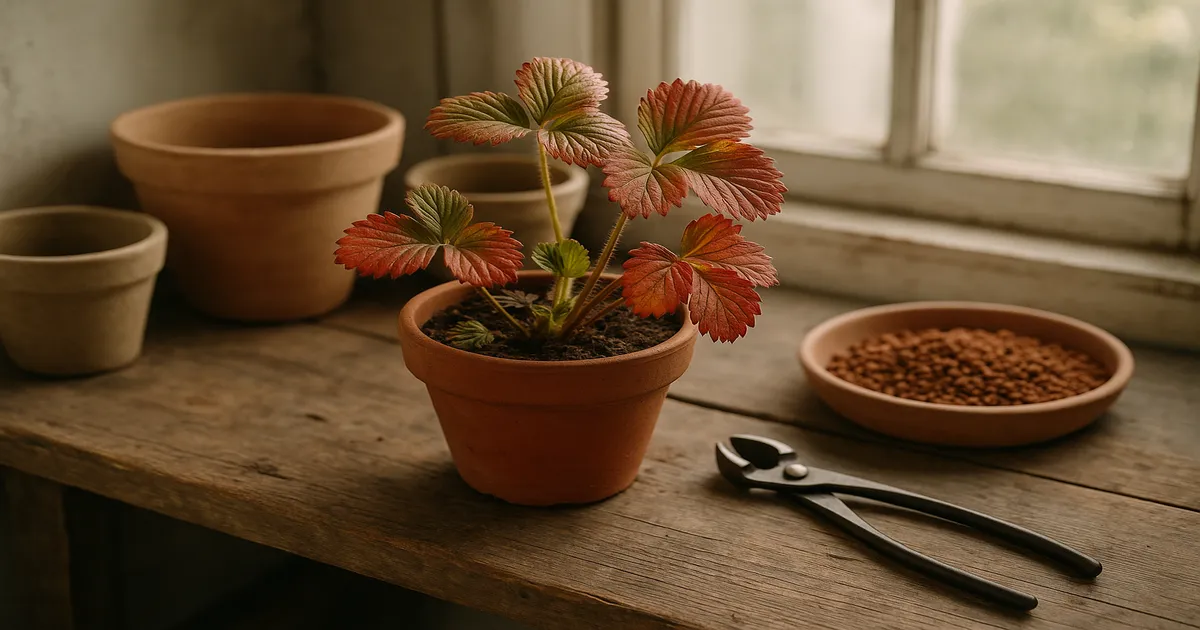
Quick Answer: Strawberry leaves turn red for several reasons — the most common being phosphorus deficiency, cold temperature stress, and natural seasonal aging. Some causes are harmless and self-correcting; others, like fungal root diseases, need prompt action. Use the diagnostic table below to pinpoint your situation quickly.
If you’re wondering why the leaves on your strawberry plant are turning red, you’re not alone — it’s one of the most common questions among home growers. The good news is that reddening isn’t automatically a crisis. The bad news is that a few causes genuinely are, so it pays to know the difference fast.
Why Are the Leaves on My Strawberry Plant Turning Red?
The Most Common Causes at a Glance
| Symptom Pattern | Most Likely Cause |
|---|---|
| Uniform red tint, older leaves, fall or spring | Seasonal senescence or cold stress |
| Purple-red tint across whole plant, early spring | Phosphorus deficiency |
| Dark red spots with no yellow halo | Leaf scorch disease (Diplocarpon earliana) |
| Wilting + red leaves + red-cored roots | Red stele root rot |
| Bronzed, stippled redness + webbing on undersides | Spider mites |
| Outer leaves collapse, brown crown tissue | Verticillium wilt |
| Leaf margins brown-red, dry soil | Drought stress |
When Should You Be Concerned?
Not all reddening demands action. Leaves that turn red in autumn as temperatures drop, or briefly in early spring on newly planted stock, are almost always showing a normal stress response. Act quickly, however, when reddening is accompanied by wilting, root discoloration, spreading spots, or visible pest activity — those combinations point to disease or infestation rather than seasonal physiology.
Strawberry Plant Basics: What Healthy Foliage Looks Like
The garden strawberry (Fragaria × ananassa) is a low-growing perennial, typically 6–12 inches tall, that spreads by runners. Most backyard plants fall into one of four categories:
- June-bearing (‘Chandler,’ ‘Earliglow,’ ‘Jewel’) — one large crop in late spring or early summer
- Everbearing (‘Ozark Beauty,’ ‘Quinault’) — two crops, spring and fall
- Day-neutral (‘Albion,’ ‘Seascape,’ ‘Tristar’) — fruits continuously regardless of day length; the most forgiving type for containers
- Alpine/woodland (Fragaria vesca ‘Alexandria,’ ‘Rügen’) — compact, no runners, small intensely flavored fruit; excellent for edging and pots
Healthy foliage is a consistent medium to deep green — trifoliate leaves with slightly serrated edges, firm texture, and no spots or discoloration. New growth at the crown should always be bright green. If the center of the plant is green but outer leaves are reddening, that’s a useful diagnostic clue in itself.
8 Reasons Strawberry Leaves Turn Red (And How to Fix Each)
1. Natural Seasonal Senescence — Nothing to Worry About
In autumn, as day length shortens and temperatures fall below 50°F (10°C), chlorophyll breaks down and underlying anthocyanin pigments become visible. It’s the same chemistry that colors maple leaves in fall. Outer, older leaves redden while the crown’s center growth stays green.
What to do: Nothing urgent. Snip off dead or heavily reddened leaves to reduce disease pressure over winter, but don’t panic about the color change itself.
2. Phosphorus Deficiency — The Most Common Culprit
This is the cause most home growers encounter and misidentify. A phosphorus-deficient plant develops a reddish-purple or bronze tint, often starting on leaf undersides and older foliage, with veins staying green a bit longer. The plant may also look stunted overall.
Phosphorus deficiency is triggered not just by low soil phosphorus, but by conditions that lock it up — cold soil below 50°F (10°C), pH outside the 5.5–6.5 sweet spot, or overwatering that leaches nutrients from containers.
How to fix it:
- Test and correct soil pH to 5.5–6.5 first — this alone often resolves the problem
- Apply bone meal, rock phosphate, or a balanced berry fertilizer (Espoma Berry-tone 4-3-4)
- For a fast fix, apply a dilute liquid phosphorus fertilizer as a foliar spray (follow label rates)
- In early spring, lay black plastic mulch to warm the soil and improve phosphorus uptake
3. Cold Temperature Stress — A Spring and Fall Trigger
When temperatures dip below 50°F (10°C), strawberry plants slow their metabolism and ramp up anthocyanin production as a protective response. Young transplants are especially susceptible. The reddening is usually uniform across the plant and fades once temperatures climb above 55°F (13°C).
What to do: Cover plants with row cover fleece during late frosts. Avoid transplanting outdoors until nighttime temperatures are reliably above 45°F (7°C). If the plant greens back up as it warms, you’re fine.
4. Drought and Water Stress — Check Your Watering Routine
Water-stressed plants can’t move phosphorus and magnesium efficiently through their tissues, triggering the same anthocyanin response. The reddening tends to start at leaf margins and tips, often accompanied by browning edges, midday wilting, and undersized fruit.
What to do: Restore consistent watering — aim for 1–1.5 inches per week. Apply 2–3 inches of straw mulch to retain soil moisture, and switch to drip irrigation if you’re using overhead watering.
5. Leaf Scorch Disease (Diplocarpon earliana) — Fungal Spots
Leaf scorch produces irregular dark reddish-purple spots on the upper leaf surface with no distinct yellow halo — that’s the key distinguishing feature. Spots merge as the infection progresses, and severely affected leaves turn entirely red-brown and die. It spreads via water splash, so overhead watering is a major risk factor.
How to treat it:
- Remove and destroy infected leaves immediately
- Apply a copper-based fungicide per label directions
- Switch to drip irrigation
- Thin plants to improve air circulation
6. Red Stele Root Rot (Phytophthora fragariae) — A Drainage Problem
This one is serious. Plants wilt and leaves turn red or yellow, but the diagnostic tell is in the roots: cut one open and the core (stele) will be brick-red to brown instead of white. It’s caused by a water mold that thrives in cold, waterlogged soil and is most destructive in wet springs.
There is no effective chemical cure once it’s established. Prevention is everything:
- Improve drainage — raise beds or move containers immediately
- Remove and destroy infected plants; don’t compost them
- Plant resistant varieties: ‘Allstar,’ ‘Earliglow,’ ‘Tristar’
- Don’t replant strawberries in the same spot for 3–4 years
7. Verticillium Wilt — A Soil-Borne Threat
Verticillium wilt causes outer leaves to turn reddish-brown and collapse while inner leaves initially stay green. Cut the crown and you’ll see brown discoloration in the vascular tissue. This soil-borne fungus persists for years and is worsened by planting strawberries after tomatoes, peppers, potatoes, or eggplants.
What to do: Remove and destroy infected plants. Solarize the soil in summer using clear plastic for 4–6 weeks to reduce fungal load. Replant with resistant varieties in a new location.
8. Spider Mite Damage — Tiny Pests, Big Impact
Spider mites don’t cause the clean red tint of phosphorus deficiency — they produce a bronzed, stippled, almost dusty redness. Check the undersides of leaves for fine webbing and tiny moving dots. Hot, dry weather above 80°F (27°C) accelerates population explosions dramatically. See the full pest section below for specific controls.
Soil, Water, and Nutrition: Preventing the Most Common Causes
Ideal Soil and pH
Strawberries need well-draining, loamy, slightly acidic soil with a pH of 5.5–6.5. Test annually and amend with sulfur to lower pH or lime to raise it.
- In-ground mix: 60% quality loam, 20% aged compost, 20% perlite or coarse sand
- Container/raised bed mix: 50% peat- or coir-based potting mix, 30% perlite, 20% aged compost
Avoid heavy clay soils entirely — they’re the fast track to root rot.
Watering
Aim for 1–1.5 inches (2.5–4 cm) of water per week from rain and irrigation combined. Water deeply 2–3 times per week during active growth, and daily during heat waves above 85°F (29°C). Container plants dry out much faster — check the top inch of soil daily and water when it feels dry. Drip irrigation or soaker hoses are strongly preferred; overhead watering wets foliage and dramatically increases fungal disease risk.
Fertilizing
Apply a balanced 10-10-10 fertilizer at planting, then switch to a low-nitrogen, higher-phosphorus formula like 5-10-10 once flowering begins. Feed every 4–6 weeks during the growing season. Excess nitrogen pushes leafy growth at the expense of fruit — and makes plants more attractive to aphids.
Overwatering vs. Underwatering: Quick Reference
| Overwatering | Underwatering |
|---|---|
| Yellowing lower leaves progressing upward | Brown, crispy leaf edges |
| Soft, foul-smelling crown tissue | Wilting that doesn’t recover by morning |
| Wilting despite wet soil | Dry soil pulling from container edges |
| Dark, mushy roots | Leaf reddening starting at margins |
How to Keep Pests Away from Strawberry Plants
Spider Mites
Barely visible to the naked eye, spider mites leave stippled, bronzed foliage and fine webbing on leaf undersides. They thrive in hot, dry conditions above 80°F (27°C).
Controls:
- Blast leaf undersides with a strong jet of water every 2–3 days
- Apply neem oil (2% solution) in the evening to avoid leaf burn
- Use insecticidal soap (potassium salts of fatty acids), coating undersides thoroughly
- Introduce predatory mites (Phytoseiulus persimilis) for warm-season infestations
- Chemical last resort: bifenazate (Floramite) — rotate modes of action to prevent resistance
Aphids
Strawberry aphids are 1–3 mm, pale green or yellow, and cluster on new growth and leaf undersides. Look for sticky honeydew residue and the sooty mold that follows. The bigger threat is virus transmission — aphids vector several serious strawberry viruses, so early control matters.
Controls:
- Lay reflective silver mulch around plants — it disorients aphids before they land
- Knock colonies off with a strong water spray
- Apply neem oil or insecticidal soap for moderate infestations
- Encourage ladybugs and lacewings; avoid broad-spectrum insecticides that kill beneficial insects
- Avoid excess nitrogen, which produces the soft new growth aphids prefer
Slugs and Snails
Slugs and snails chew irregular holes in leaves and fruit, and are most active at night or after rain. Remove debris around plants to reduce hiding spots. Apply iron phosphate bait around the perimeter of beds — it’s safe around pets and wildlife.
Birds and Larger Pests
Birds are often the biggest fruiting-season pest. Fine mesh netting draped over hoops is the most reliable solution — it keeps birds, squirrels, and rabbits out without chemicals. Anchor edges to the ground to prevent access from below.
Building a Pest-Resistant Growing Environment
Prevention beats treatment every time. A few consistent habits make a dramatic difference:
- Inspect plants weekly — catching problems early is far easier than managing an outbreak
- Use drip irrigation to keep foliage dry and reduce fungal and mite pressure
- Maintain good air circulation by spacing plants 12–18 inches apart
- Avoid excess nitrogen, which promotes lush growth that attracts aphids
- Plant companion plants like marigolds and chives to deter pests and attract beneficial insects
- Keep the area around plants clear of debris where slugs and overwintering pests hide
Step-by-Step Troubleshooting: Why Are the Leaves on My Strawberry Plant Turning Red?
Step 1 — Check the Season and Temperature
Is it early spring or autumn? Are nighttime temperatures below 50°F (10°C)? If yes, cold stress or seasonal senescence is the most likely explanation, especially if the center of the plant looks healthy. Wait and watch before taking action.
Step 2 — Inspect the Pattern and Location of Reddening
- Whole plant, uniform purple-red tint: Phosphorus deficiency
- Older outer leaves only: Senescence or drought
- Discrete dark spots with no yellow halo: Leaf scorch disease
- Bronzed, stippled redness: Spider mites — check undersides immediately
- Margins and tips browning-red: Drought stress
Step 3 — Examine Roots and Crown
Pull a struggling plant and cut a root lengthwise. White interior = healthy. Red or brown core = red stele root rot. Brown discoloration in the crown tissue = Verticillium wilt. Either finding means the plant needs to come out and the soil needs attention before replanting.
Step 4 — Look for Pests on Leaf Undersides
Flip leaves over and look carefully. Fine webbing and tiny moving dots mean spider mites. Clusters of soft-bodied insects mean aphids. Irregular holes with slime trails mean slugs. Identifying the pest before treating ensures you use the right control.
Step 5 — Test Your Soil pH and Nutrient Levels
If the cause still isn’t obvious, a basic soil test is your best next step. A pH outside 5.5–6.5 can lock up phosphorus and cause reddening even when nutrients are physically present in the soil. Most cooperative extension offices offer inexpensive soil testing, or use an at-home kit.
Frequently Asked Questions
Is it normal for strawberry leaves to turn red in autumn?
Yes, completely normal. As temperatures drop below 50°F (10°C) and day length shortens, chlorophyll breaks down and anthocyanin pigments produce red and purple colors — the same process behind autumn tree color. Remove heavily reddened leaves to reduce disease pressure over winter, but don’t be alarmed by the color change itself.
Can I eat strawberries from a plant with red or diseased leaves?
It depends on the cause. If the reddening is from cold stress, phosphorus deficiency, or seasonal aging, the fruit is perfectly safe to eat. If the plant has an active fungal disease like leaf scorch or root rot, focus on treating the problem rather than harvesting — diseased plants produce poor-quality berries regardless, though the fruit itself isn’t toxic to humans.
How do I fix phosphorus deficiency in strawberry plants quickly?
The fastest approach is a foliar spray with a dilute liquid phosphorus fertilizer applied directly to the leaves, which bypasses slow soil uptake. At the same time, check and correct your soil pH to 5.5–6.5 — pH problems are the most common reason phosphorus is unavailable even when it’s present in the soil. For a longer-term fix, work bone meal or a 5-10-10 granular fertilizer into the root zone.
What is the best organic spray to keep pests off strawberry plants?
Neem oil is the most versatile option — it controls spider mites, aphids, and several fungal diseases simultaneously. Apply a 2% solution to leaf undersides in the evening to avoid burning foliage in direct sun. Insecticidal soap is a good complement for heavy aphid infestations. Neither product has residual activity, so reapply every 7–10 days or after rain. For slugs, iron phosphate bait is the safest organic choice.
How far apart should strawberry plants be spaced to reduce pest and disease pressure?
Space plants 12–18 inches apart in rows 24–30 inches apart. Crowded plants trap moisture, restrict airflow, and create the humid microclimate that fungal diseases and spider mites love. Good spacing won’t eliminate problems, but it makes every other control measure — sprays, inspections, irrigation management — significantly more effective.