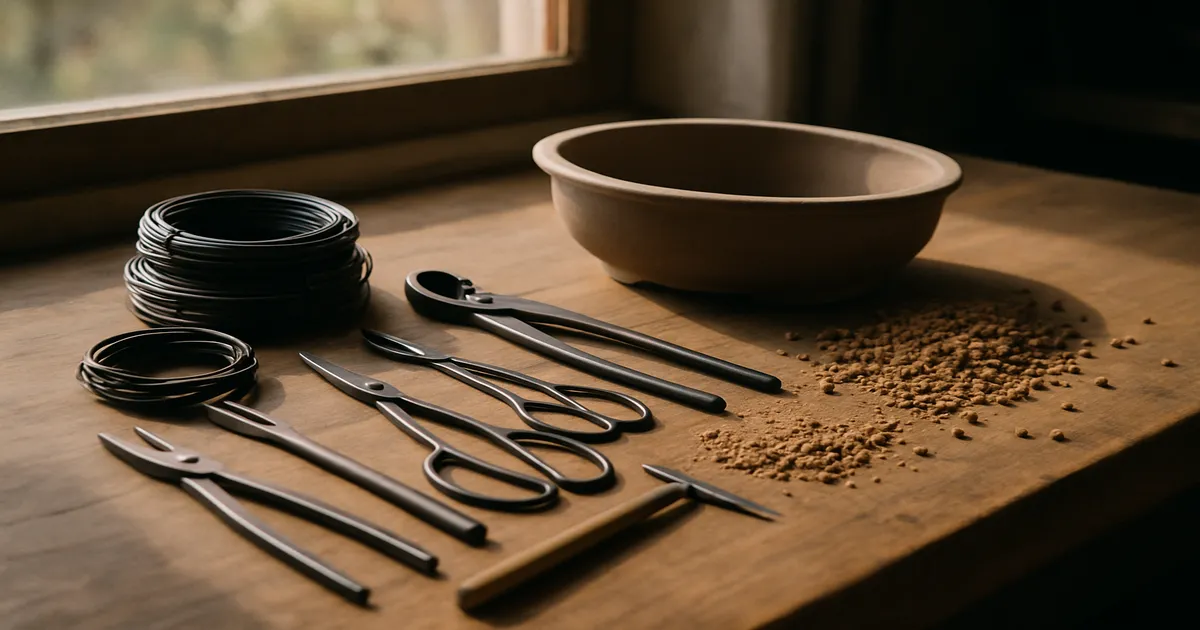
Quick Answer: For most hobbyists, the Bonsai Boy of New York Leather Tool Roll is the best all-round storage solution — purpose-built pockets, genuine leather durability, and a secure snap closure make it worth the investment once you own quality tools. On a budget, the GROWNEER Canvas Roll gets the job done for starter kits without breaking the bank.
If you’ve ever asked “how do you guys store your bonsai tools?” on a forum or Reddit thread, you already know the answers vary wildly — magnetic strips, leather rolls, pegboards, repurposed knife cases. That’s because there genuinely isn’t one right answer. The best storage depends on how many tools you own, whether you have a dedicated workspace, and how much you’ve invested in those tools. A $300 Masakuni concave cutter deserves different treatment than a $15 starter set.
This guide covers six storage solutions — from a $12 canvas roll to a traditional Paulownia wood rack — with honest pros and cons for each, plus a buying guide to help you match the right format to your actual setup.
What to Look For When Storing Bonsai Tools
Bonsai tools are uniquely awkward to store. The shapes are odd — concave cutters, knob cutters, jin pliers — the steel is often high-carbon and rust-prone, and the cutting edges are precision-ground. Generic tool storage almost always falls short somewhere.
Material: Canvas vs. Leather vs. Hard Case
Canvas is lightweight and breathable, which makes it better than nylon or sealed plastic for moisture management. The downside: it offers zero edge protection. Leather adds mild buffering between tools and lasts years longer with basic conditioning. Hard cases give the best edge isolation but sacrifice portability. Match the material to your tool quality — budget Chinese sets are fine in canvas; Japanese tools deserve leather or wood.
Pocket Sizing and Tool Fit
This is where most generic rolls fail bonsai practitioners. Knob cutters are wide and bulky. Trunk splitters are enormous. Concave cutters have protruding jaws that catch on narrow pockets. Before buying any roll, check that the pocket dimensions actually accommodate bonsai-specific shapes, not just kitchen knives or chisels.
Edge Protection Between Tools
Cutting edges contacting each other in storage causes micro-chipping — invisible until you try to make a clean cut and can’t. Look for individual pockets with enough spacing to prevent tool-to-tool contact, padded dividers or leather buffering, and individual sheaths for your most expensive cutters.
Humidity and Rust Control
High-carbon steel can develop surface rust within 24–48 hours in humid conditions. A few practical measures make a real difference:
- Silica gel desiccant packs inside any roll or case — cheap, effective, reusable
- Breathable canvas or leather over sealed plastic, which traps moisture