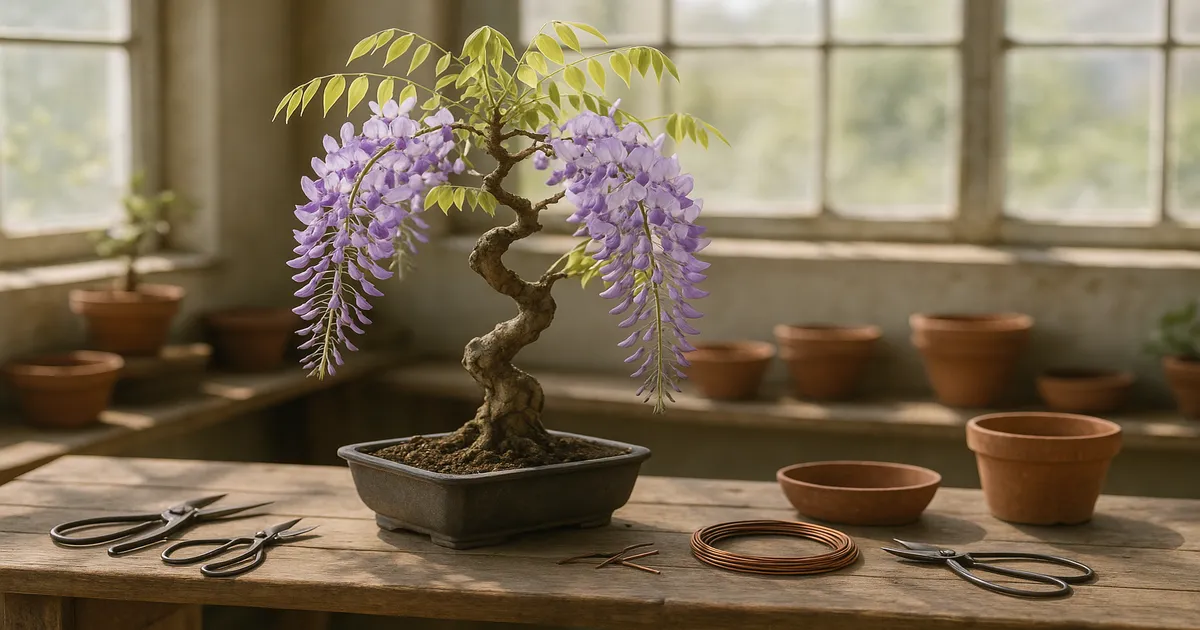
Quick Answer: To grow bonsai wisteria quickly, give it a minimum of 6–8 hours of direct sun daily, prune new shoots back to 2–3 nodes every 2–4 weeks throughout the growing season, and repot young trees every 1–2 years into a well-draining akadama-based mix. Wisteria is one of the fastest trunk-thickening species in bonsai — with disciplined technique, you can have a well-developed, reliably flowering specimen in 5–10 years.
How to Grow Bonsai Wisteria Quickly: The Core Principles
Growing bonsai wisteria quickly comes down to three non-negotiable pillars: maximum sunlight, aggressive timed pruning, and regular repotting. Skip any one of them and your tree will still grow — just slowly, and probably without flowers.
The good news is that wisteria rewards discipline generously. Cut it back hard and it responds with a flush of new shoots. Give it full sun and it builds thick bark and fat flower buds. Get the routine right and you’ll have a genuinely impressive specimen within a decade.
Wisteria belongs to the legume family (Fabaceae), so its roots host nitrogen-fixing bacteria in specialized nodules. This gives the tree a built-in fertility advantage — it partly fertilizes itself, fueling vigorous growth that makes trunk development faster than most deciduous species. Its vine habit amplifies this further. Left unchecked, wisteria grows explosively. In bonsai training, that energy is redirected into rapid trunk thickening and branch ramification. Mature specimens develop thick, silver-gray furrowed bark that looks genuinely ancient — and you can get there faster than you might expect.
Choosing the Right Species
Japanese vs. Chinese Wisteria
Wisteria floribunda (Japanese) and W. sinensis (Chinese) are the two species most commonly used for bonsai. Japanese wisteria produces the longest, most dramatic flower racemes — up to 36 inches (90 cm) on mature trees — and twines clockwise when viewed from above. Chinese wisteria has shorter racemes (8–12 inches / 20–30 cm), blooms before its leaves emerge, twines counterclockwise, and is slightly less cold-hardy. Both produce spectacular results, but the twining direction matters when you’re planning trunk movement with wire.
American and Kentucky Wisteria: Better for Beginners
W. frutescens ‘Amethyst Falls’ and W. macrostachya ‘Blue Moon’ are the species to reach for if you’re newer to wisteria bonsai. They’re more forgiving, rebloom through the season, and ‘Blue Moon’ is the hardiest wisteria available — surviving down to -40°F (-40°C) and reliable across USDA Zones 3–9. The trade-off is shorter racemes (4–12 inches / 10–30 cm), which are less dramatic at flowering time. For learning the pruning rhythms and building a solid trunk, though, they’re excellent starting points.
Species and Cultivar Comparison
| Species | Top Cultivars | Raceme Length | Cold Hardiness |
|---|---|---|---|
| W. floribunda | ’Rosea’, ‘Alba’, ‘Violacea Plena’ | 12–36 in (30–90 cm) | Zones 4–9 |
| W. sinensis | ’Prolific’, ‘Blue Sapphire’ | 8–12 in (20–30 cm) | Zones 5–9 |
| W. frutescens | ’Amethyst Falls’, ‘Nivea’ | 4–6 in (10–15 cm) | Zones 5–9 |
| W. macrostachya | ’Blue Moon’, ‘Aunt Dee’ | 6–12 in (15–30 cm) | Zones 3–9 |
All species develop the same prized thick, gnarled bark with age. Your choice really comes down to climate and how much drama you want at bloom time.
Light, Temperature, and Seasonal Care
Sunlight Requirements for Fast Growth and Flowering
Wisteria is not a houseplant — it cannot be grown indoors long-term. Insufficient light causes weak, etiolated growth, and without a proper winter dormancy cycle, flowering becomes unreliable and the tree gradually declines. The only exception is a brief indoor display of 3–5 days maximum when the tree is in full flower. After that, it goes back outside.
Aim for at least 6–8 hours of direct sun every day during the growing season. Inadequate light is the single most common reason wisteria bonsai fail to flower, and it also slows trunk development significantly. In late summer (August–September), full sun exposure is especially critical — this is when the tree is ripening next spring’s flower buds. Shade your tree during this window and you’ll be wondering why it didn’t bloom in April.
In climates where summer temperatures regularly exceed 95°F (35°C), some afternoon shade is acceptable to prevent leaf scorch. Morning sun is always preferable.
Winter Dormancy: The Key to Reliable Blooms
Wisteria needs 6–8 weeks of cold dormancy at temperatures below 45°F (7°C) to trigger reliable spring flowering. Skip this chilling requirement and the tree will break dormancy erratically, produce weak growth, and often fail to flower at all.
During dormancy, reduce watering to roughly once every 1–2 weeks — enough to prevent desiccation, but no more. Never bring the tree into a heated space. Temperatures above 50°F (10°C) in winter break dormancy prematurely and exhaust the tree’s energy reserves before spring arrives.
Winter protection by zone:
- Zones 6 and warmer: An unheated greenhouse, cold frame, or sheltered south-facing wall is usually sufficient.
- Zone 5 and colder: Move to an unheated garage or shed after the first hard frost. Aim for 25–40°F (-4–4°C).
- Below 20°F (-7°C): Insulate the pot itself with burlap or bubble wrap — container roots are far more vulnerable to freeze damage than in-ground roots.
Soil, Watering, and Feeding
The Best Soil Mix for Fast Bonsai Wisteria Growth
For established trees (3+ years in training), use a mix of 50% akadama, 30% pumice, and 20% lava rock. Akadama holds moisture and develops fine root systems as it gradually breaks down; pumice keeps the mix aerated; lava rock provides long-term structural drainage. A quality pre-blended bonsai substrate works well here — look for one with similar particle ratios.
Use 3–6mm particle size for standard pots and 1–3mm for shohin. Avoid standard potting soil or any peat-heavy mix — wisteria roots rot quickly in waterlogged, anaerobic conditions.
For young trees you’re actively pushing to develop, modify the mix slightly: 40% akadama / 30% pumice / 20% lava rock / 10% composted bark or kanuma. The organic fraction boosts water and nutrient retention just enough to support faster growth without sacrificing drainage.
Watering Through the Seasons
- Spring and summer: Water thoroughly when the top ½ inch (1–1.5 cm) of soil starts to dry. In hot weather this may mean watering once or twice daily.
- Autumn: Reduce frequency as growth slows; water when the top inch (2.5 cm) is dry.
- Winter dormancy: Water only enough to prevent desiccation — roughly once every 1–2 weeks.
Always water until it flows freely from the drainage holes. The “lift test” is your best friend: a noticeably light pot means it’s time to water. Rainwater or filtered water is ideal. Hard tap water above 200 ppm TDS gradually raises soil pH and causes chlorosis; if you’re using tap water, let it sit overnight to off-gas chlorine.
Fertilizing for Speed Without Sacrificing Flowers
Because wisteria fixes its own nitrogen, it needs less supplemental nitrogen than most bonsai species. From early spring through midsummer, a balanced fertilizer (e.g., 10-10-10) applied every two weeks is sufficient. From midsummer onward, switch to a low-nitrogen, phosphorus-potassium-focused formula. Pushing nitrogen after July drives vegetative growth at the direct expense of flower bud formation — one of the most common mistakes growers make.
Pruning Bonsai Wisteria Quickly and Correctly
Structural Pruning: Building the Framework
Structural pruning happens in late winter (February–March in Zones 6–8), just before bud break, or immediately after flowering before the tree wastes energy on seed pod development. This is when you define the primary branch structure and remove anything crossing, competing, or growing in the wrong plane.
Use sharp concave cutters to create slightly hollowed wounds that callus flush with the bark — the Kaneshin 175mm Concave Branch Cutter is a reliable choice for this. Apply cut paste to any wound larger than ¼ inch (6mm). Cut back long extension shoots to 2–3 nodes to force ramification. Favor branches emerging at 45–60° angles from the trunk, alternating left, right, and back at different heights.
Maintenance Pruning: The Every-2-Week Rule
From May through September, prune new shoots back to 2–3 leaves once they’ve extended to 6–8 leaves. Do this every 2–4 weeks without fail. Wisteria left unpruned for a month produces long, whippy vine growth that looks nothing like a bonsai and sets back your development timeline significantly.
Remove any shoots growing directly toward or away from the viewer — you want flat, two-dimensional branch pads, not a tangle of growth in every direction.
The Late-Summer Cutback: Unlocking Flower Buds
In late July or August, perform a harder cutback — reducing every shoot to just 2 leaves. This is the single most important pruning step for reliable flowering. Flower buds form on short, stubby spurs developed from the previous season’s wood, and this cutback is what creates them. Long, leafy shoots almost never produce flowers.
Remove seed pods immediately after flowering — every single one. Seed production is enormously energy-intensive and directly suppresses next year’s flower bud formation. Pull or cut any suckers emerging from the base or below the soil line as soon as you spot them.
Wiring for Shape and Trunk Movement
Wire Gauge Guide
- 1.0–1.5mm aluminum: Fine tertiary branches and ramification
- 2.0–2.5mm aluminum: Secondary branches and medium laterals
- 3.0–4.0mm aluminum: Primary branches
- 4.0–6.0mm aluminum or copper: Trunk movement on young material
Aluminum wire is the right choice for beginners and for wisteria’s tender new shoots. Copper holds set positions more firmly and is preferred by advanced practitioners for significant trunk bends, but it’s less forgiving if you make a mistake.
Applying Wire and Avoiding Scars
Wire in late winter while the tree is dormant and leafless. Wrap at a 45° angle, always wiring two branches of similar thickness with one piece of wire. The wire should be snug but not tight — you should be able to slide a fingernail underneath it. Bend branches slowly and deliberately, supporting the branch at the bend point with both thumbs to prevent splitting.
For significant trunk movement, use guy wires anchored to the pot rim rather than wrapping wire around the trunk. This avoids scarring the primary trunk, which heals slowly on wisteria and remains very visible on smooth young bark.
During the growing season, wire can bite into wisteria bark within just 4–8 weeks. Check every wired branch every 2–3 weeks from spring through summer. The moment you see bark beginning to bulge around the wire, remove it immediately — always by cutting at 2–3 inch (5–7.5 cm) intervals, never by unwinding.
Repotting to Sustain Vigorous Growth
How Often to Repot
- Young trees under 5 years in training: Every 1–2 years
- Established trees (5–15 years): Every 2–3 years
- Mature, refined specimens: Every 3–5 years
If roots are circling the inside of the pot, emerging from drainage holes, or the soil dries out within hours of watering, repot regardless of schedule.
Timing, Technique, and Pot Selection
Repot in late February to mid-March in most temperate climates, just as buds begin to swell but before they open. This lets the tree channel its spring energy surge directly into new root growth in fresh soil.
Remove the tree from its pot and use a root hook or chopstick to untangle the root mass. Remove up to one-third of the total root mass, cutting cleanly with sharp root scissors. Prioritize removing circling roots and any that are dark, soft, or rotting. Always use fresh soil mix — never reuse old mix.
For pot selection, a slightly undersized pot encourages flowering over vegetative growth by creating mild root restriction. Unglazed earthenware breathes, regulates moisture more naturally, and creates a healthier root environment than glazed ceramic or plastic.
Troubleshooting Common Problems
Why Your Wisteria Bonsai Isn’t Flowering
Work through this checklist:
- Insufficient light — less than 6 hours of direct sun daily will reliably suppress blooming
- Skipped winter dormancy — the tree needs 6–8 weeks below 45°F (7°C)
- Too much nitrogen after midsummer — promotes leafy growth, kills flower buds
- No late-summer cutback — without cutting to 2 leaves in July/August, flower spurs don’t form
- Seed pods left on the tree — energy diverted to seed production means no energy for next year’s flowers
Yellowing Leaves and Chlorosis
Yellow leaves during the growing season usually point to one of three things: overwatering (check the roots), hard water chlorosis (switch to rainwater and consider a dilute acidic fertilizer), or normal autumn senescence (no action needed). The pattern matters: uniform yellowing across older leaves often signals overwatering; yellowing between green veins (interveinal chlorosis) typically indicates a pH or iron availability problem.
Pests and Diseases
- Aphids: Common on tender new growth in spring; knock off with a strong water jet or treat with insecticidal soap.
- Scale insects: Look for brown, shell-like bumps on stems; treat with horticultural oil in late winter.
- Vine weevil: Notched leaf margins are the giveaway; check for grubs in the soil during repotting.
- Powdery mildew: White powdery coating on leaves in humid conditions; improve air circulation and avoid overhead watering.
Leggy, Weak Growth
Leggy growth with long internodes almost always means insufficient light. Move the tree to a sunnier position immediately — you cannot compensate for this with fertilizer. Over-fertilization with nitrogen produces the same weak, soft growth; if you’ve been feeding heavily, reduce nitrogen and increase airflow around the tree.
Frequently Asked Questions
How long does it take to grow bonsai wisteria quickly enough to flower?
Most wisteria bonsai begin flowering within 3–5 years when grown from a cutting or nursery stock under optimal conditions. Trees grown from seed can take 10–15 years. With disciplined pruning, full sun, and proper dormancy, a well-developed specimen with reliable annual blooming is achievable within 5–10 years.
Can you grow wisteria bonsai indoors?
No. Wisteria is strictly an outdoor bonsai. It requires full sun, seasonal temperature cycles, and a cold winter dormancy period that cannot be replicated indoors. The only exception is bringing the tree inside for a display period of 3–5 days maximum when it’s in full flower, after which it must go back outdoors immediately.
What is the fastest way to thicken a wisteria bonsai trunk?
Grow the tree in the ground or in a large training container for 2–4 years before moving it to a bonsai pot. Unrestricted root space dramatically accelerates trunk thickening. Feed regularly with a balanced fertilizer through the growing season, keep it in full sun, and allow some branches to grow freely as “sacrifice branches” — these are removed once the trunk reaches the target diameter.
Why does my wisteria bonsai have lots of leaves but no flowers?
The most likely causes are too much nitrogen fertilizer after midsummer, skipping the late-summer cutback to 2 leaves, or insufficient light. Wisteria that is growing vigorously but not flowering is almost always being pushed into vegetative mode by one of these three factors. Address all three simultaneously for best results.
Is wisteria bonsai suitable for beginners?
Wisteria is manageable for beginners who are willing to follow a consistent pruning schedule. The main challenge is the every-2-week maintenance pruning through summer — miss it and the tree quickly reverts to vine-like growth. Start with W. macrostachya ‘Blue Moon’ or W. frutescens ‘Amethyst Falls’ for greater cold hardiness and a more forgiving growth habit.