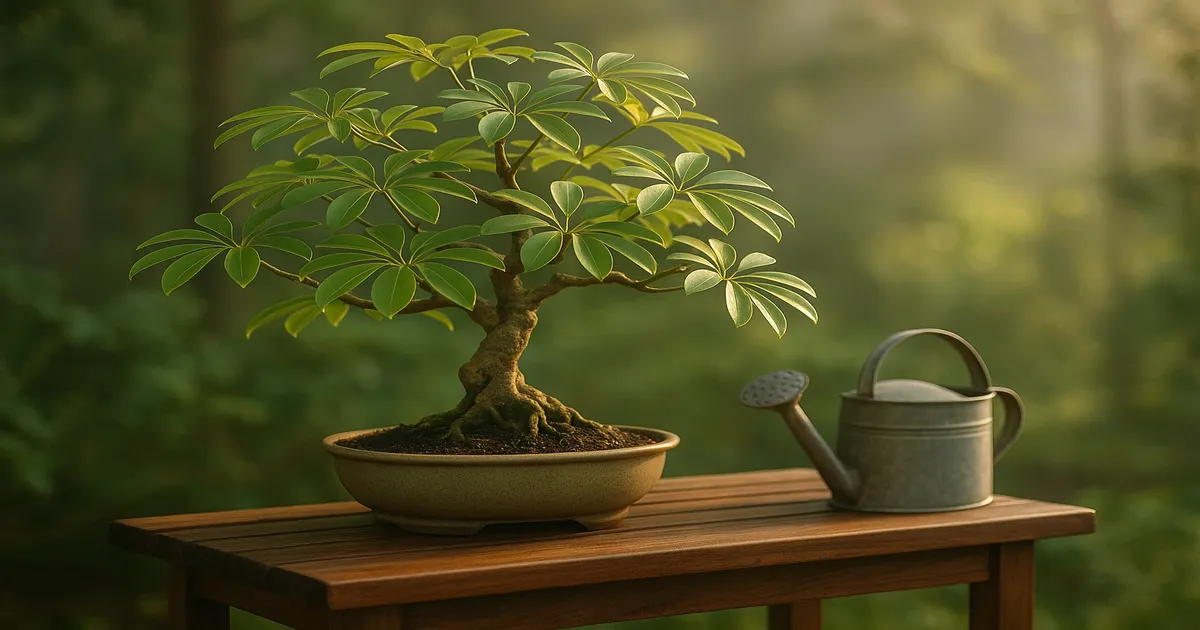
Quick Answer: Schefflera plants need thorough, deep watering every time — water until it drains freely from the holes, then wait until the top 0.5–1 inch of soil approaches dryness before watering again. There’s no fixed schedule: expect every 1–3 days in summer and every 3–7 days in winter. Overwatering kills more scheffleras than anything else, so when in doubt, wait a day.
Knowing how much water a schefflera plant needs is the single most important skill you’ll develop as its keeper. Get it right, and this tropical beauty rewards you with vigorous growth, thickening trunks, and — if humidity cooperates — the dramatic aerial roots that make it one of the most striking indoor bonsai species around.
How Much Water Does a Schefflera Plant Need?
The Core Watering Rule
Water thoroughly every single time — not a splash, but a full soak until water runs freely from every drainage hole. Then wait. Let the top 0.5–1 inch of soil approach dryness before you water again. That cycle of complete saturation followed by a partial dry-down is what schefflera’s biology demands.
The volume per watering never changes. Only the frequency shifts with the seasons.
Watering Frequency at a Glance
| Season | Typical Frequency | Soil Dryness Cue Before Watering |
|---|---|---|
| Spring / Summer | Every 1–3 days | Top 0.5–1 inch feels barely moist to dry |
| Autumn | Every 2–4 days | Top 1 inch feels dry |
| Winter (indoors) | Every 3–7 days | Top 1–1.5 inches feel dry |
These are starting points, not rules. Your specific pot, soil, and environment will shift the numbers.
Why Schefflera’s Origins Shape Its Watering Needs
Native Habitat and Rainfall Patterns
Schefflera arboricola — the dwarf umbrella tree and by far the most popular bonsai species in this genus — is native to Taiwan and Hainan Island, where annual rainfall exceeds 60–100 inches. That sounds like a plant that wants wet soil. It doesn’t.
The key is what the rain falls through: rocky cliff faces, tree bark, and fast-draining forest debris. Roots are flushed with moisture constantly but never waterlogged. High throughput, zero stagnation — that’s the biological blueprint you’re trying to replicate in a pot.
Epiphytic Roots: Built for Drainage, Not Saturation
In the wild, S. arboricola often grows as an epiphyte or lithophyte, clinging to rock faces and tree trunks rather than sitting in garden soil. This explains two things: its remarkable tolerance for root restriction in a bonsai pot, and its absolute intolerance for standing water around its roots. Anaerobic conditions — the kind created by waterlogged soil — kill roots quickly and quietly, long before you see symptoms above the soil line.
S. arboricola vs. S. actinophylla
S. arboricola is the go-to for most bonsai work: compact internodes, small leaflets, and excellent response to pruning. S. actinophylla (the octopus tree, native to tropical Australia) produces much larger leaves and a bolder structure — best suited to large, exhibition-scale bonsai. Both species share the same core watering philosophy, though the bigger pots used for S. actinophylla dry out more slowly, so adjust frequency accordingly.
The Best Soil Mix for Schefflera Watering Success
Soil composition directly controls how often you water. Use the wrong mix and even perfect technique won’t save the tree.
Recommended Bonsai Soil Composition
| Component | Ratio | Function |
|---|---|---|
| Akadama | 40% | Moisture retention, cation exchange, root anchoring |
| Pumice | 30% | Drainage, aeration, root oxygenation |
| Lava rock | 30% | Structural drainage, pH buffering |
Particle size matters: aim for 3–6 mm for standard-sized bonsai, and 1–3 mm for shohin under 6 inches tall. Some growers add 10% horticultural charcoal to suppress fungal growth in the root zone — worth considering if your tree lives in a warm, humid indoor environment. Pre-mixed, correctly sized bonsai substrate takes the guesswork out of blending your own. (Boon’s Mix Akadama Pumice Lava)
Why Standard Potting Soil Fails
Peat-based potting mixes compact over time and hold water in a dense, airless mass. In a small bonsai container, this creates exactly the anaerobic conditions that rot schefflera roots — even if the plant survives a season, you’re fighting the substrate every time you water.
Adjusting the Mix for Your Climate
In humid climates, or if you tend to water generously, shift to 30% akadama and 40% pumice to push drainage faster. In dry, heated indoor environments where pots dry out quickly, the standard 40% akadama ratio helps retain moisture between waterings. Tune the ratio to your conditions, not someone else’s.
How to Water a Schefflera Plant Correctly
Step-by-Step Technique
- Water thoroughly until water flows freely from all drainage holes.
- Wait 30 seconds, then water again — this ensures complete saturation rather than just surface wetting.
- Let the pot drain fully. After 30 minutes, empty any water sitting in the saucer. Roots sitting in standing water is a direct path to rot.
A long-necked watering can gives you precise control over flow rate and direction, which matters when you’re working around a delicate surface design.
The Finger Test and the Lift Test
The finger test is your primary tool: push your finger about an inch into the soil. Cool and slightly moist? Wait another day. Dry and at room temperature? Water now.
The lift test becomes intuitive with practice. A freshly watered pot feels noticeably heavier than one approaching dryness. Pick it up right after watering so you know what “full” feels like, then lift it again each day. When it feels meaningfully lighter, it’s time.
Factors That Increase Watering Frequency
- Temperatures above 80°F (27°C)
- Strong direct sunlight or high-intensity grow lights
- Low ambient humidity (below 40%)
- Small pot relative to tree size
- Active spring/summer growth
- Terracotta or unglazed ceramic pots (lose moisture faster than glazed or plastic)
- Higher pumice/lava ratio in the soil mix
Factors That Decrease Watering Frequency
- Temperatures below 65°F (18°C)
- Reduced light in winter or overcast conditions
- Larger pot relative to tree size
- Higher akadama ratio in the mix
- Glazed ceramic or plastic training pots
- Ambient humidity above 60%
Humidity: The Other Half of Schefflera Hydration
Schefflera wants 50–70% relative humidity. Below 40%, leaf edges start browning and aerial root development stalls. A tree sitting in perfectly watered soil but bone-dry air is still a stressed tree.
Practical Ways to Raise Indoor Humidity
- Pebble tray: Fill a tray with pebbles, add water to just below the pebble surface, and sit the pot on top. Never let the pot base touch the water directly.
- Group your plants: Clustering plants together raises local humidity naturally as they transpire.
- Room humidifier: The most effective option. Target 50–60% RH and place it near your bonsai.
- Misting: Useful for encouraging aerial root development, but it doesn’t substitute for adequate soil moisture — the surface dries within minutes.
Humidity and Aerial Root Development
Those dramatic aerial roots that define tropical bonsai character form when ambient humidity is consistently above 60–70%. Misting the trunk and exposed roots daily encourages them to emerge and elongate. Just ensure good air circulation alongside high humidity — stagnant moist air above 70% RH invites fungal problems.
Signs of Overwatering and Underwatering
Overwatering (and Root Rot)
Overwatering is the leading cause of death in indoor schefflera bonsai. Symptoms progress gradually, which is exactly what makes it dangerous.
- Early: Lower and interior leaves yellow; leaves feel soft despite moist soil
- Progressing: Sudden, dramatic leaf drop; new growth appears stunted or blackened at the tips
- Advanced: Mushy stem base; foul odor from the soil; roots appear brown-black and soft rather than cream-white and firm
Underwatering
Underwatering is more obvious and, fortunately, more forgiving.
- Early: Leaf edges curl inward; leaves feel slightly papery
- Progressing: Branch tips wilt; leaves yellow then brown from the edges inward
- Advanced: Crispy leaf drop; soil visibly pulling away from the pot edges
How to Recover from Each Problem
For a bone-dry, underwatered tree, don’t just pour water on top — dried bonsai soil often repels water at the surface. Instead, submerge the entire pot in a bucket of water for 10–15 minutes until bubbles stop rising, then drain completely and resume normal watering. Schefflera bounces back from moderate underwatering within days.
Root rot is harder. Remove the tree from its pot, trim away all brown-black mushy roots with sterilized scissors, and repot into fresh, dry bonsai mix. Hold off on watering for 24–48 hours, then resume cautiously. Skip fertilizer entirely until new growth confirms the root system is functioning again.
Seasonal Watering and Light Requirements
Spring and Summer
When temperatures climb and light intensifies, schefflera kicks into active growth and transpiration rises sharply. In good light and warm conditions — 75–85°F (24–29°C) — expect to water every 1–3 days. The soil tells you when, not the calendar. Volume per watering stays the same: thorough and complete, until water drains freely.
Autumn and Winter
As light drops and growth slows, water demand drops with it. Shift to watering every 3–7 days indoors, but still use the finger test to confirm — a tree near a sunny south-facing window in January may still want water every 3–4 days. Don’t just assume the schedule is right.
Bring outdoor trees inside before nighttime temperatures drop below 50°F (10°C). Transition gradually over two weeks — moving from full outdoor sun to indoor light in one step causes dramatic leaf drop from light shock alone.
How Light Levels Control Water Demand
Light drives photosynthesis, which drives transpiration, which drives water uptake. A schefflera at 10,000–20,000 lux (a bright south-facing window or under quality grow lights) will drink significantly more than the same tree at 2,000–3,000 lux in a dim corner. Move your tree to a lower-light spot and reduce watering frequency accordingly.
Outdoor summer placement dramatically increases water demand — check soil daily. Wind accelerates evaporation further, so a tree in a terracotta pot on a breezy patio may need water every single day.
Repotting, Pruning, and Watering Adjustments
When to Repot
Repot young, developing trees every 1–2 years; mature specimens every 2–3 years. The best time is early spring as buds begin to swell but before significant leaf extension — when nighttime temperatures consistently stay above 55°F (13°C). On vigorous trees, remove 20–30% of the root mass, cutting cleanly with sterilized scissors. Preserve fine feeder roots over thick structural roots. Aerial roots can be guided into the soil and incorporated into the design rather than removed.
Watering After Repotting or Heavy Pruning
After repotting or a significant pruning session, the tree has less leaf mass and therefore lower water demand. Reduce watering frequency — not volume — until new growth appears. Hold off on fertilizer entirely until the tree pushes new shoots, confirming the root system is functioning again.
Pruning and Its Effect on Water Uptake
For maintenance pruning, cut back to 1–2 leaves above the desired branching point. Schefflera back-buds reliably even on older wood, so don’t be timid. Light pruning can be done year-round. A well-ramified, full canopy transpires more water than a freshly pruned tree — so as the canopy fills back in, expect watering frequency to creep back up. The tree’s thirst tracks its canopy size.
Frequently Asked Questions
How often should I water a schefflera plant?
There’s no fixed schedule — it depends on your season, pot, soil, and environment. In spring and summer with good light, expect to water every 1–3 days; in winter indoors, every 3–7 days. Always use the finger test: water when the top inch of soil is dry, not before.
Can schefflera recover from overwatering?
Yes, if caught early. Remove the tree from its pot, trim all brown-black mushy roots, and repot into fresh, well-draining bonsai soil. Let the soil dry slightly between waterings and skip fertilizer until new growth confirms recovery. A mushy stem base indicates severe rot and is much harder to reverse.
Why are my schefflera leaves turning yellow and dropping?
The most common cause is overwatering — especially if yellowing starts on lower or interior leaves and the soil feels consistently damp. Sudden leaf drop can also follow a dramatic change in light or temperature, such as moving the tree indoors in autumn. Check watering frequency, soil drainage, and whether the tree recently experienced an environmental shift.
Should I mist my schefflera to keep it hydrated?
Misting raises local humidity and encourages aerial root development, but it doesn’t replace proper soil watering — the moisture evaporates within minutes. Think of misting as a humidity and aesthetics tool, not a hydration strategy. A room humidifier targeting 50–60% RH is far more effective for keeping your tree comfortable.
What soil mix prevents overwatering in schefflera bonsai?
A mix of 40% akadama, 30% pumice, and 30% lava rock gives excellent drainage while retaining enough moisture between waterings. In humid climates or if you water frequently, shift to 30% akadama and 40% pumice. Avoid any peat-based or standard potting soil — these compact over time and create the waterlogged, anaerobic conditions that rot schefflera roots.