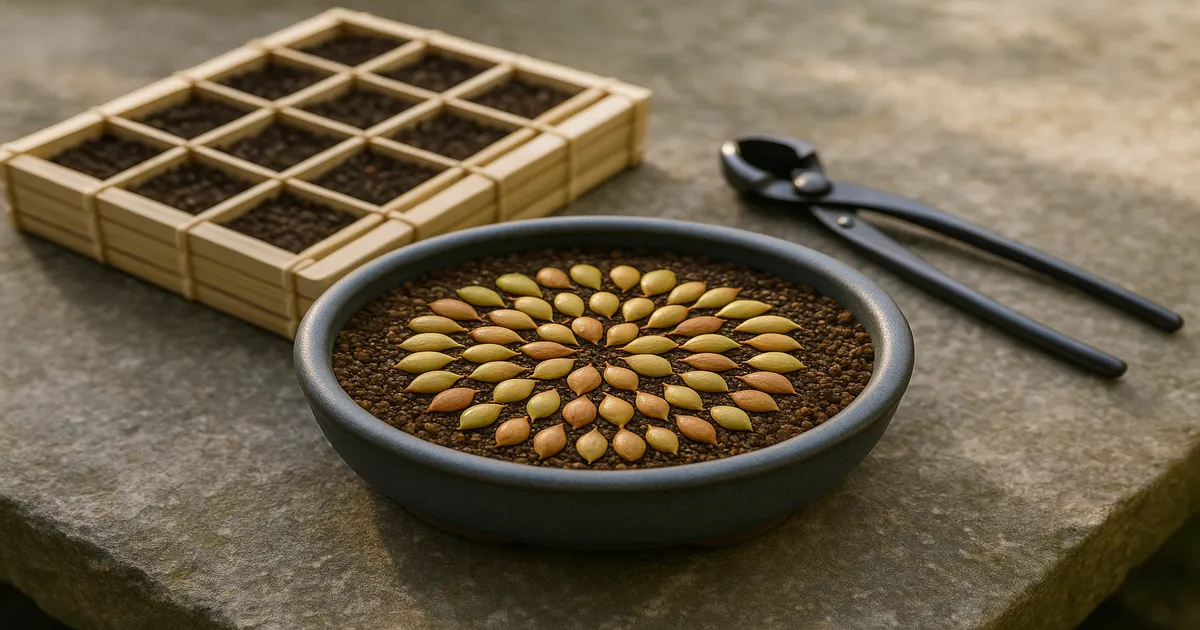
Quick Answer: Yes, you can grow a crabapple tree from a crabapple — seeds extracted from the fruit are viable and will germinate with proper preparation. The catch is that due to heavy cross-pollination and genetic variability, the seedling almost certainly won’t match the parent tree. For gardeners wanting a specific cultivar, vegetative propagation is the better route; for bonsai enthusiasts, that unpredictability is actually part of the appeal.
Growing a tree from fruit you picked yourself has a satisfying, almost primal logic to it. You absolutely can grow a crabapple tree from a crabapple — the seeds inside those tiny fruits are viable and ready to sprout, given the right conditions. There is one critical caveat, though, and it changes everything depending on what you’re trying to achieve.
Can You Grow a Crabapple Tree from a Crabapple? The Genetics Explained
Crabapple seeds germinate readily once their dormancy is broken. The challenge is genetics. Crabapples cross-pollinate freely with other Malus species and cultivars growing nearby, so every seed in that fruit carries a unique genetic combination. Plant ten seeds from the same tree and you’ll get ten different trees — some beautiful, some unremarkable, none identical to the parent.
For gardeners trying to replicate a specific named cultivar, that’s a dealbreaker. For bonsai practitioners hunting for unusual, one-of-a-kind material with interesting growth habits, it’s an opportunity.
Seed-Grown vs. Vegetatively Propagated: Which Is Right for You?
Grow from seed if:
- You want unique, genetically distinct material for bonsai development
- You’re curious what wild-type or semi-wild traits emerge
- You’re patient and enjoy the full journey from germination to finished tree
Choose vegetative propagation (grafting or cuttings) if:
- You need a specific cultivar — ‘Sargentii’, M. halliana, and so on
- You want predictable flower color, fruit size, and disease resistance
- You’re growing for a landscape where uniformity matters
Understanding Crabapple Species and Why It Matters for Propagation
What Exactly Is a Crabapple?
Botanically, crabapples belong to the genus Malus within the Rosaceae family — the same genus as domestic apples. The defining characteristic is fruit size: any Malus producing fruit 2 inches (5 cm) or smaller in diameter is a crabapple. Depending on the taxonomic authority, there are 30–55 wild species distributed across North America, Europe, and Asia. This matters for seed propagation because you’re not working with a uniform, predictable gene pool.
Why Seeds Don’t Reproduce the Parent Tree
Crabapples are highly cross-pollinated — bees don’t care which species they’re visiting. Combined with the natural genetic heterozygosity of the Malus genus, seeds from even a stunning named cultivar will produce offspring that revert toward wild-type traits: smaller flowers, less ornamental fruit, variable disease resistance. It’s not a flaw in your technique; it’s simply how crabapple genetics work.
Best Crabapple Species for Bonsai
Asian species dominate bonsai culture for good reason — they tend toward smaller leaves, finer ramification, and proportionally tiny fruit that looks stunning on a miniaturized tree.
| Species | Flower Color | Fruit Size/Color | Bonsai Notes |
|---|---|---|---|
| M. sieboldii (Toringo) | White/pink | Tiny red | One of the finest bonsai subjects; excellent ramification |
| M. halliana | Deep pink | Small purple-red | Elegant weeping habit |
| M. floribunda | Pink/white | Yellow-red | Prolific bloomer, reliable performer |
| M. cerasifera | White | Cherry-sized red | Ideal for shohin and mame sizes |
| M. sargentii | White | Tiny dark red | Naturally dwarf, naturally fine-branching |
| M. sylvestris | White/pink | Green-yellow | Rugged bark development, excellent character |
How to Grow a Crabapple Tree from a Crabapple: Step-by-Step
Harvesting and Extracting Seeds
Collect fruit in mid-to-late autumn once it’s fully ripe — look for fully developed skin color and flesh that yields slightly to pressure. Cut each fruit open to access the core; you’ll typically find 4–10 seeds per fruit. Rinse the seeds clean of pulp, which can harbor mold during stratification.
Cold Stratification: Breaking Seed Dormancy
Crabapple seeds have a built-in dormancy mechanism that mimics winter. You need to replicate that cold period before they’ll germinate.
- Mix cleaned seeds with slightly moist peat moss or vermiculite — damp, not wet.
- Seal in a zip-lock bag or lidded container.
- Add a small pinch of activated charcoal to suppress mold.
- Refrigerate at 34–40°F (1–4°C) for 60–120 days.
- Check monthly for mold and to ensure the medium hasn’t dried out.
With proper stratification, expect germination rates of 50–80%. Skip it, and you’ll be lucky to see 10–15%. A simpler alternative: sow seeds directly outdoors in autumn in a cold frame and let natural winter temperatures do the work.
Sowing and Germination
After stratification, sow seeds in early spring once the worst freezes have passed. Plant shallowly — about ¼ inch (6 mm) deep — in a well-draining mix. A 1:1 blend of perlite and seed-starting compost works well at this stage. Keep the medium consistently moist but not waterlogged, and place in a bright, warm location. Germination typically occurs within 2–4 weeks.
Caring for Seedlings
Once seedlings emerge, move them to a position with maximum light. A single hard late-spring freeze can wipe out a whole tray, so watch forecasts carefully. Water consistently, allow the surface to begin drying between waterings, and hold off on heavy fertilizing for the first few weeks. Let the roots establish first.
Soil, Watering, and Light
Best Soil Mix for Crabapple Bonsai
Crabapples need excellent drainage with enough moisture retention to stay consistently — but not perpetually — moist. A standard inorganic bonsai mix delivers this well.
Recommended mix for established bonsai: 40–50% akadama, 25–30% pumice, 20–30% lava rock. Particle size should be 3–6 mm for standard sizes, 1–3 mm for shohin and mame.
Beginner alternative: 1:1 akadama and pumice — simpler to source, still effective.
Avoid peat-heavy potting mixes and standard garden compost. They compact over time, retain too much moisture, and invite root rot. Target a soil pH of 6.0–7.0.
Watering Through the Seasons
Water when the top ½ inch (1.2 cm) of soil begins to dry — before it dries completely. In summer heat, small pots may need watering once or twice daily. As autumn arrives and growth slows, ease off. During winter dormancy, water only enough to prevent complete desiccation: roughly every 7–14 days depending on storage conditions. Always water until it flows freely from the drainage holes, then let the pot drain fully. If your tap water is hard (pH above 7.5), collected rainwater or filtered water is worth the effort — crabapples are sensitive to high alkalinity.
Sunlight and Hardiness
Crabapples need a minimum of 6 hours of direct sun daily during the growing season. Full sun produces compact internodes, abundant flower buds, and good disease resistance. Shade produces the opposite: weak elongated growth, sparse flowering, and increased susceptibility to fungal problems. In USDA Zones 8–9, some afternoon shade during peak summer heat reduces stress. In cooler zones, full sun all day is the goal.
Most crabapple species are hardy in Zones 4–8 in the ground. Container-grown trees are more vulnerable — roots exposed on all sides can suffer damage below 15–20°F (-9 to -7°C). Start protecting container trees when temperatures consistently fall below 28°F (-2°C) using a cold frame, unheated garage, or mulched pit. Never store in a heated indoor space; it breaks dormancy prematurely and exhausts the tree’s energy reserves before spring arrives.
Pruning Crabapple Trees and Bonsai
Where Flowers and Fruit Form
Crabapple flowers form on short, stubby growth called spurs that develop on wood two years old or older. New extension growth each season adds length to branches but doesn’t produce flowers until it matures. Understanding this prevents the frustrating mistake of pruning off next year’s flower display.
Maintenance Pruning
The primary pruning session happens after flowering in late spring, once fruit has set. This preserves the current season’s display while leaving a long growing season to develop new growth. A secondary pass in midsummer (July–August in the Northern Hemisphere) removes excessive new growth and improves light penetration. Throughout the season, pinch or cut new shoots back to 2–3 leaves once they’ve extended 4–6 leaves to build dense, fine ramification over time.
Structural Pruning
Major branch work belongs in late winter or early spring just before bud break. The structure is fully visible, wounds begin callusing immediately as growth kicks in, and disease pressure is lower than in warm summer conditions.
Use sharp concave branch cutters for clean, slightly hollowed cuts that callus more neatly than flat cuts. Apply cut paste to any cut larger than ¼ inch (6 mm) in diameter.
When selecting branches, aim for an alternating left-right-back arrangement that ascends the trunk with decreasing branch thickness toward the apex. Remove bar branches (two branches at the same height on opposite sides), wheel branches (multiple branches from one point), and any branch showing reverse taper.
Crabapples callus more slowly than figs or elms — large wounds over ½ inch (12 mm) can take 2–5 years to close fully. Avoid making major cuts in late summer or early autumn when healing before winter is impossible. For large stubs, consider carving them into jin (deadwood features) with a rotary carving tool — it transforms a problem into a design element.
Wiring Crabapple Bonsai
Wire Type, Gauge, and Timing
Wire gauge should be approximately one-third the diameter of the branch you’re wiring:
- Primary branches: 3.0–4.0 mm
- Secondary branches: 1.5–2.5 mm
- Fine ramification: 0.8–1.5 mm
Annealed copper wire holds position better and is preferred by experienced practitioners. Aluminum wire is more forgiving for beginners — use a gauge roughly one-third thicker than you’d use in copper to achieve equivalent holding power.
The best window for structural wiring is late winter to early spring before leaf emergence. Avoid wiring during the active spring flush when rapid growth makes wire bite almost inevitable.
Preventing Wire Scars
Crabapple bark scars quickly during rapid spring growth, and those scars can take years to fade. Check wired branches every 2–3 weeks during the growing season and remove wire before it begins cutting into the bark. A branch that needs re-wiring is far preferable to one with permanent spiral scars.
Frequently Asked Questions
How long does it take to grow a crabapple tree from seed?
A seed-grown crabapple typically reaches 3–5 feet in height within 3–5 years under good growing conditions. As a bonsai subject, expect 5–10 years of development before the tree reaches its potential. First flowering usually occurs 4–7 years from germination.
Do crabapple seeds need cold stratification to germinate?
Yes — without it, germination rates often fall below 15%. Refrigerate seeds mixed with moist peat or vermiculite at 34–40°F (1–4°C) for 60–120 days before sowing, or sow directly outdoors in autumn and let winter provide natural stratification.
Will a crabapple grown from seed look like the parent tree?
Almost certainly not. Crabapples cross-pollinate freely, and the resulting seeds carry unique genetic combinations from both parent trees. Seedlings frequently revert toward wild-type characteristics — smaller flowers, variable fruit, and less predictable disease resistance. If you need a tree identical to the parent, propagate vegetatively through grafting or cuttings.
Can you grow a crabapple bonsai from seed?
Absolutely — and many practitioners prefer it. Seed-grown trees develop natural taper from the base and can be shaped from the very beginning of their life. The genetic variability is a feature rather than a flaw in this context, often producing trees with unique character that can’t be found in any nursery catalog.
What is the difference between growing a crabapple from seed versus grafting?
Seed-grown trees are genetically unique, take longer to develop, and won’t reproduce the parent’s traits — but they grow on their own roots and can develop exceptional natural taper and character. Grafted trees are true to type, flower sooner, and are more predictable, but they carry a graft union that can be visually distracting in bonsai. For named cultivars in a landscape, graft. For bonsai development from scratch, seeds offer something grafted material never can.